Solution:
Concept: A wide pupil means dim light (dark adaptation); a narrow pupil means bright light (light adaptation).
Step 1 — (a) Identify the adjustments.
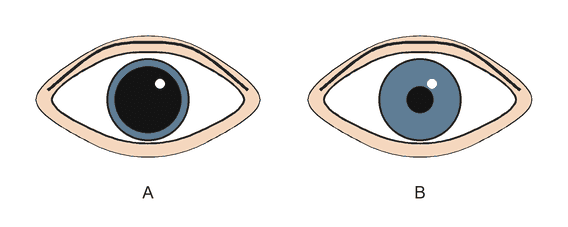
In A the pupil is wide, so A shows dark adaptation; in B it is narrow, so B shows light adaptation.

Step 2 — (b) Distinguish A and B.
Compare the pupil, the pigment rebuilt and the cells that become active:
| Basis | (A) Dark adaptation | (B) Light adaptation |
|---|
| (i) Size of pupil | Dilated (wide) | Constricted (narrow) |
| (ii) Pigment regenerated | Rhodopsin (visual purple) | Iodopsin (visual violet) |
| (iii) Cells of the retina | Rods become active | Cones become active |
Step 3 — Explain why.
In dim light the pupil opens wide to let in more light and the rods rebuild their rhodopsin; in bright light the pupil narrows, the rods' rhodopsin is bleached and the cones make iodopsin.

Therefore, (a) A dark adaptation, B light adaptation; (b) A: pupil dilated, rhodopsin, rods; B: pupil constricted, iodopsin, cones.