
Question 53 marksEasy
Categorise the following parts under (i) external, (ii) middle and (iii) internal ear.
Ear drum, hammer, pinna, cochlea, anvil, stirrup, eustachian tube, tympanum, oval window, semi-circular canals.
Confirming your payment
Sign up now and get 250 free tokens.
Sense Organs · Question 5 of 54
Categorise the following parts under (i) external, (ii) middle and (iii) internal ear.
Ear drum, hammer, pinna, cochlea, anvil, stirrup, eustachian tube, tympanum, oval window, semi-circular canals.
Solution:
Concept: The external ear ends at the ear drum; the middle ear is the air-filled cavity holding the three ossicles; the internal ear is the membranous labyrinth.
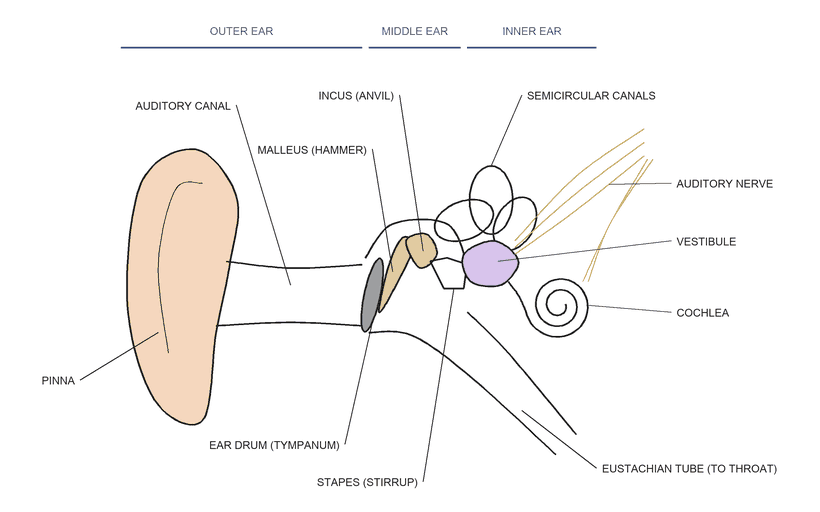
Step 1 — Place the parts of the external ear.
The pinna and the auditory canal lead up to the ear drum. Tympanum is another name for the ear drum, so it goes here too.
Step 2 — Place the parts of the middle ear.
The hammer, anvil and stirrup (malleus, incus, stapes) lie in the middle-ear cavity; the Eustachian tube opens into it; the oval window, on which the stirrup fits, is on its inner wall.
Step 3 — Place the parts of the internal ear.
The cochlea and the semi-circular canals belong to the membranous labyrinth.
Step 4 — Put them in a table.
Sorting the ten parts gives:
| Division | Parts from the list |
|---|---|
| (i) External ear | pinna, ear drum, tympanum |
| (ii) Middle ear | hammer, anvil, stirrup, Eustachian tube, oval window |
| (iii) Internal ear | cochlea, semi-circular canals |
Watch out: The oval window is the membrane between the middle and the inner ear; the book places it with the middle ear, where the stirrup touches it.
Therefore, external: pinna, ear drum, tympanum; middle: hammer, anvil, stirrup, Eustachian tube, oval window; internal: cochlea, semi-circular canals.