Solution:
Concept: In (a), (b) and (c) follow the direction in which the impulse travels; in (d) list the brain from front (forebrain) to back (hindbrain).
Step 1 — (a) Reflex arc.
The stimulus is picked up by the receptor; the sensory neuron carries the impulse into the central nervous system; the motor neuron carries the command out to the effector, which gives the response:
Stimulus → Receptor → Sensory neuron → Central nervous system → Motor neuron → Effector → Response

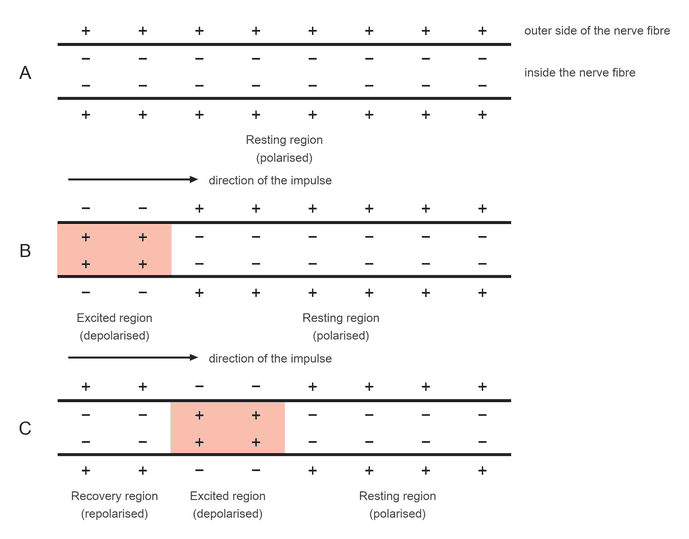
Step 2 — (b) Conduction of a nerve impulse.
At rest the outside of the fibre is positive and the inside negative (polarised). On stimulation, sodium ions rush in at that spot and the charges reverse (depolarisation). The ions are then pumped back and the spot returns to the resting state (repolarisation):
Resting (polarised) → Depolarisation → Repolarisation
Step 3 — (c) Neuron structure.
An impulse enters at the dendrites, passes through the dendron to the cell body (perikaryon), and leaves along the axon to its endings:
Dendrites → Dendron → Perikaryon → Axon → Axon endings
Step 4 — (d) Parts of the brain.
The cerebrum and diencephalon form the forebrain, the midbrain comes next, and the cerebellum, pons and medulla oblongata form the hindbrain:
Cerebrum → Diencephalon → Midbrain → Cerebellum → Pons → Medulla oblongata
Watch out: In (c) the dendrites (fine branches) come before the dendron (the thicker process they join).
Therefore, the sequences are as shown in bold in Steps 1 to 4.
