
Question 374 marksMedium
Give reason :
(a) The brain and the spinal cord are referred to as the central nervous system.
(b) Neurotronsmitters are broken down by an enzyme just after passing an impulse from one neuron to the other.
Confirming your payment
Sign up now and get 250 free tokens.
The Nervous System · Question 37 of 46
Give reason :
(a) The brain and the spinal cord are referred to as the central nervous system.
(b) Neurotronsmitters are broken down by an enzyme just after passing an impulse from one neuron to the other.
Solution:
Concept: For each statement give the cause first, then the effect it leads to.
Step 1 — (a) Why the brain and spinal cord are 'central'.
All impulses from the receptors are brought to the brain and spinal cord, and all commands to the effectors go out from them. So they act as the centre that receives information and controls and coordinates the whole body; the nerves that carry impulses to and from them form the peripheral system.
Step 2 — (b) What the neurotransmitter does at the synapse.
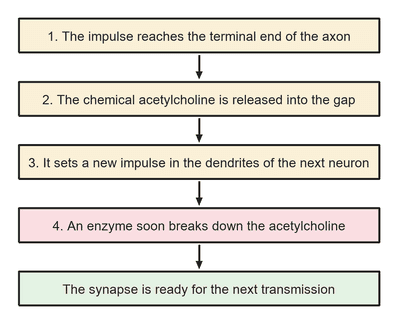
At a synapse the axon ending releases a chemical (a neurotransmitter such as acetylcholine) into the gap, and it sets up a new impulse in the dendrites of the next neuron.
Step 3 — (b) Why it must be broken down at once.
If the chemical stayed in the gap, it would go on stimulating the next neuron after the impulse had passed. So an enzyme breaks it down soon after, and the synapse becomes ready for the next impulse.
Watch out: The question spells it "Neurotronsmitters"; the word is neurotransmitters.
Therefore, (a) the brain and spinal cord are the centre that receives all impulses and sends out all commands; (b) the transmitter is destroyed so that the next neuron is not stimulated continuously and the synapse is ready for the next impulse.