Solution:
Concept: Three of the four terms belong to one group. Name that group; the term left out is the odd one.
Step 1 — (a) Duramater, Gray matter, Piamater, Arachnoid.
Dura mater, pia mater and arachnoid are the meninges, the three membranes round the brain and spinal cord. Gray matter is nervous tissue made of cell bodies, not a covering, so the odd one is gray matter.
Step 2 — (b) Cerebrum, Cerebellum, Spinal cord, Medulla oblongata.
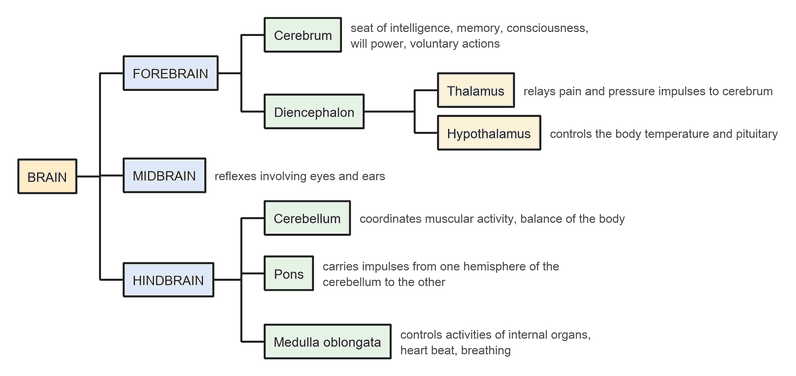
Cerebrum, cerebellum and medulla oblongata are the three main parts of the brain. The spinal cord lies outside the skull, so it is the odd one.
Step 3 — (c) Pons, Cyton, Axon, Dendrons.
Cyton, axon and dendrons are parts of a neuron. The pons is a part of the brain, so it is the odd one.
Step 4 — (d) Hypothalamus, Cerebellum, Pons, Medulla oblongata.
Cerebellum, pons and medulla oblongata are parts of the hindbrain. The hypothalamus belongs to the forebrain (diencephalon), so it is the odd one.
Step 5 — (e) Sneezing, Blinking, Blushing, Knitting without looking.
Sneezing, blinking and blushing are natural (inborn) reflexes. Knitting without looking is learnt by practice (a conditioned reflex), so it is the odd one.
Watch out: The answer needs both parts: the odd term and the name of the group formed by the other three.
Therefore, the odd ones are (a) gray matter (rest: meninges), (b) spinal cord (rest: parts of the brain), (c) pons (rest: parts of a neuron), (d) hypothalamus (rest: hindbrain), (e) knitting without looking (rest: natural reflexes).
