Solution:
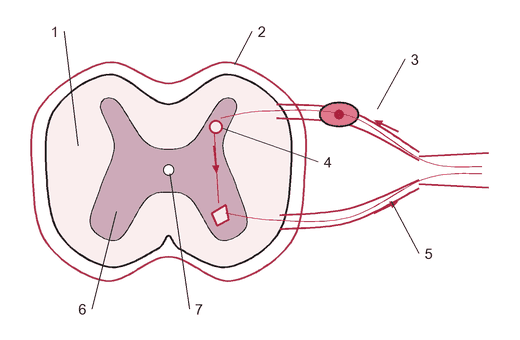
Concept: The figure is a cross-section (T.S.) of the spinal cord showing the nerve pathway of a spinal reflex. The impulse enters by the dorsal root, crosses the gray matter through an association neuron and leaves by the ventral root.
Step 1 — (i) Name the parts numbered 1 to 7.
Read the figure from the outside of the cord inwards, then along the nerve roots:
1 – White matter (outer region of the cord, made of axons)
2 – Meninges (the membranous covering round the cord)
3 – Dorsal root of the spinal nerve (sensory fibres, with the dorsal root ganglion)
4 – Association (relay) neuron in the gray matter
5 – Ventral root (motor fibres)
6 – Gray matter (inner region, made of cell bodies)
7 – Central canal
Step 2 — (ii) Name and define the phenomenon.
The path from the dorsal root to the ventral root is a reflex arc, so the diagram depicts a reflex action. A reflex action is an automatic, quick, involuntary action in the body brought about by a stimulus, without conscious thinking; for example, pulling the hand away at once from a hot iron.
Step 3 — (iii) Technical term for the point of contact.
Where the axon endings of one neuron come close to the dendrites of the next, separated by a fine gap, the point of contact is called a synapse.
Step 4 — (iv) Parts missing from the pathway.
The figure shows only the part of the arc inside and next to the spinal cord. To complete it we need the receptor (e.g. the skin), which receives the stimulus and starts the impulse in the sensory neuron, and the effector (a muscle or gland), which receives the impulse from the motor neuron and gives the response. The complete pathway is: stimulus → receptor → sensory neuron → spinal cord → motor neuron → effector → response.

Watch out: In the spinal cord the white matter is outside and the gray matter inside, the reverse of the cerebrum, so part 1 (outer) is white matter and part 6 (inner, H-shaped) is gray matter.
Therefore, (i) 1 white matter, 2 meninges, 3 dorsal root, 4 association neuron, 5 ventral root, 6 gray matter, 7 central canal; (ii) reflex action; (iii) synapse; (iv) the receptor and the effector.