Answer: (B) (2) A is False and R is True
Concept: In an assertion–reason item, judge the Assertion (A) and the Reason (R) separately as true or false. Here the four choices only ask whether each statement is true, so we do not have to decide whether R explains A. Here, in the spinal cord the arrangement of white and gray matter is the reverse of that in the brain (cerebrum).
Step 1 — Judge the Assertion (A).
False. In the cerebrum the gray matter is outside and the white matter inside; in the spinal cord the gray matter is inside and the white matter outside.
Step 2 — Judge the Reason (R).
True. Gray matter holds the cell bodies of neurons and white matter their axons, and in the cerebrum the outer region is called the cortex and the inner one the medulla.
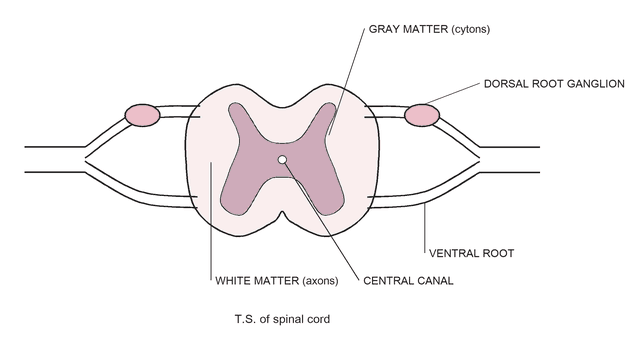
Watch out: "same" is the trap in A: the two organs have opposite arrangements.
Why the other options are wrong:
- (A) (1) A is True and R is False: It calls the Assertion true, but the Assertion is false; and it calls the Reason false, but the Reason is true.
- (C) (3) Both A and R are True: It calls the Assertion true, but the Assertion is false.
- (D) (4) Both A and R are False: It calls the Reason false, but the Reason is true.
Therefore, A is false and R is true, option (B).
