Answer: (B) (2) A is False and R is True
Concept: In an assertion–reason item, judge the Assertion (A) and the Reason (R) separately as true or false. Here the four choices only ask whether each statement is true, so we do not have to decide whether R explains A. Here, aggregates of the cell bodies of nerve cells are ganglia; a synapse is the point of contact between two neurons.
Step 1 — Judge the Assertion (A).
False. Aggregates of cytons (cell bodies, perikaryons) form ganglia, not a synapse.
Step 2 — Judge the Reason (R).
True. Nerve fibres may arise from or enter ganglia, and a synapse is where the axon endings of one neuron come close to the dendrites of another, with a fine gap between them.
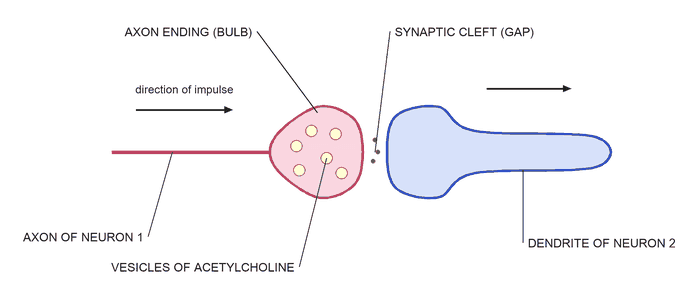
Watch out: A ganglion is a cluster of cell bodies; a synapse is a junction with a gap. Do not mix the two.
Why the other options are wrong:
- (A) (1) A is True and R is False: It calls the Assertion true, but the Assertion is false; and it calls the Reason false, but the Reason is true.
- (C) (3) Both A and R are True: It calls the Assertion true, but the Assertion is false.
- (D) (4) Both A and R are False: It calls the Reason false, but the Reason is true.
Therefore, A is false and R is true, option (B).
