Solution:
Concept: The nervous system has two major divisions, the central nervous system (brain and spinal cord) and the peripheral nervous system (the nerves). The brain has three main parts, the cerebrum, the cerebellum and the medulla oblongata, and each has its own work.
Step 1 — (i) Division that holds the brain and spinal cord.
The brain and the spinal cord form the centre that receives impulses and sends out commands, so they make up the central nervous system. The nerves leaving them form the peripheral system, and the autonomic system is one part of that peripheral system.

Step 2 — (ii) Largest part of the brain.
The cerebrum fills most of the skull and is divided into two hemispheres. The cerebellum is a much smaller part under its back, and the medulla oblongata is the lowest part.
Step 3 — (iii) What white matter is made of.
The nerve fibres (axons) of the neurons have a white myelin covering, so they form the white matter. The cell bodies (cytons) form the gray matter, and dendrites lie with the cell bodies.
Step 4 — (iv) Part concerned with body balance.
The cerebellum keeps the body balanced and coordinates the muscles. The cerebrum is the seat of intelligence, and the medulla oblongata controls the internal organs.
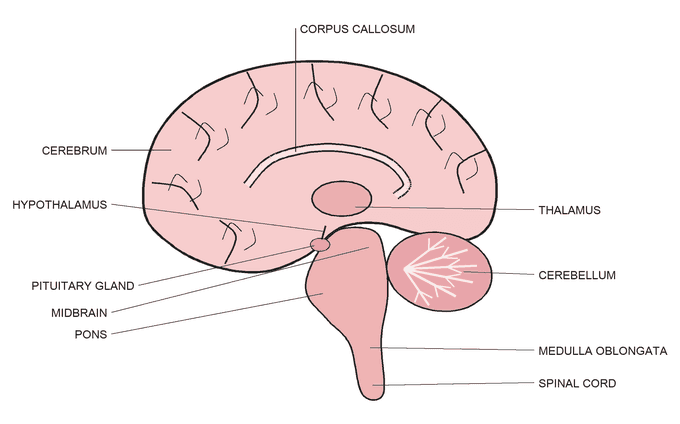
Watch out: The names sound alike: the cerebrum is the largest part, the cerebellum ("little brain") controls balance.
Therefore, (i) central, (ii) cerebrum, (iii) axons, (iv) cerebellum.
