Solution:
Concept: Every answer here is one term from the structure of the neuron (nerve cell) or of a nerve. Picture the part, recall what it is or does, and its name follows.
Step 1 — (i) The unit of the nervous system.
The brain, the spinal cord and all the nerves are built of nerve cells, and each nerve cell can receive and pass on messages. So the unit of both structure and function is the neuron (nerve cell).
Step 2 — (ii) The wave that sweeps over the nerve cell.
When a nerve cell is stimulated, a wave of electrical disturbance runs along it. This wave is the nerve impulse: a wave of depolarisation followed by repolarisation.
Step 3 — (iii) The long thread-like part.
Of the processes that arise from the cell body, one is very long and thread-like. This is the axon, which may be a few millimetres to more than a metre long.
Step 4 — (iv) The point of contact between two nerve cells.
The axon endings of one neuron come very close to the dendrites of the next, with a fine gap between them. This point of contact is the synapse. The impulse crosses the gap with the help of a chemical, acetylcholine.
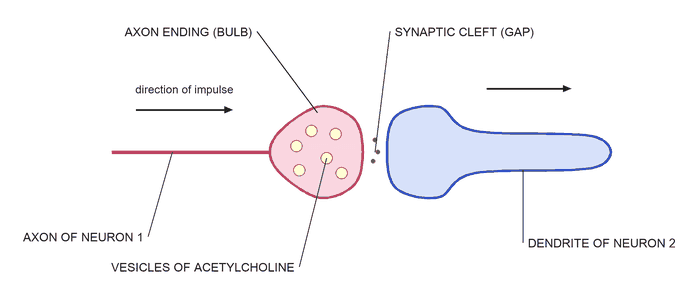
Step 5 — (v) A bundle of axons in a tubular sheath.
Many axons of separate neurons run together, wrapped in a common tubular sheath, like insulated wires inside one cable. Such a bundle is a nerve.
Step 6 — (vi) The nerve from the brain to a gland or muscle.
A nerve that carries impulses out from the brain or spinal cord to an effector (muscle or gland) is a motor nerve. A sensory nerve carries impulses the other way, from the receptors in.
Watch out: A nerve is the whole bundle of axons, while a neuron is a single cell; do not use the two words for each other.
Therefore, (i) neuron, (ii) nerve impulse, (iii) axon, (iv) synapse, (v) nerve, (vi) motor nerve.
