
Opening your dashboard
Class 9 Maths Chapter 4 Expansions: Competency-Based Questions (CBQ)
40 questions on Chapter 4, each worked through on its own page with the AI tutor. Class 9 Maths, ICSE 2026-27.
40 questions
1–5 marks · Mixed difficulty
- 11 mark
Question 1
Competency: Understanding
A square floor is covered by 98 rows of tiles with 98 tiles in each row. A mason finds the number of tiles mentally by writing 98 as .
Which working is correct?
- 21 mark
Question 2
Competency: Application
A square plot has side m. Its owner exchanges it for a rectangular plot that is 8 m longer and 5 m narrower than the square.
New area old area is equal to
- 31 mark
Question 3
Competency: Analysis
Two square flower beds have sides m and m. Placed side by side they are 10 m long in all, and together they cover 58 m².
A rectangular bed has sides m and m. Without finding and , its area is
- 41 mark
Question 4
Competency: Application
An ice cube has edge cm. It melts evenly until every edge is 1 cm shorter.
The volume of ice that has melted, in cm³, is
- 51 mark
Question 5
Competency: Analysis
Three square cards have sides cm, cm and cm. The sum of their sides is 14 cm and the sum of their areas is 70 cm².
The value of is
- 61 mark
Question 6
Competency: Understanding
Assertion (A): The value of is 100.
Reason (R): for all values of and .
- 72 marks
Question 7
Competency: Application
A square hall has side 10.2 m. Its floor is to be polished at ₹ 250 per m².
Use a suitable expansion to find the area of the floor without long multiplication. Then find the cost of polishing.
- 82 marks
Question 8
Competency: Analysis
A rectangular poster is 4 cm longer than it is wide. Its area is 45 cm².
Without finding the length and the width, find the square of its diagonal and its perimeter.
- 92 marks
Question 9
Competency: Evaluation
Meenal writes in her notebook: .
Is her statement always true, sometimes true or never true? Justify your answer with the correct expansion and one example of each kind you claim.
- 102 marks
Question 10
Competency: Application
A hall has rows of chairs with chairs in each row. For the annual day, 6 more rows are added and 4 more chairs are put in every row.
Write the number of chairs now as an expansion. Hence find how many extra chairs were brought in when .
- 113 marks
Question 11
Competency: Analysis & Evaluation
In a mental maths round the question is: "Find ."
Varun answers at once, ", so the answer is ."
Explain why Varun's method cannot be right. Then find the correct value using the expansions of and , without multiplying out or directly.
- 123 marks
Question 12
Competency: Creativity
Make a "quick multiplication card" for your class.
(a) Choose two numbers of your own, one a little more than 100 and one a little less than 100. Find their product using the expansion of .
(b) Write the rule on your card in words, so that a classmate can multiply any such pair of numbers mentally.
- 133 marks
Question 13
Competency: Application & Analysis
A solid cuboid has edges cm, cm and cm. A student measures three things:
- the sum of the three edges is 6 cm,
- the sum of the squares of the three edges is 14 cm²,
- the sum of the cubes of the three edges is 36 cm³.
Without finding , and , find the value of and then the volume of the cuboid.
- 145 marks
Question 14
Competency: Analysis
Case study — Dividing a square plot
A square plot has side metres. Two straight paths each way divide it into nine parts, as shown. The three shaded parts are squares.
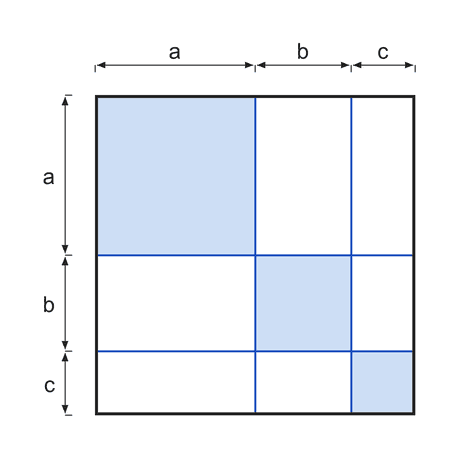
(a) Write the area of each of the nine parts in terms of , and . Add them to get the expansion of .
(b) For this plot , and . Find the total area of the three shaded squares and the total area of the six unshaded rectangles. Verify that they add up to the area of the whole plot.
(c) A second square plot, also of side 10 m, is divided in the same way with different whole-number values of , and . Its six unshaded rectangles have a total area of 66 m². Find the total area of its three shaded squares, and find one set of values of , and that fits.
- 154 marks
Question 15
Competency: Application & Evaluation
Case study — A shortcut for three years of growth
When money grows by a fraction of itself every year, ₹ 1 becomes ₹ in 3 years. For example, growth of 10% a year means .
(a) Expand .
(b) Use your expansion, term by term, to find what ₹ 10,000 becomes in 3 years when .
(c) Rahul uses the shortcut and says, "The terms I drop are too small to matter, whatever the value of ." Find, for ₹ 10,000, how much money his shortcut misses when and when . Is Rahul's statement justified?
- 161 mark
Question 16
Competency: Understanding
Ananya wants to test whether is an identity. She tries several values of and finds that both sides agree for exactly one of them.
For which value of do the two sides agree?
- 171 mark
Question 17
Competency: Application
A square photograph has side cm. It is mounted in a wooden frame that is 3 cm wide on every side.
The area of the wooden frame alone is
- 181 mark
Question 18
Competency: Analysis
For all values of , and , the expression is equal to
- 191 mark
Question 19
Competency: Analysis
The area of a rectangular garden is m². Its length and breadth are m and m, where and are whole numbers.
Which pair is correct?
- 201 mark
Question 20
Competency: Understanding & Analysis
A square tile has side cm, where , and are positive numbers.
When its area is expanded, the terms that carry a minus sign are
- 211 mark
Question 21
Competency: Application
Rohan squares numbers that end in 5 in his head. For 35 he multiplies 3 by the next number, 4, to get 12, and writes 25 after it, so .
To see why this works, he writes a number that ends in 5 as , where is its number of tens. Which expression is equal to for every whole number ?
- 221 mark
Question 22
Competency: Understanding
Assertion (A): In the expansion of , the four terms have the signs in turn.
Reason (R): is obtained from by replacing with , and every odd power of is negative.
- 231 mark
Question 23
Competency: Evaluation
Assertion (A): The area of a square of side cm is cm².
Reason (R): The square of a difference of two terms has a middle term: .
- 241 mark
Question 24
Competency: Analysis
Meera cuts two square sheets from chart paper. One has side 10.4 cm and the other has side 9.6 cm.
The average of their areas is more than the area of a square sheet of side 10 cm by
- 251 mark
Question 25
Competency: Analysis
A florist arranges flower pots in rows with pots in each row, where is a whole number. For a longer, narrower stall she tries a second layout with rows and pots in each row, using the same value .
Compared with the first layout, the second layout holds
- 262 marks
Question 26
Competency: Application
A cube-shaped water tank has edge metres.
(a) Expand to write the volume of the tank as an expression in .
(b) Check your expression for by finding the volume directly.
- 272 marks
Question 27
Competency: Evaluation
Radha estimates as .
Use the expansion of to find the exact product and the amount by which her estimate is too large. Will her estimate be too small for any pair of numbers of the form ?
- 282 marks
Question 28
Competency: Application
A square lawn has side metres.
Expand to find the area of the lawn as an expression in and . Then find the area when and .
- 292 marks
Question 29
Competency: Application
A cube of edge 10 cm is cut by three planes parallel to its faces, each 7.5 cm from a corner. It breaks into 8 pieces: a cube of edge 7.5 cm, a cube of edge 2.5 cm, three slabs and three bars.
(a) Without working out any power, find the value of and name the identity you use.
(b) Describe the three equal pieces whose total volume is cm³.
- 302 marks
Question 30
Competency: Creativity
A magician says: "Think of any number . Multiply by . Now subtract and then subtract . Your answer is !"
(a) Show that the trick works for every number .
(b) Make your own trick of the form whose answer is always 12. Say what the player must subtract.
- 312 marks
Question 31
Competency: Application & Evaluation
Sana claims that for all three triples below.
(i) (ii) (iii)
Without finding any cube, decide which triples she is right about. Then test the other triple with the cubes to show she is wrong.
- 323 marks
Question 32
Competency: Analysis
A rectangular gift box has length cm, breadth cm and height cm. The lengths of all its 12 edges add up to 60 cm, and the total surface area of the box is 148 cm². (Hypothetical data.)
The longest straight stick that fits inside a box has length cm, where .
(a) Find .
(b) Use an expansion to find .
(c) Can a 9 cm pencil be placed inside the box? Give a reason.
- 333 marks
Question 33
Competency: Analysis
Two cube-shaped paperweights have edges cm and cm, where and are whole numbers. The sum of their edges is 7 cm and the sum of their volumes is 91 cm³.
(a) Use the expansion of to find the product .
(b) Hence find the edges of the two paperweights.
- 343 marks
Question 34
Competency: Analysis
Aman notices a pattern:
and ; and ; and .
(a) Use the expansion of to show that for every number .
(b) When the middle number is even, the two numbers are odd. Write and show that the product of the two odd numbers is always 1 less than a multiple of 4. Check this with .
(c) Write 899 as the product of two numbers that differ by 2.
- 353 marks
Question 35
Competency: Analysis & Evaluation
A teacher measures how unequal three numbers , and are by the number .
(a) Show that .
(b) The heights of three friends are 150 cm, 154 cm and 158 cm. (Hypothetical data.) Find using the form in (a).
(c) What does tell you about , and ? Give a reason.
- 363 marks
Question 36
Competency: Analysis
Meena makes a square rangoli with dots on each side. To enlarge it she adds one more row and one more column of dots, so that it has dots on each side.
Dots on each side () 1 2 3 4 5 6 Dots in the square 1 4 9 16 25 ? (a) Complete the table and find how many extra dots are needed to go from each square to the next.
(b) Use the expansion of to show that the number of extra dots is .
(c) A rangoli is enlarged using 99 extra dots. How many dots does the enlarged rangoli have?
- 375 marks
Question 37
Competency: Application & Analysis
Case study — Tiling a hall floor
The floor of a rectangular hall is m long and m wide. A contractor lays it in four parts, P, Q, R and S, as shown. Tiling costs ₹ 450 per m². (Hypothetical data.)
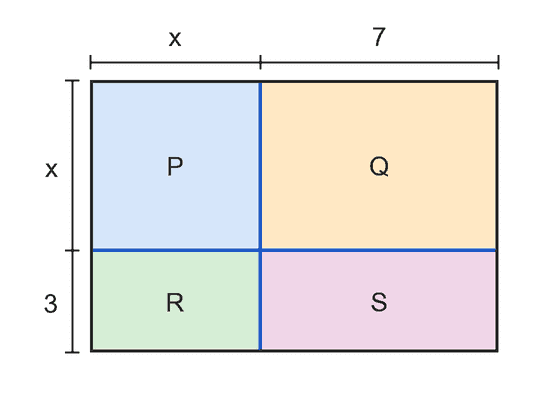
(a) Write the area of each of the four parts. Add them to get the expansion of .
(b) For , find the area of the whole floor and the cost of tiling it.
(c) A second hall has the same design but a different value of . Its parts Q and R together need 80 m² of tiles. Find for this hall, and use the expansion from (a) to find the area of its whole floor.
- 385 marks
Question 38
Competency: Analysis
Case study — Wooden blocks
A toy maker makes three cube-shaped wooden blocks. The table shows the edge and volume of each block.
Block Edge (cm) Volume (cm³) 1 9 729 2 10 1000 3 11 1331 (a) Write 9 as and 11 as . Use expansions to show that the volumes of blocks 1 and 3 in the table are correct.
(b) Show that . Use it with and to find the total volume of blocks 1 and 3.
(c) Use the result of (b) with and to find, without working out any cube, the total volume of two cubes of edges 10.5 cm and 9.5 cm.
- 394 marks
Question 39
Competency: Analysis
Case study — Cutting strips from a sheet
A square paper sheet has side cm. A strip of width cm is cut off along the top edge and another strip of width cm along the left edge, as shown. The top strip is made of parts P and R, the left strip is made of parts Q and R, and T is the remaining square sheet.
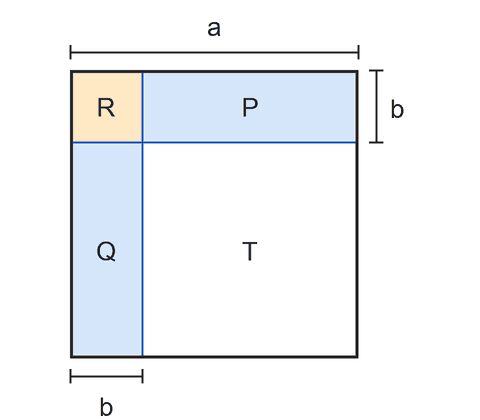
(a) Explain, using the figure, why the area of T is .
(b) For and , find the area of each strip, and find the area of T in two different ways.
(c) For , the remaining square T must have area 49 cm². Find the width of the strips and check it with the expansion.
- 404 marks
Question 40
Competency: Evaluation
Case study — A cutting error
A machine should cut square tiles of side cm. It is set wrongly, so every tile comes out with each side 0.3 cm too long. The table shows some of the tiles. (Hypothetical data.)
Intended side (cm) 10 20 30 40 Actual side (cm) 10.3 20.3 30.3 40.3 Extra area (cm²) ? ? ? ? (a) Use the expansion of to show that each tile has an extra area of cm². Say what the two terms stand for.
(b) Use your result to complete the table.
(c) For the 30 cm tile, the side is 1 % too long. A worker says that the area must therefore also be 1 % too large. Is he right? Find the actual percentage and explain the result using the expansion.