
Opening your dashboard
Class 9 Maths Chapter 3 Compound Interest (Using Formula): Competency-Based Questions (CBQ)
40 questions on Chapter 3, each worked through on its own page with the AI tutor. Class 9 Maths, ICSE 2026-27.
40 questions
1–5 marks · Mixed difficulty
- 11 mark
Question 1
Competency: Understanding
A bank officer writes this working on a slip:
Which situation does the working fit?
- 21 mark
Question 2
Competency: Application
The value of a tractor depreciates by 20% every year. After 2 years of use it is valued at ₹ 2,56,000.
What was its price when it was new?
- 31 mark
Question 3
Competency: Analysis
The number of users of a school learning app grew from 25,000 to 36,000 in 2 years. The growth was at the same rate per cent every year.
The yearly rate of growth was
- 41 mark
Question 4
Competency: Application
Two cousins deposit equal sums for 2 years at 5% per annum. Tara's bank pays simple interest. Uma's bank compounds the interest yearly. At the end, Uma gets ₹ 25 more than Tara.
The sum each of them deposited was
- 51 mark
Question 5
Competency: Analysis
Rohan wants to invest ₹ 10,000 for 2 years. Which offer gives him the largest amount at the end?
- 61 mark
Question 6
Competency: Evaluation
Assertion (A): If the value of a motorbike depreciates by 10% every year, the motorbike will be worth nothing after 10 years.
Reason (R): Each year's depreciation is calculated on the value of the article at the beginning of that year.
- 72 marks
Question 7
Competency: Application
A school invests ₹ 62,500 from its alumni fund for 2 years at 8% per annum, interest being compounded annually. At the end it wants to give scholarships worth ₹ 72,000 in all.
Use the formula to find the amount. Will the amount be enough?
- 82 marks
Question 8
Competency: Analysis
Asha and Bela invest ₹ 20,000 each, with interest compounded annually.
Asha's bank pays 10% per annum and she gets back ₹ 24,200. Bela's bank pays 20% per annum and she gets back ₹ 28,800.
Bela says, "I got more money, so I must have kept my money in the bank for longer." Use the formula to find the time for each. Is Bela right?
- 92 marks
Question 9
Competency: Evaluation
A car was bought for ₹ 5,00,000. Its value depreciates by 20% every year.
After 3 years a dealer offers ₹ 2,00,000 for it. He says, "20% a year for 3 years is 60%, so the car is now worth only 40% of its price."
Is his offer fair? Find the value of the car by the formula.
- 102 marks
Question 10
Competency: Application
Mr. Nair lends some money to a friend at 10% per annum, interest compounded yearly. After years the friend clears the loan by paying ₹ 23,100.
How much had Mr. Nair lent?
- 113 marks
Question 11
Competency: Analysis & Evaluation
Mrs. D'Souza wants to deposit ₹ 50,000 for 1 year. Two banks display these boards.
Bank A: 10.2% per annum, compounded yearly.
Bank B: 10% per annum, compounded half-yearly.
Her son says, "Bank A shows the bigger rate, so Bank A is better." Find the amount from each bank. Which bank should she choose, and why is her son's reasoning not reliable?
- 123 marks
Question 12
Competency: Creativity
A town has 10,000 trees. The council wants to have at least 13,000 trees after 3 years by increasing the number of trees by a whole-number per cent each year. The rate may be the same every year or different in different years.
Design one plan that meets the target and prove with the formula that it works. Then show that a plan of 9% every year would not meet the target. (You may use .)
- 133 marks
Question 13
Competency: Application & Analysis
A bank changes its rate of interest every year. For a 3-year deposit, compounded yearly, it paid 5% in the first year, 8% in the second year and 10% in the third year. Kabir deposited ₹ 25,000.
(a) Find the amount Kabir received after 3 years.
(b) Would the amount change if the same three rates had come in the order 10%, 8%, 5%? Give a reason.
(c) Another bank paid a steady 8% per annum for all 3 years. How much more would Kabir have received there?
- 145 marks
Question 14
Competency: Analysis
Case study — The population of a growing town
The table shows the population of a town at the end of three successive years.
Year 2021 2022 2023 Population 1,21,000 1,33,100 1,46,410 (a) Find the increase in population from 2021 to 2022 and from 2022 to 2023. Show that the rate of growth per year is the same both times.
(b) Assuming the same rate continues, use the formula to estimate the population at the end of 2024.
(c) Find the population at the end of 2019. Then use your answers to explain why the number of people added to the town is not the same every year.
- 154 marks
Question 15
Competency: Application & Evaluation
Case study — Closing an education loan early
Neha took an education loan of ₹ 80,000 at 10% per annum, interest being compounded yearly. She repays the whole loan in a single payment after years.
(a) Find the amount due at the end of 2 years.
(b) Find the amount due at the end of years.
(c) The bank's bill shows ₹ 1,06,480. Find the mistake the clerk has made and the amount by which Neha is being overcharged.
- 161 mark
Question 16
Competency: Understanding
Assertion (A): For a sum lent for 1 year, the interest compounded yearly is the same as the simple interest at the same rate per annum.
Reason (R): When interest is compounded yearly, it is added to the money only at the end of the year, so no interest is earned on interest during the first year.
- 171 mark
Question 17
Competency: Application
Ananya's bank passbook shows her fixed deposit, interest compounded yearly at the same rate every year.
Date Interest credited (₹) Balance (₹) 1 April 2023 — 20,000.00 31 March 2024 1,200.00 21,200.00 31 March 2025 1,272.00 22,472.00 (Hypothetical data.)
The interest that will be credited on 31 March 2026 is
- 181 mark
Question 18
Competency: Analysis
A scooter loses 10% of its value every year, the loss being taken on its value at the beginning of that year. The loss in its value during the second year was ₹ 8,100.
The price of the scooter when it was new was
- 191 mark
Question 19
Competency: Analysis
A new mobile phone costs ₹ 40,000. Its value falls by 25% in the first year and by 20% in each year after that, each fall being taken on its value at the start of that year.
(Hypothetical data.)
Its value at the end of 3 years is
- 201 mark
Question 20
Competency: Evaluation
The population of a town grows by 10% every year, each rise being on the population at the start of that year. Its population now is 66,000.
Assertion (A): The population of the town one year ago was 60,000.
Reason (R): Taking 10% of the present population, 6,600, away from 66,000 gives a number larger than the population one year ago.
- 211 mark
Question 21
Competency: Analysis & Evaluation
Arun needs ₹ 50,000 for a course now. He can take it from his savings, which earn 6% per annum compounded yearly, or he can take a loan at 10% per annum compounded yearly and leave his savings untouched. Either way, the loan (if taken) is repaid and the savings are counted after years.
(Hypothetical data.)
Which choice leaves Arun better off at the end, and by how much?
- 221 mark
Question 22
Competency: Application & Analysis
Kiran wins a prize. She may take ₹ 10,500 now, or ₹ 12,100 after 2 years. Any money she takes now can be deposited at 10% per annum, interest compounded yearly.
(Hypothetical data.)
Which statement is true?
- 231 mark
Question 23
Competency: Application
The yearly fee of a school is raised by 20% this year and by a further 10% next year. Each rise is on the fee of the previous year.
By what per cent is next year's fee higher than the fee before the first rise?
- 241 mark
Question 24
Competency: Evaluation
Sanjay wants the amount on ₹ 12,000 for 2 years at 10% per annum, interest compounded half-yearly. He writes
and says his working is correct.
Which statement is true?
- 251 mark
Question 25
Competency: Understanding
A scheme claims, “Your money doubles every year”, that is, the rate is 100% per annum, interest compounded yearly. Ravi puts ₹ 2,000 into the scheme.
(Hypothetical scheme.)
If the claim were true, Ravi's money after 3 years would be
- 262 marks
Question 26
Competency: Understanding & Analysis
Sheela deposits ₹ 75,000 for 2 years at 8% per annum, interest compounded yearly.
Find the interest she earns in the first year and in the second year. By how much does the second year's interest exceed the first, and why?
- 272 marks
Question 27
Competency: Analysis & Evaluation
A sum of money grows by 21% in 2 years at a certain rate per annum, interest compounded yearly.
Find the rate. Seema says, “Then it will grow by 42% in 4 years.” Is Seema right?
- 282 marks
Question 28
Competency: Application
Kiran deposits ₹ 50,000 in a bank that pays 8% per annum, interest compounded half-yearly. After one year the bank raises its rate to 10% per annum, still compounded half-yearly.
(Hypothetical data.)
Find the amount in her account after years and the total interest she has earned.
- 292 marks
Question 29
Competency: Evaluation
Vivek has ₹ 20,000 to invest. Plan X pays 10% per annum for 2 years. Plan Y pays 8% per annum for years. In both plans the interest is compounded yearly.
Which plan gives the larger amount, and by how much?
- 302 marks
Question 30
Competency: Application & Analysis
Sunil borrows ₹ 20,000 at 10% per annum, interest compounded yearly. At the end of the first year he pays back ₹ 12,000.
How much must he pay at the end of the second year to clear the loan?
- 312 marks
Question 31
Competency: Application
A water tank holds 20,000 litres. Because of a leak, 10% of the water in the tank at the start of each day is lost during that day. No water is added.
(Hypothetical data.)
Find the water left after 3 days and the water lost in the 3 days.
- 323 marks
Question 32
Competency: Understanding & Analysis
Raghav deposits ₹ 20,000 for 2 years, interest compounded yearly. The bank pays 8% in the first year but changes its rate for the second year. At the end of 2 years he receives ₹ 23,760.
(Hypothetical data.)
Find the interest of the first year, the rate in the second year and the interest of the second year.
- 333 marks
Question 33
Competency: Analysis & Evaluation
Ritu and Amit each deposit ₹ 20,000 in a bank that pays 10% per annum, interest being added to the account every 6 months.
Ritu leaves all the money in the bank for 1 year. Amit withdraws the interest at the end of the first 6 months and leaves only ₹ 20,000 in the bank for the next 6 months.
Find the total interest each has earned in the year. Why is Ritu's total larger, and by how much?
- 343 marks
Question 34
Competency: Application & Analysis
A bank offers: “Deposit ₹ 12,500 for 3 years, interest compounded yearly, and receive ₹ 21,600.” A cooperative society pays only simple interest.
(Hypothetical data.)
Find the rate per annum the bank pays. At what rate of simple interest per annum (correct to two decimal places) would the society have to pay so that ₹ 12,500 also becomes ₹ 21,600 in 3 years? Why must this rate be higher than the bank's rate?
- 353 marks
Question 35
Competency: Creativity
Create a real-life problem about an article whose value depreciates by the same per cent every year, so that its value after 3 years is ₹ 51,200.
State the price when new and the rate of depreciation in your problem, and show with the formula that your numbers give ₹ 51,200.
- 363 marks
Question 36
Competency: Application & Analysis
A refrigerator costs ₹ 50,000 today. Its price rises by 6% every year, each rise being on the price at the start of that year. Meena's parents deposit ₹ 50,000 today at 5% per annum, interest compounded yearly, to buy the refrigerator after 2 years.
(Hypothetical data.)
Find the price of the refrigerator after 2 years and the amount of the deposit after 2 years. By how much does the deposit fall short? At what rate per annum, compounded yearly, would the deposit have been just enough?
- 375 marks
Question 37
Competency: Analysis & Evaluation
Case study — Choosing a savings plan
Meera has ₹ 50,000 to save for 3 years. A bank offers three plans.
Plan Rate per annum How interest is paid A 9% Simple interest B 8% Compounded yearly C 8% Compounded half-yearly (Hypothetical data.) You may use and .
(a) Find the amount Meera gets from Plan A.
(b) Find the amount she gets from Plan B.
(c) Find the amount from Plan C. Which plan gives the most, and by how much does it beat the plan that comes second?
- 384 marks
Question 38
Competency: Application & Analysis
Case study — Two towns
The table gives the present population of two towns and how it changes every year, each change being on the population at the start of that year.
Town Present population Change every year Asha Nagar 80,000 Increases by 5% Bela Nagar 1,00,000 Decreases by 10% (Hypothetical data.)
(a) Find the population of each town at the end of 1 year.
(b) Find the population of each town at the end of 2 years.
(c) At the end of which year does Asha Nagar first have more people than Bela Nagar? By how many people does it lead then?
- 394 marks
Question 39
Competency: Application & Analysis
Case study — A fixed deposit
Mr Khan puts ₹ 80,000 in a fixed deposit for 2 years at 10% per annum, interest compounded half-yearly.
(a) Find the amount he gets at the end of 2 years.
(b) Find the compound interest he earns.
(c) He needs the money after years and closes the deposit then. Find the amount he gets and how much less interest he earns than if he had waited for 2 years.
- 405 marks
Question 40
Competency: Analysis
Case study — The value of a machine
The bar graph shows the value of a machine when it was new (year 0) and at the end of each of its first 3 years.
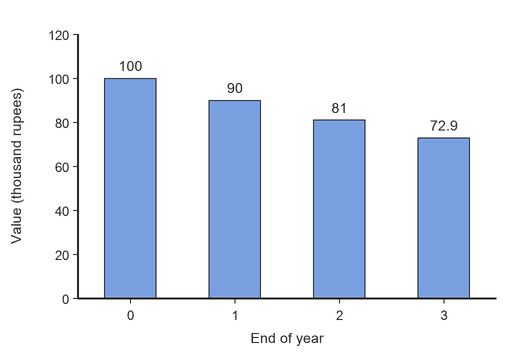
(Hypothetical data.)
(a) Read the value of the machine at the end of each year and find how much it fell in each of the 3 years.
(b) Show that the machine lost the same per cent of its value every year, and find that per cent.
(c) Show that each year's fall is 90% of the fall in the year before. Use this to find the falls in the 4th and 5th years, and hence the value of the machine at the end of 5 years. Check this value with the formula.