
Opening your dashboard
Class 9 Maths Chapter 28 Distance Formula: Competency-Based Questions (CBQ)
40 questions on Chapter 28, each worked through on its own page with the AI tutor. Class 9 Maths, ICSE 2026-27.
40 questions
1–5 marks · Mixed difficulty
- 11 mark
Question 1
Competency: Application
In a planned city the streets run parallel to the -axis and the -axis, and 1 unit stands for 1 km. A taxi goes from to along the streets, first east and then north. A crow flies straight from to .
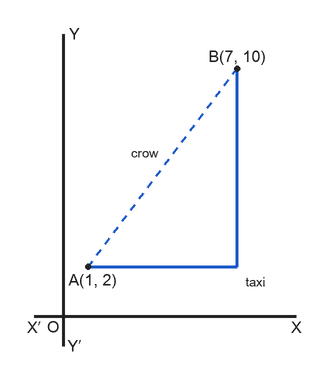
How much shorter is the crow's path than the taxi's path?
- 21 mark
Question 2
Competency: Analysis
A patient is at the point on a town map. Four clinics are marked on the same map. Which clinic is nearest to the patient in a straight line?
- 31 mark
Question 3
Competency: Application & Analysis
A square carrom court is drawn on a co-ordinate grid, where 1 unit stands for 1 m. Two opposite corners of the square are and .
The area of the court is
- 41 mark
Question 4
Competency: Application
is the circumcentre of a triangle . The vertex is the point .

The diameter of the circumcircle of the triangle is
- 51 mark
Question 5
Competency: Analysis
Three trees in a park stand at , and . A gardener ties a rope around the three trees to make a triangle.

The triangle is
- 61 mark
Question 6
Competency: Analysis & Evaluation
Assertion (A): is the circumcentre of the triangle with vertices , and .
Reason (R): The circumcentre of a triangle is the point that is equidistant from the three sides of the triangle.
- 72 marks
Question 7
Competency: Application
On an electrician's plan, 1 unit stands for 1 m. A straight cable of length 13 m joins the pole to the pole . The pole lies above the -axis.
Find the value of .
- 82 marks
Question 8
Competency: Evaluation
Meena says, "The distance of a point from the -axis is equal to its distance from the origin."
Is her statement always true, sometimes true or never true? Justify your answer.
- 92 marks
Question 9
Competency: Analysis
Three metro stations are at , and on a city map. An engineer wants to know whether one straight track can pass through all three stations.
Use the distance formula to decide. Give a reason.
- 102 marks
Question 10
Competency: Application
On a sea chart, 1 unit stands for 1 km. A fishing boat sails straight from the port to the point . It then sails straight to the point .
Find the total distance sailed. If the boat moves at 5 km per hour, how long does the trip take?
- 113 marks
Question 11
Competency: Analysis & Evaluation
A carpenter marks the corners of a window frame on a grid as , , and .
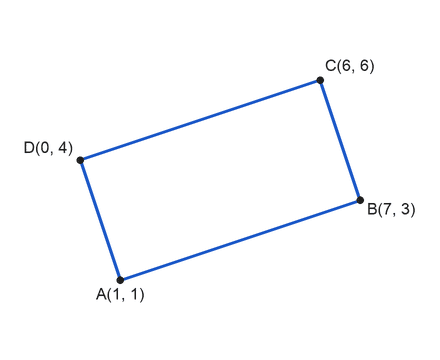
He finds that and . He says, "The opposite sides are equal, so the frame is a rectangle."
(a) Verify that the opposite sides are equal.
(b) Is his reason enough to call the frame a rectangle? Make the extra check that is needed and give your conclusion.
- 123 marks
Question 12
Competency: Creativity
Frame a real-life problem in which a point on the -axis has to be found that is equidistant from two given places. Choose your own co-ordinates for the two places.
Solve your problem and verify your answer with the distance formula.
- 133 marks
Question 13
Competency: Application & Evaluation
A drone has to carry medicine straight from a health centre at to a village at . On the map, 1 unit stands for 1 km. On one charge the drone can fly 8.5 km.
(a) Find the exact distance .
(b) Without using a calculator, find the two consecutive whole numbers between which lies.
(c) Can the drone reach the village on one charge? Justify your answer.
- 145 marks
Question 14
Competency: Application & Analysis
Case study — Reading a town map
The map of a town is drawn on a grid, where 1 unit stands for 1 km. It shows a school , a library , a market and a hospital .
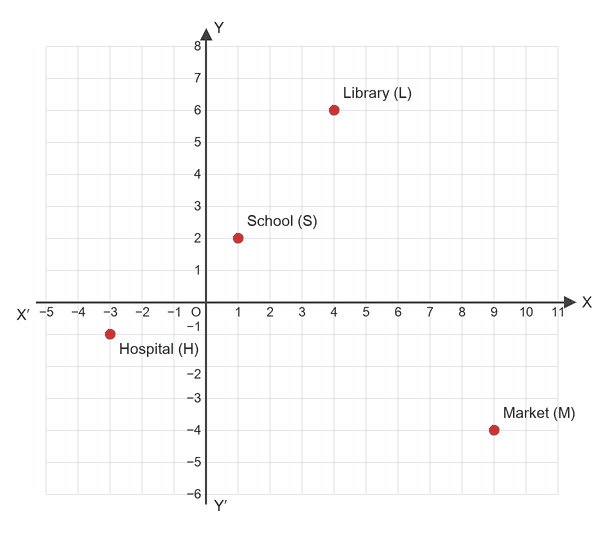
(a) Read the co-ordinates of , , and from the map.
(b) Find the straight-line distances , and . Which of the three places is farthest from the school? Which two are equally far from it?
(c) Straight roads join to , to and to . Show that the roads and meet at a right angle. Hence find the area of the triangular region .
- 155 marks
Question 15
Competency: Analysis & Evaluation
Case study — A circular walking path
In a park, three lamp-posts stand at , and on the park plan, where 1 unit stands for 10 m. A circular walking path must pass through all three lamp-posts.
The designer says the centre of the path should be . A worker says, "The point looks more like the middle. Take that as the centre."
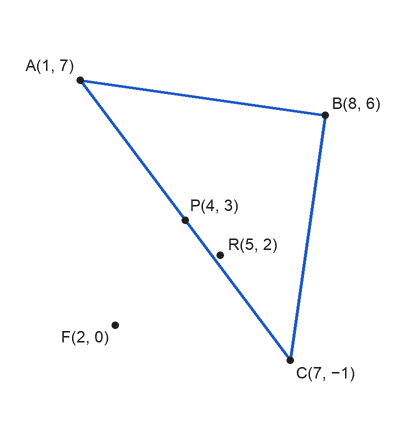
(a) Show that is equidistant from , and . What is the point called for the triangle ?
(b) Check the worker's point . Can be the centre of the path? Give a reason.
(c) Find the length of the path in metres. (Take .) A fountain stands at . Is it inside the path or outside it? Justify your answer.
- 161 mark
Question 16
Competency: Application
A cricket ground is drawn on a co-ordinate grid. The middle of the pitch is the origin , and 1 unit stands for 1 m. The boundary rope is a circle with centre and radius 65 m. A fielder stands at .
What is the shortest distance of the fielder from the boundary rope?
- 171 mark
Question 17
Competency: Analysis
The figure shows the positions of three soil sensors , and in a field. A base station is at the origin . The side of each grid square is 1 m.
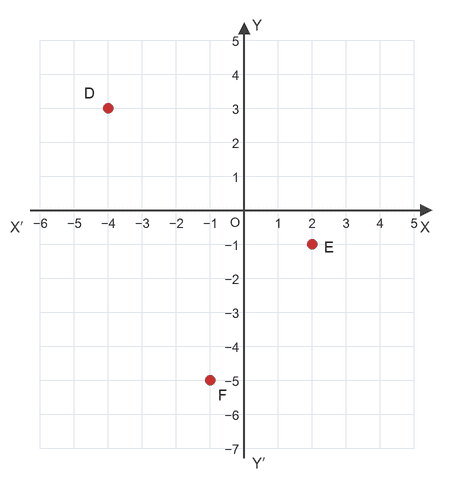
Which sensor is farthest from the base station?
- 181 mark
Question 18
Competency: Application
A roof frame is drawn on a grid (1 unit = 1 m). Its base corners are and , and its top corner is . The circumcentre of triangle lies on the -axis.
The ordinate of is
- 191 mark
Question 19
Competency: Analysis & Evaluation
Assertion (A): The distance between the points and is equal to the distance between the points and .
Reason (R): The points and are at the same distance from the origin.
- 201 mark
Question 20
Competency: Analysis & Evaluation
Assertion (A): The quadrilateral with vertices , , and is a square.
Reason (R): A quadrilateral whose four sides are all equal is always a square.
- 211 mark
Question 21
Competency: Analysis
On a map, Ravi's house is at and his school is at . His friend's house is at , where can be any number.
For how many values of is equally far from and from ?
- 221 mark
Question 22
Competency: Application
On a floor plan of a classroom, 1 unit stands for 0.5 m. Two electric sockets are marked at and on the plan.
The length of the straight wire needed to join them in the room is
- 231 mark
Question 23
Competency: Understanding & Analysis
On a drawing, two points are and . A designer enlarges the drawing by multiplying every co-ordinate by 2, so that and move to and . One unit is 1 cm in both drawings.
The distance is
- 241 mark
Question 24
Competency: Analysis & Evaluation
Three saplings are planted at , and on a park plan. A gardener wants a circular flower bed whose boundary passes through all three saplings.
How many such circles can be drawn?
- 251 mark
Question 25
Competency: Analysis
A carpenter has four sets of three nails on a board. The positions of the nails are given on a grid (1 unit = 1 cm).
Which set of three nails, if joined, forms a right-angled triangle?
- 262 marks
Question 26
Competency: Application
A cyclist rides in a straight line through a park whose map is drawn on a grid, where 1 unit stands for 1 m. A GPS tag logs her position at 10:00:00 as , and at 10:00:02 as . She rides at a steady speed between the two points. (Hypothetical data.)
Find her speed in metres per second.
- 272 marks
Question 27
Competency: Application & Analysis
A circular running track has its centre at on a school plan, where 1 unit stands for 10 m. The start gate is at the origin and is on the track. A second gate is also on the track and lies on the -axis.
Find the co-ordinates of .
- 282 marks
Question 28
Competency: Analysis
A toy buggy moves along the -axis. A beacon is fixed at , and 1 unit stands for 1 m.
Find the distance of the buggy from the beacon when the buggy is at , at and at . At which of these three positions is it nearest, and why do the first and the third positions give the same distance?
- 292 marks
Question 29
Competency: Application
Three sprinklers , and , with , are placed at the corners of an equilateral triangle on a lawn plan. One unit stands for 1 m.
Find the value of in surd form.
- 302 marks
Question 30
Competency: Analysis
A water pipe runs along the -axis of a site plan (1 unit = 1 m). A sensor is placed at . A technician wants to join the sensor to a point on the pipe with a cable exactly 4 m long.
Use the distance formula to decide whether this is possible.
- 312 marks
Question 31
Competency: Application
On a town map (1 unit = 1 km) a straight diagonal road passes through every point whose abscissa and ordinate are equal, such as and . A bus stop must be on this road and exactly km from the town hall at the origin.
Find the co-ordinates of all such points.
- 323 marks
Question 32
Competency: Application & Analysis
A roof truss is drawn on a grid (1 unit = 1 m). The two base corners are and . The apex lies on the -axis above the base, and the angle at must be a right angle.
(a) Taking , show that for every value of .
(b) Find the co-ordinates of .
- 333 marks
Question 33
Competency: Understanding & Application
A kite-shaped flower bed is drawn on a grid in the figure (1 unit = 1 m).
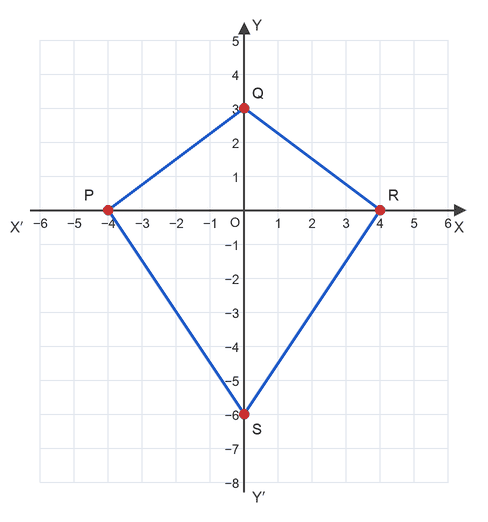
(a) Read the co-ordinates of , , and from the figure.
(b) Find the lengths of the four sides.
(c) Show that two pairs of adjacent sides are equal, but that the bed is not a rhombus.
- 343 marks
Question 34
Competency: Evaluation
Tara says, "The circumcentre of a triangle always lies inside the triangle." To test this, take the triangle with vertices , and , and the point .
(a) Show that is the circumcentre of triangle .
(b) Is Tara's statement correct? Give a reason.
- 353 marks
Question 35
Competency: Creativity
Using the distance formula, design a right-angled isosceles triangle on a co-ordinate grid. All three vertices must have integer co-ordinates, and no side may be parallel to an axis.
Write your three vertices and verify with distances that your triangle is isosceles and right-angled.
- 363 marks
Question 36
Competency: Application & Evaluation
A fire breaks out at on a city map, where 1 unit stands for 1 km. Fire station at sends engines that travel at an average of 52 km/h. Fire station at sends engines that travel at an average of 30 km/h. (Hypothetical data.)
(a) Find the distances and .
(b) Find the time each engine needs to reach the fire.
(c) Which engine reaches the fire first, and by how many minutes?
- 374 marks
Question 37
Competency: Analysis & Application
Case study — A survey drone
A drone flies over a field that is drawn on a grid, where 1 unit stands for 1 m. A computer records the position of the drone every second. Between one recorded position and the next, the drone flies in a straight line at a steady speed. (Hypothetical data.)
Time (s) 0 1 2 3 Position (a) Find the distance covered by the drone in each of the three seconds.
(b) In which second was the drone fastest? What was its speed in that second?
(c) Show that the drone moved along one straight line during the first 2 seconds, but not during all 3 seconds.
- 385 marks
Question 38
Competency: Analysis & Evaluation
Case study — A water hub for three villages
Three villages , and are shown on a district map, where 1 unit stands for 1 km. The water board plans a hub at and has two plans. (Hypothetical data.)
Plan I: a ring pipeline .
Plan II: three separate pipes, one from to each village.
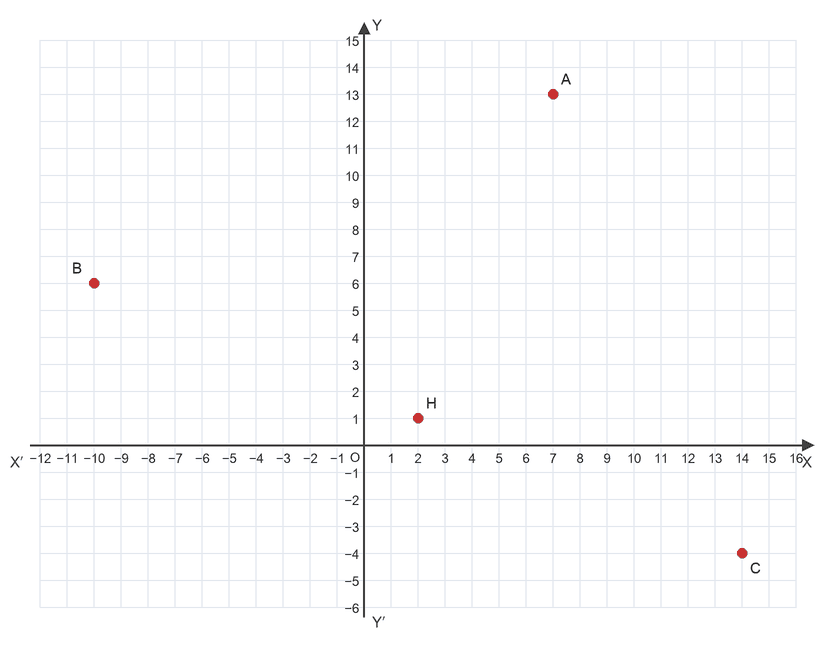
(a) Show that is equally far from the three villages. What is called for triangle ?
(b) Find the total length of pipe needed for Plan II, and for Plan I. (Take .)
(c) Which plan needs less pipe, and by about how much?
- 395 marks
Question 39
Competency: Application & Analysis
Case study — Locating a boat
Two lighthouses stand on a straight coast that runs along the -axis. Lighthouse is at the origin and lighthouse is at , and 1 unit stands for 1 km. The sea lies on the side of the positive -axis. The radar of a boat shows that is 10 km away and is 17 km away. (Hypothetical data.)
(a) Using the distance formula, write two equations in and for the position of the boat.
(b) Subtract one equation from the other to find .
(c) Find and the position of the boat. Say why one value of is rejected.
- 405 marks
Question 40
Competency: Analysis & Evaluation
Case study — A garden plot
A garden plot is drawn on a grid in the figure, where 1 unit stands for 1 m. A lamp stands at on the side . Ravi says, "The diagonals of look equal, so the plot must be a rectangle."
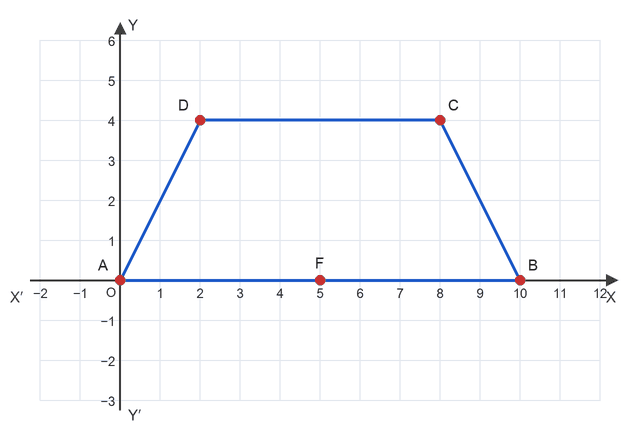
The corners are , , and .
(a) Find the lengths of the four sides. Are the opposite sides equal?
(b) Find the lengths of the two diagonals. Is Ravi's conclusion correct? Give a reason.
(c) Show that the lamp is equally far from all four corners, and find that distance.