
Opening your dashboard
Class 9 Maths Chapter 25 Complementary Angles: Competency-Based Questions (CBQ)
40 questions on Chapter 25, each worked through on its own page with the AI tutor. Class 9 Maths, ICSE 2026-27.
40 questions
1–5 marks · Mixed difficulty
- 11 mark
Question 1
Competency: Understanding
A rectangular wooden door has a straight strip nailed along one diagonal. The strip makes with the bottom edge of the door.
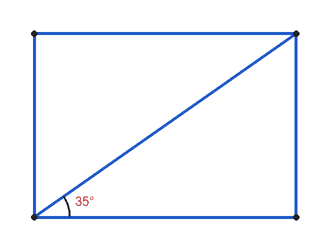
The angle that the strip makes with the vertical edge of the door at the same corner is
- 21 mark
Question 2
Competency: Application
A page of a book of tables is torn. The only entry that Kavya can read is .
From this entry she can write the value of as
- 31 mark
Question 3
Competency: Analysis
A straight ladder and a straight ramp lead up to the same loading platform from opposite sides. The ladder makes and the ramp makes with the level ground. The foot of the ladder is 1 m from the platform. (Take .)
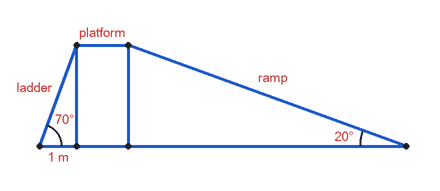
Using only this value, the length of ground covered by the ramp is about
- 41 mark
Question 4
Competency: Application
A stay wire is fixed to level ground 20 m from the foot of a tower. It makes with the ground, so its length is metres.
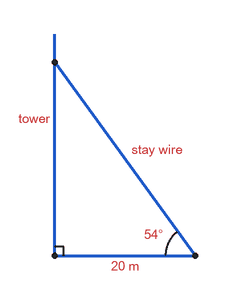
The only value at hand is .
The length of the wire, correct to two decimal places, is
- 51 mark
Question 5
Competency: Understanding
A set-square is a right-angled triangle PQR with the right angle at Q. Its sides are all different in length.
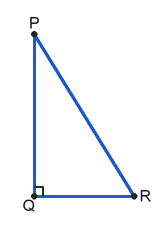
Which statement about its acute angles P and R is not true?
- 61 mark
Question 6
Competency: Evaluation
Assertion (A): is greater than .
Reason (R): , and the value of increases as increases from to .
- 72 marks
Question 7
Competency: Application
Two straight planks are laid in one line on a level floor, each with one end raised. A 12 m plank makes with the floor and a 5 m plank makes with the floor. The length of floor covered by a plank is (length of plank) cos (its angle with the floor).
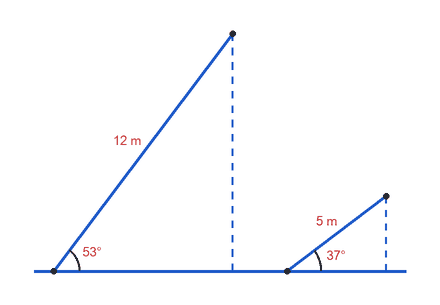
Rina's table has only sines: and . Find the total length of floor covered by the two planks.
- 82 marks
Question 8
Competency: Evaluation
Imran uses a calculator and notes down and .
Without using a calculator, explain how you know that one of these values has been entered wrongly. Which one is it, and what is the correct value?
- 92 marks
Question 9
Competency: Analysis
A roof rafter AC is 5.2 m long. It meets the horizontal beam AB at A and the vertical post BC at C, and . The design sheet gives only .
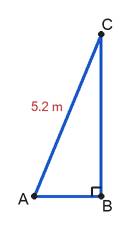
(a) Write the value of , with a reason.
(b) Find the length AB.
- 102 marks
Question 10
Competency: Application
A warning sign is a right-angled triangle. Its two acute angles are and .
(a) Find and the two angles.
(b) Write and of the larger acute angle in terms of the smaller one.
- 113 marks
Question 11
Competency: Analysis & Evaluation
A skate park has two straight ramps, each 6 m long. Ramp X makes with the level ground and ramp Y makes . (Take and .)

(a) Find the height of the top of each ramp.
(b) Find the length of ground covered by each ramp. What do you notice?
(c) Vikram says, "The angles add up to , so the two heights must add up to the length of a ramp, 6 m." Evaluate his claim.
- 123 marks
Question 12
Competency: Creativity
A publisher wants a pocket card of trigonometric values. To save space, the card will list angles only from to , and it should have as few columns as possible. A student must still be able to find all six ratios of every angle from to , using only complementary-angle relations and reciprocal relations.
Design the card: say which columns it should have and why they are enough. Then show how your card gives all six ratios of .
- 133 marks
Question 13
Competency: Analysis
Four children fly kites on tight, straight strings, each 10 m long. The heights of the kites above the children's hands, in metres, are:
, , and
(a) Write every height in terms of the sine of an angle.
(b) Without finding any values, arrange the heights from the lowest to the highest. Give a reason.
(c) A fifth kite is at a height of m. Which of the four kites is at the same height?
- 145 marks
Question 14
Competency: Analysis & Evaluation
Case study — The torn table
Only this part of a page of trigonometric tables is left in an old book.
Angle sin tan 0.2588 0.2679 0.4226 0.4663 0.6428 0.8391 (a) Use the table to write the values of , and . Give the relation used for each.
(b) A fire-engine ladder 20 m long is raised until it makes with the level ground. How far is the foot of the ladder from the point on the ground directly below its top?
(c) Ravi says, "This table cannot give any ratio of an angle that is not printed in it." Test his claim by trying to find , correct to two decimal places. Is he right?
- 154 marks
Question 15
Competency: Application & Analysis
Case study — The sail of a boat
The sail ABC of a small boat is a right-angled triangle. BC lies along the vertical mast and AB along the horizontal boom, so . The sloping edge AC is 2.5 m long. and . (The figure is not drawn to scale.)
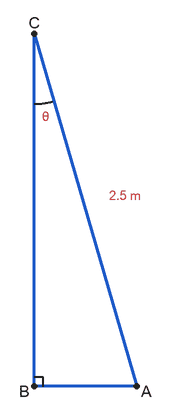
(a) Write in terms of . Hence write the value of , with a reason.
(b) Find the lengths AB and BC.
(c) Find and from the sides. Show that , and explain why this must be so.
- 161 mark
Question 16
Competency: Application
A climbing wall in a school leans back so that it makes an angle of with the vertical. For every 1 m of height that a climber gains, the climber also moves away from the vertical by a horizontal distance of metres.
The trainer prefers to use the angle between the wall and the level ground, which is . She wants to write the same horizontal distance (for 1 m of height) using this angle.
Which expression gives it?
- 171 mark
Question 17
Competency: Application
The top of a straight slide in a park is 2.4 m above the level ground. The slide makes an angle of with the vertical support pole at its top. The length of the slide equals (height of the top) .
A student who knows the values of the ratios of but not of finds the length of the slide using the angle that the slide makes with the ground. The length of the slide is
- 181 mark
Question 18
Competency: Evaluation
A student is checking a classmate's work on complementary angles.
Assertion (A): .
Reason (R): For every acute angle , .
- 191 mark
Question 19
Competency: Analysis
A student writes the values of in one row, and the values of in a second row. She then counts how many different numbers appear in the two rows together.
(The sine of a larger acute angle is larger.)
The count is
- 201 mark
Question 20
Competency: Analysis
In the figure, triangle ABC is right-angled at B, and BD is perpendicular to AC. The angle .
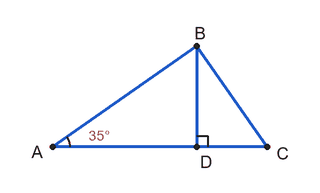
Which of the following is equal to ?
- 211 mark
Question 21
Competency: Analysis & Evaluation
Without using a calculator or tables, a student compares and . (Remember that and become larger as the acute angle becomes larger.)
Which of the following is a correct conclusion with a correct reason?
- 221 mark
Question 22
Competency: Analysis
A crate of weight rests on a smooth straight chute that makes an angle with the level ground. The force that pulls the crate down along the chute is . The force with which the crate presses on the chute is .
One identical crate is placed on a chute inclined at to the ground, and another on a chute inclined at .
Which statement is true?
- 231 mark
Question 23
Competency: Analysis
A teacher writes on the board and asks the class to find the expression that is not equal to it. Without using tables, the class tests each option.
Which of the following is not equal to ?
- 241 mark
Question 24
Competency: Evaluation
A student is comparing two reciprocal ratios in her notebook.
Assertion (A): and are equal.
Reason (R): , and equal non-zero numbers have equal reciprocals.
- 251 mark
Question 25
Competency: Application
Each step of a staircase is 16 cm high (rise) and 30 cm deep (tread). The line joining the front edges of the steps is a straight slope of length 34 cm for each step. This slope makes an angle with the level floor and an angle with the vertical wall beside the stairs.
The value of is
- 262 marks
Question 26
Competency: Application
Two bracing rods of a gate make angles and with the ground. The designer chooses the rods so that , and the first rod is steeper than the second, that is, . Both angles are acute.
Find and .
- 272 marks
Question 27
Competency: Analysis
The cross-section of a tent is a right-angled triangle ABC with . The side BC is the vertical pole and AB is the level ground. The wire AC is fixed so that .
(a) Write as a ratio of the angle , with a reason.
(b) Find the value of .
- 282 marks
Question 28
Competency: Understanding & Analysis
The arm OL of a desk lamp is 40 cm long. It is hinged at O on a vertical stand and points upwards and away from the stand. The arm makes an angle with the horizontal and an angle with the stand, above O. The lamp head L is cm above O. Riya has only one value: .
(a) Riya sets the arm at . Find , write the height of L above O as , and find this height.
(b) Riya now raises the arm, so that becomes larger. Predict what happens to and to , with a reason.
- 292 marks
Question 29
Competency: Analysis
Two identical metal shelf brackets are right-angled triangles with sides 10 cm, 24 cm and 26 cm. Bracket P is fixed with its 24 cm side along the shelf (horizontal). Bracket Q is fixed with its 10 cm side along the shelf. The slanting side of P makes an angle with the shelf, and the slanting side of Q makes an angle with the shelf.
(a) Find and .
(b) Which bracket has the steeper slanting side? Show that .
- 302 marks
Question 30
Competency: Creativity
A teacher asks every student to make a riddle card. A riddle card has three parts: a right-angled triangle whose sides are whole numbers (not 3, 4, 5), one trigonometric ratio of one acute angle written as a fraction, and a question whose answer needs the complementary-angle idea.
Make a riddle card of your own, and solve it.
- 312 marks
Question 31
Competency: Analysis
A school is building a wheelchair ramp. The school's rule says that the ramp may rise at most 1 cm for every 12 cm of horizontal run, that is, , where is the angle the ramp makes with the level ground. The builder's drawing gives only the angle between the ramp and a vertical handrail post, with . (Hypothetical data.)
(a) Write in terms of , with a reason, and find its value.
(b) Does the ramp obey the rule? Find the horizontal run needed for a total rise of 0.6 m.
- 323 marks
Question 32
Competency: Analysis
A rhombus-shaped floor tile ABCD has sides of 10 cm. Its diagonals AC and BD meet at O, and cm. Let .
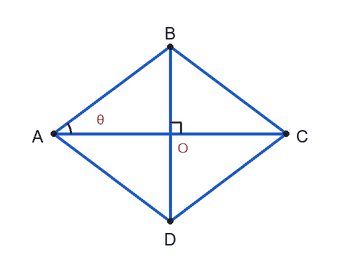
(a) Find , and hence and .
(b) Write and in terms of , using the complementary angle. Check your answers from the sides.
(c) Show that .
- 333 marks
Question 33
Competency: Application & Analysis
A vertical pole 3 m high stands on level ground. A weather station gives the position of the sun as the angle between the sun's rays and the vertical. A student's formula for the length of the pole's shadow uses the sun's elevation , the angle between the sun's rays and the level ground:
shadow length metres.
The student has only one value: . (Hypothetical data.)
(a) At 11 a.m. the station gives . Find , write the shadow length in terms of , and find it correct to two decimal places.
(b) At 4 p.m. the station gives . Using only the given value, find the shadow length correct to two decimal places.
(c) Show, without using the decimals, that the product of the two shadow lengths equals the square of the height of the pole.
- 343 marks
Question 34
Competency: Evaluation
A quiz-setter writes four expressions on the board and says, "Every one of these has the value 0."
(i)
(ii)
(iii)
(iv)
Without using tables, decide which expressions really have the value 0. For each of the others, say whether its value is positive or negative, with a reason.
- 353 marks
Question 35
Competency: Application
A triangular garden ABC has its angles in the ratio .
(a) Find the three angles.
(b) Name two angles that are complementary, and write as the cosine of another angle.
(c) Given and , find and . (Give correct to three decimal places.)
- 363 marks
Question 36
Competency: Evaluation
A worksheet says: "In , , and ."
(a) Explain why these two values cannot both be correct.
(b) The setter says that is the correct value. What is the correct value of ?
(c) Using , find .
- 375 marks
Question 37
Competency: Analysis & Evaluation
Case study — Two curves on one grid
Neha is preparing a chart for the school mathematics exhibition. She wants visitors to see how the sine and the cosine of an angle change as the angle grows from to . She plots the graphs of and on the same grid, as shown. The two curves meet at the point P. The point Q lies on the cosine curve at .
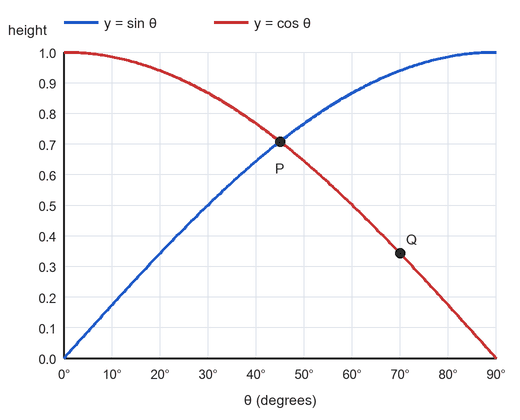
(a) Read from the graph the angle at which the two curves meet, and the common height at P, correct to one decimal place.
(b) Read the approximate height of Q from the grid. At what angle does the sine curve have the same height? Give a reason using complementary angles.
(c) At , the heights of the sine curve and the cosine curve are and . Without reading the graph, write the heights of both curves at . What does this tell you about the picture?
- 384 marks
Question 38
Competency: Analysis
Case study — The maths club's triangles
The maths club draws four right-angled triangles ABC, each right-angled at C, on a large sheet of chart paper. The members measure the sides in centimetres and write them in a table, where , and . They want to see whether the pattern between the ratios of the two acute angles A and B is the same in every triangle. (Hypothetical data.)
Triangle (BC) (CA) (AB) T1 12 35 37 T2 9 40 41 T3 28 45 53 T4 33 56 65 (a) For each triangle, find and as fractions.
(b) What do you notice about and ? Explain why this must happen in every right-angled triangle.
(c) A fifth triangle T5 has , and . Without finding any angle, write and for T5. Also say which of T1 to T4 has the largest angle A.
- 394 marks
Question 39
Competency: Application & Analysis
Case study — A mobile crane
A mobile crane has a straight boom OT of length 20 m, hinged at O on the truck. When the boom is raised to an angle with the level ground, the height of its tip T above O is metres, and the horizontal distance of T from O (the reach) is metres. The operator's chart has only two rows filled in. (Hypothetical data.)
Height (m) Reach (m) 6.84 18.79 12.86 15.32 (a) Using only this table, write the height and the reach when the boom is at and at .
(b) A load has to be set down at a point 12.86 m from O, measured horizontally. At what angle should the boom be raised?
(c) The operator says that at one particular angle the height of the tip is exactly equal to its reach. Find that angle, with a reason, and the height at that angle correct to two decimal places. (Take .)
- 405 marks
Question 40
Competency: Application & Analysis
Case study — The school wall clock
The minute hand OT of a wall clock is 10 cm long and turns about the centre O of the dial. It turns through every minute. At 12:00 it points straight up to the 12 mark. Between 12:00 and 12:15, the hand makes an angle with the upward vertical, where . In the figure, H is the foot of the perpendicular from the tip T to the vertical line through O.
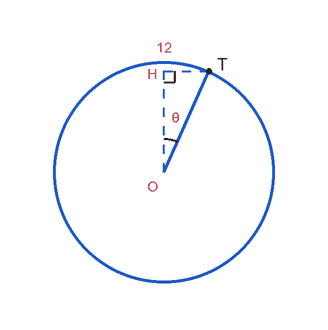
The tip T is cm above O (this is ) and cm to the right of O (this is ). Given: and .
(a) At 12:04, find how far T is above O and how far it is to the right of O.
(b) At 12:11, find the same two distances, using only the values given and the complementary angle.
(c) Show that the two distances at minutes after 12:00 are swapped at minutes after 12:00. Hence find the time between 12:00 and 12:15 at which T is equally far above O and to the right of O.