
Competency: Analysis & Evaluation
Case study — Width of a pond
In a mathematics activity, a class finds the width AB of a pond by using right-angled triangles. A is a tree on the far bank, and B is a peg on the near bank directly opposite A. A line is marked on the level ground through B, at right angles to AB. Three students stand at the points R, S and T on this line. Each measures her or his distance from B with a tape, and the distance to the tree A with a laser distance meter.
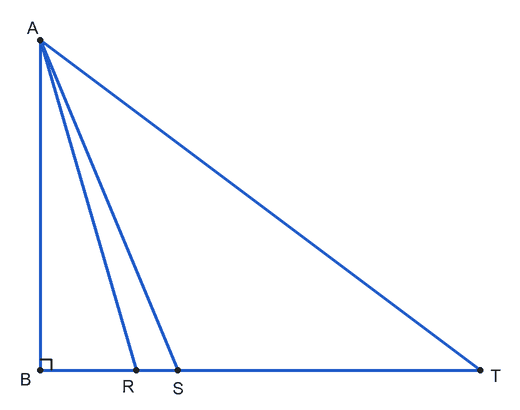
| Student | Point | Distance from B | Distance from A |
|---|---|---|---|
| Ria | R | 7 m | 25 m |
| Sam | S | 10 m | 26 m |
| Tina | T | 32 m | 41 m |
(Hypothetical data.)
(a) Use Ria's readings to find the width AB of the pond.
(b) Find the width from Sam's readings. Whose readings do not agree with the other two? If Tina's distance from B is correct, what should her distance from A be?
(c) Using the width found in (a), write , and (with Tina's corrected reading). Which is the greatest, and why?