
Opening your dashboard
Class 9 Chemistry Chapter 5 The Periodic Table: Competency-Based Questions (CBQ)
40 questions on Chapter 5, each worked through on its own page with the AI tutor. Class 9 Chemistry, ICSE 2026-27.
40 questions
1–5 marks · Mixed difficulty
- 11 mark
Question 1
Cognitive domain: Analysis
Nikhil wants to test Dobereiner's idea for himself. He picks three sets of elements and writes each set in order of increasing atomic mass.
Set Elements (atomic mass) Valencies 1 Calcium (40), Strontium (88), Barium (137) 2, 2, 2 2 Carbon (12), Nitrogen (14), Oxygen (16) 4, 3, 2 3 Nitrogen (14), Phosphorus (31), Arsenic (75) 3, 3, 3 Which of his sets can be called a Dobereiner's triad?
- 21 mark
Question 2
Cognitive domain: Application
A bag of NPK fertiliser lists three plant nutrients. The 'P' stands for phosphorus, whose atoms have their electrons arranged as 2, 8, 5.
Which description of phosphorus follows from this arrangement?
- 31 mark
Question 3
Cognitive domain: Application
Some anti-dandruff shampoos contain a compound of the element selenium. In the modern periodic table, selenium lies in group 16, directly below sulphur.
Using only this position, which prediction about selenium is correct?
- 41 mark
Question 4
Cognitive domain: Analysis
In a quiz, five cards show only the electronic configurations of five elements.
Card P Q R S T Configuration 2, 8, 1 2, 8, 8, 1 2, 7 2, 8, 7 2, 8, 8 Which pair of cards shows the most reactive metal and the most reactive non-metal among the five?
- 51 mark
Question 5
Cognitive domain: Understanding
Assertion (A): Newlands' law of octaves could be applied only to the elements up to calcium.
Reason (R): Among the elements heavier than calcium, every eighth element did not have properties similar to those of the first.
- 61 mark
Question 6
Cognitive domain: Understanding
Assertion (A): An atom of fluorine (2, 7) is smaller than an atom of lithium (2, 1).
Reason (R): An atom of fluorine has fewer electron shells than an atom of lithium.
- 71 mark
Question 7
Cognitive domain: Understanding
Kitchen foil is made of aluminium (atomic number 13). The chips inside a mobile phone are made of silicon (atomic number 14). The two elements are neighbours in period 3.
Fill in the blanks.
On moving from aluminium to silicon, the number of electron shells ________, the size of the atom ________ and the metallic character ________.
- 81 mark
Question 8
Cognitive domain: Application
Sparklers and emergency flares often contain the powder of a metal that burns with a dazzling white light. This metal lies in period 3 and group 2 of the modern periodic table.
Name the metal and, using only its group number, write the formula of its chloride.
- 91 mark
Question 9
Cognitive domain: Application
A fireworks maker has three white powders: the chlorides of calcium, strontium and barium. He wants one firework to burn with a green flame and another with a crimson flame.
Which chloride should he use for each? Predict the colour that the third chloride would give to a flame.
- 102 marks
Question 10
Cognitive domain: Understanding
In her revision notes on Mendeleev's periodic table, Sneha has written:
"Mendeleev arranged the elements in order of increasing atomic number. He put iodine (126.9) after tellurium (127.6) because iodine is the heavier of the two."
Both sentences contain a mistake. Rewrite each sentence correctly and explain the correction.
- 112 marks
Question 11
Cognitive domain: Application
The light of an LED bulb comes from a compound of the element gallium. In the modern periodic table, gallium lies in group 13, directly below aluminium (2, 8, 3).
(a) Predict the number of valence electrons of gallium, its valency and the formula of its oxide.
(b) Using the general trends down a group, predict how gallium should compare with aluminium in atomic size and in metallic character. Give a reason for each.
- 122 marks
Question 12
Cognitive domain: Evaluation
After a lesson on the modern periodic table, Arnav says, "Once the elements were arranged by atomic number, every problem of Mendeleev's table was solved. The modern periodic table has no defects."
Evaluate Arnav's statement. Give one point that supports him and two points that go against him.
- 134 marks
Question 13
Cognitive domain: Analysis
A factory that makes disinfectants and dyes uses elements of group 17. To plan safe storage, the store-keeper pins up a chart of four of these elements. The store room is kept at 25 °C. He has to decide which elements must be kept in strong gas cylinders, which in tightly closed bottles and which in jars. He also notices that the colours of the four elements are not the same.
Element Atomic number Melting point (°C) Boiling point (°C) Colour Fluorine 9 −220 −188 pale yellow Chlorine 17 −101 −34 greenish yellow Bromine 35 −7 59 reddish brown Iodine 53 114 184 violet (a) Use the data to find the physical state of each element in the store room.
(b) Describe two trends shown by the chart on going down the group. Astatine (atomic number 85) is the next member of the group. Predict its physical state at 25 °C and how its colour would compare with that of iodine.
(c) All four elements react with sodium to give salts with the same type of formula. Explain why, using their electronic structure, and write the formula of the salt formed by bromine and of the ion that bromine forms. Which of the four elements is the most reactive?
- 144 marks
Question 14
Cognitive domain: Evaluation
In Mendeleev's periodic table, copper was placed in Group I along with lithium, sodium and potassium. Meenal's family makes copper water pots, and she is surprised to find copper in the same group as sodium. From her textbook and what she sees in the workshop, she compares the two metals. She also learns that in the modern periodic table, sodium is in group 1 but copper is in group 11.
Property Sodium Copper Hardness soft; can be cut with a knife hard Action of cold water reacts violently; hydrogen is given off no reaction How it is kept under kerosene in the open air Colour of its sulphate white blue (a) Which defect of Mendeleev's periodic table does Meenal's comparison bring out? Support your answer with two pieces of evidence from her table.
(b) State the basis on which the modern periodic table is arranged. Name the type of element to which sodium and copper each belong in it, and give one property in Meenal's table that is typical of copper's type.
(c) Meenal's friend says, "A table with a mistake like this could not have been of any use to chemists." Evaluate this statement, giving two reasons.
- 155 marks
Question 15
Cognitive domain: Creativity
You have to plan a 20-minute class activity called "Be Mendeleev". Groups of classmates will be given a set of element cards and must rediscover how Mendeleev built his table, including how he dealt with an element that nobody had discovered. You may use these fourteen elements, which Mendeleev knew, and their atomic masses:
Li 7, Be 9, B 11, C 12, N 14, O 16, F 19, Na 23, Mg 24, Al 27, Si 28, P 31, S 32, Cl 35.5
Design the activity. Your plan should show:
(a) what you will write on each card, and which one card you will secretly hold back;
(b) the instructions you will give the groups, and the pattern you expect them to find;
(c) how the groups will notice that a card is missing, and the predictions they should be able to make about the missing element;
(d) one extra pair of cards you could add to show a weakness of Mendeleev's method, and how that weakness was later removed.
- 161 mark
Question 16
Cognitive domain: Analysis
Three elements A, B and C are to be placed in a periodic table. Their data are given below. (Hypothetical data.)
Element Atomic number Atomic mass A 21 45.0 B 22 44.0 C 23 51.0 Which statement about the placing of A and B is correct?
- 171 mark
Question 17
Cognitive domain: Analysis
The graph shows the approximate atomic radii of the elements with atomic numbers 3 to 9 and 11 to 17. The noble gases are not plotted. Four of the elements are marked P, Q, R and S. (P, Q, R and S are not the symbols of the elements.)

Which statement about the marked elements is correct?
- 181 mark
Question 18
Cognitive domain: Understanding
Riya is drawing a large wall chart of the modern periodic table with 18 vertical columns. Her textbook tells her that the fifteen elements from lanthanum (atomic number 57) to lutetium (atomic number 71) all belong to Group 3 of the sixth period, and that they are metals with similar properties.
Where does the textbook show these elements on the chart, and why?
- 191 mark
Question 19
Cognitive domain: Understanding
Assertion (A): Argon exists as single atoms and not as molecules.
Reason (R): The atoms of argon have an unstable arrangement of electrons, so they pair up to become stable.
- 201 mark
Question 20
Cognitive domain: Understanding
Assertion (A): Dobereiner's triads could classify all the elements that were known in his time.
Reason (R): The law of triads did not apply fully even among the elements of one family.
- 211 mark
Question 21
Cognitive domain: Application
In a school laboratory, Ms Iyer cuts a small piece of sodium with a knife. The freshly cut surface is silvery and shiny, but within a few minutes it turns dull, and after some days the piece is covered with a white crust. She tells the class that the crust forms through three changes, one after the other: first the metal reacts with the oxygen of the air, then the product reacts with water vapour of the air, and then the new product reacts with carbon dioxide of the air.
Which option gives the compound formed after each change, in the order of the changes?
- 221 mark
Question 22
Cognitive domain: Analysis
Newland arranged the elements known in his time in the increasing order of their atomic masses, in rows of seven:
Row 1 H Li Be B C N O Row 2 F Na Mg Al Si P S Row 3 Cl K Ca Cr Ti Mn Fe Every element falls in the same column as the element 7 places before it, so the elements of a column should be alike. Which pair of elements from the same column is not alike in its chemical nature?
- 231 mark
Question 23
Cognitive domain: Analysis
The diagram shows the electron arrangement of four atoms A, B, C and D. (The letters are not the symbols of the elements.)

Which statement about the atoms is correct?
- 241 mark
Question 24
Cognitive domain: Understanding
Three students use the periodic table in three different ways. The three uses are:
- Use I: finding the electronic configuration of an element from its position.
- Use II: predicting the nature of the bond in a compound from the positions of its elements.
- Use III: predicting that an element which is not yet known should exist.
Meena says that an element in period 2 and group 17 has the electron arrangement 2, 7. Karan says that a compound of a group 1 metal and a group 17 non-metal should be electrovalent. Anjali sees a gap between two known elements in Mendeleev's table and says that an element must still be found to fill it.
Which option matches each student to the correct use?
- 251 mark
Question 25
Cognitive domain: Analysis
A school laboratory has the chlorides of three alkaline earth metals: beryllium, magnesium and calcium. They are labelled X, Y and Z, but not in that order. The chlorides are melted and tested. The textbook says that all the salts of the alkaline earth metals are ionic, except those of one metal. (Molten ionic compounds conduct electricity well; covalent compounds do not.) The results (approximate values) are:
Chloride of Melting point Molten chloride conducts electricity? X 399 °C very poorly Y 714 °C well Z 772 °C well Which option correctly identifies beryllium and gives the reason?
- 262 marks
Question 26
Cognitive domain: Analysis
Dobereiner noticed that in a triad the atomic mass of the middle element, and its properties as well, are roughly the average of those of the other two. A student wants to test whether this also holds for the density and the melting point of the triad calcium, strontium and barium. (Approximate values.)
Property Calcium Strontium Barium Density (g/cm³) 1.55 2.64 3.51 Melting point (°C) 842 777 727 Find the mean of the values for calcium and barium for each property, and compare it with the value for strontium. Do the results support the idea of a triad?
- 272 marks
Question 27
Cognitive domain: Evaluation
Mina writes in her notebook: "Every period of the modern periodic table ends with a noble gas that has 8 electrons in its outermost shell. So every period has 8 elements, and the fourth period contains the elements with atomic numbers 19 to 26."
Check Mina's statement. Correct her mistakes, using the atomic numbers of the fourth period.
- 282 marks
Question 28
Cognitive domain: Understanding
The atomic numbers of lithium, sodium, potassium and rubidium are 3, 11, 19 and 37. The gaps between neighbouring atomic numbers are 8, 8 and 18, which are not equal, yet all four elements are placed in the same group and behave alike.
Write the electronic configuration of each atom and use it to explain why the four elements are alike in spite of the unequal gaps.
- 292 marks
Question 29
Cognitive domain: Evaluation
Radhika says, "The elements of Group 18 are called inert gases. Inert means that they do not react at all, so no compound of a Group 18 element can ever be made."
Evaluate her statement, using the electron arrangement of these elements and the history of their name.
- 302 marks
Question 30
Cognitive domain: Application
Ananya's notes give the valency of the elements of a group as follows. Groups 1 and 2: the valency is equal to the group number. Groups 13 and 14: the valency is the group number minus 10. Groups 15, 16 and 17: the valency is 18 minus the group number. She applies these rules to three unknown elements: E in group 13, F in group 16 and G in group 15. (E, F and G are not the symbols of the elements.)
(a) Find the valency of each of E, F and G.
(b) Write the formula of the compound formed between E and F, and the formula of the compound of G with hydrogen. (The valency of hydrogen is 1.)
- 312 marks
Question 31
Cognitive domain: Application
In Mendeleev's periodic table the formulae of the hydride and of the highest oxide of the elements of a group are written with the letter R for the element:
Group I II III IV V VI VII Hydride RH RH Highest oxide RO Neha has an element X of the third period. Its hydride has the formula and its highest oxide has the formula .
(a) Find the group of X in Mendeleev's table. Explain why the hydride alone is not enough to decide.
(b) Name the element X and write the formulae of its hydride and its highest oxide.
- 323 marks
Question 32
Cognitive domain: Analysis
The last element of every period of the modern periodic table is a noble gas. The noble gases have the atomic numbers 2 (helium), 10 (neon), 18 (argon), 36 (krypton), 54 (xenon) and 86 (radon). The fourth and fifth periods have 18 elements each, and the sixth period has 32 elements. A student wants to find the period and the group (numbered 1 to 18) of three elements E1, E2 and E3 with atomic numbers 37, 52 and 85, without looking at the table. (E1, E2 and E3 are not the symbols of the elements.)
Use the noble gases to find the period and the group of each of the three elements. Show your reasoning.
- 333 marks
Question 33
Cognitive domain: Analysis
The oxides of the elements of Group 15 change in character on going down the group. A student tests three oxides E, F and G, which belong to three different elements of the group, with dilute acid and with an alkali. (An acidic oxide reacts only with an alkali, a basic oxide reacts only with an acid, and an amphoteric oxide reacts with both.) (Hypothetical data.)
Oxide Reacts with dilute acid? Reacts with alkali? E no yes F yes yes G yes no (a) Classify each of the oxides E, F and G as acidic, basic or amphoteric.
(b) Arrange the three elements from the top of the group to the bottom.
(c) Explain the trend in terms of the metallic character of the elements.
- 343 marks
Question 34
Cognitive domain: Application
A company that makes 'neon' advertising lights buys its noble gases from a plant that separates them from liquid air. The boiling points of the gases are shown below. (Approximate values.)
Noble gas Atomic number Boiling point (°C) Helium 2 −269 Neon 10 −246 Argon 18 −186 Krypton 36 −153 Xenon 54 −108 (a) Describe how the boiling point changes on going down the group, and name the gas that is the most difficult to liquefy.
(b) Radon has the atomic number 86. Predict whether its boiling point is lower or higher than that of xenon.
(c) Explain why a noble gas can be kept in a sealed glass tube of an advertising light without reacting.
- 353 marks
Question 35
Cognitive domain: Application
The table lists some properties of four elements A, B, C and D. Each one belongs to a different type of element: representative element, transition element, inner transition element and noble gas. (Hypothetical data.)
Element Observations A Hard metal with a very high melting point; forms coloured compounds; shows more than one valency; used as a catalyst B Colourless gas made of single atoms; does not react with other elements; outermost shell is complete C Heavy metal with variable valency; forms coloured ions; radioactive; made in special laboratories D Soft metal that can be cut with a knife; 1 electron in the outermost shell; reacts violently with water (a) Name the type of each of the elements A, B, C and D, giving one property from the table as the reason.
(b) State in which groups of the periodic table the elements of the type of A are found, and where the elements of the type of C are shown.
- 363 marks
Question 36
Cognitive domain: Evaluation
Three students are asked which early scheme of classification they would use to predict the properties of an element that has not yet been discovered. Anil chooses Dobereiner's triads, Bela chooses Newland's law of octaves and Chitra chooses Mendeleev's periodic table.
For each student, give one reason why the choice is strong or weak. Then say whose choice is the best and why.
- 374 marks
Question 37
Cognitive domain: Analysis
A chemistry club studies four elements of the third period of the modern periodic table. The elements are labelled W, X, Y and Z, and their atomic numbers are 11, 13, 15 and 16. As a demonstration, the teacher burns each element in a gas jar of oxygen, adds a little water to the jar, shakes it and tests the liquid with litmus paper. The members also test whether each element conducts electricity. Their observations are recorded in the table. (W, X, Y and Z are not the symbols of the elements.) (Hypothetical data.)
Element Atomic number Oxide shaken with water in the jar Does the element conduct electricity? W 11 dissolves; red litmus turns blue yes X 13 does not dissolve; no change in litmus yes Y 15 dissolves; blue litmus turns red no Z 16 dissolves; blue litmus turns red no (a) Write the electronic configuration and the group number of each of W, X, Y and Z.
(b) Use both sets of observations to sort the four elements into metals and non-metals. Then state how the metallic character changes from W to Z, and explain why.
(c) An element M of the same period has the atomic number 12. State its group, its valency, whether it conducts electricity, and whether its oxide is more or less basic than the oxide of W.
- 384 marks
Question 38
Cognitive domain: Analysis
A teacher draws two bar graphs on the board. One shows the reactivity of the elements of Group 1 and the other shows the reactivity of the elements of Group 17, each against the period number of the element. Reactivity is shown on a scale of 0 to 10. The graphs are labelled X and Y, but the teacher does not say which graph is which group. (Hypothetical data.)
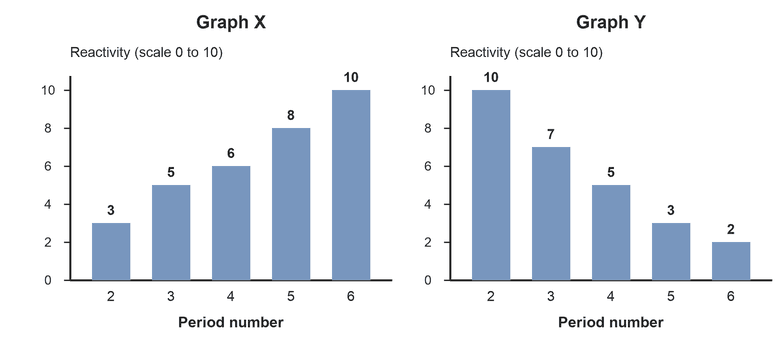
(a) State which graph is for Group 1 and which is for Group 17, giving a reason.
(b) Explain why the two groups show opposite trends.
(c) Francium is the element below caesium in Group 1, and tennessine is the element below astatine in Group 17. Using the trends in the graphs, predict how the reactivity of each compares with the last bar of its graph.
- 395 marks
Question 39
Cognitive domain: Evaluation
A school's science room has an old wall chart arranged like Mendeleev's periodic table, and the library has a new chart of the modern periodic table. The teacher asks Class 9 to compare the two charts and to recommend one for the new laboratory. Both charts are in good condition, and the laboratory will be used by Class 9 students who study the periodic table, so the chart must help them to find the properties of an element quickly. The class prepares a summary:
Feature Old chart (Mendeleev's table) New chart (modern periodic table) Basis of arrangement increasing atomic mass increasing atomic number Number of groups 8, with sub-groups A and B 18 Noble gases no place for them Group 18 Blank spaces left for undiscovered elements none Lanthanides and actinides not shown separately shown in two rows at the bottom (a) Give two ways in which the new chart improves on the old one, and say why each is an improvement.
(b) Explain why the old chart had no place for the noble gases, and how the new chart places them.
(c) Recommend one chart for the laboratory, giving a reason, and name one defect of the modern table that remains.
- 404 marks
Question 40
Cognitive domain: Creativity
For Science Day, the Class 9 chemistry club prepares a 'Who am I?' quiz. Each riddle card gives three clues, and the answer is one element. The rules are that the first clue is about the family or position of the element, the second is about its atoms, and the third is about its properties or uses. The three clues together must point to only one element, although the first clue alone must not be enough.
(a) Write a riddle card for sodium.
(b) Write a riddle card for chlorine.
(c) Write a riddle card for argon, and explain in one line for each of your three cards why the first clue alone is not enough.