
Opening your dashboard
Class 9 Chemistry Chapter 2 Chemical Changes and Reactions: Competency-Based Questions (CBQ)
40 questions on Chapter 2, each worked through on its own page with the AI tutor. Class 9 Chemistry, ICSE 2026-27.
40 questions
1–5 marks · Mixed difficulty
- 11 mark
Question 1
Cognitive domain: Application
Meera finds a sachet of lemon-flavoured fruit salt in the kitchen. The label lists two dry white powders: sodium hydrogen carbonate and citric acid. The powder has stayed unchanged in the sealed sachet for months, but when she tips it into a glass of water at room temperature, it fizzes briskly at once.
What did the water do to make the chemical change possible?
- 21 mark
Question 2
Cognitive domain: Analysis
A laboratory assistant finds four unlabelled jars of white solids. She knows that they are lead nitrate, potassium nitrate, sodium carbonate and zinc carbonate, but not which is which. She heats a little of each solid strongly in a dry test tube and records what she sees.
Solid Gas given off Residue left P no gas white solid, unchanged Q a colourless gas that turns lime water milky yellow when hot, white when cold R a reddish-brown gas, and a gas that relights a glowing splint yellow solid S only a colourless gas that relights a glowing splint white solid Which option identifies solids P and S correctly?
- 31 mark
Question 3
Cognitive domain: Understanding
During a monsoon thunderstorm, a flash of lightning heats the air around it to a very high temperature. At about 3000 °C, the nitrogen and oxygen of the air react:
The reaction stops as soon as the air cools. Which statement describes this reaction correctly?
- 41 mark
Question 4
Cognitive domain: Application
The bar chart shows the total chemical energy stored in the reactants and in the products of two reactions, X and Y.
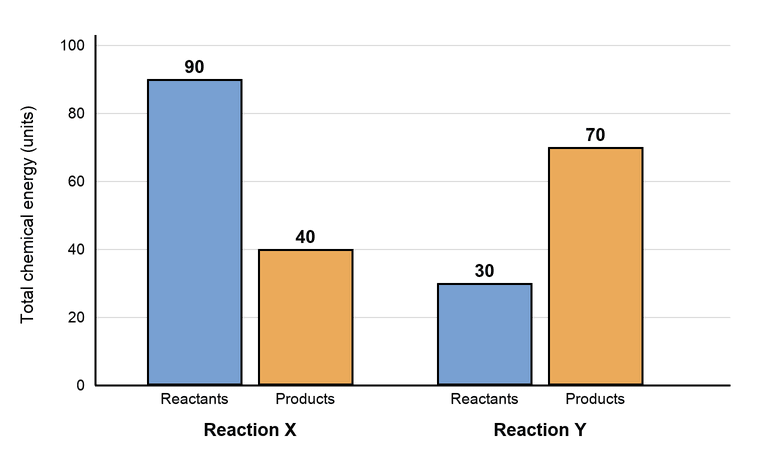
Which pair of reactions could X and Y be?
- 51 mark
Question 5
Cognitive domain: Understanding
Assertion (A): The manganese dioxide left in the test tube after oxygen has been prepared by heating potassium chlorate can be washed, dried and used again for the same preparation.
Reason (R): A catalyst alters the rate of a chemical reaction but itself remains unchanged at the end of the reaction.
- 61 mark
Question 6
Cognitive domain: Analysis
Assertion (A): When blue crystals of hydrated copper sulphate are heated gently in a dry test tube, they change into a white powder.
Reason (R): The change of hydrated copper sulphate into anhydrous copper sulphate is a reversible reaction.
- 71 mark
Question 7
Cognitive domain: Understanding
A sealed glass bulb contains nitrogen tetraoxide gas. Kept in ice, the contents are almost colourless. When the bulb is dipped in hot water, the gas turns reddish brown. When the bulb is put back in ice, the colour fades again.
Fill in the blanks.
The reddish-brown gas formed on heating is ________. Because this gas changes back into the original compound on cooling, the change is called thermal ________ and not thermal decomposition. A reaction of this kind, which can be made to go in either direction by changing the conditions, is called a ________ reaction.
- 81 mark
Question 8
Cognitive domain: Application
A bottle of freshly prepared chlorine water is left by mistake on a sunny window sill of the school laboratory. After a few hours, small bubbles of a colourless gas are seen rising in it. A second bottle of the same chlorine water, kept in a dark cupboard, shows no bubbles.
Name the gas in the bubbles, and name the kind of reaction (according to the form of energy absorbed) that produced it.
- 91 mark
Question 9
Cognitive domain: Application
Iron filings are stirred into blue copper sulphate solution. When the solution has turned pale green, it is filtered. Sodium hydroxide solution is then added to the clear filtrate.
Predict what is seen when the sodium hydroxide solution is added, and name the substance responsible for it.
- 102 marks
Question 10
Cognitive domain: Understanding
Tanvi stirs a spoonful of sugar into a cup of tea, and the sugar can no longer be seen. Later she heats a spoonful of sugar strongly on a hot tawa. It melts, turns brown and then black, and steam rises from it.
Tanvi says, "Both are chemical changes, because in both cases the white sugar has disappeared." Is she right? Give two reasons for your answer.
- 112 marks
Question 11
Cognitive domain: Evaluation
At a science fair, Ishaan drops zinc granules into a bottle containing dilute sulphuric acid and quickly stretches a balloon over its mouth. The liquid fizzes, the bottle feels warm, and the balloon swells.
A visitor says, "No new substance has formed. The balloon swelled only because the air in the bottle became warm and expanded."
Evaluate the visitor's claim. Describe two observations or tests that would settle the matter.
- 122 marks
Question 12
Cognitive domain: Application
In a village lime kiln, lumps of limestone and coal are stacked in layers and the coal is set alight. Quicklime is formed only as long as the coal keeps burning.
(a) Two chemical reactions go on in the kiln. Write the equation for each and classify it as exothermic or endothermic.
(b) Explain why the limestone stops changing into quicklime soon after the coal has burnt out.
- 134 marks
Question 13
Cognitive domain: Analysis
Dhokla batter turns light and spongy in the steamer because a pinch of baking soda (sodium hydrogen carbonate) is stirred into it. To find out what heat does to baking soda, Asha heats a spatula of the dry white powder in a hard-glass test tube. A delivery tube from the test tube dips into lime water. She records what she sees.
Step What Asha does Observation 1 Heats the powder Colourless droplets collect on the cooler upper part of the test tube; bubbles pass through the lime water, which turns milky 2 Goes on heating The bubbling slows down and stops; a white solid is left 3 Lets the tube cool, then tips out the solid and weighs it The solid is still white; it weighs less than the powder she started with 4 Heats the white solid strongly again No droplets, no bubbles, no change (a) Which observations show that a chemical change, and not just a physical change, has taken place? Name the two substances that have left the powder.
(b) Write the balanced equation for the change, name the type of reaction, and use it to explain why dhokla turns spongy.
(c) What does Step 4 tell Asha about the white solid? Explain why it behaves differently from baking soda on heating, and why Asha's reaction is called a thermal decomposition and not a thermal dissociation.
- 144 marks
Question 14
Cognitive domain: Evaluation
On a school visit to a mango orchard, Kabir brushes against a nest of red weaver ants. These ants bite and spray formic acid into the wound, and his arm begins to burn. The caretaker rubs a paste of baking soda and water on the bites and the pain soon eases. Kabir's friend Zoya had wanted to dab vinegar on them instead. The caretaker also tells the class that one plot in the orchard had become too acidic for the trees, and that he had spread slaked lime on its soil.
(a) Name the type of chemical reaction that eased Kabir's pain and that treated the soil. What are the products of this type of reaction, and to which of the four main types of chemical reaction does it belong?
(b) Would Zoya's idea have worked? Justify your answer.
(c) Next week in the laboratory, a few drops of dilute sulphuric acid fall on Kabir's hand. Zoya picks up the bottle of sodium hydroxide solution and says, "This is a strong alkali, so it will neutralise the acid fastest." Evaluate her suggestion and state what should be done instead.
- 155 marks
Question 15
Cognitive domain: Creativity
A teacher prepares white silver chloride and leaves it in an open dish near a window. By the afternoon it has turned grey. Three students explain this differently.
- Aman: "Sunlight changed it."
- Bela: "The warmth near the window changed it."
- Chirag: "The air changed it."
You are given silver nitrate solution, sodium chloride solution, test tubes with stoppers, filter paper, black paper, a beaker of warm water and a sunny window sill. Design an investigation to find out who is right. Your plan should show:
(a) how you will prepare the silver chloride, with the equation;
(b) the set-ups you will make, what is different in each, and what you will keep the same;
(c) the results you expect if Aman is right, and the equation for the change he is describing.
- 161 mark
Question 16
Cognitive domain: Analysis
Two identical 500 cm³ flasks, P and Q, each contain 50 cm³ of dilute hydrochloric acid (an excess) and a small tube holding 0.30 g of marble chips (calcium carbonate). Flask P is left open to the air. Flask Q is closed with a rubber stopper that is wired firmly in place, so that no gas can escape. Each flask is tilted so that the marble chips fall into the acid, and its reading on a balance is noted every minute. (Hypothetical data.) The graph shows both sets of readings.

Which statement explains the graph correctly?
- 171 mark
Question 17
Cognitive domain: Analysis
A student tests three halogens, , and , which are chlorine, bromine and iodine in some order. She mixes a solution of each halogen in water with solutions of the potassium salts , and . A change of colour shows that the free halogen has been formed, which means that a displacement reaction has taken place.
Mixture Observation solution + solution Colour changes; formed solution + solution Colour changes; formed solution + solution Colour changes; formed solution + solution No change solution + solution No change Which option names X, Y and Z correctly?
- 181 mark
Question 18
Cognitive domain: Analysis
Two flasks, P and Q, each hold 10 cm³ of the same hydrogen peroxide solution at room temperature. At the start, 0.5 g of manganese dioxide is added to flask P only. After 30 minutes, 0.5 g of manganese dioxide is added to flask Q as well. The oxygen from each flask is collected in a gas syringe, and its volume is read at intervals. (Hypothetical data.) The graph shows the readings.

Which conclusion does the graph support?
- 191 mark
Question 19
Cognitive domain: Understanding
Assertion (A): No change is seen when a clean zinc rod is dipped into magnesium sulphate solution.
Reason (R): Zinc is more reactive than magnesium.
- 201 mark
Question 20
Cognitive domain: Understanding
Assertion (A): A decomposition reaction does not always need heat.
Reason (R): Light and electricity can also supply the energy that breaks the bonds of a compound.
- 211 mark
Question 21
Cognitive domain: Application
A school laboratory has 4.0 g of sodium hydroxide, dissolved in water, as waste. It is to be neutralised exactly with dilute hydrochloric acid. (Relative atomic masses: H = 1, O = 16, Na = 23, Cl = 35.5.)
What mass of hydrogen chloride must the acid contain?
- 221 mark
Question 22
Cognitive domain: Application
Ria chews a small piece of plain boiled rice for about a minute without swallowing it. At first it has almost no taste, but soon it begins to taste slightly sweet. Plain rice is mostly starch, and saliva contains an enzyme.
Which statement explains the change?
- 231 mark
Question 23
Cognitive domain: Analysis
Potassium hydroxide solution is added to dilute nitric acid. All the substances are present as ions in the solution, and the reaction is written in ionic form as:
Which statement describes the reaction correctly?
- 241 mark
Question 24
Cognitive domain: Understanding
Three direct combination reactions are shown below. In a combination reaction the substances that join can be two elements, an element and a compound, or two compounds.
Reaction Equation P Q R Which option states correctly what combines in P, Q and R?
- 251 mark
Question 25
Cognitive domain: Analysis
In a closed vessel, iron and steam are kept at a high temperature, and some hydrogen forms. In a second closed vessel, iron oxide, , and hydrogen are kept at the same temperature, and some steam forms. The same reaction can go in either direction:
Which statement is correct?
- 261 mark
Question 26
Cognitive domain: Application
In 1774, the English chemist Joseph Priestley strongly heated a red powder, mercuric oxide, by focusing sunlight on it with a lens. Silvery droplets of a liquid metal collected, and the gas set free made a candle burn more brightly.
Name the silvery liquid and the gas, and name the type of reaction.
- 271 mark
Question 27
Cognitive domain: Application
After a heavy festival meal, Dev feels a burning pain in his stomach, which is caused by too much hydrochloric acid. His mother gives him a spoonful of milk of magnesia, which is magnesium hydroxide.
Write the balanced equation for the reaction in the stomach and name its type.
- 282 marks
Question 28
Cognitive domain: Analysis
Two test tubes are heated gently. Tube 1 holds shiny dark crystals of iodine: violet vapour rises, and dark crystals appear on the cooler upper part of the tube. Tube 2 holds white ammonium chloride: the white solid at the bottom disappears, and a white solid appears on the cooler upper part of the tube.
Ravi says, "The same thing happens in both tubes, so both are the same kind of change." Is he right? Give two points to support your answer.
- 292 marks
Question 29
Cognitive domain: Evaluation
Meena weighs a clean zinc plate and finds that it weighs 20.00 g. She leaves it in blue copper sulphate solution until the blue colour has faded, rinses it gently so that the reddish-brown coating of copper stays on it, dries it and weighs it again. It now weighs 19.85 g. (Hypothetical data.) (Zn = 65, Cu = 63.5)
Meena says, "Copper has been added to the plate, so it must be heavier. My balance must be faulty." Evaluate her reasoning and use the equation to explain the reading.
- 302 marks
Question 30
Cognitive domain: Application
A technician has two colourless solutions in unlabelled bottles, one of sodium chloride and one of sodium sulphate. She adds a little barium chloride solution to a sample of each.
(a) Which sample gives a white precipitate? Write the balanced equation for the reaction.
(b) Name a solution that could be added to the other sample to give a white precipitate, and name the precipitate.
- 312 marks
Question 31
Cognitive domain: Evaluation
A fertiliser plant makes ammonia from nitrogen and hydrogen at high pressure. The reaction chamber contains iron as the catalyst and a little molybdenum as the promoter. To cut costs, the manager says, "Molybdenum makes the reaction more efficient, so we can stop using the iron and keep only the molybdenum."
Evaluate the manager's proposal.
- 323 marks
Question 32
Cognitive domain: Analysis
A student carries out three steps with copper.
Step 1: Copper turnings are heated strongly in air and become covered with a black solid X.
Step 2: The black solid X is warmed with dilute sulphuric acid. It dissolves and gives a blue solution Y.
Step 3: Sodium hydroxide solution is added to Y, and a pale blue precipitate Z forms.
For each step, name the substance formed, write the balanced equation and name the type of reaction.
- 333 marks
Question 33
Cognitive domain: Application
Three clean strips of magnesium, iron and copper are put in three test tubes, each holding dilute sulphuric acid. Brisk bubbling is seen on the magnesium; only a few bubbles slowly form on the iron; nothing is seen on the copper.
(a) Name the gas formed and the test that identifies it.
(b) Write the balanced equation for the reaction of magnesium and name its type.
(c) Use the activity series to explain why copper shows no change.
- 343 marks
Question 34
Cognitive domain: Analysis
3.31 g of lead nitrate is dissolved in water, and 3.32 g of potassium iodide is dissolved in water in a second beaker. When the two solutions are mixed in a stoppered flask, a bright yellow solid forms. After filtering, washing and drying, the yellow solid weighs 4.61 g. (Hypothetical data; assume that no solid is lost.) (Pb = 207, K = 39, I = 127, N = 14, O = 16)
(a) Write the balanced equation and name the type of reaction.
(b) Use formula masses to find the mass of potassium nitrate formed, and show that mass is conserved.
(c) The yellow solid weighs only 4.61 g, but 6.63 g of reactants were taken. Explain why this does not break the law of conservation of mass.
- 353 marks
Question 35
Cognitive domain: Evaluation
Common salt is sodium chloride. Radha says, "Sodium is a very useful metal. We can get it by heating a big lump of salt in a hot furnace until it breaks up into sodium and chlorine."
(a) Is Radha right? Give a reason based on the reactivity of sodium.
(b) Name the form of energy and the state of the salt that would really break it up, and write the balanced equation.
(c) Name the two types of reaction that this change belongs to.
- 363 marks
Question 36
Cognitive domain: Creativity
Design a simple flow chart, as a numbered list of Yes/No questions, that a classmate can use to decide whether an unknown reaction is a direct combination, a decomposition, a displacement or a double decomposition reaction.
Then test your flow chart on these two reactions:
(i)
(ii)
- 374 marks
Question 37
Cognitive domain: Analysis
A student heats equal small amounts of five nitrates, one at a time, in a dry hard-glass test tube. She does the work in a fume cupboard and notes the gases given off and the solid left behind. Her teacher says that what happens depends on how reactive the metal is, so the pattern can be used to predict what other nitrates will do.
Nitrate Reddish-brown gas Gas that relights a glowing splint Solid left behind Potassium nitrate No Yes White solid (potassium nitrite) Calcium nitrate Yes Yes White solid (calcium oxide) Zinc nitrate Yes Yes Yellow when hot, white when cold (zinc oxide) Copper nitrate Yes Yes Black solid (copper oxide) Silver nitrate Yes Yes Grey shiny metal (silver) (a) Arrange the five metals from the most reactive to the least reactive, and say how the solid left behind changes along this order.
(b) Predict what happens when magnesium nitrate is heated, and write the balanced equation.
(c) A teacher wants oxygen as the only gas from a nitrate. Which nitrate in the table should be used? Why is zinc nitrate a poor choice?
- 384 marks
Question 38
Cognitive domain: Application
In a practical class, three gases X, Y and Z are made in different ways and tested, as shown in the table. The teacher asks the students to name the gases and the type of reaction in each preparation. She also tells them that one of the gases must be kept well away from flames while it is being made, and she asks them to find out why. Each test is carried out on a small sample of the gas collected in a test tube.
Gas How the gas was made Test and result X Magnesium ribbon added to dilute hydrochloric acid A lighted splint at the mouth of a test tube of the gas: the gas burns with a pop Y A little manganese dioxide added to hydrogen peroxide solution A glowing splint is put into the gas: it relights Z Dilute sulphuric acid poured on sodium carbonate The gas is bubbled through lime water: the lime water turns milky (a) Name the gases X, Y and Z.
(b) For each preparation, write the balanced equation and name the type of reaction.
(c) Name the catalyst, say how you could show that it is unchanged at the end, and say which gas must be kept away from flames and why.
- 395 marks
Question 39
Cognitive domain: Application
Meena mixes 5.6 g of iron filings with 3.2 g of sulphur powder on a sheet of paper. A magnet held above the mixture pulls out the iron filings. She mixes them again, packs the mixture into a hard-glass test tube and heats the bottom of the tube in a fume cupboard. When the mixture begins to glow red, she takes the burner away, but the red glow keeps spreading through the mixture. After the tube has cooled, she breaks it and finds a dark solid that the magnet does not attract. A tiny piece of the dark solid, dropped into dilute sulphuric acid in the fume cupboard, gives off a gas with the smell of rotten eggs. (Fe = 56, S = 32)
(a) What does the magnet show in the mixture, and what does it show in the dark solid?
(b) Write the balanced equation for the heating, name the type of reaction, and explain why the glow spreads after the burner is taken away.
(c) Name the gas, write the balanced equation for its formation, and name the type of reaction. Calculate the mass of the dark solid formed, if all the iron and sulphur react.
- 405 marks
Question 40
Cognitive domain: Creativity
The school science club wants a simple demonstration for younger students that a chemical reaction can give out heat. Your teacher asks you to plan the experiment. You are given dilute hydrochloric acid and sodium hydroxide solution of equal strength, water, two thermometers, a measuring cylinder and an insulated cup with a lid. The teacher reminds you that the test must be fair.
(a) Describe the steps of your experiment and say what you would measure.
(b) Explain why you would also run a control in which the sodium hydroxide solution is mixed with water instead of the acid.
(c) Describe the result that shows the reaction is exothermic, explain it in terms of energy, and name one source of error with a way to reduce it.