
Opening your dashboard
Class 9 Chemistry Chapter 1 The Language of Chemistry: Competency-Based Questions (CBQ)
40 questions on Chapter 1, each worked through on its own page with the AI tutor. Class 9 Chemistry, ICSE 2026-27.
40 questions
1–5 marks · Mixed difficulty
- 11 mark
Question 1
Cognitive domain: Application
A laboratory assistant has to print a label for a new jar of ammonium phosphate. The supplier's invoice gives only the name. From the chart on the wall he notes the two radicals: ammonium, , and phosphate, .
Which formula should he print on the label?
- 21 mark
Question 2
Cognitive domain: Application
At a car-battery workshop, Farhan sees a drum of dark brown powder used on the battery plates. The drum is marked only with the formula . He knows that lead shows variable valency and that the valency of oxygen is 2.
Which name should be written on the drum, and why?
- 31 mark
Question 3
Cognitive domain: Understanding
On a bottle of mineral water brought from Germany, Arjun reads: Natrium 12 mg, Kalium 3 mg per litre. He cannot guess what these words mean. His chemistry teacher, who knows no German, says at once, "The water contains sodium and potassium. Think of their symbols."
Which statement best explains how the teacher could tell?
- 41 mark
Question 4
Cognitive domain: Analysis
A mining company's laboratory receives 100 g each of three pure compounds of copper.
Sample Compound Formula 1 Copper (I) oxide 2 Copper (II) oxide 3 Copper (I) sulphide (Cu = 63.5, O = 16, S = 32)
Which statement about the mass of copper present in the three samples is correct?
- 51 mark
Question 5
Cognitive domain: Analysis
Assertion (A): While balancing , the product must not be changed to , even though this makes the number of atoms equal on the two sides.
Reason (R): In a chemical reaction, the total mass of the products is equal to the total mass of the reactants.
- 61 mark
Question 6
Cognitive domain: Understanding
Assertion (A): The formula of slaked lime, calcium hydroxide, is written as and not as .
Reason (R): A radical made of a group of atoms behaves as a single unit, so when more than one such radical is needed, the whole radical is enclosed in brackets.
- 71 mark
Question 7
Cognitive domain: Application
A safety chart in a factory lists three compounds, each made of two non-metals. Only their formulae are printed. Complete the names.
, filled in the fire extinguishers, is carbon ________. , used in making sulphuric acid, is sulphur ________. , a solvent kept in the store, is carbon ________.
- 81 mark
Question 8
Cognitive domain: Understanding
A quiz card reads: "One atom of magnesium is exactly twice as heavy as one atom of the element that is used as the standard for atomic masses."
Name the atom used as the standard, and use the card to find the relative atomic mass of magnesium.
- 91 mark
Question 9
Cognitive domain: Application
Before a practical class, Riya writes the equation for the test she is about to do.
Both solutions she will mix are clear and colourless. Using only the information in the equation, predict what she will see on mixing them, and name the substance she sees.
- 102 marks
Question 10
Cognitive domain: Understanding
Three jars arrive in the school store, labelled sodium sulphate, sodium sulphite and sodium sulphide. Sana says, "The supplier has sent the same chemical three times, with the name spelt in three ways."
Explain why she is wrong. Write the acid radical present in each compound and the formula of each compound.
- 112 marks
Question 11
Cognitive domain: Application
The LPG in a kitchen cylinder is mainly butane, . The piped natural gas supplied to many city kitchens is mainly methane, . A fire-safety poster says: "Leaked LPG collects near the floor. Leaked piped gas rises towards the ceiling."
A gas whose molecules are heavier than the molecules of air is denser than air. Take the average relative molecular mass of air as 29.
Calculate the relative molecular masses of butane and methane, and use them to explain the poster. (C = 12, H = 1)
- 122 marks
Question 12
Cognitive domain: Evaluation
The label on a strip of vitamin C tablets gives the formula of vitamin C (ascorbic acid) as . Dev copies it into his notes as and says, "It is the same thing. An empirical formula is just a shorter way of writing the same molecule."
Evaluate Dev's statement. Support your answer with the relative molecular mass and the empirical formula mass. (C = 12, H = 1, O = 16)
- 134 marks
Question 13
Cognitive domain: Analysis
Railway tracks are often joined on the spot by thermite welding. A mixture of aluminium powder and iron (III) oxide powder is packed into a crucible placed over the gap between two rails. The mixture does not react by itself, so it is set off with a strip of burning magnesium. Once started, the reaction gives out so much heat that the iron formed is molten. The molten iron runs into the gap and, on cooling, joins the rails. The other product, aluminium oxide, floats on top as slag; it hardens on cooling and is chipped off later. The skeleton equation is:
(a) Balance the equation, and show by counting atoms that it is balanced.
(b) A welding charge contains 800 g of iron (III) oxide. Calculate the mass of aluminium that reacts completely with it and the mass of iron formed. (Al = 27, Fe = 56, O = 16)
(c) State three facts about this reaction, given in the passage, that the balanced equation in (a) does not show. Rewrite the equation so that it carries as much of this information as an equation can.
- 144 marks
Question 14
Cognitive domain: Evaluation
Doctors often prescribe iron tablets to patients whose blood is short of iron. The iron is supplied as a compound, commonly ferrous sulphate [iron (II) sulphate]. At a chemist's shop, Neha compares two brands. Each tablet of brand P contains 200 mg of anhydrous ferrous sulphate, . Each tablet of brand Q contains 300 mg of ferrous sulphate crystals, . A poster for brand Q says: "More ferrous sulphate in every tablet, so more iron for your blood!" Both brands cost the same. (Fe = 56, S = 32, O = 16, H = 1)
(a) Calculate the relative molecular mass of each of the two compounds.
(b) Calculate the percentage of iron in each compound, correct to two decimal places.
(c) Find the mass of iron in one tablet of each brand, and evaluate the claim on the poster.
- 155 marks
Question 15
Cognitive domain: Creativity
Ammonia for fertilisers is made from nitrogen and hydrogen. Your younger cousin in Class 7 has written the reaction as and cannot see why you call it "not balanced".
You have a box of blue beads, a box of white beads and some short sticks (or toothpicks) to join them. Design a bead model to teach her how the equation is balanced. Your answer should show:
(a) what each bead and each joined group of beads stands for, and how the model shows that her equation is not balanced;
(b) how you would use the model to arrive at the balanced equation, with a count of the beads on each side;
(c) how the same model, with a mass given to each kind of bead, shows that mass is conserved (N = 14, H = 1);
(d) two things about the real reaction that neither the model nor the balanced equation can show.
- 161 mark
Question 16
Cognitive domain: Analysis
The chemistry club of a school is given a table about four unknown elements, A, B, C and D. The table shows what each atom does when it forms an ion. (Hypothetical data.)
Element What its atom does A loses 1 electron B loses 2 electrons C gains 3 electrons D gains 1 electron Aman uses the table to write the formulae of four compounds that these elements can form. Which formula is not correct?
- 171 mark
Question 17
Cognitive domain: Application
The shelf of a school laboratory holds four compounds. Their labels give only the names: aluminium sulphate, calcium phosphate, ammonium sulphate and magnesium hydrogen carbonate. Ms Rao asks her students to write the formula of each compound and to count the atoms in one formula.
Which compound has the largest total number of atoms in one formula?
- 181 mark
Question 18
Cognitive domain: Analysis
Slaked lime is sometimes used to neutralise an acid in a school laboratory. Tara writes the balanced equation for slaked lime reacting with dilute nitric acid, and checks it by counting atoms.
Element Left side Right side Calcium 1 1 Hydrogen 2 + 2 = 4 4 Nitrogen 2 2 Oxygen 2 + 3 = 5 6 + 2 = 8 Tara says, "Oxygen is not equal on the two sides, so the equation is not balanced."
Which statement correctly describes Tara's mistake?
- 191 mark
Question 19
Cognitive domain: Evaluation
Assertion (A): Carbon has the same valency in carbon monoxide, , and in carbon dioxide, .
Reason (R): The valency of oxygen is 2 in both carbon monoxide and carbon dioxide.
- 201 mark
Question 20
Cognitive domain: Evaluation
Assertion (A): The percentage of nitrogen in pure ammonium nitrate, , is the same whether 10 g or 10 kg of it is analysed.
Reason (R): The formula of a pure compound is fixed, so the ratio of the masses of its elements is fixed.
(N = 14, H = 1, O = 16)
- 211 mark
Question 21
Cognitive domain: Application
A chemical store has a safety chart in which only the names of three compounds are readable. The formulae have been smudged. In names of compounds of two non-metals, the prefixes mono, di, tri, tetra and penta tell the number of atoms of that element in one molecule.
The names are: (i) dinitrogen pentoxide, (ii) phosphorus trichloride, (iii) carbon disulphide.
Which row gives the correct formulae in the same order?
- 221 mark
Question 22
Cognitive domain: Analysis
A student compares one formula unit of washing soda crystals, , with one formula unit of blue vitriol crystals, , to check a classmate's remark that washing soda is the heavier crystal and also holds the larger share of water. (Na = 23, C = 12, O = 16, H = 1, Cu = 63.5, S = 32)
Which statement about the two crystals is correct?
- 231 mark
Question 23
Cognitive domain: Application
A fertiliser company analyses a white solid. The result shows 35 % nitrogen, 5 % hydrogen and 60 % oxygen by mass. The laboratory wants its empirical formula. (N = 14, H = 1, O = 16)
Which is the empirical formula of the solid?
- 241 mark
Question 24
Cognitive domain: Analysis
Priya's kitchen uses piped natural gas, which is mainly methane. For a project she builds a ball model of methane burning in oxygen. A grey ball is an atom of carbon (C), a white ball is an atom of hydrogen (H) and a red ball is an atom of oxygen (O). Balls that touch are joined in one molecule.
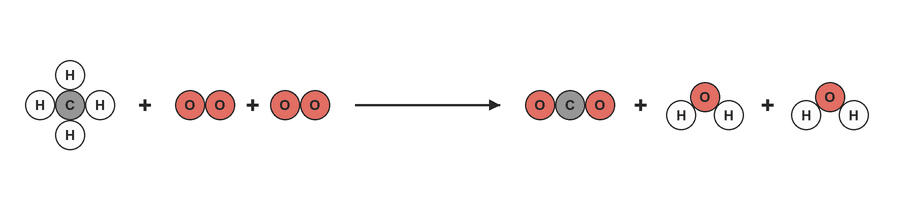
Which option gives the equation shown by her model and says correctly whether it is balanced?
- 251 mark
Question 25
Cognitive domain: Understanding
A fuel-testing laboratory finds that a gaseous hydrocarbon has the empirical formula and a relative molecular mass of 70. (C = 12, H = 1)
What is the molecular formula of the gas?
- 262 marks
Question 26
Cognitive domain: Understanding
Aluminium sulphate, , is used to treat muddy water, and calcium phosphate, , is a raw material for fertilisers. The valency of aluminium is 3, of sulphate is 2, of calcium is 2 and of phosphate is 3.
(a) For each of the two formulae, show that the total positive valency is equal to the total negative valency.
(b) A student writes aluminium sulphate as . Use the same idea to show that this formula cannot be correct.
- 272 marks
Question 27
Cognitive domain: Application
A toilet-bowl cleaner packet lists its main ingredient as sodium hydrogen sulphate, . Rahul notices that it has one hydrogen atom more than sodium sulphate, . The valency of sodium is 1.
(a) State the valency of the sulphate radical and of the hydrogen sulphate radical.
(b) Write the formula of aluminium hydrogen sulphate. The valency of aluminium is 3.
- 282 marks
Question 28
Cognitive domain: Analysis
A teacher explains that the oxygen we breathe is , while the ozone high in the atmosphere, which shields us from harmful rays of the Sun, is . Both are made of the same kind of atom only. (O = 16)
(a) Calculate the relative molecular mass of oxygen and of ozone.
(b) How many times is a molecule of ozone as heavy as a molecule of oxygen? Explain why the two have different masses although both contain only oxygen atoms.
- 292 marks
Question 29
Cognitive domain: Application
A gardener crushes cleaned eggshells into a fine powder and mixes it into the soil of a potted plant to add calcium. The powder is about 90 % calcium carbonate, , by mass, and the rest has no calcium. (Hypothetical data.) (Ca = 40, C = 12, O = 16)
(a) Find the mass of calcium carbonate in 5.0 g of the powder.
(b) Find the mass of calcium in 5.0 g of the powder.
- 302 marks
Question 30
Cognitive domain: Analysis
The black, magnetic mineral magnetite, which is used as an ore of iron, has the formula . The valency of oxygen is 2. The valency of iron is known to be 2 or 3 in its compounds.
(a) Find the total positive valency that the 3 atoms of iron must provide, and show that all three atoms cannot have the same whole-number valency.
(b) Show how iron atoms of valency 2 and valency 3 together can account for the formula.
- 312 marks
Question 31
Cognitive domain: Evaluation
In a quiz on a hydrogen-fuelled bus, the equation for the burning of hydrogen is shown as
A student reads it and says, "The equation shows that 2 g of hydrogen react with 1 g of oxygen to form 2 g of water." (H = 1, O = 16)
Evaluate the student's statement. Use the relative molecular masses to give the correct ratio of masses.
- 323 marks
Question 32
Cognitive domain: Application
Baking soda gives off a gas with an acid, and this is why it is added to dhokla batter to make it rise. For a school demonstration Anil puts 8.4 g of baking soda, , in a flask and adds 6.0 g of acetic acid, , the acid of vinegar. They react completely with a lot of fizzing, and the gas escapes into the air. (Hypothetical data.) The reaction is
(H = 1, C = 12, O = 16, Na = 23)
(a) Count the atoms of each element on both sides to show that the equation is balanced.
(b) Calculate the relative molecular mass of each of the five substances.
(c) 8.4 g of baking soda is one-tenth of its relative molecular mass in grams. Find the mass of carbon dioxide that escapes, and show that the mass of the products is equal to the mass of the reactants.
- 333 marks
Question 33
Cognitive domain: Analysis
A science teacher shows three fuel gases burning: methane, , in a kitchen burner, ethene, , and ethyne, (acetylene), in a welding torch. She says, "The flame becomes smokier as the percentage of carbon in the gas increases." (C = 12, H = 1)
(a) Calculate the relative molecular mass of each gas.
(b) Calculate the percentage of carbon in each gas, correct to one decimal place, and arrange the gases in the order of increasing percentage of carbon.
(c) Use your result to say which of the three gases should give the smokiest flame, according to the teacher's remark.
- 343 marks
Question 34
Cognitive domain: Analysis
A school stockroom register records salts with codes instead of formulae. M stands for the metal and A stands for the acid radical. The three codes are:
Code Pattern of the formula Salt 1 Salt 2 Salt 3 The salts in the stockroom are aluminium sulphate, calcium phosphate and magnesium sulphate.
(a) For salt 1 and salt 2, find the valency of M and of A from the subscripts.
(b) Match the three salts with the three codes.
(c) Explain why the formula of magnesium sulphate is not written as .
- 353 marks
Question 35
Cognitive domain: Application
At a dental check-up, Sunita's dentist says that some toothpastes contain stannous fluoride to protect teeth. At home, Sunita finds a table in her chemistry book showing that tin has valency 2 and valency 4. The valency of fluoride is 1 and that of oxygen is 2. The book uses the endings "-ous" and "-ic" and also Roman numerals in brackets.
(a) Write the formula of stannous fluoride.
(b) Write the formula of stannic oxide and its name using a Roman numeral.
(c) Write the name of in the "-ous" form and with a Roman numeral, and explain why a name must show which valency of tin is meant.
- 363 marks
Question 36
Cognitive domain: Analysis
In a school laboratory a teacher heats 1.27 g of fine copper turnings with an excess of sulphur powder in a hard-glass test tube. A black compound of copper and sulphur is formed. After cooling and removing the unreacted sulphur, the compound has a mass of 1.59 g. (Hypothetical data.) (Cu = 63.5, S = 32)
(a) Find the mass of sulphur that combined with the copper.
(b) Divide each mass by the atomic mass to find the ratio of the atoms of copper and sulphur.
(c) Write the empirical formula of the compound, and find the valency of copper in it if the valency of sulphur is 2.
- 374 marks
Question 37
Cognitive domain: Application
A doctor tells a Class 9 group that the human body is built mainly from a handful of elements. The table gives the approximate percentage by mass of six of them in an adult. She adds that bones and teeth get much of their hardness from calcium phosphate, and that the elements of this compound are also found elsewhere in the body. The students decide to compare the numbers in the table with what the formula of calcium phosphate tells them.
Element Percentage by mass in the body Oxygen 65 Carbon 18 Hydrogen 10 Nitrogen 3 Calcium 1.5 Phosphorus 1.0 (Ca = 40, P = 31)
(a) Write the symbol of each of the six elements in the table.
(b) Write the formula of calcium phosphate by the criss-cross method, and state the number of atoms of each element and the total number of atoms in one formula.
(c) In pure calcium phosphate, the ratio of the mass of calcium to the mass of phosphorus is 120 : 62. Compare this with the ratio in the table, and give a reason for the difference.
- 384 marks
Question 38
Cognitive domain: Application
In Meera's garden, the leaves of a mango tree make glucose, , from the carbon dioxide of the air and the water that the roots take up. The reaction takes place in sunlight with the help of chlorophyll, and oxygen is given out. Meera's teacher says that this is how a tree grows, because the glucose is used to build the plant's food and its body, and the oxygen that goes out into the air is what we breathe. Meera wants to check whether the numbers of atoms agree on both sides. The skeleton equation is
(H = 1, C = 12, O = 16)
(a) Balance the equation, and show the count of the atoms on both sides.
(b) Calculate the relative molecular mass of each of the four substances.
(c) In one experiment, the leaves of a small branch make 1.80 g of glucose. Find the masses of carbon dioxide and water used and of oxygen given out, and show that the total mass is conserved. (Hypothetical data.)
- 395 marks
Question 39
Cognitive domain: Evaluation
Hamid weighs a clean strip of magnesium ribbon and burns it in a crucible with its lid slightly open. A white powder, magnesium oxide, is left in the crucible. He weighs the powder after cooling. He repeats the test with four different masses of magnesium and plots the red line on the graph below. The next day, Sana burns 0.60 g of magnesium in the same way, collects 0.90 g of white powder, and marks her result on the same graph as the hollow circle S. (Hypothetical data.) (Mg = 24, O = 16)

(a) Read from the graph the mass of magnesium oxide formed from 0.72 g of magnesium, and find the mass of oxygen that combined with it.
(b) Find the relative molecular mass of and the percentage of magnesium in it. Show that the graph line agrees with this percentage.
(c) Find the mass of magnesium oxide that Sana should have got from 0.60 g of magnesium. Sana says, "The magnesium oxide I made must contain a different percentage of magnesium." Evaluate her statement and suggest one likely cause of her result.
- 404 marks
Question 40
Cognitive domain: Creativity
In a class game called "Name the metal", each team gets a clue card about a hidden metal M. Team Alpha's card reads: "My oxide has the formula and contains 52.9 % of the metal by mass." The teacher gives a list of three possible metals with their atomic masses: aluminium (Al = 27), chromium (Cr = 52) and iron (Fe = 56). The oxygen atom has an atomic mass of 16. Each team must find the metal and must then write a new clue card for the next team, using the same pattern.
(a) For each of the three metals, calculate the percentage of the metal in its oxide .
(b) Identify the hidden metal on Team Alpha's card.
(c) Create a similar clue card for calcium oxide, (Ca = 40), with the percentage of the metal in it, and say how another team can check the clue.