
Opening your dashboard
Class 9 Biology Chapter 3 Tissues: Plant and Animal Tissues: Competency-Based Questions (CBQ)
40 questions on Chapter 3, each worked through on its own page with the AI tutor. Class 9 Biology, ICSE 2026-27.
40 questions
1–5 marks · Mixed difficulty
- 11 mark
Question 1
Cognitive domain: Application
In the biology laboratory, Tanvi rinses her mouth and gently rubs the inside of her cheek with the blunt end of a clean ice-cream spoon. She spreads the scraping on a slide, stains it and looks at it under a microscope. She sees thin, flat cells with prominent nuclei. Which tissue has she taken, and what is its work in the mouth ?
- 21 mark
Question 2
Cognitive domain: Analysis
A tree was cut down to widen a road. The figure shows the cut face of its trunk.
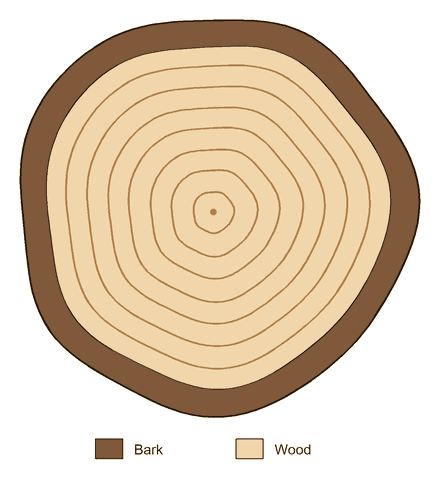
Each brown line in the wood marks one annual ring. Two students want to find the age of the tree from this face. What is the age of the tree, and which tissue forms the rings that are counted ?
- 31 mark
Question 3
Cognitive domain: Application
Little Pihu folds the upper part of her grandfather's external ear right over. As soon as she lets go, the ear springs back to its old shape. Nothing is broken and he feels no pain. Which tissue gives the external ear this property ?
- 41 mark
Question 4
Cognitive domain: Analysis
Kiran marked the young root of a germinating gram seed with fine ink lines mm apart, starting from the tip. This divided the root into four parts of equal length.
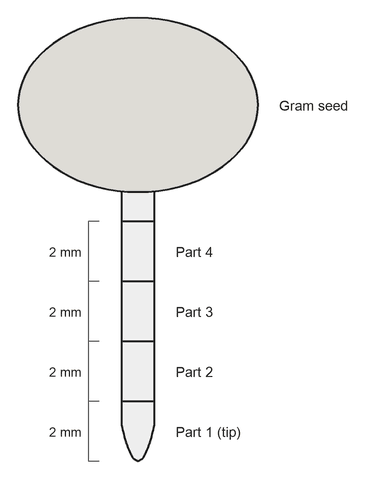
After two days she measured each part again.
Part of the root Length at the start Length after two days Part 1 (at the tip) 2 mm 8 mm Part 2 2 mm 3 mm Part 3 2 mm 2 mm Part 4 (farthest from the tip) 2 mm 2 mm Which conclusion is best supported by her results ?
- 51 mark
Question 5
Cognitive domain: Understanding
Assertion (A): A single nerve cell can carry a message all the way from a toe to the lower part of the backbone.
Reason (R): The axon of a nerve cell may be very long, sometimes as long as one metre.
- 61 mark
Question 6
Cognitive domain: Analysis
Assertion (A): In an old mango tree, most of the water going up to the leaves is carried by the oldest xylem, which forms the wood at the centre of the trunk.
Reason (R): Xylem provides for the upward movement of water and dissolved materials absorbed from the soil by the roots.
- 71 mark
Question 7
Cognitive domain: Application
Dev hammered a nail into the trunk of a young neem tree, m above the ground, to hang a bird-feeder. In the next 5 years the tree grew m taller and its trunk became thicker.
Complete the sentence :
The nail is now about ______ m above the ground, because a tree grows in height only at the ______ of its stem and branches.
- 81 mark
Question 8
Cognitive domain: Understanding
Ishaan says, "The tongue is a muscle, so the tongue is a tissue." His sister points out that the tongue has muscle cells to move it, nerve cells to carry messages and epithelial cells to cover it, all working together.
Complete the sentence :
A tissue is a group of ______ cells performing a specific function, so the tongue, in which several tissues work together, is an ______.
- 91 mark
Question 9
Cognitive domain: Application
Riya can feel a tough cord at the back of her leg, just above the heel. When she stands on tiptoe, the muscle of her calf contracts. The cord becomes tight and pulls up the heel bone.
Complete the sentence :
This cord is a ______, because it connects a ______ to a bone.
- 102 marks
Question 10
Cognitive domain: Evaluation
After a heavy lunch, Ravi says, "All muscles obey us. I move my arm when I want to. In the same way, if I decide, I can stop the muscles of my intestine from pushing the food along."
Is Ravi's claim correct ? Justify your answer by comparing the two muscles he mentions.
- 112 marks
Question 11
Cognitive domain: Evaluation
While studying plant tissues, Aarav remarks, "A dead cell cannot do any work. So a plant would be much better off if every one of its cells were living."
Judge Aarav's remark. Support your answer with two examples of tissues from the chapter.
- 122 marks
Question 12
Cognitive domain: Understanding
During the rains, Sana notices that drops of water roll off the leaves of a garden plant like beads and the leaf stays dry. At home she sees that a cork stopper keeps a bottle of vinegar tightly closed without soaking up the liquid.
Explain both observations. Name the category of permanent plant tissue involved, and say where on a plant such tissue is found.
- 134 marks
Question 13
Cognitive domain: Application
Case: Mr Salim works in a flour mill, where the air is full of fine flour dust. At a health camp, a doctor shows him a chart of the windpipe (trachea) and explains two things. First, the wall of the windpipe has rings of a tissue X, which is firm and yet elastic, and these rings keep the windpipe open. Second, the inner lining of the windpipe is a tissue Y, whose cells have thread-like projections at their free ends.
(a) Name tissue X. State two of its features given in your chapter, other than being elastic.
(b) Name tissue Y and its thread-like projections. Explain how tissue Y deals with the flour dust that enters the windpipe.
(c) The windpipe bends easily when Mr Salim turns or bends his neck, and it does not get crushed. Explain why tissue X suits the windpipe better than bone would.
(d) To which of the four main kinds of animal tissue do X and Y belong ?
- 145 marks
Question 14
Cognitive domain: Analysis
Case: Nisha cut a leafy stalk of a balsam plant, cm long, under water and stood it in a beaker of water coloured with red food colour. The stalk of balsam is almost transparent, so she could see the red colour rising in it. She noted the height reached by the colour every 10 minutes.
Time from the start 0 min 10 min 20 min 30 min Height reached by the red colour 0 cm 3 cm 6 cm 9 cm After an hour she cut across the stalk and looked at the cut end with a hand lens. The figure shows what she saw. Only the parts marked P were red.
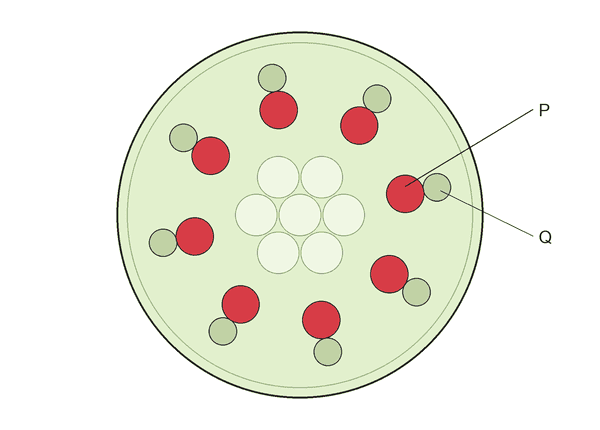
(a) Find the rate at which the colour rose in the stalk. What height would it have reached 50 minutes from the start ?
(b) Name the tissue P. Why did only this tissue become red ?
(c) The colour rose as an unbroken column. Explain how the structure of the vessels of tissue P makes this possible.
(d) Tissue Q lies next to P in every bundle but it was not coloured. Name tissue Q, and state what it carries and in which direction.
- 155 marks
Question 15
Cognitive domain: Creativity
Case: For the school science fair, Arnav's group has to build a large model of a short piece of the stem of a herb, showing its tissues. They have a thick cardboard tube, drinking straws, a kitchen sponge, toothpicks, a sheet of cling film, coloured paper and glue. The model must show the epidermis, the parenchyma, the sclerenchyma, the xylem and the phloem.
(a) Choose a material for each of the five tissues. Give the reason for each choice from the structure or the function of the tissue.
(b) Describe how the group should arrange these materials inside the cardboard tube.
(c) State two ways in which the model is not like a real stem, and suggest one improvement.
- 161 mark
Question 16
Cognitive domain: Application
Kabir looks at a thin lengthwise slice of the wood of a hibiscus twig under a microscope. He sees long tubes, each made of elongated cells placed end to end. The cells are dead and have no contents, their walls are hard, thick and lignified, and the cross walls between neighbouring cells have dissolved, so each tube is one continuous pipe. Which elements has he seen, and what is their job in the plant ?
- 171 mark
Question 17
Cognitive domain: Application
A thin section across a tiny, hollow tube of a mouse kidney shows that the wall of the tube is made of a single layer of cells. Each cell is about as tall as it is wide, like a small cube, and has a round nucleus in the centre. In which of the following would you expect to find the same kind of epithelium ?
- 181 mark
Question 18
Cognitive domain: Analysis
A student studied stained slides of four samples of animal tissue, W, X, Y and Z. She estimated what share of the area of each slide is taken up by the cells and what share by the non-living material between the cells (the matrix, with any fibres in it). (Hypothetical data.)
Sample Cells Matrix and fibres W X Y Z Which conclusion is best supported by the table ?
- 191 mark
Question 19
Cognitive domain: Understanding
Assertion (A): The parenchyma cells of a potato tuber can store starch.
Reason (R): Every parenchyma cell in a plant contains chloroplasts.
- 201 mark
Question 20
Cognitive domain: Analysis
Assertion (A): The food made in a leaf can pass from one sieve tube cell to the next along the phloem.
Reason (R): Companion cells are living parenchyma cells that lie closely associated with the sieve tube cells.
- 211 mark
Question 21
Cognitive domain: Application
Arjun, a Class 9 boy, weighs kg. According to your chapter, striated muscles make up about half of the body weight. Which option gives the mass of his striated muscles and a place in the body where such muscles are found ?
- 221 mark
Question 22
Cognitive domain: Analysis
A student cuts a thin slice of a three-year-old woody stem, like the one in your textbook, and lists the tissues she can name in it : cork, cambium, phloem, xylem and parenchyma. She says that all five are permanent tissues. Which of the following is true about her list ?
- 231 mark
Question 23
Cognitive domain: Evaluation
A chemical is sprayed on a young tree. It stops the cambium from dividing, but it does not harm the tips of the shoots. (Hypothetical situation.)
Statement 1: The tree can no longer grow taller.
Statement 2: The tree can no longer increase in girth.
Which option is correct ?
- 241 mark
Question 24
Cognitive domain: Analysis
A thin slice was cut across a nerve of a mouse's leg and stained. The figure shows what was seen : a large number of circles of nearly the same size, each with a small dark dot at its centre, packed closely inside one common covering.

Which statement describes the figure correctly ?
- 251 mark
Question 25
Cognitive domain: Application
While bathing, Latika scrubs the hard skin of her heels with a pumice stone. Fine, white flakes of dead skin come off, but the heels do not bleed. Which feature of the outer covering of the skin best explains why the scrubbing does not make them bleed ?
- 262 marks
Question 26
Cognitive domain: Application
Rhea pulls out the long, thin "strings" from a raw stalk of celery, which is a leaf stalk. She finds that the strings are tough, yet the stalk bends without snapping. Under a microscope, a slice of a string shows elongated living cells with walls thickened at the corners.
(a) Name the tissue that forms the strings.
(b) Give one reason why this tissue suits a leaf stalk better than sclerenchyma.
- 272 marks
Question 27
Cognitive domain: Application
A potato tuber forgotten in a dark cupboard grows pale shoots, and the tuber slowly shrinks and becomes soft. No green leaf has formed on the shoots yet.
(a) Which tissue of the tuber stored the food that the shoots are using ?
(b) Through which tissue does this food travel to the shoots, and in which direction ?
- 282 marks
Question 28
Cognitive domain: Evaluation
Tara's revision notes on animal tissues say : "Epithelial tissue covers only the outside of the body. All connective tissues are solid."
Find the two mistakes in these notes and correct each one with a suitable example.
- 292 marks
Question 29
Cognitive domain: Analysis
In a stained slide of an onion root tip, a student looked for cells in which chromosomes are visible, which means that the cell is dividing. She counted such cells out of cells in the tip. In a thin strip of the outer skin of a mature onion scale leaf, she found such cells out of . (Hypothetical data.)
(a) Find the percentage of dividing cells in the root tip.
(b) Name the kind of tissue in the root tip and the kind in the skin of the scale leaf, giving a reason for each.
- 302 marks
Question 30
Cognitive domain: Understanding
A footballer breaks a bone of his leg and also tears a piece of cartilage in his knee. The bone mends in about two months, but the torn cartilage heals very slowly. Using the features of the two tissues given in your chapter, explain why the two heal at such different speeds.
- 312 marks
Question 31
Cognitive domain: Evaluation
Ravi says : "The food passes through the mouth, the stomach and the intestine, so all three must have the same kind of lining."
Judge Ravi's statement. Name the epithelium that lines the mouth and the one that lines the stomach and the intestine, and give the work of each.
- 322 marks
Question 32
Cognitive domain: Analysis
A long fibre (axon) of a nerve cell of a mouse is cut cleanly away from its cell body in a laboratory.
(a) Which part of the nerve cell still contains the nucleus ?
(b) Predict whether the cut-off fibre can go on living as a complete nerve cell, and give a reason.
- 333 marks
Question 33
Cognitive domain: Application
When a leaf lies in damp soil for many weeks, its soft parts rot away and only a fine, stiff net of veins is left, called a leaf skeleton.
(a) Name one tissue of the veins whose cells have thick, lignified walls, and which therefore stays behind.
(b) Name the tissue of the leaf that carried out photosynthesis. Why does it rot away first ?
(c) A fresh leaf is called an organ. Explain why.
- 343 marks
Question 34
Cognitive domain: Analysis
At a health camp, a laboratory counted the cells in mm of blood from two people. Person B had a fever and a sore throat. (Hypothetical data.)
Cells in mm of blood Person A Person B Red blood cells White blood cells Platelets (a) For each person, find how many red blood cells there are for each white blood cell, to the nearest whole number.
(b) Which kind of cell shows a clear difference, and by how many times ?
(c) Suggest why person B has this difference.
- 353 marks
Question 35
Cognitive domain: Creativity
A teacher gives four unlabelled slides of animal tissues : squamous epithelium, cartilage, striated muscle and nerve tissue. Design a simple identification key, made of yes / no questions, with which a student can tell the four tissues apart. Draw it as a flow chart or write it as numbered questions, and make sure every tissue is reached by a different path.
- 363 marks
Question 36
Cognitive domain: Application
Case: A camel can walk for days in a hot desert with very little food. Its hump holds a large mass of adipose tissue, while the rest of its body has only a thin layer of this tissue under the skin.
(a) What does adipose tissue store ?
(b) After many days without food the hump of a camel becomes small and soft. Explain why.
(c) Adipose tissue also acts as insulation and retains body heat. Explain why it is useful to the camel to keep most of this tissue in one hump instead of spreading it all over the body.
- 375 marks
Question 37
Cognitive domain: Analysis
Case: A school measured a neem tree in its garden every years. The height of the tree and the girth of its trunk (the distance round the trunk) at m above the ground are in the table. (Hypothetical data.)
Age of the tree Height Girth years m cm years m cm years m cm years m cm (a) Find the average increase in height per year, and the average increase in girth per year, between the ages of and years.
(b) Name the meristem responsible for each of these two kinds of growth, and say where it lies.
(c) Suppose the girth goes on increasing at the same average rate as between and years. Predict the girth at the age of years, and name the tissue that the cambium adds each year towards the inside of the trunk, which forms the wood.
- 385 marks
Question 38
Cognitive domain: Analysis
Case: A Class 9 group measured how quickly a student can catch a falling ruler. One student held a cm ruler upright, with its cm mark level with the top of her partner's open fingers. She dropped it without warning, and the partner caught it as fast as she could. The distance the ruler fell before it was caught was noted. The same student did five trials, and the distances were cm, cm, cm, cm and cm. (Hypothetical data.)
The time , in seconds, for which the ruler fell is given by , where is the distance in metres and m s.
(a) Find the mean distance and the reaction time of the student, to two decimal places.
(b) Name the tissue that carried the message from the eye to the hand, and the kind of muscle that closed the fingers. State whether the muscle is under the control of the student's will.
(c) After a long game, the same student's five distances had a mean of cm. Find the new reaction time, and give one reason, from the tissues of this chapter, why her reaction might have become slower.
- 394 marks
Question 39
Cognitive domain: Evaluation
Case: Meena made a table of tissues for revision. Her teacher marked three of the six entries as wrong.
No. Tissue Meena's note Chlorenchyma Parenchyma with chloroplasts ; helps the leaf to make food. Stratified epithelium A single layer of tall cells that lines the stomach. Lymph A fluid that contains both red and white blood cells. Collenchyma Living cells with walls thickened at the corners ; supports young stems. Phloem fibres Carry food from the leaves to the roots. Adipose tissue Stores fat and forms padding under the skin and around the kidneys. (a) Which three entries were marked wrong ?
(b) Correct each of the three wrong entries.
(c) Entry mixes up two epithelia. Name the epithelium that has one layer of tall cells and say where it is found, and say how many layers stratified epithelium has and where it is found.
- 404 marks
Question 40
Cognitive domain: Creativity
Case: A carrot plant makes sugar in its leaves, and part of it is stored as food in its root. A student decides to tell the story of one sugar molecule and one water molecule, as a short diary written by the sugar.
(a) Name, in order, the three plant tissues that the sugar molecule passes through, from the place where it is made to the place where it is stored.
(b) Write a diary of four or five sentences from the point of view of the sugar molecule. Name each tissue in your diary and say what makes the journey possible.
(c) Add one more line in which the sugar meets a water molecule travelling in the opposite direction, and say how the tissue of the water molecule differs from the tissue of the sugar molecule.