
Opening your dashboard
Class 9 Biology Chapter 18 Health Organisations: Competency-Based Questions (CBQ)
40 questions on Chapter 18, each worked through on its own page with the AI tutor. Class 9 Biology, ICSE 2026-27.
40 questions
1–5 marks · Mixed difficulty
- 11 mark
Question 1
Cognitive domain: Application
In a village, everyone drinks water from a deep hand-pump. A laboratory tested the water and found no disease-causing germs in it. The water is clear and the area around the pump is kept clean. Yet many villagers who have used this water for years have the same health problem. Which is the most likely cause ?
- 21 mark
Question 2
Cognitive domain: Analysis
Two lanes of the same colony get the same treated tap water. A health worker recorded the cases of diarrhoea in one month.
Lane People living there What was seen Cases of diarrhoea P 300 Cut fruit and sweets sold uncovered; an open garbage heap nearby 45 Q 300 Food stalls keep food covered; garbage removed daily 9 Which conclusion is best supported by the data ?
- 31 mark
Question 3
Cognitive domain: Application
In a remote block of a hill district, most babies are born at home, and there is no trained person to help the mother during childbirth. The district officer wants help from an organisation whose regular activities already cover this need. Which choice is correct ?
- 41 mark
Question 4
Cognitive domain: Analysis
The table gives the number of cases of two diseases reported in a country over five years.
Year Disease X Disease Y 2019 212 0 2020 205 0 2021 219 3 2022 208 4800 2023 214 35 All the cases of disease X came from the same hill district every year. In 2022, the cases of disease Y came from 14 districts of three states. The WHO organises campaigns for the control of both kinds of diseases. How should X and Y be described ?
- 51 mark
Question 5
Cognitive domain: Understanding
Assertion (A): Diarrhoea, typhoid and dysentery are very common in areas that are deficient in proper water supply.
Reason (R): At many places, the water from hand-pumps and other sources is contaminated.
- 61 mark
Question 6
Cognitive domain: Analysis
Assertion (A): A family living in a clean multi-storeyed building of a big city faces no risk at all from the unhygienic conditions of a slum on the outskirts of the same city.
Reason (R): Lack of general cleanliness leads to the breeding of houseflies, mosquitoes and other insects which cause diseases.
- 71 mark
Question 7
Cognitive domain: Understanding
A ship reaches a port from a country where plague has broken out. One sailor has fever and swellings. The port health officer does not let him go into the town. He is kept and treated in a separate ward, away from other people, until the doctors declare him free of the disease. The other sailors, who are well, are examined and allowed to go.
Complete the sentence :
The step taken for the sick sailor is called ______, and it was taken mainly to prevent the ______ of the disease to others.
- 81 mark
Question 8
Cognitive domain: Application
During Road Safety Week, Red Cross volunteers visit a school. On Monday they show the students how to cross a busy road and why a helmet must be worn. On Friday there is a crash outside the school gate, and the same volunteers bandage the injured riders.
The main function of the Red Cross is to perform activities which should prevent or remove human sufferings. Complete the sentence :
Monday's work is meant to ______ human suffering, while Friday's work is meant to ______ it.
- 91 mark
Question 9
Cognitive domain: Application
Rhea visits two places in her holidays. In the first place, a small population lives mainly by agriculture, dairies and poultry farming. In the second place, tribal people live on forest products, and there is neither proper drinking water nor any medical facility.
Complete the sentence :
Out of the five types of habitations in India, the first place is a ______ and the second place is a ______.
- 102 marks
Question 10
Cognitive domain: Evaluation
A town on the bank of a river is short of funds. A council member says, "Let us pour the town's sewage straight into the river without treating it. The river flows away from our town, so it will harm nobody."
Evaluate this decision. Give two reasons for your answer.
- 112 marks
Question 11
Cognitive domain: Understanding
Scientists in a rich country work out a better way of using a vaccine against a children's disease. A poor, developing country has many children with this disease, but it has no research laboratory of its own.
Explain how the WHO makes it possible for the children of the second country to benefit from this discovery. Refer to one reason for the formation of the WHO and one of its activities.
- 122 marks
Question 12
Cognitive domain: Evaluation
In a class discussion, Aryan says, "The Red Cross was started for wars. When there is no war, the Red Cross has nothing to do, so it is not needed in peace-time."
Do you agree with Aryan ? Justify your answer with two points.
- 135 marks
Question 13
Cognitive domain: Analysis
Case: A slum-dwelling of about 1200 people lies on the outskirts of a big city. The people drew water from a hand-pump that stood beside an open drain. Garbage lay in heaps, and rain water stood in pits. A health team recorded the number of cases in one month (Survey 1). Then two steps were taken, one after the other, and the cases were recorded again after each step.
- Step 1 : The hand-pump was closed and safe, treated tap water was supplied.
- Step 2 : The drain was covered, the garbage was removed daily and the pits were filled.
Survey Cases of diarrhoea, dysentery and typhoid Cases of malaria 1 (before any step) 90 55 2 (after Step 1) 18 54 3 (after Step 2) 15 11 (a) Calculate the percentage fall in the cases of diarrhoea, dysentery and typhoid from Survey 1 to Survey 2. Why did Step 1 bring about this fall ?
(b) The cases of malaria hardly changed after Step 1. Explain why.
(c) By how many did the cases of malaria fall after Step 2 ? Explain how Step 2 brought about this fall.
(d) What do these results tell a health planner about tackling the health problems of such a colony ?
- 144 marks
Question 14
Cognitive domain: Application
Case: A fire breaks out late in the evening at a crowded village fair. Many stalls are burnt. Dozens of people have burns and other injuries, and some have lost all their goods. The nearest hospital is 30 km away, and it soon reports that it is running short of blood. A unit of the Indian Red Cross Society reaches the fair ground.
(a) State two things the Red Cross unit will do for the injured people at the fair ground itself and on the way to the hospital.
(b) How can the Red Cross help with the problem reported by the hospital ?
(c) Some of the injured are traders from another state. A bystander shouts, "Help our own villagers first !" Using what you know about the work of the Red Cross on battlefields, explain how the volunteers should respond.
(d) A month later, the fair committee asks the Red Cross how such suffering can be avoided next year. Which activity of the Red Cross answers this request ?
- 155 marks
Question 15
Cognitive domain: Creativity
Case: Your school is holding a "Model WHO" day. Your team has to put up a display that shows visitors how the WHO deals with an outbreak. You choose this story : cholera breaks out in a member country, and the WHO helps to stop it from spreading to the neighbouring countries.
(a) Design a flow chart with at least four boxes and arrows to show how the news of the outbreak travels and what it leads to.
(b) Design a campaign poster for the people of the affected area. Give it a slogan and three short messages based on what you have learnt about how such a disease spreads and is controlled.
(c) Suggest one more exhibit for your display that shows a different activity of the WHO, and say what the visitor will learn from it.
- 161 mark
Question 16
Cognitive domain: Analysis
The out-patient register of a city clinic for one day is summarised below. (Hypothetical data.)
Illness seen Patients Diarrhoea 30 Typhoid 12 Dysentery 18 Malaria 27 Dengue 18 Fracture 15 Other illnesses 30 Total 150 What percentage of the patients had an illness that belongs to the group of food and water-borne diseases ?
- 171 mark
Question 17
Cognitive domain: Understanding
A severe earthquake destroys many homes in a country. Within days, Red Cross volunteers and blood supplies reach the area from several other countries, and they work together with the Red Cross society of that country. Which statement explains how this is possible ?
- 181 mark
Question 18
Cognitive domain: Application
After an accident at a nuclear power plant in one country, doctors in many other countries want reliable and up-to-date guidance about the effect of radiation on human health. Which activity of the WHO is mainly meant to meet this need ?
- 191 mark
Question 19
Cognitive domain: Analysis
Assertion (A): The headquarters of the WHO are located in New Delhi, because the WHO has a regional office in that city.
Reason (R): The WHO has six regional offices in the world, including one in Delhi.
- 201 mark
Question 20
Cognitive domain: Understanding
Assertion (A): The health problems of the five types of habitations in India differ from one kind of habitation to another.
Reason (R): The health problems of different habitations cannot be grouped into any common categories.
- 211 mark
Question 21
Cognitive domain: Evaluation
A town recorded 96 road accidents in the year before a Red Cross unit started road-safety classes for school children and drivers, and 60 in the year after the classes. (Hypothetical data.) The volunteers say that their classes brought the number down. Which conclusion is best supported by these data ?
- 221 mark
Question 22
Cognitive domain: Analysis
Country M finds cases of plague, but its officials keep the news secret for three weeks so that tourists do not stop coming. The neighbouring countries learn about the disease only when many of their own people fall ill. Which statement describes the effect of M's silence ?
- 231 mark
Question 23
Cognitive domain: Analysis
In a school hostel, 40 students fall ill with loose motions and fever within two days. The warden thinks the cause is the drinking water, while the cook thinks it is mosquitoes. Which observation would best support the warden and not the cook ?
- 241 mark
Question 24
Cognitive domain: Understanding
Health is one of the primary concerns of all the governments of the world. They take steps individually at the national level and also collectively at the global level. Which of the following is a step taken collectively at the global level ?
- 251 mark
Question 25
Cognitive domain: Evaluation
A student writes in a school magazine : "The WHO works for the health of the people of the whole world. So the Red Cross is not needed, and the WHO should replace it." Which is the best evaluation of this statement ?
- 262 marks
Question 26
Cognitive domain: Analysis
In a big city, many new multi-storeyed buildings come up in one colony, but the old underground sewer of the colony is not made larger. During a heavy rain the sewer overflows, and pools of dirty water stand in the lanes and around the hand-pumps for more than a week.
Explain two ways in which this can make the people of the colony ill, naming the group of diseases in each case.
- 272 marks
Question 27
Cognitive domain: Application
A new volunteer is given this list of jobs and is told that two of them belong to the WHO and not to the Red Cross.
(1) Tying a splint on a fractured arm after a road accident.
(2) Fixing the purity and the size of the dose of a standard painkiller.
(3) Taking blood to a hospital after a fire.
(4) Telling doctors in all countries about the latest findings on the use of a vaccine.
Pick the two jobs that belong to the WHO and name the WHO activity in each case.
- 282 marks
Question 28
Cognitive domain: Analysis
Two brands of the same painkiller tablet are sold in many countries. Every tablet of brand X has the same dose and is free from impurities. In brand Y, the dose of the tablets in a single strip varies a great deal, and some tablets contain impurities. (Hypothetical data.)
(a) State two problems that brand Y can cause to patients.
(b) Why is it useful that a world body, and not each country on its own, lays standards for such drugs ?
- 292 marks
Question 29
Cognitive domain: Evaluation
The committee of a colony collects money and builds a large new tank, so that every house gets water the whole day. The tank is filled directly from a nearby pond without any treatment, and nothing else is done. The chairman says, "Now our health problems are over."
Evaluate this claim. Give two points.
- 302 marks
Question 30
Cognitive domain: Understanding
Four statements about the two health organisations are given below. Two of them are wrong.
(1) The emblem of the Red Cross Society is a white cross painted on a red background.
(2) The WHO has twelve regional offices in the world.
(3) Red Cross Day is celebrated on 8 May.
(4) The WHO was established in 1948.
Identify the two wrong statements and write each correctly.
- 312 marks
Question 31
Cognitive domain: Evaluation
A town on a busy highway had 52 road accident victims last year. 14 of them died on the way to the hospital because no vehicle was available to carry them quickly. All the births in the town take place in a well-staffed maternity hospital. (Hypothetical data.)
A Red Cross unit can start only one new service in the town : an ambulance service for all emergencies, or training of midwives. Which should it choose ? Give two reasons based on the data.
- 323 marks
Question 32
Cognitive domain: Understanding
A health worker's list of illnesses seen in a village during the monsoon : typhoid, malaria, dysentery, dengue, gastroenteritis.
(a) Put the illnesses into the two groups of common health problems.
(b) State one reason for the spread of each group.
(c) Why can the use of safe water alone not stop all the illnesses in the list ?
- 333 marks
Question 33
Cognitive domain: Analysis
An outbreak of a new infectious disease, which spreads from person to person through coughs and sneezes, is followed through the following events. (Hypothetical data.)
Day Event 0 The first cases appear in country P. 2 Country P informs the WHO. 3 The WHO sends an alert to the neighbouring countries Q and R. 4 Q and R start checking travellers at their border posts. Ill travellers are kept apart in hospital, and the people who sat near them are kept apart for some days and watched. 9 The first patient reaching Q from P is found at a border post and kept apart in hospital. (a) Name the WHO activities seen on Day 3 and on Day 4.
(b) How many days passed between Day 3 and the finding of the first patient in Q ?
(c) Explain why it was important that the checks in Q began before that patient arrived.
- 343 marks
Question 34
Cognitive domain: Application
A Red Cross unit writes this report about a bus accident on a highway :
"We gave first-aid to the injured at the spot. We took the seriously hurt people to hospital in our ambulance. We arranged blood for those who had lost much blood. The next month we talked to the bus drivers of the town about safe driving."
(a) Write the Red Cross activity for each of the four sentences of the report.
(b) Which sentence is an effort to prevent future suffering ?
(c) Name one more activity of the Red Cross that is not mentioned in the report.
- 353 marks
Question 35
Cognitive domain: Application
Dr Rao in Delhi and Dr Ouma in a laboratory of another country are each studying a different part of the causes of cancer. Neither laboratory has enough staff to complete the work quickly.
(a) Name the WHO activity that can help them.
(b) Explain how the combined efforts of many countries give better results.
(c) Dr Rao's director suggests that the cancer study should instead be handed over to the National Institute of Communicable Diseases (NICD), Delhi. Is this institute the right body for the study ? Give a reason from the chapter.
- 363 marks
Question 36
Cognitive domain: Evaluation
A tribal hamlet deep in a forest has neither proper drinking water nor any medical facility. A donor offers funds for one project to be started first : (1) a protected well with a hand-pump and regular cleaning, or (2) a small dispensary with a nurse.
(a) Which project should be started first ? Give two reasons.
(b) Why should the other project also be taken up soon ?
- 374 marks
Question 37
Cognitive domain: Analysis
Case: A health team surveyed five sources of drinking water in a block and counted the cases of diarrhoea, dysentery and typhoid among the people using each source in one monsoon month. The bar graph shows the cases per 1000 people. (Hypothetical data.)
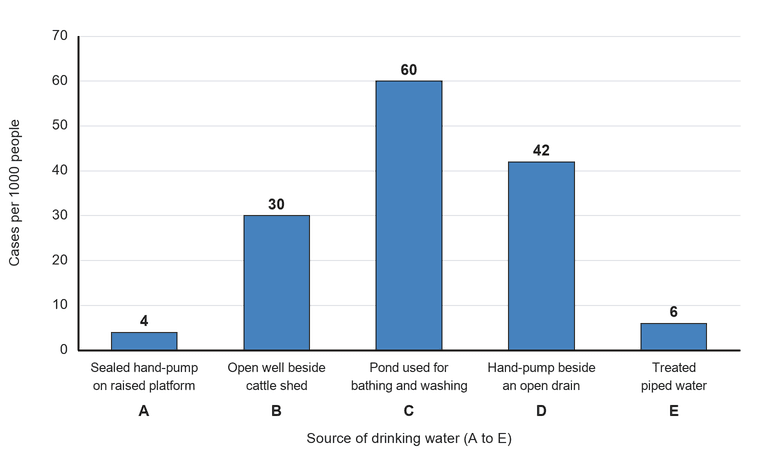
(a) Which source A to E had the highest number of cases per 1000 people ? How many times the number for source E is this number ?
(b) Sources D and A are both hand-pumps. Why do they differ so much in the number of cases ?
(c) Source D serves 500 people. It is replaced by a hand-pump like source A. Assume that the cases among its users then fall to the rate of source A. How many fewer cases will there be in a similar month ?
- 384 marks
Question 38
Cognitive domain: Application
Case: A strong earthquake hits a mountain region in a country next to India. Many houses fall, and many of the injured are women and children. The Indian Red Cross Society joins a team of Red Cross volunteers from several countries. A local agency, which is not a part of the Red Cross, asks to paint the Red Cross emblem on its trucks so that they can pass the checkpoints quickly.
(a) Why can the Red Cross volunteers of different countries work together here ?
(b) Write two activities, from the major activities of the Red Cross, that the team will carry out for the injured.
(c) Should the volunteers agree to the request of the local agency ? Give a reason.
- 394 marks
Question 39
Cognitive domain: Analysis
Case: Cholera breaks out in country A. In the second week the WHO sends information about the outbreak to the neighbouring countries B and C. Country B at once joins a WHO campaign against cholera: its water supplies are treated with chlorine, people are told to drink boiled water and wash their hands, and patients are treated early with ORS. Country C takes no special step. The table shows the new cases in each country in four weeks. (Hypothetical data.)
Week Country A Country B Country C 1 20 0 0 2 85 1 3 3 160 4 24 4 150 3 90 (a) In which week was the number of new cases highest in country A ? Find the total cases in four weeks in country B and in country C.
(b) Name two WHO activities that helped country B, and say how each helped.
(c) How many more cases did country C have than country B ? What does the table suggest about acting on the information sent out by the WHO ?
- 405 marks
Question 40
Cognitive domain: Creativity
Your school has been asked to prepare a radio message of about 70 words for villagers, to be broadcast before the monsoon.
(a) Write the message. It must warn about both groups of common health problems and give one simple step for each.
(b) Underline or name the part of your message that deals with each group.
(c) Add one sentence that tells the villagers that the Red Cross or the WHO can help, and say which activity of that organisation you mean.
(d) Say why such a message is useful for the people of villages in India.