
Opening your dashboard
Class 9 Biology Chapter 16 Diseases: Cause and Control: Competency-Based Questions (CBQ)
40 questions on Chapter 16, each worked through on its own page with the AI tutor. Class 9 Biology, ICSE 2026-27.
40 questions
1–5 marks · Mixed difficulty
- 11 mark
Question 1
Cognitive domain: Application
Arif is bitten on the leg by a stray dog while walking home from school. Four neighbours give four different pieces of advice. Which advice should his family follow ?
- 21 mark
Question 2
Cognitive domain: Analysis
The three maps show the same state, which has six districts. Each dot stands for one case of a disease. A different disease is shown on each map.

A health officer adds these notes :
- Map X : the cases are found year after year, always in this one district.
- Map Y : the disease broke out this month and is spreading from one district to its neighbours.
- Map Z : there are only a few scattered individual cases.
Which option names the kind of disease shown on each map correctly ?
- 31 mark
Question 3
Cognitive domain: Analysis
About forty guests ate at a wedding feast on Sunday night. By Tuesday morning, many of them had vomiting and loose motions. A local newspaper called it "an outbreak of typhoid". The doctor treating the guests did not agree, and pointed to this table.
Disease Incubation period Cholera A few hours to 6 days Typhoid 7 to 14 days Which statement best supports the doctor ?
- 41 mark
Question 4
Cognitive domain: Application
During an outbreak of a disease in a town, the health department passes three orders : cut fruits may not be sold in the open, all cooked food in eating places must be kept covered, and flies must be killed. On the basis of its transmitting agents, this disease is most likely to be :
- 51 mark
Question 5
Cognitive domain: Understanding
Assertion (A): In the laboratory, viruses are cultured on living tissue.
Reason (R): Viruses can be crystallized and stored on the shelf.
- 61 mark
Question 6
Cognitive domain: Analysis
Assertion (A): A person who looks and feels perfectly healthy can still pass on HIV to others.
Reason (R): The incubation period of AIDS may be more than 10–12 years, and during this period the infected person is HIV-positive.
- 71 mark
Question 7
Cognitive domain: Understanding
Several students of a hostel have diarrhoea with griping pain, and they pass mucus and sometimes blood in their stools. The doctor finds that the cause is not a bacterium but a kind of amoeba. The warden then notices that the cooked food in the mess is left uncovered and that flies sit on it.
Complete the sentence :
The amoeba has been destroying the lining of the ______ intestine of these students, and it most probably reached them through food contaminated by ______.
- 81 mark
Question 8
Cognitive domain: Application
Kabir sat next to a classmate on 1 March. The next day that classmate was found to have COVID-19. On 6 March Kabir is still well, and his mother says, "Symptoms mostly appear in about five days. Five days are over, so he is safe."
Complete the sentence :
Kabir cannot be called safe before about ______ March, because the incubation period of COVID-19 can be as long as ______ days.
- 91 mark
Question 9
Cognitive domain: Application
A fisherman from a coastal village has had fever with chills several times. Over the years one of his legs has become so swollen that it looks like the leg of an elephant. His village has many stagnant drains full of mosquitoes.
Complete the sentence :
His leg is swollen because tiny worms have blocked the circulation of ______ in it, and these worms were passed into his body by the bite of the ______ mosquito.
- 102 marks
Question 10
Cognitive domain: Evaluation
Eight-year-old Tina has chicken pox. Watery blisters cover her chest and back, and some of them have started drying into scabs. Her aunt says, "Prick the blisters so that the water comes out and they heal faster. And as the blisters are drying, send her back to school tomorrow."
Evaluate both parts of the aunt's advice.
- 112 marks
Question 11
Cognitive domain: Application
Two brothers share a small room with their father, who has tuberculosis. Both breathe the same air. The elder brother eats well and is strong, and he stays healthy. The younger brother has been weak and under-nourished for a long time, and he develops tuberculosis.
Explain why only one of the two brothers fell ill, although both were exposed to the germs.
- 122 marks
Question 12
Cognitive domain: Understanding
In a village in the sub-Himalayan region, many people have goitre. A new teacher posted to the village is afraid to sit close to her neighbours. "So many people here have it," she says. "I am sure to catch it from them." The health worker tells her that no germ of any kind is involved in goitre.
Explain why her fear is not justified, although the disease is so common in that village. In your answer, name the category to which goitre belongs on the basis of communicability, and its category on the basis of the extent of occurrence.
- 135 marks
Question 13
Cognitive domain: Analysis
Case: In one month, several people of a small town fell ill with typhoid. A health team grouped the affected neighbourhood by the milk that the families used. The team also learnt that the man who milks the cows at Dairy X had recovered from typhoid two months earlier and now feels perfectly well.
Group Milk used Number of persons Cases of typhoid P Dairy X, boiled before use 150 3 Q Dairy X, used without boiling 120 36 R Dairy Y, used without boiling 100 1 (a) Calculate the percentage of persons who got typhoid in each group.
(b) Which milk appears to be the source of the infection ? Give the evidence from your calculation.
(c) Groups P and Q used milk from the same dairy. Account for the difference between them.
(d) The milkman of Dairy X feels perfectly well. Explain how he could still be the source of the germs. State two measures that reduce the chances of typhoid in the town.
- 144 marks
Question 14
Cognitive domain: Evaluation
Case: In a village, pigs roam freely and feed near the fields that people use as open toilets. Pork is a common food there and is often eaten only lightly roasted. Many villagers have become very weak although they eat well, and they notice small, flat, white segments in their faeces. The village health committee proposes four steps :
- Step 1 : Eat pork only after cooking it thoroughly.
- Step 2 : Build toilets, so that human faeces do not lie in the open where pigs feed.
- Step 3 : Spray insecticide to kill all mosquitoes.
- Step 4 : Give BCG vaccination to everyone.
(a) Name the disease and the organism that causes it. Why do the patients become weak ?
(b) Judge steps 1 and 2. Will they help to control this disease ? Give the reason for each.
(c) Judge steps 3 and 4. Will they help to control this disease ? Give the reason for each.
- 155 marks
Question 15
Cognitive domain: Creativity
Case: The Class 9 Health Club wants to show the junior classes how quickly an infectious disease that spreads by contact can pass through a group, and how simple precautions slow it down. The club plans a harmless classroom activity with 20 volunteers. One volunteer, the "first patient", gets a little dry wheat flour (atta) rubbed on the palm of the right hand to stand for the germs. The others do not know who it is. Everyone then walks about and shakes hands.
(a) Plan the activity in clear steps, in two rounds — one without any precaution and one with a precaution of your choice. State what will be counted in each round.
(b) Draw a table in which the club can record the results.
(c) What result do you expect, and what will it show ? State one way in which this model is not like a real disease.
- 161 mark
Question 16
Cognitive domain: Understanding
Four children were examined at a school health camp. Which one of them has a disease, according to the meaning of disease given in this chapter ?
- 171 mark
Question 17
Cognitive domain: Application
The Class 9 Health Club makes a calendar of talks. Each date must be matched with the topic that this chapter links to it. Which entry is matched correctly ?
- 181 mark
Question 18
Cognitive domain: Application
A small village clinic has four medicines in stock: streptomycin, chloromycetin, quinine and melarsoprol. Four patients arrive.
- P has had a cough for many weeks, with blood in the mucus and loss of weight.
- Q has a fever that rises every afternoon, and reddish eruptions on the chest and abdomen.
- R has chills and high fever that return on every third or fourth day.
- S came back from a tsetse-fly area and is confused and cannot sleep.
Which row gives the medicine that best suits P, Q, R and S in this order ?
- 191 mark
Question 19
Cognitive domain: Analysis
Two patients in a hospital both have jaundice, with deep yellow urine and light-coloured stools.
- Ravi ate at a roadside stall. His first symptoms came days later.
- Meena was given blood in a hospital. Her first symptoms came weeks later.
A doctor uses these facts about two kinds of hepatitis :
Disease Incubation period Mainly spread by Hepatitis A to days contaminated food Hepatitis B to weeks contaminated syringes, transfusion equipment and blood Which row is the most likely diagnosis ?
- 201 mark
Question 20
Cognitive domain: Analysis
A doctor in a tropical village clinic sees three patients.
- X has swollen legs, and had fever with chills from time to time.
- Y has long round worms in the intestine; he often eats raw vegetables grown in a field that is used as an open toilet.
- Z passes small, flat, white segments in his faeces; he often eats lightly cooked pork.
Which row gives the disease of X, Y and Z and the way each most probably got it ?
- 211 mark
Question 21
Cognitive domain: Analysis
Assertion (A): COVID-19 is a communicable disease that spread as a pandemic.
Reason (R): COVID-19 is caused by the virus SARS-CoV-2, which passes from person to person through droplets in the air, and it spread all across the globe.
- 221 mark
Question 22
Cognitive domain: Understanding
Assertion (A): Streptomycin is a very effective medicine for curing chicken pox.
Reason (R): Streptomycin acts on bacteria, and chicken pox is caused by a virus, Varicella zoster.
- 231 mark
Question 23
Cognitive domain: Evaluation
The bar chart shows the number of cases of a fever reported each year in District D. (Hypothetical data.)

In 2023 a newspaper wrote, "The fever has become a pandemic in District D." Which reply is best supported by the chart and by this chapter ?
- 241 mark
Question 24
Cognitive domain: Application
Baby Zoya is months old. Her doctor advises a vaccine that contains live but weakened Varicella virus, so that her body will build its own defence in advance. Which statement is correct ?
- 251 mark
Question 25
Cognitive domain: Analysis
On World Rabies Day a teacher tells the class how Louis Pasteur treated a boy who had been badly bitten by a mad dog. He gave the boy injections of weakened germs up to the th day. A student asks, "The boy had already been bitten, so why did the injections still protect him ?" The incubation period of rabies is about month. Which is the best answer ?
- 262 marks
Question 26
Cognitive domain: Understanding
On 2 July Dev played carrom with a friend who had chicken pox. Droplets from the friend carried the Varicella virus to Dev. Dev felt perfectly well until 18 July, when a pink spot appeared on his chest and soon became a watery blister.
Name the term used for (i) the Varicella virus, as a disease-causing organism, (ii) the passing of the virus from the friend to Dev, and (iii) the period from 2 July to 18 July. Find the length of the period in days and say whether it agrees with the to days given for chicken pox in the table of incubation periods.
- 272 marks
Question 27
Cognitive domain: Evaluation
At a free medical camp in a village, only two syringes are available for injections. The organiser says, "We will rinse the syringe in plain water after each person. A needle is so thin that no germ can pass from one person to another through it."
Evaluate the organiser's statement.
- 282 marks
Question 28
Cognitive domain: Application
Karan's friend Vir has hepatitis. His urine is deep yellow, his stools are light coloured, and he has a fever and no appetite. Karan helps to nurse him at home.
(i) Name the organ that the virus has attacked, and state what Vir should do about rest.
(ii) State one hygiene step that Karan should follow after helping him, with the reason for it.
- 292 marks
Question 29
Cognitive domain: Analysis
In a tsetse-fly area two patients come to a clinic, and tests show that both have sleeping sickness. Patient 1 has fever, headache, itchiness and joint pains. Patient 2 is confused, has poor coordination and numbness, and has trouble in sleeping.
(i) Which patient is in the more dangerous phase of the disease ? Name this phase.
(ii) Why is the disease called sleeping sickness ?
- 302 marks
Question 30
Cognitive domain: Application
A district health officer receives two reports.
- Report 1: A disease has broken out and spread from one town to dozens of other places within a week.
- Report 2: A fever rises in a village every monsoon, and the doctors say that a mosquito carries it.
(i) For Report 1, which basis of classification tells the officer how big a relief effort to plan ? Name the category that fits the report.
(ii) For Report 2, which basis of classification tells him what kind of control to choose ? Name the control step.
- 312 marks
Question 31
Cognitive domain: Evaluation
A poster outside a clinic reads, "Wear a mask and you are safe from tuberculosis, COVID-19, malaria and taeniasis."
Evaluate the poster by stating against which of the four diseases a mask can help and against which it cannot, with a reason for each group.
- 323 marks
Question 32
Cognitive domain: Analysis
Two patients at a clinic have diseases caused by protozoa.
Patient P Patient Q Main complaint Diarrhoea with griping pain; mucus and sometimes blood in the stools Chills and high fever that return on every third or fourth day Where the patient lives A hostel where food is left uncovered A hot, humid village beside rice fields with standing water (i) Name the disease of each patient.
(ii) Which of the two diseases needs an insect to spread, and which insect is it ?
(iii) State one control measure for each disease.
- 333 marks
Question 33
Cognitive domain: Creativity
The school skit team wants to explain the four terms sporadic, endemic, epidemic and pandemic to Class 6. Use a cricket craze as your model. Write one line for each term, saying how the craze would look in that case. Then, for each line, state in a few words the feature of the disease that your line shows.
- 343 marks
Question 34
Cognitive domain: Application
A doctor gives advice to three families.
(i) A newborn baby lives in a house where the grandfather has tuberculosis.
(ii) A family is going to a village fair at a place where cholera has broken out.
(iii) A family in a town has had typhoid in the monsoon for two years running.
For each family, name the injection or vaccine that helps, and state one more step from this chapter that adds to the protection.
- 353 marks
Question 35
Cognitive domain: Evaluation
In a health club debate three students make claims about typhoid.
- Nikhil: "As soon as the fever of typhoid goes, the patient is fully strong again and the illness can never come back."
- Omar: "Streptomycin is the very effective antibiotic for typhoid."
- Pari: "Flies are only a nuisance near food; they do not spread typhoid."
Evaluate each claim in one or two sentences.
- 363 marks
Question 36
Cognitive domain: Analysis
The table gives the incubation periods of five diseases.
Disease Incubation period Rabies about month Cholera to days HIV/AIDS up to or more years Pneumonia to days Measles to days (i) Arrange the diseases from the shortest to the longest incubation period.
(ii) A person was exposed to one of these diseases days ago and is still well. For which diseases can we not yet say that she has escaped infection ?
(iii) Why is a disease with a very long incubation period harder to control ?
- 374 marks
Question 37
Cognitive domain: Analysis
Case: The graph shows the number of cases of malaria in each month of one year in two villages, A and B, that lie close together. The rains lasted from June to September. At the end of August, every family in village A was given mosquito nets, and village B was given none. (Hypothetical data.)
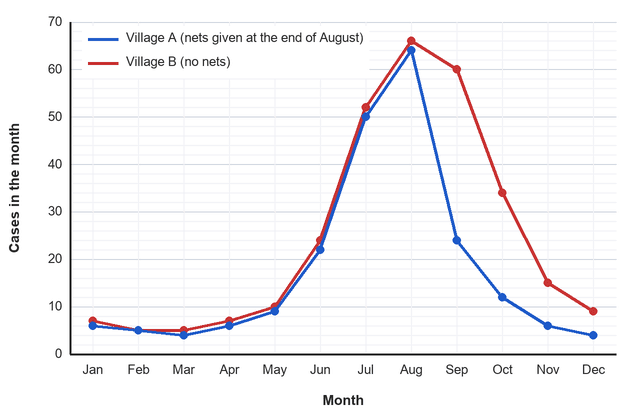
(Each small grid line stands for 2 cases.)
(a) In which month did village B have most cases, and how many ?
(b) Explain why the cases in both villages rose from May to August.
(c) In September, by what percentage were the cases in village A fewer than in village B ? Does the graph show that nets help ? Why can the fall in village B from October to December not be credited to nets ?
- 384 marks
Question 38
Cognitive domain: Application
Case: A school doctor tested the stools of the children of two Class 6 sections for the eggs of roundworm (Ascaris) before and one year after a health campaign. The campaign taught children to wash their hands with soap before eating, to wash raw vegetables well, and to use the toilets. Section 6A followed the campaign every day, and section 6B followed it only on a few days. (Hypothetical data.)
Section Children tested Children with roundworm before the campaign Children with roundworm after one year 6A 6B (a) Find the percentage of children with roundworm in each section before and after the campaign.
(b) Which section's result is better, and by how many percentage points did its percentage fall ?
(c) A parent of a child in 6B says, "My son washes his hands on most days, so he cannot get roundworm." Using the way Ascaris eggs reach a child, explain why following the habits only on some days still lets children get infected.
- 394 marks
Question 39
Cognitive domain: Analysis
Case: Mr Rao fell ill at home with vomiting and loose motions, and reached a hospital hours later, where he was diagnosed with cholera. The nurse recorded the water he lost and the water he was given in four periods of hours, counting from the start of his illness; the first row is what his family told her. (Hypothetical data.)
Period Water lost in vomiting and loose motions (litres) Urine passed (litres) Saline water given (litres) 0 to 6 hours 6 to 12 hours 12 to 18 hours 18 to 24 hours (a) Find the total water lost in vomiting and loose motions in the hours, and the total saline water given.
(b) Explain why Mr Rao passed very little urine in the first hours.
(c) Give two readings from the table that show that he was recovering by the last period, and say what the saline water did.
- 405 marks
Question 40
Cognitive domain: Evaluation
Case: A village of people has money of ₹ to spend on health. The table shows the number of cases of five diseases in a year, and three plans proposed by the health committee. (Hypothetical data.)
Disease Cases in a year How it spreads Cholera contaminated food and water, carried by flies Ascariasis eggs from faeces on hands and raw vegetables Malaria bite of the Anopheles mosquito Filariasis bite of the Culex mosquito Tuberculosis air, dust and sputum Plan What it does Cost Effect X Community toilets, covered drains, covered food stalls and hand-washing points ₹ Cuts cholera and ascariasis by Y Mosquito nets and clearing of stagnant water ₹ Cuts malaria and filariasis by Z BCG vaccination and isolation of patients ₹ Cuts tuberculosis by (a) Which disease has the most cases, and what kind of germ causes it ?
(b) Find the number of cases per year that each plan prevents.
(c) The money is not enough for all three plans. Which two plans would you choose ? Support your choice with the numbers, and say what the village should still do about the plan that is left out.