
Opening your dashboard
Class 9 Biology Chapter 12 Skeleton – Movement and Locomotion: Competency-Based Questions (CBQ)
40 questions on Chapter 12, each worked through on its own page with the AI tutor. Class 9 Biology, ICSE 2026-27.
40 questions
1–5 marks · Mixed difficulty
- 11 mark
Question 1
Cognitive domain: Application
A patient's blood report shows that the numbers of both red blood cells and white blood cells are far below normal. To find the cause, the doctor decides to examine a sample of the soft tissue taken from inside one of the patient's bones. Why does the doctor look inside a bone for a disorder of the blood ?
- 21 mark
Question 2
Cognitive domain: Analysis
An X-ray report of an injured motorcyclist reads : "Crack in the 15th vertebra, counted from the skull downwards." In which region of the vertebral column does this vertebra lie, and what is joined to it ?
- 31 mark
Question 3
Cognitive domain: Analysis
A student gently tests how much movement is possible at four joints of a model skeleton that has been made to copy the human body exactly.
Joint What joins the two bones Movement possible J1 Cartilage Very little J2 Fibrous tissue holding the bones very tightly None J3 A sac of fluid lies between the two bone ends Free, but in one plane only J4 A sac of fluid lies between the two bone ends Free, in all directions Which of these could be the joint between a rib and the breast-bone ?
- 41 mark
Question 4
Cognitive domain: Application
While playing badminton, Sameer snaps the tendon that joins his calf muscle (gastrocnemius) to the heel bone. The calf muscle itself is not injured, and it can still contract. What will Sameer be unable to do with that leg ?
- 51 mark
Question 5
Cognitive domain: Understanding
Assertion (A): A person can walk and run for hours every day without breaking the backbone, although the backbone is jolted at every step.
Reason (R): The vertebral column is curved, and the curve absorbs pressure and shock.
- 61 mark
Question 6
Cognitive domain: Understanding
Assertion (A): A bone that has been strongly heated becomes so soft and flexible that it can be tied into a knot.
Reason (R): Strong heating destroys the organic matter of a bone, and only its mineral part is left.
- 71 mark
Question 7
Cognitive domain: Application
A batsman stands side-on at the crease. Without moving his shoulders, he turns his head to the left to watch the bowler run in, and then to the right to check the fielder at square leg.
Complete the sentence :
In this movement his skull is rotated on the upper end of the ______ vertebra, and a joint of this kind is called a ______ joint.
- 81 mark
Question 8
Cognitive domain: Understanding
To "show his muscles" to his little sister, Arnav bends his arm at the elbow and brings his fist close to his shoulder. A hard bulge appears on the front of his upper arm. When he straightens the arm again, the bulge flattens out.
Complete the sentence :
The bulge is the ______ muscle, and it appears because a muscle that contracts becomes ______ and thicker.
- 91 mark
Question 9
Cognitive domain: Application
Asha nods her head to say "yes". Her skull rests on the top of the backbone. The weight of the face pulls the front of the skull down, and the muscles at the back of the neck pull the back of the skull down.
Complete the sentence :
Here the top of the backbone, which lies between the weight and the power, acts as the ______, and so the nodding skull is a lever of the ______ order.
- 102 marks
Question 10
Cognitive domain: Evaluation
While studying joints, Rohit says, "A joint is useful only if it allows movement. The joints between the bones of the cranium allow no movement at all, so they are a weakness in the design of our body. It would be better if these bones could move freely on one another."
Do you agree with Rohit ? Justify your answer.
- 112 marks
Question 11
Cognitive domain: Analysis
A gardener lifts the handles of a loaded wheelbarrow, as shown in the figure.

Which lever action of the human body, described in your chapter, is of the same order as the wheelbarrow ? Justify your answer by naming the fulcrum, the weight and the power in the wheelbarrow and in the body.
- 122 marks
Question 12
Cognitive domain: Application
Farhan fell off his bicycle and landed on his left shoulder. The X-ray shows that his left collar-bone is broken, while the shoulder-blade and the bone of the upper arm are unharmed. Yet Farhan cannot hold his left shoulder and arm steady.
Name the two parts of the skeleton to which the collar-bone is joined at its two ends. Use this to explain why a break in this one bone makes the whole shoulder and arm unsteady.
- 135 marks
Question 13
Cognitive domain: Analysis
Case: Two complete adult human skeletons were dug up at an ancient site in Haryana. A team of students helped the scientist to record them.
Feature Skeleton 1 Skeleton 2 General build Larger; heavier bones Smaller; lighter bones Hip bone (pelvis) Narrower Wider and trough-shaped Number of ribs 24 24 Bones found in the right hand 8 in the wrist, 5 in the palm, 14 in the fingers 8 in the wrist, 5 in the palm, 11 in the fingers (a) Which skeleton is most likely that of a woman ? Give two pieces of evidence from the table, and state how the shape of her pelvis was useful to her.
(b) A student writes, "Out of the 24 ribs, 20 are joined directly to the breast-bone." Correct this statement. Show how many ribs are joined directly, how many are joined indirectly and how many are not joined to the breast-bone at all.
(c) How many finger bones are missing from the right hand of Skeleton 2 ? What are these bones called ? Show your working.
(d) The students also find a small separate bone lying at the front of each knee. Name this bone. How is its origin different from that of the other bones ?
- 145 marks
Question 14
Cognitive domain: Evaluation
Case: A group of engineering students is building a human-like robot. They want its body to move just as a human body does. Their first design uses the following joints.
Place in the robot Joint used in the design Movement it gives Shoulder Hinge joint In one plane only Elbow Ball and socket joint In all directions Between the head and the neck Hinge joint In one plane only Hip Ball and socket joint In all directions (a) Which one of these four choices matches the human body ? Name the bone and the cavity that form this joint in our body.
(b) Judge the choice made for the shoulder. Which arm movements of a human will the robot be unable to copy ? What should be used instead ?
(c) Judge the choice made for the elbow. Give one reason why the joint found in the human elbow suits its work better.
(d) The robot must also turn its head to the left and to the right. Is the joint chosen between the head and the neck suitable ? Suggest the joint to be used, with a reason.
- 155 marks
Question 15
Cognitive domain: Creativity
Case: For a class project, Mitali has to make a model that explains why the backbone is built of many small vertebrae with pads of cartilage between them, and not as one long solid rod. She has ten empty wooden thread reels, a sheet of soft foam, a piece of thick cord and a pair of scissors.
(a) Describe how Mitali should build the model. State what each material stands for in the vertebral column.
(b) Describe two things she can do with the finished model to show the advantages of this kind of structure.
(c) She then makes a second model with the reels only, leaving out the foam. What difference will the class notice when both models are pressed from the top ? What does this show ?
(d) Give one way in which the model is unlike the real vertebral column, and suggest how it could be improved.
- 161 mark
Question 16
Cognitive domain: Analysis
The graph shows how the strength of the bones of a healthy person changes with age (hypothetical data). The highest strength is taken as 100.
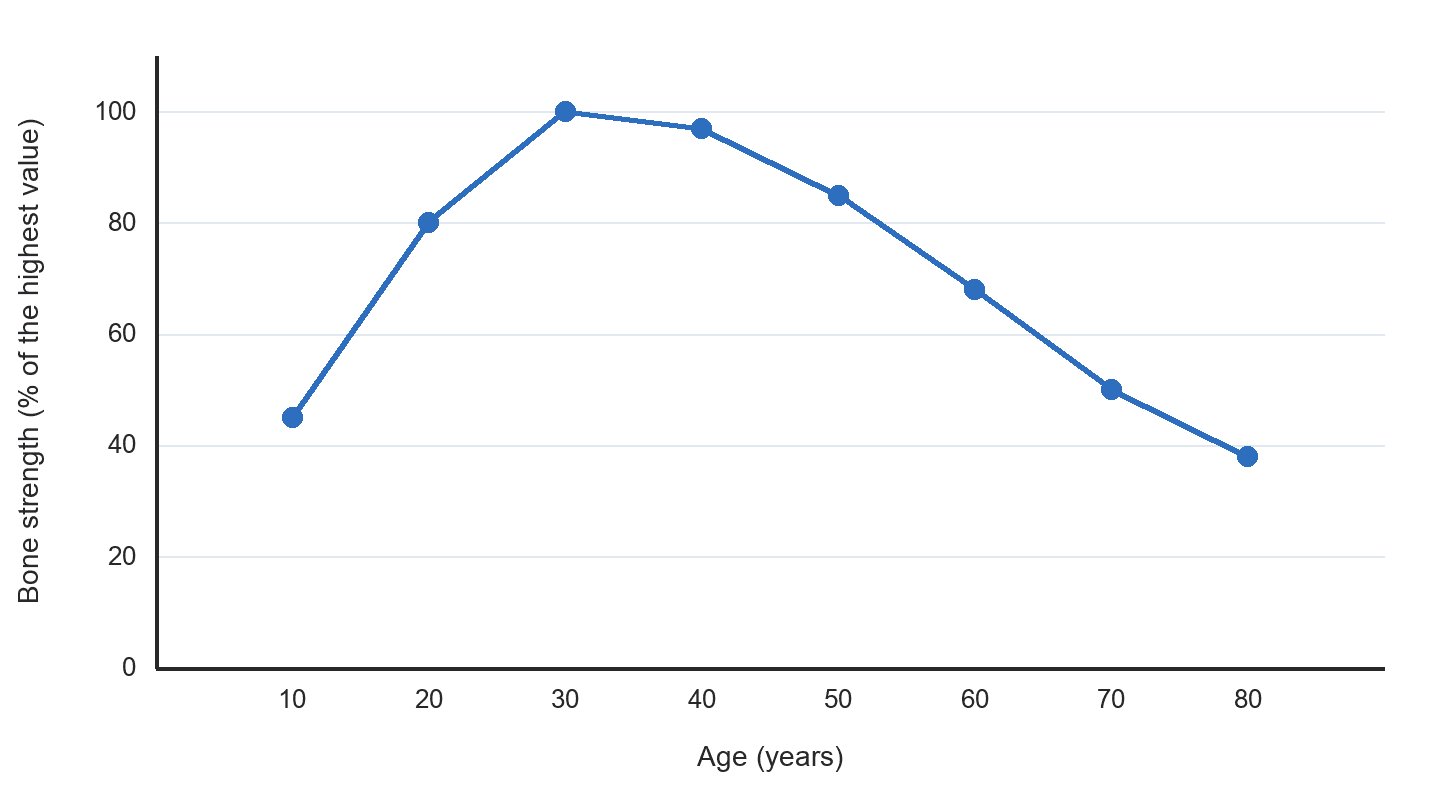
Which statement is supported by the graph and by what you have learnt about bones ?
- 171 mark
Question 17
Cognitive domain: Application
During a hockey match Riya twists her ankle. Her X-ray shows damage in a group of 7 small, box-like bones with a spongy structure, lying between the shank and the foot. These bones show little movement among themselves. Which statement about these bones is correct ?
- 181 mark
Question 18
Cognitive domain: Understanding
Three situations from a school day are given.
Situation 1: A boy stands upright with a heavy bag on his back, and his body does not fold up like a rubber toy.
Situation 2: A ball hits another boy on the chest, but his heart and lungs are not harmed.
Situation 3: A girl contracts her biceps by only a few centimetres, and her hand throws a ball through a long arc.
Which option names the function of the skeleton that is mainly shown in each situation (1, 2 and 3) ?
- 191 mark
Question 19
Cognitive domain: Application
For a science exhibition, Meena makes a model of the bony cage of the chest from 12 pairs of cane strips. She joins pairs 1 to 7 directly to a flat strip in the front using hyaline cartilage, joins pairs 8, 9 and 10 to the cartilage of pair 7, and leaves pairs 11 and 12 free in the front.
Which row names the three kinds of ribs correctly for the 5th, 9th and 12th pairs ?
- 201 mark
Question 20
Cognitive domain: Analysis
The figure shows three tools as simple levers. F is the fulcrum, E is the effort and L is the load.

Three actions of the human body are given.
- Nodding the head, with the skull resting on the first vertebra (a lever of the first order).
- Rising on the toes, with the body weight acting between the toes and the heel (a lever of the second order).
- Bending the arm by the biceps muscle, with the muscle pulling between the elbow and the hand (a lever of the third order).
Which option matches each action with the tool that is a lever of the same order ?
- 211 mark
Question 21
Cognitive domain: Analysis
Assertion (A): The heart wall keeps contracting and relaxing about 70 times a minute, day and night, all through life, without getting tired.
Reason (R): Cardiac muscles, which make up the walls of the heart, are capable of rapid movements and do not tire easily.
- 221 mark
Question 22
Cognitive domain: Analysis
Assertion (A): Since the bones of the skull are joined by immovable joints, the lower jaw cannot move up and down when we chew food.
Reason (R): The eight bones of the cranium are joined to each other in such a way that they are permanently fixed.
- 231 mark
Question 23
Cognitive domain: Application
A student studies a human skull model. The model has 22 bones in all. She notes that 8 of them are joined to each other permanently to form the brain-box, and she sees a large opening at the back of the brain-box. Which option gives the numbers of bones in the cranium and in the face, and states what passes through the large opening ?
- 241 mark
Question 24
Cognitive domain: Application
A student writes down three muscles and notes how each one works.
P: forms the wall of the heart; works day and night without our will.
Q: the biceps; moves the arm only when we decide to move it.
R: the diaphragm; works on its own while we sleep, but we can also control it when we take a deep breath on purpose.
Which row names the kinds of muscle correctly ?
- 251 mark
Question 25
Cognitive domain: Evaluation
Sneha sorts the bones into the two divisions of the skeleton as shown. Her teacher marks it as correct.
Axial skeleton Appendicular skeleton skull, sternum, ribs, sacrum collar-bone, shoulder blade, hip bone, knee-cap Which statement correctly judges the teacher's decision ?
- 262 marks
Question 26
Cognitive domain: Understanding
Aarav makes a model arm. A string (the "muscle") is fixed at the shoulder end, and its other end is tied to the lower arm bone. When he pulls the string, the lower arm lifts.
Using the model, explain how a real muscle moves a bone. Name the structure by which the movable end of the muscle is attached to the bone, and say why a muscle cannot push the bone back.
- 272 marks
Question 27
Cognitive domain: Analysis
The hip bones are joined to the sacrum, and the hind limbs carry the weight of the whole body. In an adult the sacrum is a single large bone formed by the fusion of five vertebrae.
Analyse why a sacrum fused into one bone is better for the hip girdle than five separate vertebrae. Name the other main job of the hip girdle.
- 282 marks
Question 28
Cognitive domain: Understanding
The hinge of a school door starts to squeak, and the caretaker puts a few drops of oil on it. The door then swings smoothly.
Using this idea, state the two special requirements of a synovial joint and say how each is met. Name the joint of the arm that moves like a door hinge.
- 292 marks
Question 29
Cognitive domain: Understanding
A baby is born with a small tail-like outgrowth at the base of the spine. The doctor tells the parents that it can be removed safely, as it does not do any useful work.
(a) Name the part of the backbone that represents a tail in the human body. How many fused vertebrae form it ?
(b) Why is this part called a rudimentary tail ?
- 302 marks
Question 30
Cognitive domain: Evaluation
A physiotherapist tells her students, "A shoulder joint gets dislocated much more easily than a hip joint, although both are ball and socket joints."
Evaluate this claim using the structure of the two sockets. State whether it is reasonable and give your reasons.
- 312 marks
Question 31
Cognitive domain: Application
Ramesh stands still for the whole of the national anthem, about one minute, without swaying or falling. His upper arm looks rounded when he is standing at ease.
Name two functions of muscles, other than movement, that are shown here and explain each one.
- 323 marks
Question 32
Cognitive domain: Analysis
A man falls from a roof, and the doctor finds that the ring-like part of one vertebra in his back has cracked. There is a danger to the structure that runs through the vertebra.
(a) Name the opening of a vertebra through which this structure runs and the two parts that form the opening.
(b) Name the structure that runs through it and explain why a crack here is dangerous.
(c) Which structure acts as a cushion between two vertebrae and what is it made of ?
- 333 marks
Question 33
Cognitive domain: Application
A baby learning to walk often falls, even though the baby's leg muscles are strong enough. A grown-up walks smoothly without thinking about it.
(a) Which idea about the working of muscles explains this ?
(b) Name the pair of muscles that bend and straighten the arm at the elbow.
(c) What would happen to the arm if both these muscles contracted fully at the same time ?
- 343 marks
Question 34
Cognitive domain: Evaluation
A school health poster says, "Bones are just made of calcium. Drink milk every day, and your bones will stay hard and strong for the whole life."
Evaluate this poster using what you have learnt about bone.
(a) Which part of the statement is partly correct ?
(b) Which two facts about bone does the poster leave out or get wrong ?
(c) Rewrite the poster in one correct sentence.
- 353 marks
Question 35
Cognitive domain: Understanding
During a games period a teacher notes four activities.
- Arun runs a 100 m race.
- Priya, sitting on a bench, writes the scores with a pen.
- Sara swims across the pool.
- Neel, standing in one place, nods his head to say "yes".
(a) Which of these activities are examples of locomotion, and which show only the movement of a part of the body ? Give a reason.
(b) To hold the pen, Priya uses the small bones of her fingers. Name these bones, and say how Priya's writing would be affected if each finger were one solid bone.
(c) Name the two systems of the body that work together to bring about all four activities.
- 363 marks
Question 36
Cognitive domain: Analysis
Neha presses four parts of her body: the tip of her nose, the outer ear, the place where her ribs meet her breast-bone, and her shin. The first three feel firm but a little flexible, and the shin feels hard and rigid.
(a) Which supporting tissue is present in the first three and which in the shin ?
(b) Why is the tissue in the first three better than bone for those places ?
(c) What is the extra advantage at the place where the ribs meet the breast-bone ?
- 375 marks
Question 37
Cognitive domain: Analysis
Case: On a ward round in a hospital, a doctor notes the following about four patients (hypothetical data).
Patient Damage Observation P1 Several ribs crushed in an accident Fear of injury to the heart and lungs P2 Disease of the soft tissue inside the ends of a thigh bone Red blood cell count is very low P3 Vertebrae of the lower back broken Cannot sit upright; the spinal cord is at risk P4 Elbow joint locked after a fracture Cannot bend the arm, although the biceps muscle is healthy (a) Name the function of the skeleton that is affected in each of the four patients.
(b) In P4, the biceps muscle is healthy but the arm does not bend. Explain why.
(c) At the back, P1's ribs are joined to one group of vertebrae. Name this group and give the number of vertebrae in it. Explain why this number is the same as the number of pairs of ribs.
- 384 marks
Question 38
Cognitive domain: Evaluation
Case: For a project, Kabir counts the bones of an adult human skeleton and writes a table. His teacher says that there are two mistakes in it.
Region of the axial skeleton Kabir's count Skull (cranium 8, face 14, ear ossicles 6, hyoid 1) 29 Vertebral column 33 Ribs 12 Sternum 1 Total 75 (a) Find the two mistakes and correct them.
(b) Find the correct total for the axial skeleton. Then use the total number of bones in an adult skeleton (206) to find the number in the appendicular skeleton.
(c) Kabir says, "My book says the total is 213, so a human adult has 213 bones." Evaluate his claim.
- 394 marks
Question 39
Cognitive domain: Analysis
Case: On sports day Anjali, a Class 9 student, enters the long-jump pit. At the start she swings her arms back and forth at the shoulders. She runs and takes off by rising on her toes. She lands with her knees bending, and her backbone bends a little as she lands softly. A girl who landed stiffly with straight legs hurt her back (hypothetical data).
(a) Name the joint at the shoulder that allows Anjali to swing her arm in all directions. State where its ball and socket are found.
(b) Name the type of joint at the knee and say how it moves when she bends her knees.
(c) Using two features of the human skeleton, explain why landing with a bent knee and a curved backbone is safer than landing stiffly.
- 405 marks
Question 40
Cognitive domain: Creativity
Case: The Biology Club of Class 9 wants to make a "Skeleton Care Card" to give to all the students in the school.
(a) Write three tips for the card. Each tip must be linked to one fact from this chapter in a single line, for example a fact about bone, joints or muscles.
(b) Write one catchy slogan of not more than ten words for the card. It must use at least one fact about the skeleton.
(c) Design a simple table to check, after one month, whether the students followed the tips. Give the column headings and say how you will find out which tip was followed best.