
Opening your dashboard
Class 8 Physics Chapter 4 Energy: Competency-Based Questions (CBQ)
40 questions on Chapter 4, each worked through on its own page with the AI tutor. Class 8 Physics, ICSE 2026-27.
40 questions
1–5 marks · Mixed difficulty
- 11 mark
Question 1
Competency: Understanding & Application
Four girls are helping on the school sports day.
- Asha holds a heavy flag pole upright and perfectly still for five minutes.
- Bina pushes hard against the wall of the pavilion to stretch her legs. The wall does not move.
- Charu squeezes a soft rubber ball in her fist until it is flattened.
- Divya stands still at the gate with a tray of medals on her head.
In the language of physics, which girl does work with the force she applies ?
- 21 mark
Question 2
Competency: Analysis
A traffic camera near a school records the following at one instant.
Vehicle Mass (kg) Speed (m s) Scooter with rider 150 20 Car 1000 6 Cyclist with cycle 80 10 Loaded truck 5000 3 Which of them has the greatest kinetic energy at that instant ?
- 31 mark
Question 3
Competency: Application
A librarian lifts a dictionary of mass 2 kg from a shelf 0.5 m above the floor and places it on a shelf 2.0 m above the floor. (Take the force of gravity on a mass of 1 kg as 10 N, i.e. g = 10 N kg.)
By how much does the gravitational potential energy of the dictionary increase ?
- 41 mark
Question 4
Competency: Application
An emergency torch has no cells. When its handle is turned, a small dynamo inside it spins, and the dynamo makes a small bulb glow.
Which option shows the useful energy changes in the torch, in the correct order ?
- 51 mark
Question 5
Competency: Understanding & Analysis
Assertion (A): A rubber ball dropped on a hard floor rises, after the bounce, to a height less than the height from which it was dropped.
Reason (R): A part of the mechanical energy of the ball is destroyed each time the ball strikes the floor.
- 61 mark
Question 6
Competency: Understanding
Assertion (A): A 1 kW pump and a 2 kW pump each lift 500 kg of water from the same well into the same roof tank. Both pumps do the same amount of work on the water.
Reason (R): The work done in lifting a body depends on the force of gravity on the body and the height through which it is lifted, and not on the time taken.
- 72 marks
Question 7
Competency: Application
A boy draws water from a well with a rope. The water surface is 9 m below the top of the well. A bucket full of water weighs 150 N.
(a) Find the work he does against the force of gravity in raising one full bucket to the top.
(b) He needs 20 full buckets to fill a drum. Find the total work he does in raising them. Give your answer in kilojoule.
- 82 marks
Question 8
Competency: Understanding & Evaluation
Rohan does 6 J of work in stretching the rubber of his catapult. When he lets go, the pebble flies off with 4.5 J of kinetic energy.
(a) How much energy is stored in the stretched rubber, and in what form ?
(b) Rohan says, "The other 1.5 J of energy has been destroyed." Is he right ? Give a reason.
- 92 marks
Question 9
Competency: Analysis
Meera notes what she sees, hears and feels when three things are used in her kitchen.
Thing in use What Meera observes Gas burner a blue flame that gives light; the pan kept on it becomes hot Mixer-grinder the blades spin fast; there is a loud whirring; the body feels warm after a few minutes Electric toaster the wires inside glow red; the bread becomes hot and brown (a) Name the form of energy that each of the three takes in while it is being used.
(b) For the mixer-grinder, name the form of energy that is useful and two forms that are given out but are not wanted. Use Meera's observations.
- 102 marks
Question 10
Competency: Application & Analysis
In a rope-climbing contest, Arun, who weighs 400 N, climbs 6 m up the rope in 12 s. Bhanu, who weighs 500 N, climbs the same 6 m in 20 s.
(a) Find the work done by each boy against the force of gravity.
(b) Find the power spent by each boy. Does the boy who does more work also spend more power ?
- 114 marks
Question 11
Competency: Analysis & Evaluation
Case study: A child of mass 30 kg sits at rest at the top A of a playground slide, as shown in the figure. She slides down, and a speed sensor fixed at the bottom B shows that she passes it at 5 m s. (Take the force of gravity on a mass of 1 kg as 10 N, i.e. g = 10 N kg.)
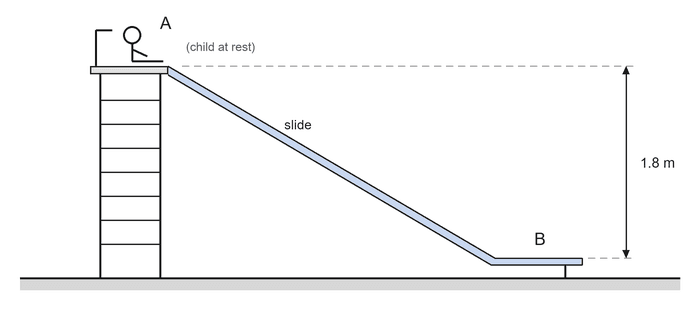
(a) Read the height of A above B from the figure and find the potential energy of the child at A, measured from the level of B. What is her kinetic energy at A ?
(b) Find her kinetic energy at B. How much of her mechanical energy is missing at B, and what has happened to it ?
(c) Her friend says, "The energy at B is less than the energy at A, so energy is not conserved on a slide." Judge this statement. Then find the speed with which the child would reach B if the slide had no friction at all.
- 124 marks
Question 12
Competency: Application & Evaluation
Case study: A family lists the electrical appliances it uses every day, the power marked on each and the time for which each is used. The electricity board charges ₹7 for each kWh of electrical energy.
Appliance Power Time used each day Ceiling fan 75 W 8 h Geyser 2000 W 0.5 h Television 100 W 4 h Four LED lamps together 40 W 5 h (a) Find the electrical energy used by each appliance in one day, in kWh.
(b) Find the total energy used in one day and the cost of using these appliances for 30 days.
(c) The father says, "The geyser is on for only half an hour a day, so it adds the least to the bill." Judge his statement. How much money is saved in 30 days if the geyser is used for 0.3 h a day instead of 0.5 h ?
- 133 marks
Question 13
Competency: Analysis
Case study: A science club tests an old filament lamp and an LED lamp. For each lamp the members measure how much light energy is given out for every 100 J of electrical energy supplied. Their results are shown in the bar chart.
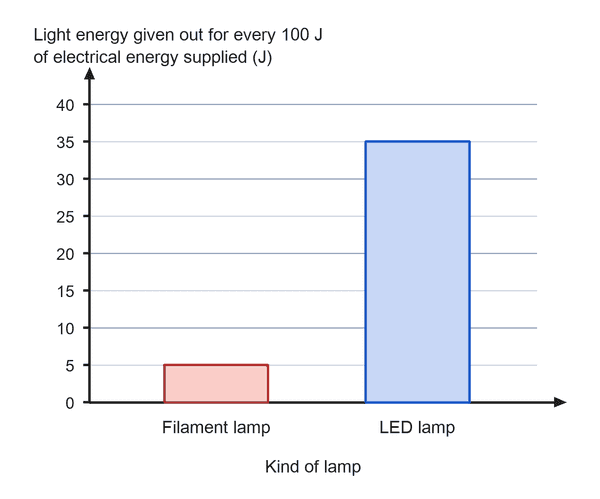
(a) Read from the chart the light energy given out by each lamp for every 100 J of electrical energy supplied.
(b) For each lamp, how much of the 100 J does not come out as light ? Into which form does this energy change, and why is it called degraded energy ?
(c) How much electrical energy must be supplied to each lamp to get 70 J of light ? Which lamp should the club recommend for the school, and why ?
- 144 marks
Question 14
Competency: Application & Analysis
Case study: On a school trek, Riya and her elder brother Kabir climb from the base camp to a hill top which is 300 m higher than the camp. Riya has a mass of 40 kg and carries a bag of mass 5 kg. Kabir has a mass of 60 kg and carries nothing. Riya walks up a long, gently sloping, winding path. Kabir goes straight up a short, steep path. (Take the force of gravity on a mass of 1 kg as 10 N, i.e. g = 10 N kg.)
(a) Find the gain in gravitational potential energy of Riya together with her bag. Give your answer in kJ.
(b) Find the gain in gravitational potential energy of Kabir. Who gains more, and by how much ?
(c) Riya says, "My path was much longer than Kabir's, so I should have gained more potential energy than you have calculated." Is she right ? Give a reason. From where did the two climbers get this energy ?
- 154 marks
Question 15
Competency: Creation
You are given a long plastic ruler with a groove along its middle, a few books, a glass marble, an empty matchbox tray and a metre scale.
Design an investigation to find out how the kinetic energy of the moving marble depends on its speed. Write :
(a) the steps you will follow, and how you will compare the kinetic energy of the marble in different trials,
(b) two things you will keep the same so that the test is fair,
(c) a table for your readings, the result you expect and the reason for it.
- 161 mark
Question 16
Competency: Analysis
Four labourers push or pull loaded trolleys at a building site. In each case the force acts along the direction in which the trolley moves. The table shows what each one did. (Hypothetical data.)
Labourer Force applied (N) Distance moved by the trolley (m) Time taken (s) Asif 240 3 5 Bhola 150 5 12 Chandra 300 2 2 Dilip 100 7 30 Who does the greatest amount of work?
- 171 mark
Question 17
Competency: Analysis
The graph shows how the kinetic energy of two bodies P and Q changes with their speed. Both bodies are moving in a straight line. The masses of P and Q are not given.
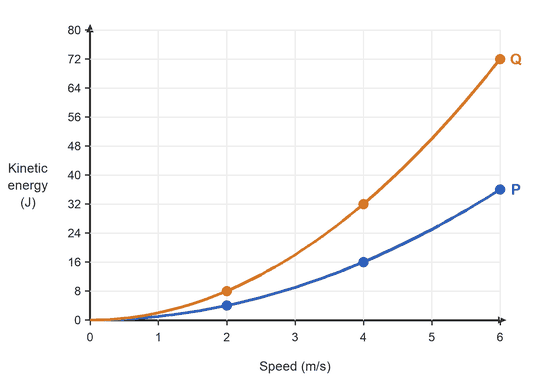
Which statement about the masses of P and Q is correct?
- 181 mark
Question 18
Competency: Analysis
A family studies how much electrical energy three appliances use. The graph shows the energy used by each appliance (A, B and C) against the time for which it is switched on. The three appliances are an electric geyser of power 2000 W, an electric iron of power 1000 W and a mixer-grinder of power 500 W.

Which option matches the three lines with the appliances correctly?
- 191 mark
Question 19
Competency: Analysis
Assertion (A): At the highest point of its path, a ball thrown vertically upwards has no energy at all.
Reason (R): At the highest point the ball is, for a moment, at rest, so its kinetic energy is zero.
- 201 mark
Question 20
Competency: Application
A garden lamp has a small solar panel on its top and a rechargeable cell inside. During the day it is kept in the sun. After sunset it glows for several hours.
Which option gives the main energy changes in the correct order, in the day and at night?
- 211 mark
Question 21
Competency: Application
Four labourers record the total work they do in raising bricks to a roof during one morning. Each records it in a different unit. (Hypothetical data.)
Labourer Work done P 2.4 kJ Q 2300 J R 0.0025 MJ S 250 kgf m Use 1 kgf = 9.8 N. Who did the most work?
- 221 mark
Question 22
Competency: Evaluation
A pendulum bob of mass 0.25 kg is released from rest at A. It swings down through the lowest point B and rises on the other side, passing D. The figure shows the heights of A and D above B. Take the potential energy at B as zero, neglect air resistance and take the force of gravity on a mass of 1 kg as 10 N, i.e. .

Which statement is not correct?
- 231 mark
Question 23
Competency: Understanding
Assertion (A): On a cold morning, rubbing the palms of the hands together makes them feel warm.
Reason (R): The mechanical energy of the moving palms changes into heat energy because of friction.
- 241 mark
Question 24
Competency: Analysis
A store clerk keeps four boxes on shelves of different heights above the ground. Three of the boxes have the same gravitational potential energy. (Hypothetical data.) Take the force of gravity on a mass of 1 kg as 10 N, i.e. .
Box Mass (kg) Height of shelf (m) P 3 5 Q 4 3 R 6 2 S 2 6 Which box has a potential energy different from the other three?
- 251 mark
Question 25
Competency: Understanding
A firework rocket, lit by an adult from a safe distance, shoots up into the sky, glows brightly and ends with a loud bang. All the energy for this comes from the chemical energy stored in the powder inside the rocket.
Into which forms of energy does this chemical energy change?
- 262 marks
Question 26
Competency: Application
A pair of bullocks pulls a loaded cart along a straight village road with a steady force of 600 N in the direction in which the cart moves. (Hypothetical data.)
(a) Find the work done by the bullocks in pulling the cart through 1.5 km. Give your answer in joule and in kilojoule.
(b) The driver wants the total work done to be 1.2 MJ. How much farther must the bullocks pull the cart with the same force?
- 272 marks
Question 27
Competency: Application
A model steam engine in a science exhibition has a spirit burner under a small boiler. The steam pushes a piston, which turns a wheel that winds up a thread and lifts a small load of mass 0.2 kg through a height of 1.0 m. While this happens, the burner gives out 40 J of heat energy to the boiler. (Hypothetical data.) Take the force of gravity on a mass of 1 kg as 10 N, i.e. .
(a) Write the chain of energy changes, from the spirit to the lifted load.
(b) Find the energy gained by the load. What fraction of the 40 J has become useful, and where has the rest gone?
- 282 marks
Question 28
Competency: Application
A crane lifts a steel girder of weight 500 kgf vertically through a height of 6 m. (Hypothetical data.)
(a) Find the work done by the crane in kgf m.
(b) Express this work in joule and in kilojoule, taking 1 kgf = 9.8 N. State the gain in the gravitational potential energy of the girder.
- 292 marks
Question 29
Competency: Application
At a rice mill a conveyor motor lifts sacks of rice, each of mass 50 kg, from the floor to a loft 3 m high, one sack after another. (Hypothetical data.) Take the force of gravity on a mass of 1 kg as 10 N, i.e. .
(a) The motor has a power of 750 W. If all of its power were used to lift sacks, how many sacks could it lift in one minute?
(b) In practice only 60 % of the power of the motor does useful lifting. How many sacks does it lift each minute now?
- 302 marks
Question 30
Competency: Application
A boy throws a ball of mass 0.4 kg straight up. It leaves his hand with a kinetic energy of 20 J. Neglect air resistance and take the level of his hand as the level of zero potential energy. Take the force of gravity on a mass of 1 kg as 10 N, i.e. .
(a) Find the greatest height above his hand to which the ball rises.
(b) Find the potential energy and the kinetic energy of the ball when it is 3 m above his hand.
- 312 marks
Question 31
Competency: Understanding
At a village fair, Rani notices four things: (i) the wound-up spring of a toy car, held still before it is let go; (ii) the wind turning a paper windmill; (iii) water stored in a tall overhead tank that supplies the fair; (iv) a spinning top.
(a) For each of the four, state whether its energy is kinetic or potential, and give the reason.
(b) Which two of the four have energy even though they are not moving? Give one example of work that each of them can do.
- 323 marks
Question 32
Competency: Analysis
A toy car of mass 0.5 kg is given three different starting speeds on a rough floor, and the distance it travels before stopping is measured each time. The kinetic energy of the car is used up in doing work against the force of friction, and the work done is force × distance. (Hypothetical data.)
Trial Starting speed (m s) Distance travelled before stopping (m) 1 1 0.5 2 2 2.0 3 3 4.5 (a) Find the kinetic energy of the car at the start of each trial.
(b) Use the work done against friction to show that the force of friction is the same in all three trials, and find it.
(c) Predict the distance the car would travel if it started at 4 .
- 333 marks
Question 33
Competency: Application
A labourer on a building site raises bricks to a roof 8 m high, using a rope that passes over a fixed pulley. Each trip the bucket holds 40 kg of bricks. He makes 15 trips. In every trip he pulls for 20 s, and then rests for 20 s while the bucket is refilled. Ignore the mass of the bucket and rope and all friction. (Hypothetical data.) Take the force of gravity on a mass of 1 kg as 10 N, i.e. .
(a) Find the work done in one trip and in all 15 trips.
(b) Find the power spent by the labourer while he is pulling.
(c) Find his average power over the whole job, including the rests.
- 343 marks
Question 34
Competency: Application
A bicycle lamp of power 3 W is lit by a dynamo that is turned by the wheel. The dynamo changes only 60 % of the mechanical energy it receives into electrical energy. Rohan rides for 20 minutes with the lamp on. (Hypothetical data.) Take the force of gravity on a mass of 1 kg as 10 N, i.e. .
(a) Find the electrical energy used by the lamp in 20 minutes.
(b) Find the mechanical energy that Rohan must supply to the dynamo in this time.
(c) Through what height could this mechanical energy lift a mass of 60 kg?
- 353 marks
Question 35
Competency: Evaluation
An advertisement says, "Our stream-powered pump needs no fuel and will run for ever." It shows water falling through 2 m on to a water wheel that turns a dynamo. The electricity from the dynamo runs a motor and pump that lift the same water back to the top. Suppose 50 kg of water falls every second. The water wheel and dynamo together change 60 % of the potential energy lost by the water into electrical energy. The motor and pump together change 70 % of that electrical energy into the potential energy of the water they lift. (Hypothetical data.) Take the force of gravity on a mass of 1 kg as 10 N, i.e. .
(a) Find the potential energy lost by the falling water each second, and the electrical energy produced each second.
(b) Find the energy used by the pump each second to lift the water, and the greatest height to which it can lift the 50 kg of water that fell.
(c) Judge the claim of the advertisement.
- 363 marks
Question 36
Competency: Application
A farmer's motor pump is rated 1.5 H.P. It raises water from a borewell 15 m deep, and it runs for 2 hours. Use and . (Hypothetical data.) Take the force of gravity on a mass of 1 kg as 10 N, i.e. .
(a) Find the power of the pump in watt.
(b) Find the energy used by the pump in 2 hours, in kWh and in joule.
(c) Only 40 % of this energy goes into lifting the water. Find the mass of water raised from the borewell. Give your answer to the nearest 100 kg.
- 374 marks
Question 37
Competency: Analysis
Case study: In a hill village, farmers send apples down to the road by a cable ropeway. A loaded trolley of total mass 250 kg starts from rest at the orchard, 80 m above the road, and runs down the cable on its pulley wheel, as shown in the figure. A brake keeps the trolley slow, and a speed sensor at the lower station reads 4 as the trolley arrives. The farmers want to know how much energy the brake has to take away. (Hypothetical data.) Take the force of gravity on a mass of 1 kg as 10 N, i.e. .
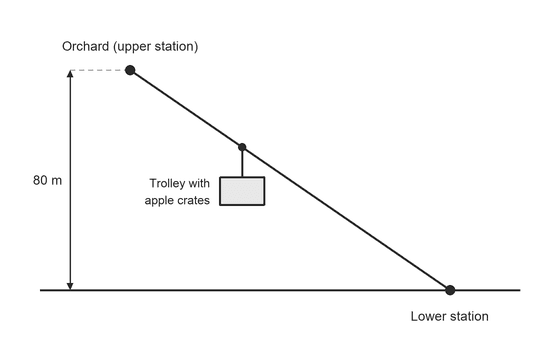
(a) Find the potential energy lost by the trolley in coming down, and its kinetic energy on arrival.
(b) Find the energy that has been changed into other forms, as a percentage of the potential energy lost. Name the main form into which it has changed.
(c) Find the speed the trolley would reach at the lower station if the brake failed and no energy were lost. Explain why the brake is needed.
- 384 marks
Question 38
Competency: Application
Case study: The health club of a school puts up a chart that shows the food energy in one serving of three snacks. (Hypothetical data.) The chart also says that when a person climbs stairs, only one-fourth of the food energy used becomes useful work against gravity, and the rest is changed to heat. Kabir, whose mass is 40 kg, climbs a staircase of 5 floors, each 3 m high. Take the force of gravity on a mass of 1 kg as 10 N, i.e. .
Snack Food energy in one serving (kJ) Banana 400 Peanut chikki 600 Samosa 1000 (a) Find the work Kabir does against gravity in climbing the staircase once.
(b) Find the food energy he uses for this climb. How many complete climbs of this staircase could the energy of one banana support?
(c) Kabir says, "If I eat one samosa, I can burn all of it off by climbing this staircase once." Judge his statement using the data.
- 395 marks
Question 39
Competency: Evaluation
Case study: A cycle shop sells three electric bicycles, E1, E2 and E3, whose batteries store the amounts of energy shown in the table. (Hypothetical data.) A courier wants to ride up a hill road that rises 30 m, using the motor alone without pedalling. The rider and the bicycle together have a mass of 100 kg. On such a climb, only 60 % of the energy stored in the battery becomes useful work against gravity, and the rest is changed to heat in the motor and the battery and in overcoming friction. Use . Take the force of gravity on a mass of 1 kg as 10 N, i.e. .
Model Energy stored in the battery (kWh) E1 0.24 E2 0.36 E3 0.48 (a) Find the potential energy gained by the rider and bicycle in one climb, and the energy stored in the battery of E2 in joule.
(b) Find the number of complete climbs that each model can make on one full charge.
(c) The courier must make 30 climbs in a day on a single charge. A friend says, "E2 will do, because it can make nearly 30 climbs." Judge this statement and say which models are suitable.
- 404 marks
Question 40
Competency: Creativity
Isha and Jay, two friends of the same age, want to find out which of them spends more power in going up the school staircase. They have a bathroom weighing scale, a measuring tape, a stopwatch and a notebook. One of them climbs at a time, at a steady pace, while an adult watches. Design the investigation. Write:
(a) the steps you will follow and the measurements you will take,
(b) a table for the readings, and the formula you will use to find the power,
(c) two things you will keep the same so that the test is fair, and the reason why the heavier friend need not spend more power.