
Opening your dashboard
Class 8 Maths Chapter 3 Squares and Square Roots: Competency-Based Questions (CBQ)
40 questions on Chapter 3, each worked through on its own page with the AI tutor. Class 8 Maths, ICSE 2026-27.
40 questions
1–5 marks · Mixed difficulty
- 11 mark
Question 1
Competency: Analysis
A square courtyard is paved with square tiles, with the same number of tiles in every row and every column. The mason remembers only that the total number of tiles is between 2000 and 2100 and that it ends in the digit 5. How many tiles were used?
- 21 mark
Question 2
Competency: Application
A giant chessboard painted on a school playground is a square of area m². It has 8 equal small squares along each side. What is the length of the side of each small square?
- 31 mark
Question 3
Competency: Analysis
A square vegetable plot has an area of 150 m². Wire for fencing it once all round is sold only in rolls of 10 m. What is the least number of rolls needed?
- 41 mark
Question 4
Competency: Understanding
A house number is a riddle : "I am a perfect square. I lie between 300 and 400. I am an even number." What is the house number?
- 51 mark
Question 5
Competency: Evaluation
Rahul says, "If I double a perfect square, I get another perfect square." He is talking about the squares of natural numbers. Which is the best judgement of his statement?
- 61 mark
Question 6
Competency: Understanding
Assertion (A) : and .
Reason (R) : The number of decimal places in the square of a decimal number is double the number of decimal places in the number.
- 72 marks
Question 7
Competency: Application
An LED panel has 180 bulbs. A shopkeeper wants to join some of these panels and rearrange all their bulbs into one square display, with the same number of bulbs in every row and column. Using prime factors, find the least number of panels he needs. How many bulbs will there be in each row?
- 82 marks
Question 8
Competency: Analysis & Evaluation
Jaya writes two results in her notebook :
Check each result by first working out the number under the root sign. Which one has a mistake? What does this tell you about taking the square root of a sum and of a product?
- 92 marks
Question 9
Competency: Analysis
Mr Rao owns a rectangular plot 45 m long and 20 m wide. He is offered a square plot of exactly the same area in exchange. Find the side of the square plot. Which of the two plots needs less fencing all round, and by how much?
- 102 marks
Question 10
Competency: Application
A square flower bed has an area of m². Find the length of its side. Bamboo sticks are to be fixed along its boundary, one stick every m. How many sticks are needed?
- 113 marks
Question 11
Competency: Analysis & Evaluation
The floor of a square hall has an area of 2209 m². The contractor says, "So each side of the hall is 43 m."
(a) Looking only at the unit digit of 2209, explain why the side must end in 3 or in 7.
(b) Using , decide whether the side is 43 m or 47 m. Is the contractor right?
(c) Confirm your answer by finding by the division method.
- 123 marks
Question 12
Competency: Application & Analysis
A shopkeeper stacks tins of ghee for a display. The top row has 1 tin, the next row has 3 tins, the next has 5 tins, and so on. Each row has 2 tins more than the row above it. He uses exactly 400 tins.
(a) How many rows does the display have?
(b) How many tins are there in the bottom row?
(c) He now receives 41 more tins. Can he add exactly one more complete row at the bottom, with no tin left over? Give a reason.
- 133 marks
Question 13
Competency: Creativity
Make up a "Who am I?" riddle about a perfect square that lies between 1000 and 2000. Your riddle must have exactly three clues. Each clue should use a different fact about square numbers, such as even or odd, the unit digit, or the unit digit of the square root. The three clues together must fit only one number. Write your riddle and show that it has only one answer.
- 145 marks
Question 14
Competency: Application & Analysis
Case study: A builder's notice lists four square plots for sale.
Plot Area (in m²) A 1296 B 2025 C 1000 D 3136 (a) One of these plots cannot have a side that is a whole number of metres. Which one? Give a reason that needs no calculation.
(b) Find the sides of plots A and D by the prime factor method. How much more fencing does plot D need than plot A?
(c) A fifth square plot E has 4 times the area of plot A. Without multiplying 1296 by 4, find the side of plot E. Does a plot with 4 times the area need 4 times the fencing? Explain.
- 155 marks
Question 15
Competency: Application
Case study: For the annual day, a school builds a square stage with a floor area of exactly 200 m².
(a) Between which two consecutive whole numbers of metres does the side of the stage lie? Give a reason.
(b) Find the side of the stage correct to two decimal places, using the division method.
(c) An LED strip is to be fixed once all round the edge of the stage. The strip is sold only in whole metres at ₹ 50 per metre. Find the least length that must be bought, and its cost.
- 161 mark
Question 16
Competency: Understanding
Assertion (A) : While finding by the division method, the first group of digits is the single digit 3, and the remaining digits are grouped as 45 and 96.
Reason (R) : In the division method, the integral part is grouped in pairs from the decimal point towards the left, so a single digit left over forms a group by itself, and the decimal part is grouped in pairs from the decimal point towards the right.
- 171 mark
Question 17
Competency: Analysis
The number line shows a point P. The point P marks the square root of one of the numbers given in the options.

Which number has its square root marked by P?
- 181 mark
Question 18
Competency: Application
A square sticker has an area of 49 cm². A printer enlarges it so that every side becomes 3 times as long. What is the area of the enlarged sticker?
- 191 mark
Question 19
Competency: Analysis
A student squares different 3-digit natural numbers on a calculator and records how many digits each answer has. Which statement describes what she will find?
- 201 mark
Question 20
Competency: Evaluation
Mira says, "Squaring a number always makes it bigger." Which of the following numbers shows that her statement is wrong?
- 211 mark
Question 21
Competency: Analysis
Meena is finding the square root of a 4-digit perfect square by the division method. In her first step the quotient digit is 7 and the remainder is 13. The next pair of digits that she brings down is 41. Which number is she working on?
- 221 mark
Question 22
Competency: Analysis
A teacher writes four numbers on the board. Each ends in a digit with which a perfect square may end, and none ends in an odd number of zeros. So the unit-digit test cannot reject any of them. Using the fact that a perfect square leaves remainder 0 or 1 when divided by 3, find the number which is not a perfect square.
- 231 mark
Question 23
Competency: Application & Analysis
Square A has a perimeter of 14 m. Square B has an area of m². Which statement about the two squares is correct?
- 241 mark
Question 24
Competency: Application
The houses of a street are numbered from 200 to 1000. The owner of the street paints a star on every house whose number is a perfect square. How many houses get a star?
- 251 mark
Question 25
Competency: Understanding
Assertion (A) : If 7, 24 and 25 form a Pythagorean triplet, then 14, 48 and 50 also form a Pythagorean triplet.
Reason (R) : If , then .
- 262 marks
Question 26
Competency: Analysis & Evaluation
Karan writes in his notebook :
He says, "The power means half." Check each result by squaring it. Which results are wrong? Write the correct values and say what means.
- 272 marks
Question 27
Competency: Creativity
Using prime factors, make up two different numbers, neither of which is a perfect square, whose product is a perfect square. Write the prime factors of each number and of the product, and find the square root of the product.
- 282 marks
Question 28
Competency: Application
A square field has an area of hectares. (1 hectare = 10,000 m².) The farmer fences it all round. Inside, he puts up two straight fences parallel to one pair of sides and two parallel to the other pair, from edge to edge, so that the field is cut into 9 equal square plots. Using the prime factor method, find the side of the field, and find the total length of fencing, inside and all round.
- 292 marks
Question 29
Competency: Analysis
Mr Iyer says, "Six years ago my age in years was a perfect square. After 5 years from now it will again be a perfect square." Using the property , find his present age.
- 302 marks
Question 30
Competency: Application
A square photograph has an area of cm². It is mounted on a square board whose edges are 1 cm beyond the photograph on every side. Using the division method, find the side of the photograph and the area of the board.
- 312 marks
Question 31
Competency: Analysis & Evaluation
Ravi says, " correct to two decimal places, because is very close to 12." Using the squares of , and the middle value , decide whether Ravi is right.
- 323 marks
Question 32
Competency: Application & Analysis
A QR code is a square grid of small black or white squares called modules. A version 1 QR code has modules, and each next version has 4 more modules along every side.
(a) Find the total number of modules in a version 2 QR code.
(b) A QR code on a poster has 1369 modules. Find the number of modules along one side, and the version of the code.
(c) Can a QR code have exactly 1000 modules? Give a reason.
- 333 marks
Question 33
Competency: Application
On a town plan, an area of 1 cm² stands for 25 m² of ground. (Hypothetical data.)
(a) What length of ground does 1 cm on the plan stand for?
(b) A square park takes up 36 cm² on the plan. Find the actual side and the actual area of the park.
(c) The park is to be fenced all round at ₹ 150 per metre. Find the cost of the fence.
- 343 marks
Question 34
Competency: Understanding & Analysis
A page of Anita's notebook is torn, and some entries are lost. She is finding by the division method. Her notes read :
- Step 1 : Pair the digits from the right : 39 69.
- Step 2 : The largest square not more than 39 is ......, so the first digit of the root is ...... and the remainder is ......
- Step 3 : Bring down 69 to get ...... Double the quotient to get ...... as the start of the new divisor.
(a) Fill in the three blanks of Step 2.
(b) Fill in the two blanks of Step 3.
(c) Find the next digit of the root and the final remainder, and write . Check your answer by squaring.
- 353 marks
Question 35
Competency: Evaluation
Farah says, "In a perfect square, the total number of prime factors, counting repeats, is even. So a number with an even number of prime factors must be a perfect square."
(a) Test her first sentence on 144 and 225 by writing their prime factors.
(b) Explain why the first sentence is true for every perfect square.
(c) Show by one example that her second sentence is false.
- 363 marks
Question 36
Competency: Analysis
Chetan lists the squares of some numbers which end in 5 :
Number Square 15 225 25 625 35 1225 45 2025 (a) Look at the numbers before the last two digits of each square (2, 6, 12 and 20). How are they related to the tens digit of the number (1, 2, 3 and 4)?
(b) Use the pattern to write the square of 65, and check it by multiplying.
(c) Use the pattern to write the square of 105, and check it by multiplying.
- 374 marks
Question 37
Competency: Application & Analysis
A square park has an area of 1225 m². In the middle of the park there is a square pond of area 441 m². The rest of the park is a strip of grass of the same width all round the pond, as in the figure. (Hypothetical data.)
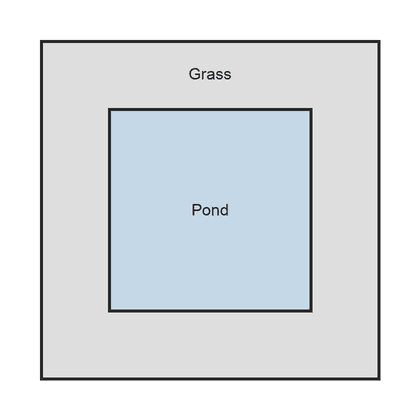
(a) Find the side of the park and the side of the pond by the prime factor method.
(b) Find the width of the grass strip.
(c) Find the area of the grass strip, and the cost of putting new grass on it at ₹ 18 per m².
- 385 marks
Question 38
Competency: Analysis & Evaluation
The bar graph shows the areas of four square garden beds A, B, C and D in a school garden. (Hypothetical data.)
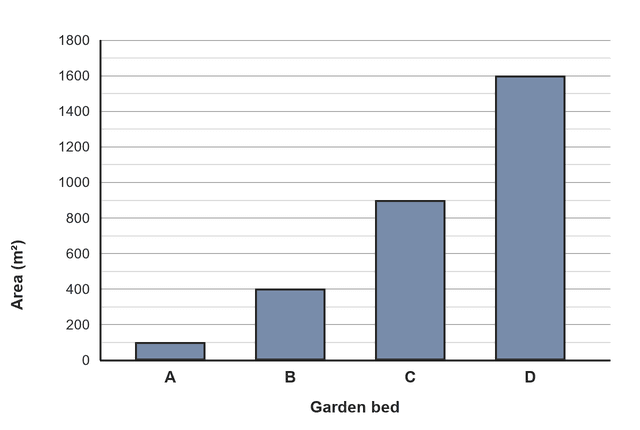
(a) Read the area of each bed from the graph, and find the side of each bed.
(b) Each bed is fenced once all round. Find the total length of fencing needed for the four beds.
(c) A new square bed E is made whose area equals the total area of beds C and D. Find the side of E. Is it equal to the sum of the sides of C and D? What do the numbers 30, 40 and the side of E form?
- 394 marks
Question 39
Competency: Application & Evaluation
A tailor wants to cut a square tablecloth of area m² from a roll of cloth. The roll comes in two widths, 1.5 m and 1.8 m, and the cloth is sold in lengths which are multiples of 5 cm. The 1.8 m wide cloth costs ₹ 240 per metre. Ignore any cloth needed for hems. (Hypothetical data.)
(a) Find the side of the tablecloth correct to two decimal places, using the division method.
(b) Which roll or rolls can be used? Give a reason.
(c) Find the least length of the 1.8 m wide cloth that the tailor must buy, and its cost.
- 405 marks
Question 40
Competency: Analysis
The floor of a hall is a square covered with square tiles, with the same number of tiles along every side. The tiles along the four edges form a ring of dark tiles, and all the other tiles are light. The figure shows a small model of such a floor. (Hypothetical data.)
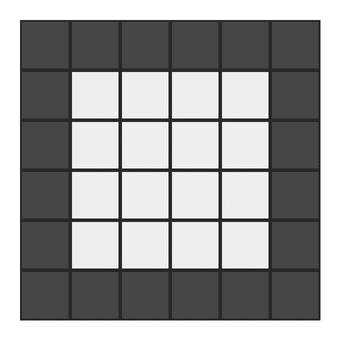
(a) For the model in the figure, count the tiles along one side and the dark tiles. Show that the number of dark tiles is , and say why 4 is subtracted.
(b) In the real hall there are 96 dark tiles. Find the number of tiles along one side and the total number of tiles in the hall.
(c) Show that the number of light tiles in the real hall is a perfect square, and find its square root. How does the figure help you see why?