
Opening your dashboard
Class 8 Maths Chapter 25 Probability: Competency-Based Questions (CBQ)
40 questions on Chapter 25, each worked through on its own page with the AI tutor. Class 8 Maths, ICSE 2026-27.
40 questions
1–5 marks · Mixed difficulty
- 11 mark
Question 1
Competency: Understanding
A cricket captain has called "heads" at the toss in four matches, and the fair coin has shown heads all four times. He is about to toss the same coin for the fifth match.
What is the probability that the coin shows heads this time?
- 21 mark
Question 2
Competency: Analysis
A parking lot has 40 slots numbered 1 to 40. A car is given one slot at random.
What is the probability that the slot number has the digit 3 in it?
- 31 mark
Question 3
Competency: Application
A lucky-dip box at a school fair has 200 folded chits. Of these, 8 chits win a big prize, 32 win a small prize and the rest say "Try again". Meena picks one chit without looking.
What is the probability that she wins a prize?
- 41 mark
Question 4
Competency: Analysis
Three friends want to decide who pays for the snacks. Each of them tosses a fair coin at the same time. If all three coins show the same face, they toss again.
What is the probability that they have to toss again?
- 51 mark
Question 5
Competency: Application
A health camp records the blood groups of the 40 students of a class.
Blood group A B AB O No. of students 12 14 4 10 One student of the class is chosen at random. What is the probability that the student's blood group is A or B?
- 61 mark
Question 6
Competency: Understanding
Assertion (A): The probability that a kabaddi team wins its next match is 0.7. So the probability that it does not win the match is 0.3.
Reason (R): For any event , .
- 72 marks
Question 7
Competency: Evaluation
A bag has 3 red balls and 5 blue balls of the same size. One ball is drawn without looking.
Tina writes: "P(red) , because there are 3 red balls and 5 blue balls."
Find the correct probability and explain Tina's mistake.
- 82 marks
Question 8
Competency: Application
A box has 6 red tokens and 4 blue tokens of the same size. A teacher wants the probability of drawing a red token to become . She will only add blue tokens.
How many blue tokens must she add? Check your answer.
- 92 marks
Question 9
Competency: Analysis
Rahul drops a drawing pin on a table 200 times. It lands "point up" 124 times and "point down" the other times.
(a) From these trials, what is the chance that the pin lands point up on the next drop?
(b) Are "point up" and "point down" equally likely outcomes for this pin? Give a reason from the data.
- 102 marks
Question 10
Competency: Application
In a school canteen, the lunch token machine gives one snack and one drink at random. The snacks are samosa (S), idli (I) and sandwich (W). The drinks are tea (T) and juice (J). All combinations are equally likely.
Write all the possible outcomes. Find the probability that a student gets juice with a snack that is not a samosa.
- 113 marks
Question 11
Competency: Analysis
A shop has 80 school shirts on a shelf, mixed together.
Size S M L XL No. of shirts 15 30 25 10 A shirt is picked from the shelf at random.
(a) Find the probability that it is of size M, and the probability that it is not XL.
(b) Ten shirts of size M are sold. A shirt is now picked at random from those left. Find the new probability of getting size M and of getting size L.
(c) No shirt of size L was sold. Did the probability of getting size L still change? Explain.
- 123 marks
Question 12
Competency: Analysis & Evaluation
Three friends play a game with two dice. The two dice are thrown together.
- Ali gets a point if the sum of the two numbers is 7.
- Bina gets a point if both dice show the same number.
- Chitra gets a point if the sum is 10 or more.
Chitra complains, "My rule is the hardest. I need big numbers on both dice." Find the probability that each friend gets a point in one throw. Is Chitra's complaint correct?
- 133 marks
Question 13
Competency: Creativity
Twenty identical cards are numbered 1 to 20 and put in a box. One card is drawn at random.
For this experiment, make up three events of your own:
- one event whose probability is ,
- one sure event, and
- one impossible event.
For each event, list or describe the favourable outcomes and show that its probability is what it should be.
- 145 marks
Question 14
Competency: Application & Analysis
Case study: A school asks its 120 students of Class 8 how they come to school. Every student gives one answer. The results are shown below.
Bus Cycle Walk Total Girls 30 18 12 60 Boys 24 26 10 60 Total 54 44 22 120 (a) One student of Class 8 is chosen at random. Find the probability that the student comes by bus.
(b) One student of Class 8 is chosen at random. Find the probability that the student is a girl who cycles, and the probability that the student does not walk to school.
(c) Now one student is chosen at random from the girls only, and one from the boys only. Find the probability of "comes by bus" for each. Who is more likely to come by bus, a girl or a boy? Why is neither answer equal to the answer of part (a)?
- 154 marks
Question 15
Competency: Analysis & Evaluation
Case study: Riya and Kabir play with a well-shuffled pack of 52 playing cards. The pack has four suits: hearts and diamonds are red, clubs and spades are black. Each suit has 13 cards: ace, 2 to 10, jack, queen and king. The jack, queen and king are called face cards.
(a) Riya draws one card at random from the full pack. Find the probability that it is a king.
(b) Find the probability that the card she draws is a red face card.
(c) Riya's card is the king of hearts. She keeps it on the table and does not put it back. Kabir now draws one card from the remaining pack. Riya says, "Your chance of getting a king is still ." Is she right? Find Kabir's probability of getting a king, and say whether it is more or less than .
- 161 mark
Question 16
Competency: Analysis
Two dice are thrown together. The grid shows all 36 equally likely outcomes. Each cell is one outcome: the row gives the number on the first die and the column gives the number on the second die. The shaded cells are the outcomes of an event E.

The probability of the event E is
- 171 mark
Question 17
Competency: Application & Analysis
A jar holds only red marbles and blue marbles, and the numbers of red and blue marbles are in the ratio . Rohan shuffles the jar and takes out one marble without looking.
The chance that the marble is blue is
- 181 mark
Question 18
Competency: Application
A month of the year is chosen at random.
The probability that the month does not have 31 days is
- 191 mark
Question 19
Competency: Application & Analysis
Thirty identical tokens, numbered 1 to 30, are put in a bag. One token is drawn at random.
The probability that the number on it is a factor of 30 is
- 201 mark
Question 20
Competency: Analysis & Evaluation
Assertion (A): One card is picked without looking from a shuffled pack of 52 playing cards. The chance that it is a red face card is the same as the chance that it is a black face card.
Reason (R): Each of the 4 suits has 3 face cards, and two of the suits are red and two are black.
- 211 mark
Question 21
Competency: Analysis & Evaluation
Assertion (A): A box has 6 identical tokens marked 1, 2, 2, 3, 3, 3. A token is picked at random. The probability that the token is marked 3 is .
Reason (R): The tokens show only 3 different marks, 1, 2 and 3, so each of these marks has the probability .
- 221 mark
Question 22
Competency: Application
From its past record, the probability that a school football team wins its next match is 0.45 and the probability that it loses is 0.35. A match can end only in a win, a loss or a draw. (Hypothetical data.)
The probability that the next match is a draw is
- 231 mark
Question 23
Competency: Understanding & Analysis
A die is thrown once. Two events are complementary when exactly one of them must happen, so every outcome belongs to one of them and to only one.
Which pair of events is complementary?
- 241 mark
Question 24
Competency: Analysis
A two-digit number is chosen at random from all the two-digit numbers, 10 to 99.
The probability that it is a multiple of 11 is
- 251 mark
Question 25
Competency: Application & Analysis
A spinner has 10 equal sectors carrying the numbers shown. The spinner is spun and comes to rest at random, with one sector against a fixed pointer.
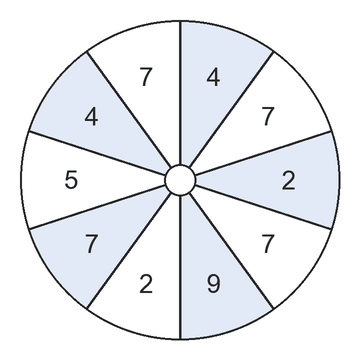
The probability that the arrow stops on a prime number is
- 262 marks
Question 26
Competency: Understanding & Analysis
A ₹1 coin, a ₹2 coin and a ₹5 coin are tossed together. Each outcome is written in this order: ₹1 coin, ₹2 coin, ₹5 coin. For example, HHT means that the ₹1 coin and the ₹2 coin show heads and the ₹5 coin shows a tail.
(a) Write all the outcomes in which the ₹1 coin and the ₹2 coin show the same face.
(b) Find the probability that the ₹1 coin and the ₹2 coin show the same face and the ₹5 coin shows a head.
- 272 marks
Question 27
Competency: Application
A date is chosen at random from the 31 dates of the month of March.
(a) Find the probability that the date is a multiple of 5 or a multiple of 7.
(b) Find the probability that the date is neither a multiple of 5 nor a multiple of 7.
- 282 marks
Question 28
Competency: Application
Ten coins are put in a bag: four ₹1 coins, three ₹2 coins and three ₹5 coins. One coin is taken out without looking, and each coin is equally likely to be taken.
(a) Find the probability that the value of the coin is a prime number of rupees.
(b) Find the probability that the value of the coin is an odd number of rupees.
- 292 marks
Question 29
Competency: Analysis
Three cards carry the digits 3, 4 and 5. Two cards are drawn one after the other, and the first card is not put back. The first digit drawn is the tens digit and the second digit drawn is the ones digit of a two-digit number.
(a) Write all the possible two-digit numbers.
(b) Find the probability that the number formed is divisible by 3.
- 302 marks
Question 30
Competency: Analysis
The 10 letters of the word CHANDIGARH are written one on each of 10 identical cards. Aditi shuffles the cards and picks one.
(a) Find the probability that the letter on the card is one that occurs twice in the word.
(b) Find the probability that the letter on the card occurs only once in the word.
- 312 marks
Question 31
Competency: Understanding & Application
Four friends, one after the other, toss the same coin once each and note the faces.
(a) How many outcomes are possible for the four tosses?
(b) Find the probability of getting no head.
(c) Find the probability of getting at least one head.
- 323 marks
Question 32
Competency: Creativity & Evaluation
Anu, Bela and Chitra want to choose one of them fairly to lead the school assembly, and each must have the same chance.
(a) Make a rule that uses one throw of a die to choose one of the three girls. Show that each girl has the probability .
(b) A fourth girl, Divya, joins them. Make a rule that uses two tosses of a coin to choose one of the four. Show that each has the probability .
(c) Deepa suggests, “Toss a coin twice and count the heads. For no head choose Anu, for one head choose Bela and for two heads choose Chitra.” Is this fair to the three girls? Give a reason.
- 333 marks
Question 33
Competency: Application & Analysis
In a board game, a player can start only when at least one of the two dice, thrown together, shows 6. Priya throws the two dice together.
(a) In how many of the 36 equally likely outcomes does at least one die show 6?
(b) Find the probability that Priya can start.
(c) Find the probability that she cannot start, and check your answer to (b).
- 343 marks
Question 34
Competency: Analysis & Evaluation
In a school raffle, 99 tickets numbered 1 to 99 are sold and one ticket is drawn at random. Rita has all the tickets whose numbers are multiples of 10. Sam has all the tickets whose numbers end in the digit 3. Tina has all the tickets whose numbers are perfect squares. No ticket belongs to two of them.
(a) How many tickets does each of them have?
(b) Find the probability that each of them wins.
(c) Who has the best chance of winning? Do any two of them have the same chance?
- 353 marks
Question 35
Competency: Application & Analysis
A craft box holds only red, blue and green beads. Meera picks one bead without looking. The probability that it is red is and the probability that it is green is . The box has 24 green beads. (Hypothetical data.)
(a) How many beads are there in the box?
(b) How many red beads are there?
(c) Find the probability of getting a blue bead, and the number of blue beads.
- 363 marks
Question 36
Competency: Application & Analysis
A full pack has 52 playing cards in four suits of 13 cards each. Hearts and diamonds are the red suits and spades and clubs are the black suits. In every suit, the jack, the queen and the king are called face cards.
Kabir loses the whole suit of diamonds from his pack. His sister shuffles the cards that are left and picks one.
(a) Find the probability that the card is red.
(b) Find the probability that the card is a king, and the probability that it is a face card.
(c) For a full pack of 52 cards, these three probabilities are , and . Which of the three probabilities have changed after the diamonds were lost?
- 375 marks
Question 37
Competency: Analysis & Evaluation
Case study — A game of tambola
In tambola (housie), the numbers 1 to 90 are written on 90 identical tokens and put in a bag. The caller draws one token at random and reads out the number. Raju has the ticket shown below, which carries 15 different numbers.
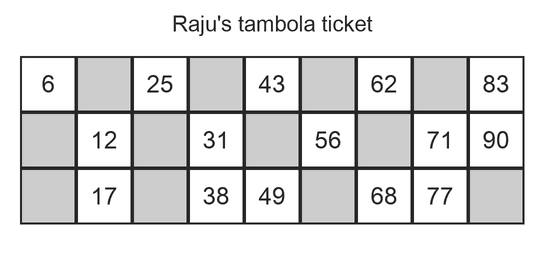
(a) Find the probability that the first number called is on Raju's ticket, and the probability that it is not on his ticket.
(b) Find the probability that the first number called is an even number that is on Raju's ticket.
(c) Raju says, “The first number called is just as likely to be a number of my ticket that is greater than 50 as a number of my ticket that is less than 50.” Is he right? Give a reason.
- 384 marks
Question 38
Competency: Application & Analysis
Case study — Beads for the craft class
The craft teacher keeps beads of three colours in three bags. The table shows the number of beads in each bag. (Hypothetical data.)
Bag Red Blue Green Total Bag X 6 4 2 12 Bag Y 9 8 3 20 Bag Z 10 12 8 30 A bead is drawn at random from a bag, without looking.
(a) Find the probability of getting a red bead from each of the three bags.
(b) From which bag is a red bead most likely? In which two bags is a blue bead equally likely?
(c) The beads of Bag Y and Bag Z are now poured into one big bag and mixed. Find the probability of getting a red bead from the big bag. Is it between the probabilities for Bag Y and Bag Z?
- 395 marks
Question 39
Competency: Analysis & Evaluation
Case study — Tossing coins in class
For a class activity, each of 80 students tossed an ordinary coin three times and counted the number of heads. The table shows how many students got each number of heads. (Hypothetical data.)
Number of heads 0 1 2 3 Number of students 8 31 33 8 (a) Write all the possible outcomes of tossing a coin three times. Find the probability of getting 0, 1, 2 and 3 heads.
(b) Using these probabilities, about how many of the 80 students should get each number of heads? Compare with the table.
(c) Aman says, “Our results are different from your answers, so our coins must be unfair.” Is he right? Give a reason.
- 404 marks
Question 40
Competency: Analysis & Evaluation
Case study — A weather forecast
A newspaper gives the probability of rain on each of four days of a week. (Hypothetical data.)
Day Monday Tuesday Wednesday Thursday Probability of rain 0.15 0.40 0.65 0.80 (a) Find the probability that it does not rain on each day.
(b) On which days is it more likely to rain than not to rain?
(c) Meena adds the four probabilities of rain and says, “The probability that it rains on all four days is 2.” Explain why this cannot be right.