
Opening your dashboard
Class 8 Maths Chapter 13 Factorisation: Competency-Based Questions (CBQ)
40 questions on Chapter 13, each worked through on its own page with the AI tutor. Class 8 Maths, ICSE 2026-27.
40 questions
1–5 marks · Mixed difficulty
- 11 mark
Question 1
Competency: Application
A rectangular notice board has area cm². Its breadth is cm. The length of the board is
- 21 mark
Question 2
Competency: Understanding
Rina has to factorise by splitting the middle term. She must look for two numbers whose
- 31 mark
Question 3
Competency: Application
A flat metal washer is a circle of radius 8.5 cm with a circular hole of radius 5.5 cm cut out of its middle. Its area is . Taking , the area of the washer is
- 41 mark
Question 4
Competency: Analysis
Riya wants to add a number to so that the result is a perfect square trinomial. The number she must add is
- 51 mark
Question 5
Competency: Analysis
At a school fair every child pays ₹ for a ride and ₹ for a snack. In the morning children come and in the evening children come. The total collection is ₹ . Which product gives the same collection?
- 61 mark
Question 6
Competency: Evaluation
Assertion (A) : is a complete factorisation.
Reason (R) : An expression is completely factorised when none of its factors can be factorised any further.
- 72 marks
Question 7
Competency: Application
A caterer charges ₹ 37 for a plate of food. On Saturday he serves 46 plates and on Sunday he serves 54 plates.
Write his total earning for the two days as a sum of two products. Then find it mentally by taking out a common factor. In the same way find .
- 82 marks
Question 8
Competency: Analysis
Two square plots lie side by side along a road. Their sides add up to 40 m. The bigger plot has 320 m² more area than the smaller plot.
Find the side of each plot.
- 92 marks
Question 9
Competency: Evaluation
Sana's notebook shows this working:
"There is no common factor now, so this trinomial cannot be factorised," she writes.
Find the mistake in Sana's working and factorise the trinomial correctly.
- 102 marks
Question 10
Competency: Application
A square kitchen garden has area m², where is greater than 2.
Find the side of the garden in terms of . If , find the length of fencing needed to go once around the garden.
- 113 marks
Question 11
Competency: Analysis & Evaluation
Rohit tries a few numbers in : for he gets 6, for he gets 24 and for he gets 60. He claims, "For every whole number greater than 1, is divisible by 6."
(a) Factorise completely.
(b) Use your factors to find the value of for .
(c) Is Rohit's claim always true? Justify using the factors.
- 123 marks
Question 12
Competency: Creativity
Make a "factor puzzle" for your classmates.
(a) Choose two binomials of your own, one in and one in , and multiply them to get an expression with four terms.
(b) Write the four terms in a jumbled order, and show how a classmate can get your two binomials back by grouping.
(c) Show one way of pairing the four terms that does not help, and say why.
- 133 marks
Question 13
Competency: Application
A group of friends go out for dinner. The bill is ₹ and they share it equally.
(a) Factorise the bill amount.
(b) Write the share of each friend in terms of .
(c) Each friend pays ₹ 25. Find the number of friends and the bill amount. Check the bill with the original expression.
- 145 marks
Question 14
Competency: Application & Analysis
Case study: An architect plans three rectangular rooms. The floor areas are given in terms of , where is greater than 3.
Room Floor area (m²) Hall Store Bedroom (a) Factorise each area. Which room is a square?
(b) The architect wants to put the three rooms in one row, so that they all have the same width. Show that this is possible. Write the common width and the total length of the row.
(c) For , find the total floor area of the three rooms in two ways: by adding the three areas, and by using the width and the total length from part (b).
- 154 marks
Question 15
Competency: Application & Evaluation
Case study: A carpenter has a square board of side 65 cm. He cuts away a square piece of side 35 cm from one corner. An L-shaped board is left.
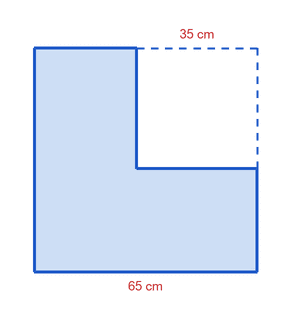
(a) Write the area of the L-shaped board as a difference of two squares. Find it by factorising, without squaring 65 or 35.
(b) The carpenter cuts the L-shaped board into two pieces and joins them to make one rectangle, with nothing wasted. Use your factors to suggest the length and breadth of this rectangle.
(c) His helper says, "The board that is left has area cm²." Explain why the helper is wrong. By how much is his answer too small?
- 161 mark
Question 16
Competency: Analysis
In a class quiz, Riya has to write as a product of two brackets. She notices that the two brackets and are not the same.
The correct product is
- 171 mark
Question 17
Competency: Analysis
(Hypothetical data.) A stationery shop packs boxes, where . The total number of pencils in the boxes is , and every box holds the same number of pencils.
The number of pencils in one box is
- 181 mark
Question 18
Competency: Application
Ravi wants to multiply without a calculator. He notices that both numbers are 3 away from 50, and writes them as and .
Using the factors of a difference of two squares, his answer is
- 191 mark
Question 19
Competency: Analysis
A teacher writes four trinomials on the board and says that exactly one of them has as a factor.
The trinomial is
- 201 mark
Question 20
Competency: Analysis
Anil knows that is one factor of the trinomial .
The value of is
- 211 mark
Question 21
Competency: Understanding
Meera has the three kinds of tile shown below.
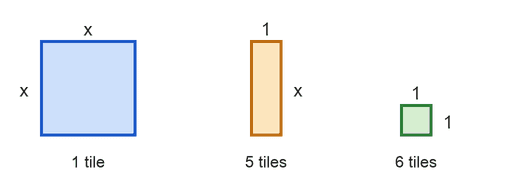
She fits all of her tiles (1 big square, 5 strips and 6 small squares) into one rectangle, with no gaps and no overlaps.
The sides of the rectangle are
- 221 mark
Question 22
Competency: Evaluation
Assertion (A): The expressions and have the same factorisation, .
Reason (R): Changing the order in which the terms of an expression are written does not change the expression.
- 231 mark
Question 23
Competency: Evaluation
Assertion (A): .
Reason (R): The difference of two squares, , can be written as .
- 241 mark
Question 24
Competency: Analysis
Kavya wants to factorise . She lists the pairs of integers whose product is , with their sums.
Pair Product Sum The factorisation of is
- 251 mark
Question 25
Competency: Evaluation
Dev claims that . To test the claim he puts a value of in both sides.
Which value of would not show that his claim is wrong?
- 262 marks
Question 26
Competency: Application
(Hypothetical data.) A school fund of ₹ is shared equally among students, where is a positive whole number.
(a) Factorise the fund by taking out the highest common factor.
(b) Write each student's share in terms of . Find the share when .
- 272 marks
Question 27
Competency: Analysis & Evaluation
Ishaan tries to factorise by grouping. He writes
and says, "The brackets do not match, so the expression cannot be factorised." Dilip says, "One grouping is not enough to be sure."
Assume that a factorisation would have the form . Use this to decide whether the expression can be factorised in this form.
- 282 marks
Question 28
Competency: Application
(Hypothetical data.) A rope of length metres is cut into equal pieces, each metres long, where .
(a) Factorise the length of the rope.
(b) Write the number of pieces in terms of . Find it when .
- 292 marks
Question 29
Competency: Application
(Hypothetical data.) A rectangular notice board has an area of 60 square decimetres and a perimeter of 34 decimetres. Its length and breadth are whole numbers of decimetres.
(a) Find the length and the breadth.
(b) Use these two numbers to factorise .
- 302 marks
Question 30
Competency: Application
In a mental-maths contest, Neha has to find the value of each expression without squaring any large number.
(a)
(b)
Show how a perfect square trinomial helps her.
- 312 marks
Question 31
Competency: Application
(Hypothetical data.) A closed box in the shape of a cuboid has a volume of cm³, where .
(a) Factorise the volume completely, to get three expressions for the length, breadth and height of the box.
(b) Find the three dimensions and the volume when .
- 323 marks
Question 32
Competency: Understanding
(Hypothetical data.) The ground floor of a hall has 25 rows and the balcony has 15 rows. In every row there are 14 seats on the left side and 6 seats on the right side.
(a) Write the total number of seats as the sum of four products.
(b) Group the four products in pairs and take out a common factor to write the total as one product.
(c) Find the total number of seats.
- 333 marks
Question 33
Competency: Analysis & Evaluation
Sara and Tom both factorise by splitting the middle term. Sara writes as . Tom writes it as .
(a) Show how the numbers and can be found.
(b) Complete both factorisations.
(c) Are the two answers the same? Explain.
- 343 marks
Question 34
Competency: Application & Analysis
(Hypothetical data.) A designer cuts two identical square tiles from a sheet. Together the two tiles have an area of cm², where .
(a) Take out the common factor to find the area of one tile.
(b) Factorise the area of one tile, to find the side of a tile in terms of .
(c) Find the side and the area of one tile when .
- 353 marks
Question 35
Competency: Analysis
Rahul is given three expressions. For each one, state the method you would use first and give its complete factorisation.
(i)
(ii)
(iii)
- 363 marks
Question 36
Competency: Creativity
(a) Write a short real-life problem, not about the area of a rectangle, whose answer needs the expression to be factorised.
(b) Solve your problem by factorising.
(c) Check your answer by choosing in your problem.
- 374 marks
Question 37
Competency: Analysis & Evaluation
Case study: Meera factorises and gets . To test her answer she fills this table.
(a) For which values of in the table do the two columns agree?
(b) What does the table tell you about Meera's factorisation? Find the correct factorisation.
(c) Meera first tried only and was satisfied. Explain why this test was not enough.
- 385 marks
Question 38
Competency: Application & Analysis
Case study: (Hypothetical data.) A square courtyard is covered with square tiles, with tiles along each side, where . The tiles along the border are blue, and all the tiles inside the border are white.
(a) Write the number of white tiles in terms of . Write the number of blue tiles as a difference of two squares, and factorise it.
(b) Find the number of blue tiles when .
(c) A courtyard of this kind has exactly 96 blue tiles. Find . Can such a courtyard have exactly 50 blue tiles? Give a reason.
- 395 marks
Question 39
Competency: Analysis & Evaluation
Case study: Kabir squares pairs of consecutive odd numbers and subtracts. He records his results in a table.
Pair Difference of squares and and and and (a) Let the smaller odd number be , so that the larger one is . Factorise and simplify it.
(b) Use your result to find without squaring either number.
(c) Every result in Kabir's table is a multiple of 8. Explain why this is true for every pair of consecutive odd numbers. Can the difference of the squares of two consecutive odd numbers be 100? Give a reason.
- 405 marks
Question 40
Competency: Application & Analysis
Case study: (Hypothetical data.) Three friends ride from the same starting point on a cycle track. The table gives the distance each one covered and the time each one took, where . Each rides at a steady speed.
Rider Distance (km) Time (hours) Asha Bala Chitra (a) Factorise each distance, and write each rider's speed in terms of .
(b) For , find the distance, the time and the speed of each rider. Who rides the farthest?
(c) Show that the fastest rider is faster than the slowest rider by the same number of km per hour, whatever the value of . Find this number.