
Opening your dashboard
Class 8 Chemistry Chapter 5 Language of Chemistry: Competency-Based Questions (CBQ)
40 questions on Chapter 5, each worked through on its own page with the AI tutor. Class 8 Chemistry, ICSE 2026-27.
40 questions
1–5 marks · Mixed difficulty
- 11 mark
Question 1
Cognitive domain: Application
Ravi is helping the laboratory assistant to print new labels for the store room. For a bottle of grey cobalt metal powder he types the label CO. The assistant tells him that this label could cause a serious mistake.
Why is the label wrong?
- 21 mark
Question 2
Cognitive domain: Application
A water-testing laboratory reports the ions found in a sample of borewell water.
Positive ions Negative ions , , , , Nikhil writes the formulae of four salts that can be formed from these ions. Which formula has he written wrongly?
- 31 mark
Question 3
Cognitive domain: Understanding
The packet of baking soda in Farida's kitchen carries the words sodium bicarbonate, .
Which statement reads this formula correctly?
- 41 mark
Question 4
Cognitive domain: Analysis
In a blast furnace, iron (III) oxide is heated with carbon monoxide. Iron and carbon dioxide are formed. Asha writes the skeletal equation and counts the atoms.
Element Atoms on the left Atoms on the right Fe 2 1 O 4 2 C 1 1 Which change will balance the equation correctly?
- 51 mark
Question 5
Cognitive domain: Understanding
Assertion (A): The formula of slaked lime (calcium hydroxide) used for whitewashing is written and not .
Reason (R): When a radical made of more than one atom is taken two or more times in a formula, the radical is enclosed in a bracket and the number is written outside it.
- 61 mark
Question 6
Cognitive domain: Understanding
Assertion (A): The equation , taken by itself, does not tell a lime-kiln worker that limestone has to be heated strongly to get quicklime.
Reason (R): Conditions such as temperature, pressure and catalyst cannot be shown in a chemical equation in any way.
- 71 mark
Question 7
Cognitive domain: Recall
The label on a bottle of packaged drinking water lists the dissolved minerals: calcium, magnesium, bicarbonates, chlorides, sulphates.
Fill in the blanks.
In the water, calcium and magnesium are present as ions that carry a ________ charge. Such ions are called cations or ________ radicals. The bicarbonate ion has the symbol ________, and the valency of the sulphate ion is ________.
- 81 mark
Question 8
Cognitive domain: Application
Two jars in the school store hold oxides of copper. The new jar is labelled cupric oxide, CuO. The old jar has only a faded name, cuprous oxide. The laboratory assistant wants a fresh label for the old jar.
Write the modern name (with a Roman numeral) and the formula of cuprous oxide.
- 91 mark
Question 9
Cognitive domain: Understanding
Meenal mixes blue copper sulphate solution with sodium hydroxide solution and writes the equation for the reaction.
Look at the formulae on both sides. Identify the two groups of atoms that have moved from one compound to another without breaking up, and give the general name for such a group.
- 102 marks
Question 10
Cognitive domain: Application
While clearing an old chemical store, Sister Agnes finds two tins with labels in the old style: stannic oxide and plumbous oxide. She asks Class 8 to prepare modern labels. (Tin shows valencies 2 and 4. Lead shows valencies 2 and 4.)
(a) Write the modern name of each compound and state the valency of the metal in it.
(b) Work out the formula of each compound by the criss-cross method. Show the step in which the numbers are reduced.
- 112 marks
Question 11
Cognitive domain: Analysis
A farmers' co-operative shop sells two fertilisers that supply nitrogen to crops: ammonium nitrate, , and ammonium sulphate, .
(H = 1, N = 14, O = 16, S = 32)
(a) Calculate the molecular mass of each compound.
(b) Count the nitrogen atoms in one molecule of each. Then decide, without any long calculation, in which compound nitrogen makes up the larger share of the mass. Give your reasoning.
- 122 marks
Question 12
Cognitive domain: Evaluation
Kabir weighs a piece of magnesium ribbon. Its mass is 2.4 g. He burns it completely in a crucible, taking care that no ash escapes, and weighs the white ash. Its mass is 4.0 g. He writes in his notebook:
"The mass went up, so matter was created. This breaks the law of conservation of mass, and the equation must be wrong."
(Mg = 24, O = 16)
Evaluate Kabir's conclusion. Use the equation and his two readings to support your answer.
- 134 marks
Question 13
Cognitive domain: Application
In many towns the tap water comes from borewells and is "hard". It contains dissolved calcium hydrogen carbonate. When this water is boiled in a kettle, the calcium hydrogen carbonate breaks up into calcium carbonate, water and carbon dioxide. The calcium carbonate does not dissolve. It sticks to the inside of the kettle as a white crust called scale. Ananya's mother removes the scale by leaving some vinegar in the kettle for an hour. Vinegar contains acetic acid, . It reacts with the scale to form calcium acetate, which dissolves in water, along with water and carbon dioxide.
(a) Use the ions and to write the formula of calcium hydrogen carbonate. How many atoms of each element are there in one molecule?
(b) Write the equation for the change that takes place when the hard water is boiled. Make a table of atoms to decide whether any numbers have to be added to balance it.
(c) The acetate ion is . Write the formula of calcium acetate, and then write the balanced equation for the action of vinegar on the scale. Show that your equation is balanced.
- 144 marks
Question 14
Cognitive domain: Analysis
A child with loose motions loses a lot of water and salts from the body. The health worker at the village centre gives Vivek's mother packets of ORS (oral rehydration salts). The powder in one packet is dissolved in one litre of clean drinking water, and the child sips the solution through the day. It puts back the lost water and salts, and its glucose gives energy. Vivek copies part of the label into his notebook.
Compound Formula Mass in one packet Sodium chloride NaCl 2.6 g Potassium chloride KCl 1.5 g Glucose 13.5 g (H = 1, C = 12, O = 16, Na = 23, Cl = 35.5, K = 39)
(a) How many different elements are present in these three compounds taken together? Name the positive and negative radicals present in the two salts.
(b) Calculate the molecular mass of each of the three compounds.
(c) Vivek says, "We reduce to CaO. In the same way the formula of glucose should be reduced to ." Is he right? Use the meaning of a molecular formula and your answer to (b) to explain.
- 155 marks
Question 15
Cognitive domain: Creativity
For a science-fiction story in the school magazine, the editors invent two new metals and name them kalpanium and navium. They want symbols that follow the rules used for real elements. These symbols are already in use and cannot be taken again: N, Na, Ne, Ni, K, Kr.
Three editors suggest a symbol for kalpanium.
Editor Suggested symbol Tara K Joseph KA Imran ka (a) Examine each suggestion and state why it cannot be accepted.
(b) Propose one suitable symbol for kalpanium and one for navium. Explain how each of your symbols follows the rules.
(c) In the story, an atom of kalpanium loses three electrons when it combines. Using your symbol, write the symbol of its ion, and work out the formulae of its oxide and its sulphate.
(d) Kalpanium burns in oxygen to form its oxide. Write a balanced equation for this reaction, using your symbol.
- 161 mark
Question 16
Cognitive domain: Analysis
A student studies four particles from a chart. For each one, the chart gives the number of protons (positive charges) and electrons (negative charges).
Particle Protons Electrons P 11 10 Q 17 18 R 12 12 S 8 10 Which statement about these particles is correct?
- 171 mark
Question 17
Cognitive domain: Application
Ritu draws a model of the starting mixture used to make ammonia. Each pair of joined circles is one molecule.
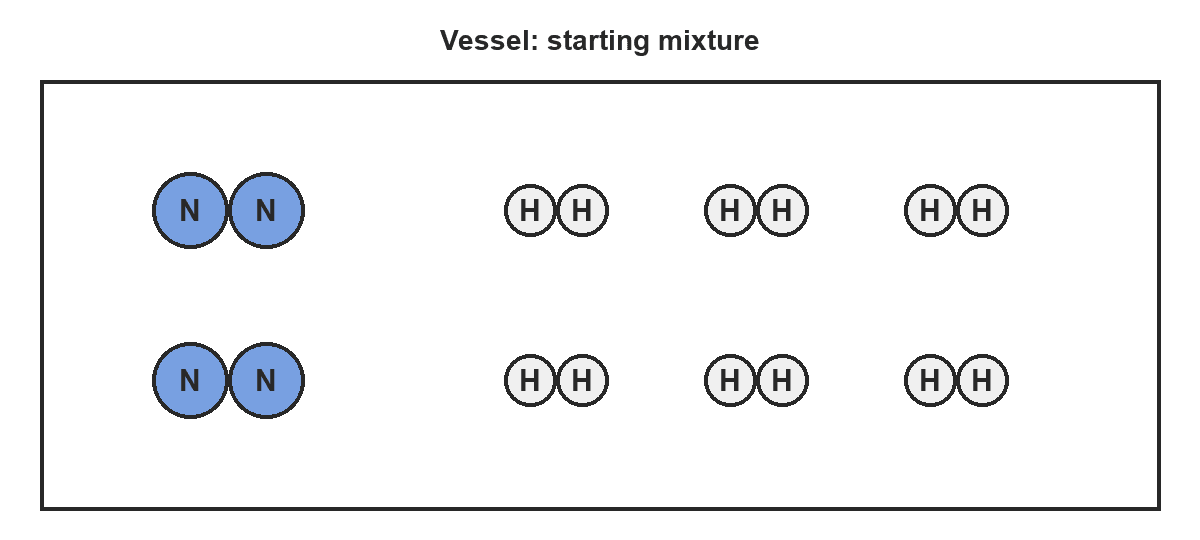
She writes the skeletal equation . Assume that all the nitrogen and all the hydrogen in the vessel react completely to form ammonia. (In a real plant only part of the mixture reacts each time.)
How many molecules of ammonia can form from this mixture?
- 181 mark
Question 18
Cognitive domain: Analysis
A laboratory report lists two oxides of iron found in a sample from a steel plant.
Oxide Formula Oxide 1 Oxide 2 The valency of oxygen is 2 in both. Which statement is correct?
- 191 mark
Question 19
Cognitive domain: Understanding
Iron filings and sulphur powder are mixed and heated. The reaction is written as:
Which of the following is a correct reading of this equation?
- 201 mark
Question 20
Cognitive domain: Understanding
Assertion (A): Nitrogen has a valency of 3 in ammonia, , but a valency of 4 in nitrogen dioxide, .
Reason (R): All non-metals show only one valency.
- 211 mark
Question 21
Cognitive domain: Analysis
Assertion (A): A molecule of magnesium nitrate, , contains only 3 atoms in all.
Reason (R): The number 2 written outside a bracket multiplies every atom inside the bracket.
- 221 mark
Question 22
Cognitive domain: Analysis
A teacher writes four expressions about chlorine on the board: , , and .
Four students match the expressions, in this order, with their meanings. Which student is correct?
- 231 mark
Question 23
Cognitive domain: Application
Neha has five radical cards: , , , and . She picks one positive card and one negative card, writes the formula of the compound by the criss-cross method, and counts all the atoms in one molecule.
Which pair of cards gives a compound with exactly 7 atoms in one molecule?
- 241 mark
Question 24
Cognitive domain: Analysis
Aluminium sulphate is used in some towns to clear muddy water. It is a compound of aluminium ions and sulphate ions. A chemist analyses one molecule of it and records the atoms present.
Element Atoms in one molecule Aluminium 2 Sulphur 3 Oxygen 12 Which formula agrees with the table and with the valencies of the two radicals?
- 251 mark
Question 25
Cognitive domain: Application
In the school store, three bottles of sodium salts have lost their names. Their formulae are still readable.
Bottle Formula 1 2 3 Which row gives the correct names of the three compounds?
- 262 marks
Question 26
Cognitive domain: Application
A teacher holds up two gas jars. One holds sulphur dioxide, , the choking gas formed when sulphur burns in air. The other holds sulphur trioxide, , another oxide of sulphur. Oxygen has valency 2 and hydrogen has valency 1.
(a) Find the valency of sulphur in and in . Show your working.
(b) Hydrogen sulphide is . Using this compound as well, say what your three results show about sulphur.
- 272 marks
Question 27
Cognitive domain: Analysis
Potassium sulphide, , is made from potassium and sulphur.
(a) Write one change for a potassium atom and one change for a sulphur atom, showing the electrons lost or gained and the ion formed in each case.
(b) Use these two changes to explain why two potassium ions are needed for every sulphide ion.
- 282 marks
Question 28
Cognitive domain: Application
A model kit has coloured balls, and each ball is marked with the symbol of its element. Two models, P and Q, are shown below.

(S = 32, O = 16, N = 14, H = 1)
(a) Write the molecular formula and the name of the compound that each model represents.
(b) Calculate the molecular mass of each compound.
- 292 marks
Question 29
Cognitive domain: Evaluation
Potassium chlorate is heated with a little manganese dioxide to get oxygen in the laboratory. At the end, the same mass of manganese dioxide is found unchanged in the test tube. The book writes the equation as:
Mehul says: "Manganese dioxide is a reactant, so it should be written on the left side." He rewrites the equation as:
(a) Count the atoms of each element on both sides of Mehul's equation and say whether it is balanced.
(b) Evaluate Mehul's statement, and explain why manganese dioxide is written above the arrow.
- 302 marks
Question 30
Cognitive domain: Application
Calcium metal, when heated strongly in nitrogen gas, combines with the nitrogen to form a solid, calcium nitride. The valency of calcium is 2 and the nitride ion is .
(a) Write the formula of calcium nitride by the criss-cross method.
(b) Write the skeletal equation for the reaction of calcium with nitrogen and balance it.
- 312 marks
Question 31
Cognitive domain: Analysis
Zinc oxide is a white powder used in sunscreens and ointments. It forms when zinc burns in oxygen. A quiz card gives the balanced equation with the product hidden as X:
(a) Count the atoms on the left side and use them to find the formula of X.
(b) Check your formula with the valencies of zinc (2) and oxygen (2), and name X.
- 323 marks
Question 32
Cognitive domain: Analysis
Rani heats 5.0 g of pure calcium carbonate strongly in a crucible. The reaction is
When she stops heating, the solid left in the crucible weighs 2.9 g. (Hypothetical data.) (Ca = 40, C = 12, O = 16)
(a) Find the molecular masses of , and .
(b) Use them to find the mass of calcium oxide that 5.0 g of calcium carbonate should give if all of it breaks up.
(c) Compare the answer with her reading and give a reason for the difference.
- 333 marks
Question 33
Cognitive domain: Application
Milk of magnesia, used as an antacid, contains magnesium hydroxide. It acts on the hydrochloric acid in the stomach to form magnesium chloride and water.
(H = 1, O = 16, Mg = 24, Cl = 35.5)
(a) Count the atoms of each element on both sides and balance the equation.
(b) Show that the balanced equation obeys the law of conservation of mass.
- 343 marks
Question 34
Cognitive domain: Evaluation
Rakesh reads the balanced equation for sodium burning in chlorine gas:
He says: "This tells us that 2 g of sodium reacts with 1 g of chlorine to give 2 g of sodium chloride." (Na = 23, Cl = 35.5)
(a) Say what the numbers in the equation really show.
(b) Find the masses of sodium, chlorine and sodium chloride that the equation represents, and show that they obey the law of conservation of mass.
- 353 marks
Question 35
Cognitive domain: Creativity
Prepare a revision card for younger students on the expression (sulphuric acid). The card must:
- explain what the big number 3 and the small numbers 2 and 4 mean;
- give the total number of atoms of each element shown and the total number of atoms;
- carry one "common mistake" warning, with the correct way to write it.
- 363 marks
Question 36
Cognitive domain: Analysis
A student is given three compounds of the same acid radical, R. The formulae of the three compounds are on the label.
Compound Formula With sodium With calcium With aluminium (a) Use any one formula to find the valency of R.
(b) R contains one atom of phosphorus and four atoms of oxygen. Write the symbol, with its charge, and the name of R.
(c) Write the formula of zinc R, using the valency of zinc, 2.
- 374 marks
Question 37
Cognitive domain: Analysis
Before modern extinguishers came into use, many buildings had soda-acid fire extinguishers. Inside, a solution of sodium bicarbonate (baking soda) was mixed with dilute sulphuric acid. They reacted to form sodium sulphate, water and carbon dioxide gas. The gas built up pressure inside the cylinder and pushed the liquid out through a nozzle on to the fire. The skeletal equation is:
(H = 1, C = 12, O = 16, Na = 23, S = 32)
(a) Name the reactants and the products, and give the number of atoms of each element in one molecule of sodium bicarbonate.
(b) Balance the equation. Show the count of atoms on each side.
(c) Using the balanced equation, find the mass of carbon dioxide formed when 168 g of sodium bicarbonate reacts completely.
- 385 marks
Question 38
Cognitive domain: Evaluation
In a fume cupboard, a teacher heats zinc powder with sulphur powder in an open crucible to form zinc sulphide, . She repeats the experiment four times with different amounts, and weighs the substances before and after heating. (Hypothetical data.)
Trial Mass of zinc (g) Mass of sulphur (g) Mass of zinc sulphide formed (g) 1 6.5 3.2 9.6 2 13.0 6.4 19.2 3 19.5 9.6 28.8 4 26.0 12.8 38.2 The equation for the reaction is:
(Zn = 65, S = 32)
(a) For each trial, find the missing mass, that is, the mass of zinc and sulphur taken minus the mass of zinc sulphide formed. Give one reason why mass goes missing from an open crucible.
(b) Use the equation to find the mass of sulphur that 6.5 g of zinc needs, and the mass of zinc sulphide it should give. Say whether the sulphur was taken in the right proportion in every trial.
(c) A student says: "Trial 4 made the most zinc sulphide, so it was done most carefully." Evaluate this statement by working out, for each trial, the missing mass as a percentage of the mass of zinc and sulphur taken.
- 394 marks
Question 39
Cognitive domain: Application
Some railway tracks are joined by a method that uses a mixture of iron (III) oxide and aluminium powder. When the mixture is lit, the aluminium takes the oxygen from the iron (III) oxide. Aluminium oxide and very hot molten iron are formed. The molten iron flows into the gap between two rails and, on cooling, joins them.
(Al = 27, Fe = 56, O = 16)
(a) Write the formulae of iron (III) oxide and aluminium oxide, by the criss-cross method.
(b) Write the skeletal equation and balance it.
(c) A welder uses 80 g of iron (III) oxide. Find the mass of aluminium powder needed to react with it completely, and the mass of iron formed.
- 405 marks
Question 40
Cognitive domain: Creativity
A teacher wants to teach balancing with a bead model. She uses one colour of bead for sodium atoms and another colour for oxygen atoms, and wants to show the reaction of sodium with oxygen:
(a) Describe how the beads can be joined to show one molecule of and one unit of . Count the beads of each colour on the two sides to show that the equation is unbalanced.
(b) Describe the steps the class should follow with the beads to balance the equation, and write the balanced equation. Give the number of beads of each colour on each side at the end.
(c) One student wants to balance the oxygen by writing the product as NaO. Use the bead model and the valencies to explain why this is not allowed.