
Opening your dashboard
Class 8 Chemistry Chapter 3 Elements, Compounds and Mixtures: Competency-Based Questions (CBQ)
40 questions on Chapter 3, each worked through on its own page with the AI tutor. Class 8 Chemistry, ICSE 2026-27.
40 questions
1–5 marks · Mixed difficulty
- 11 mark
Question 1
Cognitive domain: Application
In a pathology laboratory in Pune, a technician places a tube of blood in a machine that spins it at a very high speed. After a few minutes, the heavier dark red part has collected at the bottom of the tube and a pale yellow liquid is left above it.
Which of these jobs done at home uses the same principle of separation?
- 21 mark
Question 2
Cognitive domain: Analysis
A testing laboratory analyses three samples each of two solids. Solid X is a white powder. Solid Y is a yellow metal made by melting copper and zinc together. The table shows the mass of each element found in each sample.
Sample Solid X: calcium (g) Solid X: oxygen (g) Solid Y: copper (g) Solid Y: zinc (g) 1 5.0 2.0 7.0 3.0 2 10.0 4.0 6.0 4.0 3 7.5 3.0 8.5 1.5 Which conclusion do these results support?
- 31 mark
Question 3
Cognitive domain: Understanding
The first-aid box of a school has a small bottle of tincture of iodine. Its label says that it is made by dissolving solid iodine in alcohol. The liquid is clear and brown, and it looks the same throughout.
Which of these mixtures is of the same type, both in the states of its components and in its composition?
- 41 mark
Question 4
Cognitive domain: Application
After a craft class, the sweepings from a laboratory table contain three things mixed together: sand, sawdust and common salt. Irfan is asked to get all three back as separate substances.
Which plan will work?
- 51 mark
Question 5
Cognitive domain: Understanding
Assertion (A): A fractionating column is fitted over the distilling flask when a mixture of alcohol and water is separated.
Reason (R): The boiling points of alcohol (78 °C) and water (100 °C) differ by less than 30 °C.
- 61 mark
Question 6
Cognitive domain: Analysis
Assertion (A): Soap lather is a heterogeneous mixture.
Reason (R): Soap lather is a mixture of a liquid and a gas.
- 71 mark
Question 7
Cognitive domain: Recall
At a science exhibition, Tenzin heats a salt solution in a distilling flask that is joined to a Liebig condenser. Pure water collects in the receiver. Fill in the blanks in his chart.
The steam changes back into water inside the ________. The pure water collected in the receiver is called the ________. The salt is left behind in the ________.
- 81 mark
Question 8
Cognitive domain: Application
A factory that makes electric bulbs must fill each bulb with a gas that will not react with the white-hot filament. The store has cylinders of four gases: oxygen, hydrogen, chlorine and argon.
Name the gas that should be chosen, and the class of elements to which it belongs.
- 91 mark
Question 9
Cognitive domain: Understanding
Meena stirs one spoonful of common salt into a glass of water (glass P) and one spoonful of chalk powder into another glass of water (glass Q). She leaves both glasses undisturbed for half an hour.
Predict what she will see in each glass, and state the type of mixture in each.
- 102 marks
Question 10
Cognitive domain: Analysis
A teacher heats an orange-red powder in a hard-glass test tube. Shining silvery droplets collect on the cooler, upper part of the tube. A glowing splinter held at the mouth of the tube bursts into flame, which shows that oxygen is coming out.
(a) Is the powder an element, a compound or a mixture? Give a reason from the observations.
(b) Before the heating, a student had shaken some of the powder with water and filtered it, hoping to get the silvery metal. Explain why this could not work.
- 112 marks
Question 11
Cognitive domain: Understanding
Rahul's mother makes nimbu pani by stirring lemon juice, sugar and a pinch of salt into water. The drink tastes sour, sweet and slightly salty at the same time. For his grandfather, she makes another glass with much less sugar in it.
(a) Which two characteristics of mixtures are shown by the taste of the drink and by the grandfather's glass?
(b) Rahul says that nimbu pani should have a chemical formula, just as water has the formula . Explain why he is wrong.
- 122 marks
Question 12
Cognitive domain: Application
For a class chart, Kavya writes: "An element is made of only one kind of atom. So one molecule of any element has only one atom."
(a) Her first sentence is correct, but her second is not. Correct it, using sulphur () and phosphorus () as examples.
(b) How many atoms are there altogether in 3 molecules of phosphorus and 2 molecules of sulphur?
- 134 marks
Question 13
Cognitive domain: Application
At a scrap yard in Kanpur, old machines are cut into small pieces. One heap of this scrap contains bits of iron, bits of plastic and broken glass. The owner wants to sell each material separately, because factories pay more for sorted scrap. Picking the pieces out by hand is too slow for such a large heap. He has a strong magnet fixed to a crane and a large tank of water. At the end of the day, the water in the tank is muddy and has some salt dissolved in it. His daughter Zoya, a Class 8 student, tests the three materials and makes this table.
Material Attracted by a magnet? When put in water Iron Yes Sinks Plastic No Floats Glass No Sinks (a) Name the method that will remove the iron from the heap, and the property on which it depends.
(b) Describe how the plastic and the glass can then be separated from each other in the tank. Name the method.
(c) Zoya wants to get clean water from the muddy, salty water of the tank. She says, "Filtering it is enough." Is she right? Explain, and name the method that will give water free from salt.
- 144 marks
Question 14
Cognitive domain: Evaluation
The water works of a town takes its water from a river. During the monsoon the river water is brown with fine clay. At the water works, alum is added and the water is left in large settling tanks. It is then passed slowly through thick beds of sand. An engineer tests the water at each stage, and her results are shown in the table. Looking at the last row, a visitor says, "This water is now a pure substance. The battery factory next door can use it directly."
Stage Suspended solids (mg per litre) Dissolved salts (mg per litre) River water 400 180 After alum and settling 40 180 After the sand beds 2 180 (a) For which purpose is the river water treated before it is supplied to homes? Name the process in which alum is used.
(b) Use the table to explain why the suspended solids decrease at each stage while the dissolved salts stay the same.
(c) Evaluate the visitor's statement. What should the battery factory do to the water, and why?
- 155 marks
Question 15
Cognitive domain: Creativity
The students of a school on the coast of Gujarat want to show visitors how drinking water can be got from sea water by using only the heat of the Sun. They have these things: a wide steel bowl, a small glass tumbler, a thin clear plastic sheet, a string, a small pebble and some sea water.
(a) Design an arrangement that uses only these things. Say where each thing is placed.
(b) Explain how your arrangement works. Name the two changes of state that take place, and the method of separation that it copies.
(c) What will be left in the bowl after many days? How can the students show, without tasting it, that the water collected has no salt in it?
(d) Suggest one change that would make the arrangement collect water faster. Give a reason.
- 161 mark
Question 16
Cognitive domain: Analysis
A layer of ozone gas high in the atmosphere protects living things from the harmful rays of the Sun. Each molecule of ozone is made of three oxygen atoms joined together, and it is written as . Sana says, "Ozone has three atoms in its molecule, so it must be a compound."
Which statement about ozone is correct?
- 171 mark
Question 17
Cognitive domain: Application
Air is mainly a mixture of nitrogen and oxygen gases, and at room temperature these two gases do not react with each other. During a thunderstorm, the very high temperature of a lightning flash makes some nitrogen and oxygen combine and form nitric oxide, a new gas. A large amount of heat energy is absorbed in this change.
Which statement is correct?
- 181 mark
Question 18
Cognitive domain: Analysis
Zoya makes a table to show the states of the components and the type of four mixtures. Her teacher says that exactly one row is wrong.
Row Mixture States of the components Type of mixture 1 Acetone and water Liquid + liquid Heterogeneous 2 Brass Solid + solid Homogeneous 3 Sand and water Solid + liquid Heterogeneous 4 Soda water Liquid + gas Homogeneous Which row is wrong, and why?
- 191 mark
Question 19
Cognitive domain: Understanding
Three people do the following jobs.
- P: A mechanic fills a car battery with distilled water, and not with tap water.
- Q: A cook removes small stones from the rice before cooking.
- R: A refinery separates crude petroleum into petrol, diesel and kerosene.
Which option gives the purpose of separation in jobs P, Q and R, in this order?
- 201 mark
Question 20
Cognitive domain: Understanding
Assertion (A): A mixture of kerosene oil and water can be separated by using a separating funnel.
Reason (R): Kerosene oil is obtained from crude petroleum by fractional distillation.
- 211 mark
Question 21
Cognitive domain: Analysis
Assertion (A): Filtering sea water through a very fine filter paper gives water that has no salt in it.
Reason (R): The particles of dissolved salt are too small to be held back by the filter paper.
- 221 mark
Question 22
Cognitive domain: Analysis
The boxes below show the particles in four different samples P, Q, R and S. In every box, atoms of one element are drawn as filled circles and atoms of another element as open circles. Atoms that are joined together form one molecule.
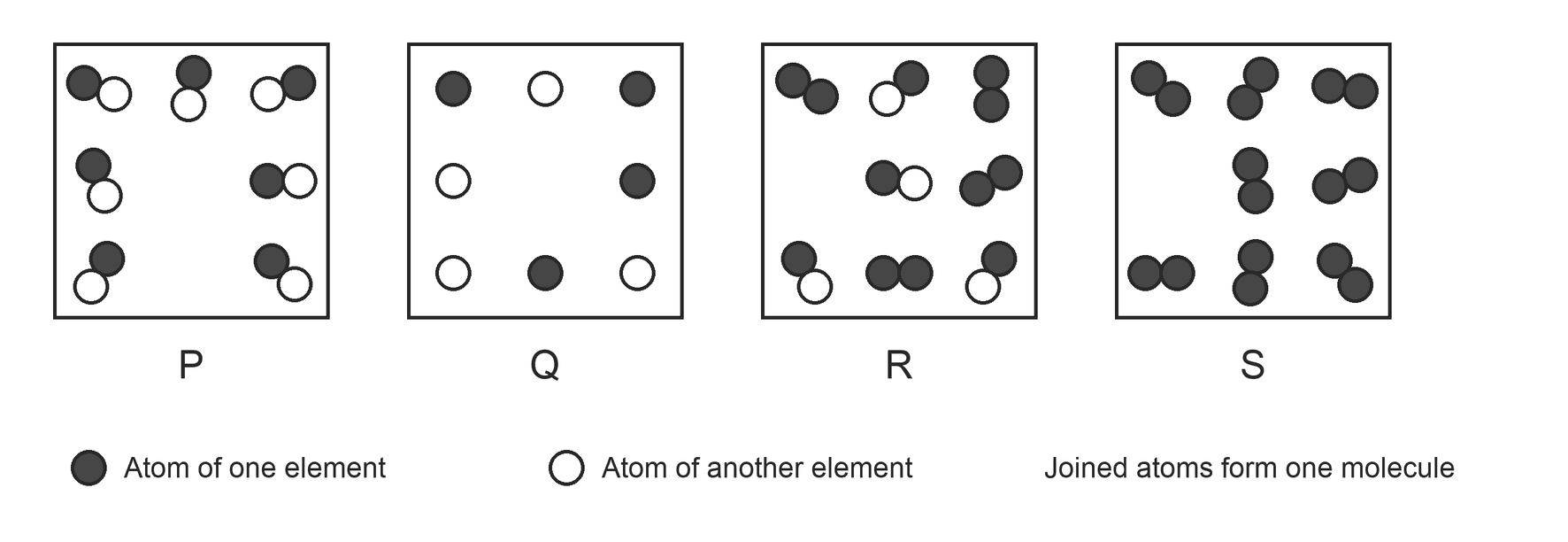
Which box shows a mixture of an element and a compound?
- 231 mark
Question 23
Cognitive domain: Application
A school store has four bottles, labelled with the names and formulae of four substances. A student looks for the compound whose molecule has atoms of exactly three different elements and a total of 8 atoms.
Which bottle should she pick?
- 241 mark
Question 24
Cognitive domain: Analysis
Gauri has a dry mixture of iodine crystals, fine sand and common salt. She stirs the mixture well with a lot of water and then filters it. Iodine hardly dissolves in water.
What will she find on the filter paper and in the filtrate?
- 251 mark
Question 25
Cognitive domain: Application
A porous clay pot is filled with a mixture of equal volumes of hydrogen and carbon dioxide. The gases slowly spread out through the pores of the pot into the surrounding room. Carbon dioxide is a much heavier gas than hydrogen.
Which statement is correct about the gas that passes out through the pores in the first few minutes?
- 262 marks
Question 26
Cognitive domain: Application
After the harvest, Gurmeet's father in a village near Karnal pours threshed wheat slowly from a raised basket while the wind blows. The light husk is carried away to one side and the heavy grains fall in a heap below. Later, his mother passes the flour ground from the wheat through a fine-mesh sieve. The coarse bits of bran stay on the sieve and the fine atta falls through.
(a) Name the method used to separate the husk from the grains, and the property in which the two components differ.
(b) Name the method used to separate the bran from the atta, and the property in which these two components differ.
- 272 marks
Question 27
Cognitive domain: Analysis
A farmer in Vidarbha collects soil from three corners X, Y and Z of her field and sends the samples to a laboratory. The report gives the composition of each sample. (Hypothetical data.)
Sample Sand Clay Humus (decayed plant matter) X 60% 30% 10% Y 45% 40% 15% Z 70% 20% 10% (a) Is soil a compound or a mixture? Give a reason from the table.
(b) Is soil a homogeneous or a heterogeneous mixture? Give a reason.
- 282 marks
Question 28
Cognitive domain: Understanding
Hydrogen gas combines with chlorine gas in diffused sunlight to form hydrogen chloride gas, according to this equation.
(a) Classify hydrogen, chlorine and hydrogen chloride as elements or compounds. Give a reason for each class.
(b) How many molecules of hydrogen and how many molecules of chlorine are needed to form 6 molecules of hydrogen chloride?
- 292 marks
Question 29
Cognitive domain: Application
In a craft class, three stains are made by accident: nail polish on a wooden desk, paint on a sleeve, and rust on a white shirt. A table in the lab gives these solvents: acetone, turpentine oil and oxalic acid. None of the stains comes off with plain water. (The teacher handles the solvents.)
(a) Match each stain with the solvent that will dissolve it.
(b) Why does plain water fail to remove them?
- 302 marks
Question 30
Cognitive domain: Evaluation
At a fire-safety talk, the fire officer says that water is used to put out most fires. Chirag objects: "Water is made of hydrogen, which burns, and oxygen, which helps things to burn. So water should make a fire burn more fiercely."
(a) Is Chirag's reasoning correct? Explain, using what you know about a compound and its elements.
(b) State one more property in which water differs from hydrogen and oxygen.
- 312 marks
Question 31
Cognitive domain: Understanding
A company that makes solar panels uses silicon. A student examines a sample of it and finds that it is a shiny, grey, hard solid, and that it breaks into pieces when it is struck with a hammer.
(a) Which of these properties is like a metal and which is like a non-metal?
(b) To which class of elements does silicon belong? State its atomicity and name one other element of the same class.
- 323 marks
Question 32
Cognitive domain: Understanding
A classification chart of matter has its boxes named P to U. Box R stands for elements and box U stands for heterogeneous mixtures.
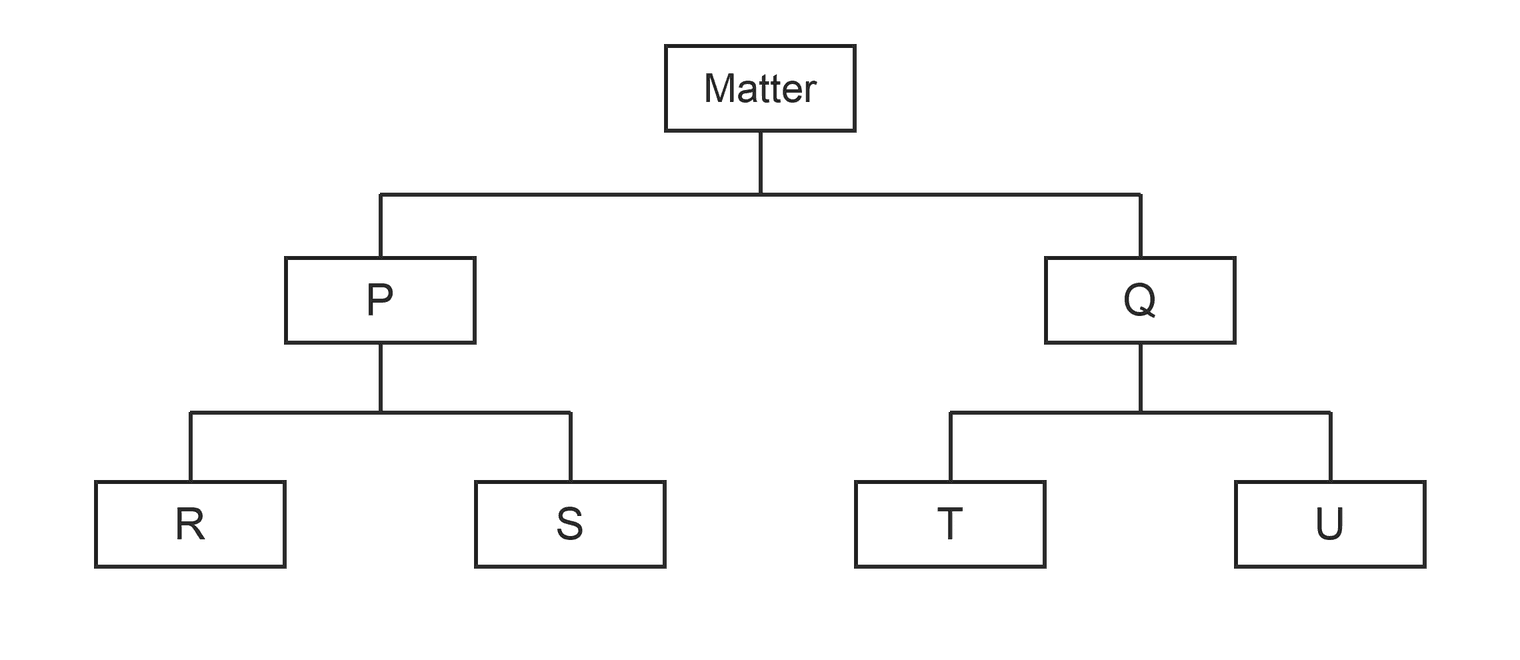
(a) Name the groups of matter in the boxes P, Q, S and T.
(b) Put each of these into the correct box among R, S, T and U: oxygen, carbon dioxide, tap water and soil.
(c) The substances in box S and in box T may both look uniform. State one characteristic that tells them apart.
- 333 marks
Question 33
Cognitive domain: Analysis
In a space-research laboratory, 3 g of hydrogen and 16 g of oxygen are fed into the engine of a test rocket, where they combine to form water. Hydrogen and oxygen combine in the ratio 1 : 8 by mass. (Hypothetical data.)
(a) What mass of hydrogen is needed to combine completely with 16 g of oxygen?
(b) Which of the two gases is left over, and how much of it? What mass of water is formed?
(c) Show that the total mass is the same before and after the change.
- 343 marks
Question 34
Cognitive domain: Analysis
Aarav takes two sealed bottles of the same fizzy drink to a picnic. One bottle has been kept in a refrigerator and the other in the kitchen at room temperature. The fizz in a fizzy drink is carbon dioxide gas dissolved in the drink. He opens both bottles at the same time and leaves them open.
(a) State the states of the components of the fizzy drink and the type of the mixture.
(b) In which bottle will the fizz die out sooner? Give a reason.
(c) How can all the dissolved gas be removed from a liquid?
- 353 marks
Question 35
Cognitive domain: Evaluation
Pooja's mother has made a hot, concentrated syrup of sugar in water. Pooja wants to get pure sugar crystals from it. She suggests that the hot syrup should be left to cool slowly. Her brother says that it is better to keep heating the syrup on a high flame until all the water has gone.
(a) Name the process in Pooja's plan and say what happens in it.
(b) Evaluate her brother's plan. Give two reasons why it is not as good for getting pure sugar.
- 363 marks
Question 36
Cognitive domain: Application
In a science club activity, Imran pours 50 mL of mustard oil, 100 mL of water and two spoons of fine sand into a tall glass jar. He stirs the contents well and leaves the jar undisturbed for ten minutes.
(a) Name the three layers from the top to the bottom of the jar. Give a reason for the position of each.
(b) Give the states of the three components and say whether the mixture is homogeneous or heterogeneous.
(c) Describe how all three components can be obtained separately. Name the methods.
- 375 marks
Question 37
Cognitive domain: Analysis
A teacher finds an unsigned note and wants to know which of three black pens, Pen 1, Pen 2 or Pen 3, was used to write it. She puts a spot of each pen's ink, and a spot of the ink of the note, on a pencil line drawn on a strip of chromatography paper. She dips the lower edge of the paper in a solvent, taking care that the pencil line stays above the solvent. When the solvent front has reached the top, she takes out the paper and dries it. Each spot has split into coloured spots, shown in grey here. (Hypothetical data.)
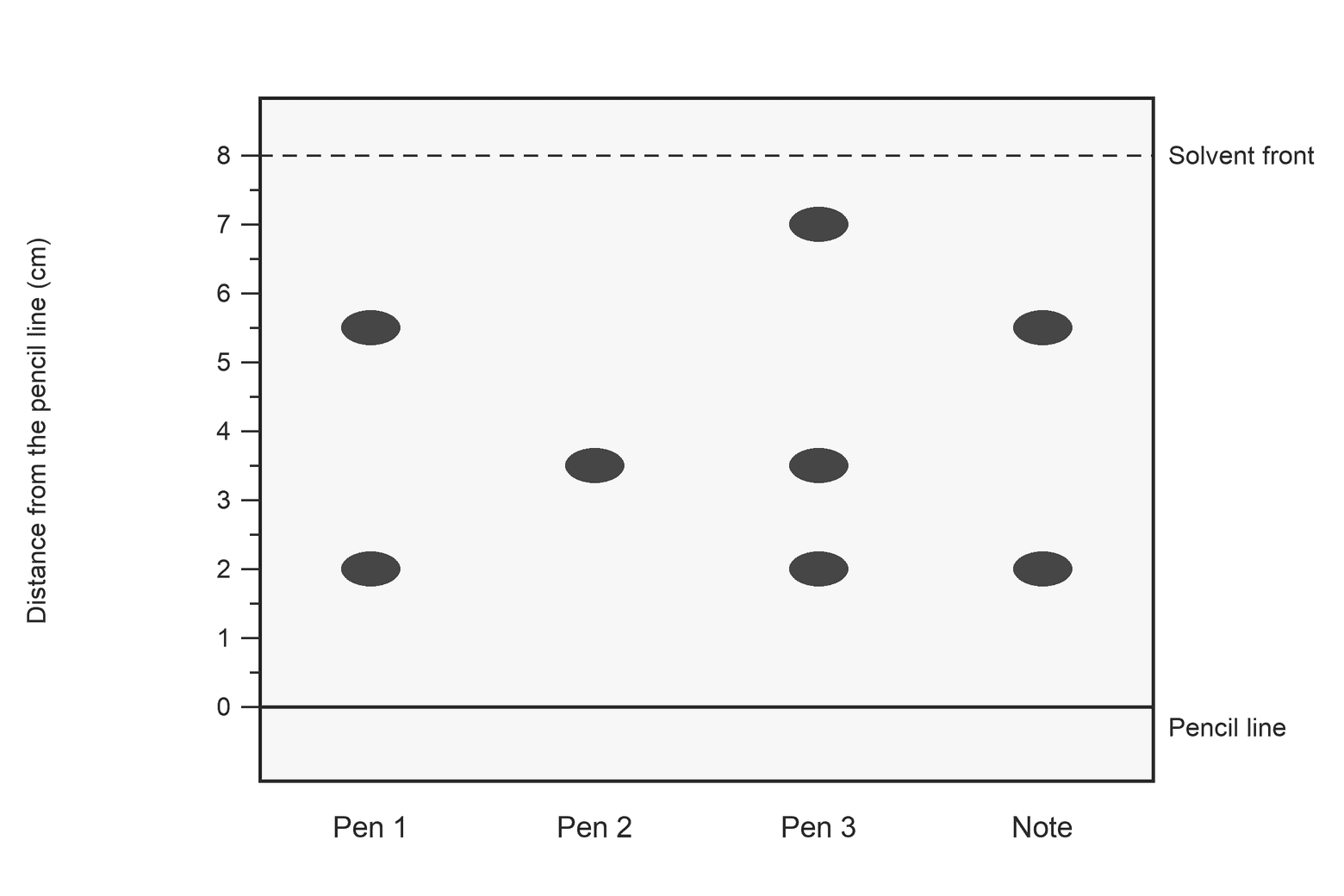
(a) How many different dyes are there in the ink of Pen 3, and how many in the ink of the note?
(b) Which pen was used to write the note? Give two reasons from the chromatogram.
(c) The ink of the note has two dyes. Which of the two is more soluble in the solvent? By how many centimetres did it travel more than the other dye?
(d) Why is the starting line drawn with a pencil, and why must it be kept above the solvent at the start?
- 384 marks
Question 38
Cognitive domain: Evaluation
Rohan has a mixture of 60 g of potassium nitrate and 12 g of common salt. He dissolves it in 100 g of hot water at 80 °C, then lets the solution cool to 30 °C. He wants to get the potassium nitrate out of the mixture in a pure form. For simplicity, assume that each salt dissolves as if the other were absent. (Hypothetical data; the solubilities are approximate.)
Salt Solubility in 100 g of water at 30 °C Solubility in 100 g of water at 80 °C Potassium nitrate 46 g 169 g Sodium chloride 36 g 38 g (a) Show with the table that both salts dissolve completely in the hot water at 80 °C.
(b) Find the mass of potassium nitrate that separates out at 30 °C. Why does no common salt separate out with it?
(c) Rohan's friend says, "Instead of cooling, just boil the water away completely. You will get pure potassium nitrate." Evaluate this idea.
- 394 marks
Question 39
Cognitive domain: Application
In a house in Punjab, Bimla makes ghee by heating 500 g of white butter in a heavy pan on a low flame. The butter melts, and the water in it bubbles away as steam. Light-brown specks of milk solids settle at the bottom of the pan. When the pan has cooled a little, she pours the clear golden liquid through a muslin cloth into a steel jar. A little brown residue stays on the cloth. The ghee in the jar turns pale yellow and semi-solid on cooling.
(a) Name the method by which the water is removed from the butter. Is the water recovered?
(b) Name the two methods by which the brown solid is separated from the ghee. Name the residue and the filtrate.
(c) Bimla wants to collect the water that escapes as steam. Name the method she should use and say what changes the steam into water.
- 405 marks
Question 40
Cognitive domain: Creativity
The science club of your school is making "Matter Detective" cards for Science Day. Each card gives three clues about one substance, and the visitors have to say whether it is an element, a compound, a homogeneous mixture or a heterogeneous mixture. A good card has clues that fit only the right class. Last year, many visitors guessed the answers from a single clue, so this year each card will be checked for fairness before it is used.
(a) Write a card with three clues for a compound, using sodium chloride as the substance.
(b) Write a card with three clues for a homogeneous mixture, using brass as the substance.
(c) A new member writes a card whose only clue is, "It looks the same throughout." Explain why this card is not fair, and suggest a clue that would repair it.