
Opening your dashboard
Class 8 Chemistry Chapter 1 Matter: Competency-Based Questions (CBQ)
40 questions on Chapter 1, each worked through on its own page with the AI tutor. Class 8 Chemistry, ICSE 2026-27.
40 questions
1–5 marks · Mixed difficulty
- 11 mark
Question 1
Cognitive domain: Application
The brake pipes of a car are filled with a liquid called brake oil. When the driver presses the pedal, the push is passed through the liquid to the wheels at once. A mechanic in Pune finds that some air bubbles have entered the pipes of a car. Now the pedal feels soft and has to be pressed much further before the car slows down.
Which statement best explains why the air bubbles spoil the brakes?
- 21 mark
Question 2
Cognitive domain: Analysis
Farhan measures two liquids in measuring cylinders, weighs them, and then pours them into one cylinder and stirs. The room temperature does not change. His readings are shown below.
Volume Mass Water 50 mL 50.0 g Spirit (alcohol) 50 mL 39.5 g Mixture of the two 97 mL 89.5 g Which conclusion fits both columns of the table?
- 31 mark
Question 3
Cognitive domain: Understanding
Before a school match in Kolkata, the games teacher places a flat football on a digital balance. It reads 410 g. She pumps air into the ball until it is hard and places it on the same balance again. Now it reads 414 g.
Which property of matter does the change in the reading show?
- 41 mark
Question 4
Cognitive domain: Application
Rust is formed when iron combines with the oxygen and water vapour present in air. Nisha puts a ball of clean, damp iron wool into a glass jar, screws the lid on airtight and weighs the jar. The balance reads 250.0 g. After two weeks the iron wool is covered with brown rust. She weighs the closed jar again without opening it.
What will the balance read?
- 51 mark
Question 5
Cognitive domain: Understanding
Assertion (A): A small cylinder fitted in an auto-rickshaw can store a large amount of CNG (compressed natural gas).
Reason (R): The particles of a gas are far apart from each other, so they can be pushed closer together by applying pressure.
- 61 mark
Question 6
Cognitive domain: Analysis
Assertion (A): Wet clothes hung on a line become dry even on a cold winter day.
Reason (R): The boiling point of pure water is 100 °C.
- 71 mark
Question 7
Cognitive domain: Understanding
On a hot afternoon Asha pours sweet liquid milk mixture into kulfi moulds and keeps them in the freezer. Two hours later the kulfi is hard.
Complete the sentences about what happened in the freezer.
The change of the liquid mixture into solid kulfi is called ________. During this change the kinetic energy of the particles ________ (increases / decreases), and the intermolecular forces of attraction ________ (increase / decrease).
- 81 mark
Question 8
Cognitive domain: Understanding
Rohan reads that a single drop of water contains about tiny particles of water. Each of these particles is made of two atoms of hydrogen and one atom of oxygen joined together, and each one can exist on its own.
What name is given to such a particle of water?
- 91 mark
Question 9
Cognitive domain: Application
Priya puts a drop of water containing fine pollen grains on a glass slide and looks at it through a microscope. The pollen grains are moving slowly in a zig-zag way. She then warms the slide gently and looks again.
Predict how the movement of the pollen grains will change. Give a reason.
- 102 marks
Question 10
Cognitive domain: Application
For Lohri, a sweet-maker in Amritsar melts jaggery into a thick syrup, mixes in roasted peanuts and pours the hot syrup into a flat steel tray. The syrup spreads and fills every corner of the tray. After it cools, he cuts hard squares of chikki that keep their shape when lifted out.
Use the kinetic theory of matter to explain:
(a) why the hot syrup takes the shape of the tray;
(b) why the cooled chikki keeps its own shape.
- 112 marks
Question 11
Cognitive domain: Evaluation
Shreya fills a plastic bottle with water, screws the cap on tightly and weighs it. It weighs 520 g. She leaves it in the freezer overnight. In the morning all the water has turned to ice and the bottle has bulged outwards. Shreya says, "Ice takes up more space than the water did, so the bottle must now weigh more than 520 g."
Is Shreya's conclusion correct? State what the balance will read now and justify your answer.
- 122 marks
Question 12
Cognitive domain: Evaluation
During a class discussion Kabir says, "Air is not matter because we cannot see it. Sunlight is matter because we can see it."
Judge each of Kabir's two statements using the definition of matter. Support your answer for air with one simple observation.
- 135 marks
Question 13
Cognitive domain: Analysis
An ice-cream seller at a school fair keeps his kulfi cold with blocks of dry ice. Dry ice is solid carbon dioxide. It is far colder than ordinary ice, about −78 °C. In the open air it does not melt. It slowly gets smaller and changes straight into carbon dioxide gas. The label on his box says: "Never store dry ice in an airtight bottle."
With their teacher's help, Dev's class placed a block of dry ice on a tray on a balance in the open laboratory. The tray stayed dry throughout.
Time (minutes) 0 20 40 60 Mass of the block (g) 400 380 360 340 (a) Name the change of state taking place. Which observation of the class shows that no liquid is formed?
(b) Find how much mass the block loses every minute. If it goes on at the same rate, how long will the whole 400 g block last? Has the lost matter been destroyed? Explain.
(c) Use the kinetic theory of matter to explain the warning on the label.
- 144 marks
Question 14
Cognitive domain: Application
Large hospitals do not store oxygen as a gas. Oxygen gas is cooled and compressed until it becomes a pale blue liquid, which boils at −183 °C. The liquid is kept in a big, well-insulated tank outside the building. When oxygen is needed, some of the liquid is allowed to warm up. It changes back into gas, which flows through pipes to the patients' beds. One litre of liquid oxygen gives about 860 litres of oxygen gas at room temperature.
(a) Name the process by which oxygen gas is changed into liquid oxygen. State the two conditions used to bring it about.
(b) Explain, in terms of particles, why one litre of the liquid gives such a large volume of gas.
(c) A small tank holds 20 litres of liquid oxygen. How many litres of oxygen gas can it supply? A patient is given 5 litres of oxygen gas every minute. For how long can this tank supply one such patient?
- 155 marks
Question 15
Cognitive domain: Creativity
Tanvi's village on the Gujarat coast has only salty well water during a drought. Her teacher asks her to design a simple device that uses sunlight to get a little water without salt from the salty water.
Tanvi has: a wide steel basin, a small clean cup that is shorter than the basin, a clear plastic sheet big enough to cover the basin, a string, a small stone and salty water.
(a) Design the device. Describe how Tanvi should arrange these things, and say what the stone is for.
(b) Name the two changes of state that take place in the device, in the correct order, and say where each one happens.
(c) Will the water collected in the cup taste salty? Give a reason.
(d) Tanvi collects much less water on a cloudy day than on a sunny day. Explain why, and suggest one change to her device that would help it collect more water.
- 161 mark
Question 16
Cognitive domain: Understanding
Rekha's brother shows her the see-through gas lighter he uses to light the kitchen stove. A colourless liquid can be seen inside the closed lighter. When he presses the button, a gas comes out and burns. The fuel is a gas under ordinary conditions in the open air.
Which statement explains why the fuel is a liquid inside the lighter?
- 171 mark
Question 17
Cognitive domain: Analysis
In Varanasi, a craftsman beats 1 g of pure silver between sheets of paper for hours to make vark, the shiny silver leaf put on sweets. The 1 g of silver spreads into thin sheets that together cover about 0.25 m². Each sheet is so thin that a stack of about 2,500 of them would be only about 1 mm thick, yet every sheet is still shiny silver.
Which conclusion do these observations support best?
- 181 mark
Question 18
Cognitive domain: Analysis
A student's notes list four rows about the three states of matter. Her teacher says that only one row is correct.
Which row is correct?
- 191 mark
Question 19
Cognitive domain: Analysis
In a school laboratory in Pune, a little smoke from an incense stick that has just been put out is trapped in a small glass cell, and the cell is sealed so that no air can move in or out. A strong lamp lights the cell from the side. Through a microscope, Arjun sees the smoke particles as tiny bright specks. Each speck keeps jerking about in a zig-zag way, changing direction all the time, although nothing is stirring the air in the cell.
What does this observation show about the air in the cell?
- 201 mark
Question 20
Cognitive domain: Analysis
Assertion (A): The particles of a gas do not hit the walls of a closed container, because they are very far apart from one another.
Reason (R): The particles of a gas move randomly in all directions with a high kinetic energy.
- 211 mark
Question 21
Cognitive domain: Evaluation
Assertion (A): When a candle burns inside a tightly closed jar placed on a balance, the reading on the balance stays the same.
Reason (R): The wax is not destroyed; it changes into other substances that stay inside the closed jar.
- 221 mark
Question 22
Cognitive domain: Analysis
Water is heated in two identical beakers, X and Y, on the same burner at the same setting. Both start at 25 °C. One beaker holds 100 mL of water and the other holds 200 mL, but not necessarily in this order. A thermometer reading is taken every minute. (Hypothetical data.)
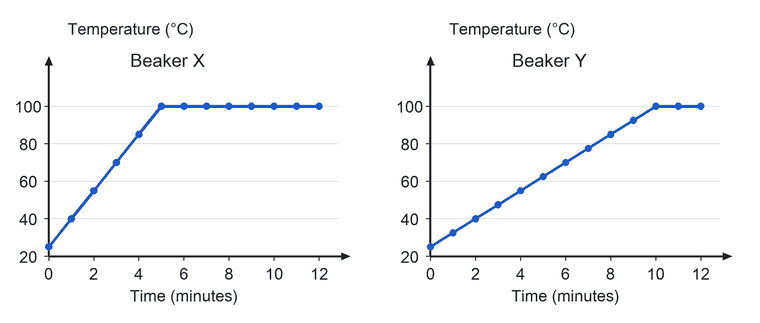
Which statement is correct?
- 231 mark
Question 23
Cognitive domain: Understanding
Mohan's mother notices two things in the kitchen. A little mustard oil spills from a bottle and runs down the outside of it. Later, a scent from an air freshener sprayed in one corner soon spreads in every direction through the kitchen and into the next room.
Which statement correctly describes mustard oil and the scent gas?
- 241 mark
Question 24
Cognitive domain: Application
In Delhi, coconut oil in a glass bottle is a clear liquid all summer. On winter mornings, when the room is at about 15 °C, the oil in the bottle turns into a white solid. When the bottle is stood in a mug of warm water, the solid turns back into a clear liquid. Coconut oil melts at about 24 °C.
Which statement explains why the oil is solid on winter mornings?
- 251 mark
Question 25
Cognitive domain: Evaluation
Aman has two white crystalline solids, sugar and salt. Both are solids, both are white and both dissolve in water. He says, "All the particles in sugar and in salt must be the same, because the two solids look alike."
Which statement judges Aman's claim correctly according to the kinetic theory of matter?
- 262 marks
Question 26
Cognitive domain: Application
Ishita reads that one drop of water contains about particles of water. She fills a glass with 250 mL of water. Assume that 20 drops of water make 1 mL.
(a) How many drops of water are there in the glass?
(b) Estimate the number of particles of water in the glass.
- 272 marks
Question 27
Cognitive domain: Understanding
Dev boils water in a flask. He leads the steam through a long glass tube into a clean, dry flask that stands in a bowl of ice-cold water. After some time a little water collects in the cold flask.
(a) Name the change of state that takes place in the cold flask, and state the condensation point of steam at normal atmospheric pressure.
(b) How does this temperature compare with the boiling point of pure water? Name the change of state that is the reverse of condensation.
- 282 marks
Question 28
Cognitive domain: Application
A label on a spray can says: "Do not leave in a hot car. The can may burst if it gets very hot." The can is tightly closed, and the space above the liquid inside it is filled with a gas under pressure.
(a) Use the kinetic theory of matter to say what happens to the particles of the gas inside the can when the car heats up in the sun.
(b) Explain why this may make the can burst.
- 292 marks
Question 29
Cognitive domain: Analysis
Three white substances P, Q and R are heated gently, one at a time, in a dry test tube. They are candle wax, ammonium chloride and a strip of paper, in some order.
- P: The solid turns into a clear liquid. On stronger heating, the liquid slowly changes into vapour.
- Q: The solid gradually disappears from the bottom of the tube. No liquid is seen. A white solid collects on the cooler upper part of the tube.
- R: There is no change of state. It turns brown, then black, and burns.
(a) Identify P, Q and R.
(b) Name the changes of state that take place in P and in Q.
- 302 marks
Question 30
Cognitive domain: Application
Mercury and coloured alcohol (ethanol) are both used in thermometers. Their melting and boiling points are given below.
Liquid Melting point (°C) Boiling point (°C) Mercury −39 357 Alcohol (ethanol) −114 78 (a) On a winter night in Dras in Ladakh the temperature falls to about −45 °C. Which thermometer can show this reading, and why?
(b) A teacher wants to measure the temperature of boiling water at normal atmospheric pressure. Which thermometer should she use, and why?
- 312 marks
Question 31
Cognitive domain: Understanding
Neeta presses the point of a steel pin, with the same push each time, into three solids kept in a cool room: a block of butter just taken out of the fridge, a candle and a copper coin. The pin sinks easily into the butter, makes only a shallow dent in the candle with a hard push, and leaves no mark on the copper coin.
(a) Which of the three solids has the strongest force of attraction between its particles, and which has the weakest? Give a reason.
(b) Neeta leaves the candle in hot sunlight for an hour, so that it becomes soft but does not melt. Predict how easily the pin will now go into the candle, and explain why.
- 323 marks
Question 32
Cognitive domain: Application
India's only active volcano is on Barren Island in the Andaman Sea. Deep under the ground, where it is very hot and the pressure is very high, some of the rock melts into a molten material. When the molten material (lava) reaches the surface during an eruption, it flows down the slope, cools and becomes hard rock again.
(a) Name the change of state when hard rock changes into molten material and the change of state when lava becomes hard rock.
(b) Even the hardest rocks melt only at very high temperatures. Explain why, in terms of the particles of rock.
(c) What happens to the kinetic energy of the particles and to the forces of attraction between them as the lava cools into rock?
- 333 marks
Question 33
Cognitive domain: Evaluation
Three students make statements about matter. Judge each statement. If it is wrong, correct it and give a reason.
(a) "When a liquid is heated, the spaces between its particles decrease and the forces of attraction between them increase."
(b) "In a liquid the particles are held in fixed positions and can only vibrate, and so a liquid has a definite shape."
(c) "A gas has no definite shape or volume, because its particles are free to move in the whole space available to them."
- 343 marks
Question 34
Cognitive domain: Creativity
Neha wants to show that water evaporates faster when it is warmer. She may use anything found at home, such as plates, a measuring cup, a spoon, a clock and a sunny window ledge.
(a) Describe a fair test that Neha can carry out. Say what she must keep the same and the one thing she changes.
(b) State what she should measure and how she will compare the results.
(c) What result should she expect, and which idea about evaporation does it support?
- 353 marks
Question 35
Cognitive domain: Analysis
Meena fills an open plastic tray with water and keeps it in the freezer of her refrigerator, which stays at about −18 °C. By the next morning the water has become ice cubes. She forgets the tray at the back of the freezer. Six weeks later the ice cubes are clearly smaller, yet the tray around them is dry, with no water and no flat layer of new ice in it. Ice can slowly change directly into water vapour even below 0 °C.
(a) Name the change of state when the water in the tray became ice cubes, and the change of state by which the cubes later became smaller.
(b) Give two observations from the story which show that the ice did not first melt into liquid water.
(c) Explain, in terms of kinetic energy and the forces of attraction, how particles can leave the ice cubes and go into the air.
- 363 marks
Question 36
Cognitive domain: Analysis
Five groups repeat the experiment in which barium chloride solution and sodium sulphate solution are mixed in a corked conical flask. Each group weighs the whole flask with its contents before and after mixing. (Hypothetical data.)
Group Mass before mixing (g) Mass after mixing (g) 1 148.2 148.2 2 151.0 151.0 3 149.6 149.2 4 150.4 150.4 5 152.3 152.3 (a) Which group's result does not agree with the law of conservation of mass, and by how much did its reading change?
(b) Give two possible reasons why this group's reading changed.
(c) What do the results of the other four groups tell us about the law?
- 375 marks
Question 37
Cognitive domain: Evaluation
Priya's family in Jaipur makes candles for Diwali. In summer, the shelves of the shop can reach 45 °C, and a candle that softens there is spoilt. Her supplier gives the melting points of three waxes A, B and C. Priya wants a wax that stays hard in the shop but still melts easily near the flame once the candle is lit and burning for some time. (Hypothetical data.)
Wax Melting point (°C) A 38 B 52 C 74 (a) Which waxes stay solid on a shelf at 45 °C? Which wax melts, and what is the name of that change?
(b) Priya melts wax B and pours it into a mould. At what temperature does it start to solidify as it cools? What happens to the kinetic energy of its particles and to the forces of attraction between them as it sets?
(c) Which wax, B or C, would you recommend for the shop? Give two reasons.
- 384 marks
Question 38
Cognitive domain: Analysis
Anil is making ice for a school fair in Ahmedabad. He places 100 mL of water at room temperature in a small steel cup inside a freezer that is kept at about −18 °C. He records the temperature of the water every 10 minutes with a digital thermometer, and the graph shows his readings. He notices that the temperature stays the same for some time, even though the cup is still in the cold freezer. (Hypothetical data.)

(a) Read the freezing point of water from the graph. For how many minutes does the temperature stay constant?
(b) State the physical state of the contents of the cup at 20 minutes, 100 minutes and 220 minutes.
(c) Anil repeats the experiment with 200 mL of water in the same freezer. How will the flat part of the graph change, and why?
- 394 marks
Question 39
Cognitive domain: Analysis
At a science museum in Delhi, a display on "Ideas about matter" has four cards. Two of the cards have mistakes.
- Card 1: Maharshi Kannada, an Indian philosopher, was perhaps the first to suggest that matter is made up of very tiny particles called anu, which are formed of still smaller particles called parmanu.
- Card 2: Greek philosophers believed that all kinds of matter are made up of five elements: sky, air, fire, water and earth.
- Card 3: Ancient Indian philosophers believed that all kinds of matter are made up of four elements: fire, water, air and earth.
- Card 4: A Greek thinker, Democritus, named the smallest particle of matter the atom.
(a) Which two cards have mistakes?
(b) Rewrite those two cards correctly.
(c) Which of the words anu and parmanu stands for the atom, and which stands for the molecule, in the modern idea of matter?
- 405 marks
Question 40
Cognitive domain: Evaluation
In Bengaluru, the Rao family uses one domestic LPG cylinder to cook all their meals. LPG is a gas under normal conditions, but it is stored in the cylinder as a liquid under high pressure. When the stove knob is turned on, the pressure falls, the liquid changes into gas, and the gas burns at the burner. The family weighs the cylinder at three times, as shown in the table. (Hypothetical data.)
Cylinder Mass (kg) Empty cylinder 14.8 New, full cylinder 29.0 After 18 days of use 23.6 (a) Find the mass of LPG in the full cylinder, the mass of LPG used in 18 days and the average mass used per day.
(b) If the family goes on using LPG at the same rate, for about how many more days will the gas last?
(c) A neighbour says, "The 5.4 kg of LPG was destroyed when it burnt." Judge this claim.