
Opening your dashboard
Class 8 Biology Chapter 8 Diseases and First Aid: Competency-Based Questions (CBQ)
40 questions on Chapter 8, each worked through on its own page with the AI tutor. Class 8 Biology, ICSE 2026-27.
40 questions
1–5 marks · Mixed difficulty
- 11 mark
Question 1
Cognitive domain: Analysis
A student in a school hostel fell ill with a disease that made him cough and sneeze a lot. Within a week, some other students also had the same disease. The warden made the record given below.
Group Number of students What they shared with the sick student Number who fell ill P 6 Slept in the same dormitory as the sick student, but ate in a different mess 5 Q 6 Ate the same food and drank the same water as the sick student, but slept in another building 0 Which way of spreading of the disease is best supported by this record ?
- 21 mark
Question 2
Cognitive domain: Application
In the craft class, Arif cuts his finger with a paper cutter and it starts bleeding. His teacher at once tells him to hold the hand up, higher than his chest, while she brings clean water and cotton wool. Why does she ask him to raise his hand ?
- 31 mark
Question 3
Cognitive domain: Analysis
A health worker inspected two wards of a town and made these notes.
Ward Drains Rain water Garbage X Open Stands in puddles for many days Kept in covered bins Y Covered Drains away quickly Lies in open heaps near the food stalls If nothing is changed, which diseases is the health worker most likely to find in each ward ?
- 41 mark
Question 4
Cognitive domain: Application
In a health centre, the nurse takes a new disposable syringe out of a sealed packet for every person, uses it once and then throws it away safely. She never uses the same syringe for two persons. The spread of which of these diseases is this practice mainly meant to prevent ?
- 51 mark
Question 5
Cognitive domain: Understanding
Assertion (A): A female Anopheles mosquito that has fed on the blood of a malaria patient can pass on malaria, but the mosquito itself does not fall ill with malaria.
Reason (R): Vectors are organisms which carry germs from a source of infection but do not themselves suffer from the disease.
- 61 mark
Question 6
Cognitive domain: Analysis
Assertion (A): Dengue and chikungunya are caused by the same virus.
Reason (R): Both dengue and chikungunya are spread by the bite of the Aedes mosquito.
- 71 mark
Question 7
Cognitive domain: Application
A man drank alcohol at a party and then drove his car. On the highway he thought that a truck ahead was much farther away than it really was. When he at last tried to brake and turn, his hands and feet did not move together properly, and the car hit the divider.
Complete the sentence :
The accident shows two effects of alcohol : it impairs ______, and it affects the ______ coordination of the body.
- 81 mark
Question 8
Cognitive domain: Understanding
Rahul was given the TAB vaccine by injection. Some months later he drank contaminated water at a fair, and typhoid germs entered his body. His friends who drank the same water fell ill with typhoid, but Rahul did not.
Complete the sentence :
Rahul stayed healthy because the vaccine had stimulated his ______ to produce ______ against the germs of typhoid.
- 91 mark
Question 9
Cognitive domain: Application
During a function in a crowded, closed hall, an old man suddenly falls unconscious. People rush and stand all around him. A scout lays him down comfortably and sends for a doctor. She then asks the crowd to move back and gets the doors and windows opened.
Complete the sentence :
The scout moves the crowd away and opens the windows so that fresh ______ can reach the man, and the other thing she should do for him at once is to loosen his ______.
- 102 marks
Question 10
Cognitive domain: Evaluation
Anu has had bodyache and a high body temperature for three days. Each time the temperature goes up, her aunt puts a cloth dipped in ice-cold water on Anu's forehead. The aunt says, "Fever is the disease, and the cold cloth is curing it. We do not need a doctor."
Evaluate what the aunt is doing and what she is saying.
- 112 marks
Question 11
Cognitive domain: Understanding
A family bought fresh spinach, tomatoes and cucumbers. They rinsed them quickly in water taken from an open tank, into which dirty water from a nearby drain sometimes flows. The cucumbers and tomatoes were eaten raw as salad. Two days later, three members of the family had an intestinal disease.
Explain how the family got the disease although the vegetables were fresh. What should they do differently ?
- 122 marks
Question 12
Cognitive domain: Evaluation
Sohan's 19-year-old cousin has started chewing tobacco. When Sohan objects, the cousin says, "Only smoking is harmful, because smoke goes into the lungs. I only chew tobacco. There is no smoke, so there is no risk to my health."
Is the cousin's argument sound ? Justify your answer.
- 135 marks
Question 13
Cognitive domain: Analysis
Case: The health department of a district has been immunizing infants against measles. The bar chart shows the number of measles cases reported in the district in four different years. The percentage of infants immunized in each of those years is written below the bars.

(a) By how many did the number of measles cases fall between 2016 and 2025 ? Describe the link between the percentage of infants immunized and the number of cases.
(b) The measles vaccine is made from living germs. Explain why it does not give the child measles, and how it protects the child.
(c) Measles is a highly contagious disease. Suggest why immunizing more infants brought down the number of cases in the whole district.
(d) In 2025 there were still 30 cases. Use the chart to suggest a reason, and say what the health department should do.
- 144 marks
Question 14
Cognitive domain: Application
Case: After a flood, about 150 people are staying in a relief camp set up in a school. Nisha, a student volunteer, makes four notes in her diary.
- Note 1 : The drinking water comes from a hand pump that is standing in flood water mixed with sewage.
- Note 2 : Leftover food and garbage lie in an open heap next to the kitchen, and houseflies are everywhere.
- Note 3 : There are puddles of stagnant rain water all round the building.
- Note 4 : Five people with influenza are sleeping in the crowded hall along with everyone else.
(a) For each of notes 1, 2 and 3, state how disease can spread in the camp.
(b) Suggest one preventive measure for each of notes 1, 2 and 3.
(c) What should be done about the five people in note 4 ? Explain why, by referring to the way influenza spreads.
- 155 marks
Question 15
Cognitive domain: Creativity
Case: Three cases of dengue have been reported in Ananya's colony just after the rains. The students of the colony decide to run a "Dry Day Drive" every Sunday for one month. They will visit houses, with the permission of the families, and help them to remove the places where mosquitoes can breed.
(a) Design a checklist of four places in and around a house that the students should inspect, and draw a table in which they can record what they find in five houses.
(b) Write three pieces of advice for the families, based on the chapter, with a reason for each.
(c) Suggest how the students can judge, at the end of the month, whether the drive has worked. Also write a catchy slogan for it.
- 161 mark
Question 16
Cognitive domain: Application
Four students describe themselves at a school health camp. Which one is in good health, as health is defined in the chapter ?
- 171 mark
Question 17
Cognitive domain: Application
Mr Iyer has fever or chills, a cough, tiredness and difficulty in breathing. The doctor says that he has COVID-19, which is caused by the SARS-CoV-2 virus. Which set of steps matches the preventive measures given for this disease in the chapter ?
- 181 mark
Question 18
Cognitive domain: Analysis
The graph shows the rainfall and the number of dengue cases reported in a town in six months of a year. (Hypothetical data.)

Which conclusion is best supported by the graph ?
- 191 mark
Question 19
Cognitive domain: Understanding
At a health centre, a nurse says that the vaccine against diphtheria is made from the poison (toxin) that diphtheria germs secrete, after the poison has been made harmless by adding formalin. A mother asks, "If the poison is harmless, how can it still protect my baby ?" Which reply is correct ?
- 201 mark
Question 20
Cognitive domain: Application
During a cycle race, a speck of dust flies into Sana's right eye. The eye waters and she wants to rub it hard with her fingers. The sports teacher stops her. What should the teacher advise ?
- 211 mark
Question 21
Cognitive domain: Analysis
A doctor makes notes on three patients, P, Q and R, who have each had one harmful habit for many years. (Hypothetical data.)
Patient Doctor's notes P Cough and irritation in the throat; high blood pressure; a warning about the risk of mouth and lung cancer Q Damaged liver with fat stored in it; poor judgement and little self-control; hands and feet that do not work together R Needs the substance again and again and finds it very hard to give up; serious damage to the nervous system; breathing trouble and heart problems Name the habit of P, Q and R respectively.
- 221 mark
Question 22
Cognitive domain: Analysis
Assertion (A): It is safe to release untreated sewage into a river, because the flowing water washes the germs away.
Reason (R): Contamination of drinking water with faeces causes a number of diseases.
- 231 mark
Question 23
Cognitive domain: Understanding
Assertion (A): Polio vaccine can be given to an infant as drops by mouth.
Reason (R): A vaccine stimulates the white blood cells to produce antibodies against the germs of that disease.
- 241 mark
Question 24
Cognitive domain: Evaluation
The health workers of a ward studied the illnesses reported in one monsoon month and what they found nearby. (Hypothetical data.)
Illness Cases What the survey found nearby Malaria and dengue places where water stood for many days; open drains Intestinal diseases spread by houseflies open heaps of garbage Influenza Crowded homes The funds allow only one measure to be taken first. Assume that each measure removes all the cases of the illness it is aimed at. Which measure will prevent the largest number of cases ?
- 251 mark
Question 25
Cognitive domain: Understanding
Five events in the spread of malaria are given below in a jumbled order.
P. The mosquito bites a healthy person.
Q. A female Anopheles mosquito feeds on the blood of a malaria patient.
R. The healthy person has chills and an intermittent high fever.
S. The Plasmodium enters the blood stream of the healthy person.
T. The Plasmodium is gained in the body of the mosquito.
Arrange the events in the correct order.
- 262 marks
Question 26
Cognitive domain: Evaluation
Mr and Mrs Menon plan a holiday in a seaside town where many cases of chikungunya have just been reported. Mrs Menon says, "Mosquitoes are everywhere, so there is nothing we can do. We may as well go."
Evaluate Mrs Menon's statement and give two steps from the chapter that would protect the family.
- 272 marks
Question 27
Cognitive domain: Understanding
Ravi is bitten by a stray dog. At the hospital the doctor starts a course of the anti-rabies vaccine. The nurse tells Ravi's brother that the vaccine is made from rabies germs that have been killed. The brother asks, "If the germs are dead, how can it help, and can it give Ravi rabies ?"
Answer his two questions.
- 282 marks
Question 28
Cognitive domain: Application
Nikhil has influenza, with a cold, fever and chills. His mother lets him rest in a separate room and gives him his own towel, cup and plate to use, which nobody else touches.
Give one reason for the separate room and one reason for the separate towel, cup and plate.
- 292 marks
Question 29
Cognitive domain: Evaluation
At a party, an older boy offers Aman a tablet of a narcotic drug, saying, "Just take it once to relax before the exams. One tablet will do nothing to you." Aman thinks that this may be true.
Evaluate the older boy's statement and give two reasons for your answer.
- 302 marks
Question 30
Cognitive domain: Analysis
A student writes, "A mosquito and a housefly are both vectors, but they do not spread disease in the same way."
Explain this statement by saying, for each of the two, where it picks up the germs and how it passes them on to a healthy person.
- 312 marks
Question 31
Cognitive domain: Application
Hot tea spills over Dev's forearm and the skin turns red. His shirt sleeve is not stuck to the skin and there is no blister yet. His elder cousin says that the sleeve must be left on, because clothes are never removed from a burn.
What first aid should be given for this superficial burn ? Is the cousin right about the sleeve ? State two things that should not be done in a burn.
- 323 marks
Question 32
Cognitive domain: Analysis
Case: Two patients, P and Q, came to a clinic with high fever. The nurse measured the temperature of each at 8 a.m. and 8 p.m. for four days. The chart gives the readings. (Hypothetical data.)
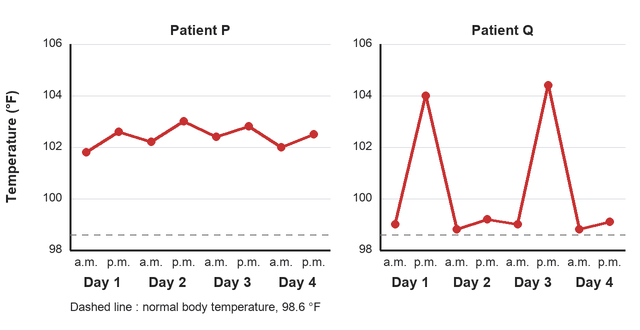
(a) Which patient's chart shows the pattern of fever described for malaria ? Give a reason from the chart.
(b) Name the germ that causes malaria and the mosquito that spreads it.
(c) Name two other symptoms of malaria and one way of preventing it.
- 333 marks
Question 33
Cognitive domain: Understanding
Sunita's grandmother has a round scar on her upper arm. She says it is from an injection that she was given as a child against a dreadful disease which spread from person to person. Children are no longer given this injection. The idea of such an injection came to a doctor when he saw that milkmaids who handled cows suffering from cowpox never caught the dreadful disease.
(a) Name the disease and the doctor.
(b) Say what the injection contained and why it protected the person.
(c) Why is this injection no longer given ?
- 343 marks
Question 34
Cognitive domain: Analysis
A doctor tells a class, "A person with AIDS usually does not die of AIDS itself. The person falls ill with one infection after another, and one of these infections proves fatal."
(a) Name the germ that causes AIDS and say what it does to the body.
(b) Explain the doctor's statement.
(c) Why do health centres use a new disposable syringe for every person ?
- 353 marks
Question 35
Cognitive domain: Evaluation
A father says, "My daughter has had all her vaccines, so she is immunized against every disease. She need not wash her hands before meals, and it does not matter where her food and water come from."
(a) Is the first part of the statement correct ? Explain.
(b) Give one disease from the chapter, spread by houseflies, which a measles vaccine would not prevent. Why not ?
(c) Why do the clean hands, food and water still matter for a girl who has been immunized ?
- 363 marks
Question 36
Cognitive domain: Application
Mr Gupta, aged 52, has smoked for thirty years and drinks alcohol every day. He has recently had a heart attack, and the tests show that his liver is damaged. His neighbours have stopped visiting him, afraid that they will "catch" his illness.
(a) Are a heart attack and liver damage communicable or non-communicable ? Give a reason.
(b) Name one more harmful effect of tobacco and one more of alcohol, other than those in the case.
(c) Mr Gupta's wife and children do not smoke. Can his smoking still harm them ? Name the condition.
- 375 marks
Question 37
Cognitive domain: Analysis
Case: The villages of Rampur and Sundarpur have the same population and houses each. A health team surveyed both villages in the month after the rains and counted the cases of dengue. (Hypothetical data.)
What the team found Rampur Sundarpur Houses with water standing around them Houses using mosquito repellents Dengue cases in the month (a) Find the percentage of the houses with standing water in each village, and the percentage by which the cases in Sundarpur are fewer than those in Rampur.
(b) Using the chapter, explain how the findings of the survey are related to the number of cases.
(c) Suggest two steps for Rampur, with a reason for each, and say what the team should count after a month to find out whether the steps have worked.
- 384 marks
Question 38
Cognitive domain: Evaluation
Case: In a first-aid drill at school, volunteer Zoya acted in four mock accidents while her teacher watched. In the first, a girl had a speck of dust in the eye, and Zoya asked her to rub it with a handkerchief. In the second, a boy had a mock fracture of the forearm, and Zoya moved the arm up and down to see how bad it was. In the third, a mock chemical burn on a hand was washed under cool running water for twenty minutes and then covered with a dressing. In the fourth, a person who had fainted was made comfortable and the clothes were loosened.
(a) Which two actions of Zoya were correct and which two were wrong ?
(b) Correct each wrong action.
(c) Name the item that the teacher should show Zoya to keep the injured forearm at rest in the mock fracture.
- 395 marks
Question 39
Cognitive domain: Creativity
Case: The Health Club of Class VIII is making a board game, "Healthy Steps", like snakes and ladders, to teach younger children the ideas of this chapter. A good habit takes a player up a ladder, and an unsafe habit takes a player down a snake.
(a) Write three ladder squares, each with a good habit from the chapter and the disease or harm that it prevents.
(b) Write three snake squares, each with an unsafe habit or condition from the chapter and the disease or harm that it can lead to.
(c) Write one question card that tests whether a player can tell a vaccine from a first-aid measure, and give its answer.
- 404 marks
Question 40
Cognitive domain: Analysis
Case: The chapter names seven diseases against which infants are immunized : tetanus, diphtheria, whooping cough, mumps, measles, tuberculosis and polio. A doctor checks the immunization card of baby Aarav. (Hypothetical card.)
Vaccine given to Aarav Disease it works against Given ? BCG vaccine Tuberculosis Yes Polio drops Polio Yes Vaccine for three diseases Diphtheria, whooping cough and tetanus Yes Measles vaccine Measles No Mumps vaccine Mumps No (a) How many of the seven diseases has Aarav been immunized against ? Find this as a percentage of the seven, correct to .
(b) Name the two diseases for which he is not yet protected. What will his body make once the measles vaccine is given ?
(c) The BCG vaccine is made from living weakened germs, and the diphtheria and tetanus vaccines are made from toxoids. Say how these two kinds of vaccines differ.