
Opening your dashboard
Class 8 Biology Chapter 2 Reproduction in Plants: Competency-Based Questions (CBQ)
40 questions on Chapter 2, each worked through on its own page with the AI tutor. Class 8 Biology, ICSE 2026-27.
40 questions
1–5 marks · Mixed difficulty
- 11 mark
Question 1
Cognitive domain: Application
During the monsoon, Ananya forgot a slice of bread in a closed lunch box for a week. When she opened the box, the bread was covered with fuzzy black patches of a fungus. Nobody had put any fungus on the bread. What is the best explanation ?
- 21 mark
Question 2
Cognitive domain: Analysis
The figure shows a flower cut lengthwise. Four of its parts are numbered 1 to 4. Part 3 is the whole swollen base in the centre of the flower.
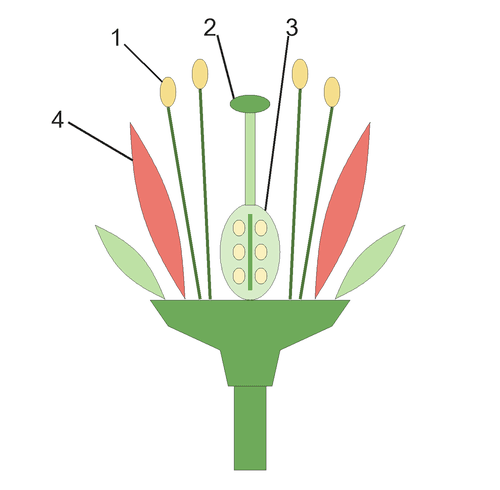
A bee dusted with pollen from another flower of the same kind visits this flower. On which part must the pollen grains be left for pollination to take place, and which part will later grow into the fruit ?
- 31 mark
Question 3
Cognitive domain: Application
Vallisneria plants grow rooted at the bottom of a village pond. To stop mosquitoes from breeding, the whole surface of the pond is covered with a clear floating plastic sheet for a few weeks. The Vallisneria plants stay green and healthy, but this season they form no seeds. What is the most likely reason ?
- 41 mark
Question 4
Cognitive domain: Analysis
A nursery owner has one rose plant with deep red flowers. She raises new rose plants from it in two ways and keeps a record.
What she recorded Plants raised from stem cuttings Plants raised from seeds Time taken to bear the first flowers 5 months 20 months Colour of the flowers deep red in every plant red in some, pink or white in others Which conclusion is supported by both rows of her record ?
- 51 mark
Question 5
Cognitive domain: Understanding
Assertion (A): A flower whose stigma never receives any pollen grain does not form seeds.
Reason (R): An ovule develops into a seed only after its egg cell fuses with a male gamete brought by the pollen tube.
- 61 mark
Question 6
Cognitive domain: Analysis
Assertion (A): A maize plant produces pollen grains in very large quantity.
Reason (R): The wind carries every pollen grain of maize straight to the stigma of another maize flower, so no pollen grain is wasted.
- 71 mark
Question 7
Cognitive domain: Application
A long green filament of Spirogyra is floating in a pond. A fish swimming past breaks it into 5 pieces. No piece dies, and after some days every piece has grown to full length.
Complete the sentence :
The pond now has ______ individuals of Spirogyra in place of one, and this kind of asexual reproduction is called ______.
- 81 mark
Question 8
Cognitive domain: Understanding
A gardener bends a lower branch of a jasmine plant down to the ground. He removes a ring of bark from the part that touches the soil, covers that part with soil and keeps a brick on it. Even before any roots appear, the leaves at the tip of this branch stay fresh and green. He cuts the branch off only after it has given out roots.
Complete the sentence :
The leaves stay fresh because, until it is cut off, the branch is still joined to the ______ plant, and this method of artificial vegetative propagation is called ______.
- 91 mark
Question 9
Cognitive domain: Application
Dev opens a flower from his garden and counts 6 stamens in it. Each stamen has one anther at its tip. He wants to know in how many separate sacs the pollen of this flower develops.
Complete the sentence :
The pollen grains of this flower develop in ______ pollen sacs in all, and the pollen grains contain the ______ gametes.
- 102 marks
Question 10
Cognitive domain: Evaluation
Mr Rao wants the sweet fruits of an alphonso mango tree in his own garden. He cuts a small shoot from the alphonso tree and fixes it on the cut stem of a young neem tree. He ties the two loosely with a thread and leaves the joint open to the air. The shoot dries up in a few days.
Judge Mr Rao's method. Point out two mistakes and say what he should have done.
- 112 marks
Question 11
Cognitive domain: Application
The flowers of the raat ki rani plant are small and pale. They open after sunset, when it is too dark for their colour to be seen, and yet many moths visit them every night and pollinate them.
(a) Which feature of these flowers helps the moths to find them in the dark ?
(b) Suggest two other features these flowers are likely to have that make pollination by insects successful. Give the use of each.
- 122 marks
Question 12
Cognitive domain: Understanding
A farmer sowed carrot seeds for the first time. After some months he pulled out every plant and sold the carrots. He was surprised that not one of his plants had produced flowers or seeds. "What shall I sow next time ?" he wondered.
(a) Explain why his carrot plants had no flowers or seeds.
(b) What should he do to get carrot seeds from his own crop ?
- 135 marks
Question 13
Cognitive domain: Analysis
Case: Students of a school in Dehradun worked with pea plants. A pea flower has both stamens and a carpel. They chose 40 flower buds and divided them into four groups of 10. A paper bag tied over a bud keeps out insects and any pollen from outside.
Group What was done to the 10 flower buds Flowers that formed pods (fruits) 1 Left open, nothing done 9 2 Covered with paper bags, nothing else done 8 3 Stamens removed from the buds, then covered with paper bags 0 4 Stamens removed from the buds, covered with paper bags; later, pollen from another pea plant was dusted on each stigma with a brush and the bags were put back 9 (a) The flowers of Group 2 got no pollen from outside, yet most of them formed pods. What kind of pollination took place in them ? Where did the pollen come from ?
(b) Explain why no flower of Group 3 formed a pod.
(c) What kind of pollination took place in Group 4 ? What is this way of transferring pollen by hand called ?
(d) Compare Group 3 with Group 4. What do these two groups together prove about the formation of a fruit ?
- 145 marks
Question 14
Cognitive domain: Evaluation
Case: Mohan has to cover a bare patch of a school lawn quickly. He pulls out a long creeping stem of lawn grass and cuts it at three places, as shown in the figure, to get four pieces. He plants all four pieces in moist soil. He makes two claims :
Claim 1 : "Every one of the four pieces will grow into new grass."
Claim 2 : "A lawn grown from pieces like this is safer from disease than a lawn grown from seeds."
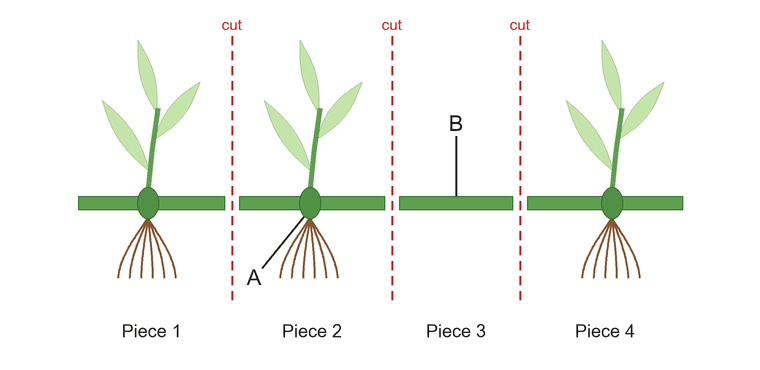
(a) Name the parts of the stem marked A and B.
(b) Is Claim 1 correct ? Use the figure to justify your answer.
(c) Is Claim 2 correct ? Give a reason.
(d) Even so, was Mohan's decision to use pieces of grass instead of seeds a sensible one for this job ? Give two reasons.
- 154 marks
Question 15
Cognitive domain: Creativity
Case: The school garden has a bed of bright yellow marigold flowers and, next to it, a bed of maize plants in flower. Riya says, "Insects visit the marigold flowers far more often than the maize flowers." The Nature Club wants to plan a simple survey to check this. The members will only watch from a distance and will not touch or disturb any insect.
(a) Plan the survey. What will the members count ? State two things they must keep the same for the two beds so that the comparison is fair.
(b) Draw a table in which the members can record their counts for three days.
(c) What result do you expect ? Explain it using the features of the flowers of the two plants.
- 161 mark
Question 16
Cognitive domain: Application
A kitchen onion was forgotten on a shelf for several weeks in the monsoon. A green shoot has come out from its top, although the onion has had no soil and no food from outside. As the shoot grows taller, the bulb becomes softer and smaller. Where does the shoot get its food from, and from which part does it grow ?
- 171 mark
Question 17
Cognitive domain: Evaluation
A technician sets up ten culture flasks. All ten flasks hold the same jelly, made in one batch, with nutrients and plant growth substances. In each flask she places a small shoot tip (an explant) on the jelly. Nine flasks show a lump of cells called callus after two weeks. In flask 4, however, a fuzzy white growth covers the jelly within three days and the explant turns brown and dies. Which is the most likely reason ?
- 181 mark
Question 18
Cognitive domain: Analysis
Assertion (A): Grafting is a method of artificial vegetative propagation.
Reason (R): For a successful graft, the cambium layers of the stock and of the scion must come into very close contact.
- 191 mark
Question 19
Cognitive domain: Application
The figure shows a young apple plant made by grafting. Shoot A was cut from an apple tree that bears large, sweet red apples. Part C is the lower stem of a hardy wild apple plant with a strong root system. B is the joint, bound with tape.

Which statement is correct ?
- 201 mark
Question 20
Cognitive domain: Understanding
Assertion (A): Fusion of the male and the female gametes takes place on the stigma, where the pollen grain lands.
Reason (R): The pollen grains reach the stigma during the process of pollination.
- 211 mark
Question 21
Cognitive domain: Analysis
A pumpkin plant is grown inside a closed net house that keeps out all insects. It bears two kinds of flowers. Flower X has only stamens and no carpel. Flower Y has only a carpel and no stamens. Many flowers of kind Y wither and fall off without forming any pumpkin. Which statement is correct ?
- 221 mark
Question 22
Cognitive domain: Understanding
A student noted four things in a garden.
-
A stem of lawn grass creeps on the ground and puts out roots and new shoots from its nodes.
-
A gardener ties a shoot of one guava plant on the cut stem of another guava plant.
-
A leaf of Bryophyllum falls on moist soil and tiny plants grow from the notches of its margin.
-
A gardener bends a branch of a jasmine plant, covers a part of it with soil, and cuts it off after it has given out roots.
Which of these are examples of natural vegetative propagation ?
-
- 231 mark
Question 23
Cognitive domain: Application
A single mint plant was planted in one corner of a school garden. After one monsoon, mint covers a large patch, but the plants are crowded and weak, with small pale leaves. Every plant in the patch grew from the creeping stems of the first plant. What explains the crowding ?
- 241 mark
Question 24
Cognitive domain: Analysis
A fungus growing on stale rice has sporangia, and each sporangium holds spores. All the spores are set free and carried away by the air. Only spore in every falls in a warm, moist place and germinates. (Hypothetical data.)
How many new fungi are expected, and what does this show about spore formation ?
- 251 mark
Question 25
Cognitive domain: Analysis
A farmer grows a special variety of maize. Next to his field is a field of another maize variety that is in flower. To find out how far the neighbour's pollen travels, he puts sticky glass slides in the direction of the wind at different distances from the neighbouring field. After one day he counts the pollen grains on each slide. (Hypothetical data.)
Distance from the neighbouring field (m) Pollen grains on the slide Which conclusion is best supported by the table ?
- 262 marks
Question 26
Cognitive domain: Understanding
Rina watches two kinds of single cells under a microscope.
Cell X is a bacterium. Its nuclear material divides into two, and then the cell splits across the middle into two similar cells.
Cell Y is a yeast cell. A small outgrowth appears on its body, grows larger and then gets detached along with its own nucleus to lead an independent life.
(a) Name the method of asexual reproduction in X and in Y.
(b) Just after the new cells separate, compare the sizes of the two cells formed from X with each other, and the size of the new cell of Y with the parent cell it came from.
- 272 marks
Question 27
Cognitive domain: Evaluation
A news report says, "Scientists placed a tiny piece of an orchid shoot on a nutrient jelly. Within three days it had grown into plantlets, which were taken straight to the garden."
(a) Is the time in this report believable if the method was micro-propagation ? Give a reason from the chapter.
(b) Write the stages in the correct order, from the piece of shoot to the plant in the soil.
- 282 marks
Question 28
Cognitive domain: Application
During a nature walk in the monsoon, Kabir turns over a leaf of a fern growing on a damp, shaded wall. He sees rows of small brown dots on its underside. When he taps the leaf over a sheet of white paper, a fine brown powder falls out, and a light breeze blows some of it away.
(a) What is the brown powder, and what can happen to it if it lands on another damp, shaded wall ?
(b) Is this sexual or asexual reproduction ? Give a reason.
- 292 marks
Question 29
Cognitive domain: Analysis
Children pluck every bright petal as soon as the flowers of mustard open in a school garden, but they do not touch the maize plants that are in flower in the same garden.
(a) Predict what happens to seed formation in the mustard plants, and give a reason.
(b) Will the maize plants be affected in the same way ? Explain.
- 302 marks
Question 30
Cognitive domain: Application
A maize tassel makes about pollen grains. A cob has about ovules, and each ovule needs one pollen grain to reach it. (Hypothetical data.)
(a) What per cent of the pollen grains of one tassel would be enough to fertilise all the ovules of one cob ?
(b) Why does maize still make so many pollen grains ?
- 312 marks
Question 31
Cognitive domain: Application
Meena needs young Bryophyllum plants for a school plant sale, and she wants to grow them only from leaves. Each full-grown leaf of her plant has notches in its margin, with a bud in each notch. In a trial on moist soil, out of every buds grew into a tiny plant. (Hypothetical data.)
(a) How many tiny plants can she expect from one leaf ?
(b) What is the smallest number of leaves she should place on moist soil to get at least plants ? Show your working.
- 323 marks
Question 32
Cognitive domain: Application
One year it rained almost every day when the maize crop and the mustard crop of a village were in flower. Both crops gave far fewer grains and seeds than usual.
(a) Use a feature of the pollen of maize to explain the poor yield.
(b) Explain the poor yield of mustard.
(c) A seed company still wanted mustard seeds from a small plot. Name the method it could use to make sure that the flowers are pollinated.
- 333 marks
Question 33
Cognitive domain: Evaluation
A student wrote three statements in a test.
Statement 1 : A potato plant that grows from an eye of a potato is formed by the fusion of a male and a female gamete.
Statement 2 : In budding, the bud of a yeast cell gets detached along with its own nucleus.
Statement 3 : Wind-pollinated flowers are large and brightly coloured, so that the wind can see them.
Say whether each statement is true or false. Correct each false statement.
- 343 marks
Question 34
Cognitive domain: Understanding
Rohan opens a pea pod and finds peas inside.
(a) Name the part of the flower from which the pod developed and the part from which each pea developed.
(b) Each pea formed after a pollen tube entered an ovule and released two male gametes. How many male gametes were used up in forming all peas ?
(c) What happened to the petals and the stamens of the flower after fertilisation ?
- 353 marks
Question 35
Cognitive domain: Analysis
The figure shows four stages P, Q, R and S of binary fission in a bacterial cell. They are not drawn in the order in which they take place.
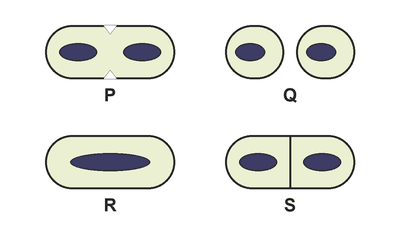
(a) Write the letters of the stages in the correct order, from the first to the last.
(b) What change takes place in the dark nuclear material between stage R and stage P ? In which stage has a wall formed across the middle ?
(c) How many parents are needed, and why are the two final cells alike ?
- 363 marks
Question 36
Cognitive domain: Analysis
A farmer keeps four boxes of honey bees in orchard A of a fruit tree. Orchard B of the same tree and the same size has no bees. In each orchard flowers were marked and the fruits counted later. (Hypothetical data.)
Orchard Flowers marked Fruits formed A (with bees) B (no bees) (a) Find the per cent of flowers that formed fruit in each orchard.
(b) Explain the difference.
(c) Give two features of the flowers that make bees visit them.
- 375 marks
Question 37
Cognitive domain: Analysis
Case: A farmer in Shimla cuts a potato into four pieces P, Q, R and S, shown in the figure, and plants all of them in moist soil. After days he records what has happened. (Hypothetical data.)
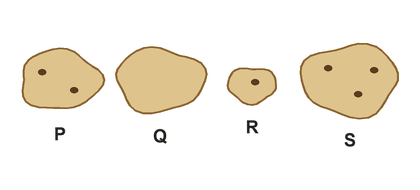
Piece Mass (g) Shoots after days P strong shoots Q none R thin, weak shoot S strong shoots (a) What do the dark spots on the pieces stand for, and how does the figure explain the result for Q ?
(b) Piece R gave a weak shoot. Suggest why.
(c) Write a rule for cutting a potato for planting.
(d) Will the new plants have the same characters as the potato from which they came ? Give a reason.
- 385 marks
Question 38
Cognitive domain: Analysis
Case: Tara puts pollen grains of a flower on a stigma and examines the pollen tubes under a microscope at different times. The ovule lies mm from the stigma along the path of the tube. (Hypothetical data.)
Time after pollination (h) Length of pollen tube (mm) (a) Why does a pollen grain have to land on the stigma before a pollen tube can start to grow ?
(b) Find the average speed of growth of the tube between h and h.
(c) At what time had the tube reached the ovule ? Give the reason.
(d) Name the two products formed after the male gametes of the tube fuse with the female parts of the ovule.
- 394 marks
Question 39
Cognitive domain: Creativity
Case: A garden designer is asked to invent an imaginary pond plant, "Jalmala", that must be pollinated by water, like Vallisneria.
(a) Where should the male flowers and the female flowers of Jalmala be borne, and how should the male flowers reach the female ones ?
(b) Give two features of the flowers and the pollen that you would design for water pollination.
(c) Write a flow chart of four boxes that shows the steps from a floating male flower to a seed.
- 404 marks
Question 40
Cognitive domain: Evaluation
Case: A village farmer wants many lemon plants that give fruits like those of his best lemon tree, and as soon as possible. He has no laboratory. A nursery records the result of four methods, each started with plants. (Hypothetical data.)
Method Plants that grew First fruits after (years) Fruits like the parent plant Seeds No, they differ Cuttings Yes Grafting Yes Tissue culture Yes, but it needs a laboratory (a) Find the per cent of plants that grew with each method.
(b) Which method would you advise the farmer to use ? Give two reasons from the table.
(c) Why is tissue culture not a good choice for him, even though it gives plants like the parent ?