
Opening your dashboard
Class 7 Maths Chapter 7 Ratio and Proportion: Competency-Based Questions (CBQ)
40 questions on Chapter 7, each worked through on its own page with the AI tutor. Class 7 Maths, ICSE 2026-27.
40 questions
1–5 marks · Mixed difficulty
- 11 mark
Question 1
Competency: Understanding
All the vehicles parked in a housing society are two-wheelers or cars. The ratio of two-wheelers to cars is .
Which statement must be true?
- 21 mark
Question 2
Competency: Analysis
Two stalls at a school fair sell lemonade.
Stall P uses 3 lemons for every 5 glasses. Stall Q uses 5 lemons for every 8 glasses.
Which stall's lemonade has more lemon in each glass?
- 31 mark
Question 3
Competency: Application
Ravi walks km to school. Sita walks km to school.
The ratio of Ravi's distance to Sita's distance, in its simplest form, is
- 41 mark
Question 4
Competency: Application
A mason makes concrete by mixing cement, sand and gravel in the ratio .
He has 12 buckets of sand, and plenty of cement and gravel. He uses up all the sand.
How many buckets of the three materials does he mix in all?
- 51 mark
Question 5
Competency: Application
On Arun's bicycle, 2 turns of the pedals make the back wheel turn 5 times.
How many turns of the pedals make the back wheel turn 35 times?
- 61 mark
Question 6
Competency: Evaluation
Assertion (A): The heights of a sapling at the end of the first, second and third months were 20 cm, 30 cm and 45 cm. These three heights are in continued proportion.
Reason (R): Three quantities are in continued proportion when the difference between the first and the second is equal to the difference between the second and the third.
- 72 marks
Question 7
Competency: Evaluation
A cricket team played 20 matches. It won 12 matches and lost 8. No match was drawn.
A sports reporter writes, "The ratio of matches won to matches played is ."
Is the reporter correct? If not, say which two quantities give , and write the correct ratio.
- 82 marks
Question 8
Competency: Application
Three friends paint a long wall. Anil paints of the wall, Bina paints of it, and Chetan paints the rest.
They are paid ₹ 1,800 in all, and they share it in the ratio of the work done.
Write the ratio of their work as a ratio of whole numbers. Then find Chetan's share.
- 92 marks
Question 9
Competency: Application
An orchard has mango trees and guava trees in the ratio . There are 18 mango trees.
The farmer plants 6 more mango trees. He wants the ratio of mango trees to guava trees to stay .
How many guava trees are there now? How many more guava trees must he plant?
- 102 marks
Question 10
Competency: Analysis
Water flows from a tap into a tank. Rina notes two readings:
- in 4 minutes the tap fills 18 litres;
- in 10 minutes the tap fills 45 litres.
(a) Use "product of extremes = product of means" to check whether the tap is running at a steady rate.
(b) At this rate, how long will the tap take to fill 63 litres?
- 113 marks
Question 11
Competency: Application & Analysis
A fruit seller packs apples, bananas and oranges in a basket.
The ratio of apples to bananas is . The ratio of bananas to oranges is .
(a) Find the ratio apples : bananas : oranges.
(b) The basket has 70 fruits in all. How many fruits of each kind are there?
(c) How many more apples must be added to this basket so that the ratio of apples to bananas becomes ?
- 123 marks
Question 12
Competency: Creativity
Write a real-life word problem of your own that can be solved by this proportion:
(a) Write your problem. Say what each of the four terms stands for in it.
(b) Solve the proportion and write the answer to your problem with its unit.
- 133 marks
Question 13
Competency: Analysis & Evaluation
A drawing is enlarged two times on a photocopier. Each time it is enlarged in the same ratio.
The drawing is 8 cm wide at the start and 12 cm wide after the first enlargement.
Kiran says, "The width grows by 4 cm each time. So after the second enlargement it will be 16 cm wide."
(a) Explain why Kiran is not correct.
(b) Find the correct width after the second enlargement.
(c) Which of the three widths is the mean proportional between the other two? Verify it.
- 144 marks
Question 14
Competency: Application & Analysis
Case study — A family's monthly budget
The Sharma family earns ₹ 36,000 in a month. The table shows how the money is used.
Head Food Rent Education Other expenses Savings Amount (₹) 12,000 9,000 6,000 3,000 6,000 (a) Find the ratio food : rent : education in its simplest form.
(b) Find the ratio of the savings to the total income.
(c) Next year the income becomes ₹ 42,000. The family divides it among the five heads in the same ratio as now. Find the new savings. How much more will be spent on food than now?
- 155 marks
Question 15
Competency: Application & Analysis
Case study — Idlis for the hostel breakfast
A hostel cook makes idli batter from rice and urad dal in the ratio by weight.
The store has 4.5 kg of rice and 1.2 kg of urad dal.
(a) How much urad dal is needed to use up all 4.5 kg of rice? Is the dal in the store enough for this?
(b) The cook uses all the dal and keeps the ratio . How much rice does he use? What is the total weight of rice and dal used?
(c) 800 g of rice and dal together make 40 idlis. Use a proportion to find how many idlis the cook can make. The hostel has 65 children and each child gets 4 idlis. Are the idlis enough? If not, how many idlis are short?
- 161 mark
Question 16
Competency: Analysis
The figure shows three rectangular photo frames P, Q and R. The length and breadth of each frame are marked in cm.

For which frames is the ratio of length to breadth the same?
- 171 mark
Question 17
Competency: Application
Meena takes 1 hour 15 minutes to finish a chapter of her story book. Rohit takes 50 minutes to finish the same chapter.
The ratio of Meena's time to Rohit's time, in its simplest form, is
- 181 mark
Question 18
Competency: Analysis
In a bag, the red and the blue marbles are in the ratio . There are no marbles of any other colour.
Which of the following can be the total number of marbles in the bag?
- 191 mark
Question 19
Competency: Application
A painter finds that 3 litres of paint cover 40 square metres of a wall. He must paint a wall of 100 square metres with the same paint, put on in the same way.
How many litres of paint does he need?
- 201 mark
Question 20
Competency: Analysis
(Hypothetical data.) An auto-rickshaw driver shows this fare chart.
Distance (km) 2 4 6 8 Fare (₹) 40 60 80 100 Which statement about the distance and the fare is correct?
- 211 mark
Question 21
Competency: Understanding & Evaluation
Assertion (A): The mean proportional between 2 and 8 is 4.
Reason (R): The mean proportional between two numbers is the average of the two numbers.
- 221 mark
Question 22
Competency: Understanding & Analysis
Assertion (A): The numbers 5, 8, 10 and 16, taken in this order, are in proportion, but the numbers 5, 8, 16 and 10, taken in this order, are not.
Reason (R): Four numbers , , and , taken in this order, are in proportion when , so the order of the numbers matters.
- 231 mark
Question 23
Competency: Analysis
(Hypothetical data.) A lassi stall makes 20 litres of lassi from curd and water in the ratio . A customer wants it thinner, so the stall owner adds water until the ratio of curd to water becomes .
How much water is added?
- 241 mark
Question 24
Competency: Application
In a 24-hour day, the times that Rohit spends sleeping, at school and on all other activities are in the ratio .
How many hours does he spend at school?
- 251 mark
Question 25
Competency: Application & Analysis
(Hypothetical data.) Three friends share one cycle in their hostel. In a week Ria rides it for 2 hours, Tara for 3 hours and Uma for 5 hours. The weekly rent of ₹ 200 is shared in the ratio of the hours for which each rides it.
Who pays more than ₹ 50?
- 262 marks
Question 26
Competency: Evaluation
Rahul has to divide ₹ 1,200 between Ali and Bina in the ratio . He writes: Ali gets ₹ 400, because , and Bina gets ₹ 240, because .
(a) Show that Rahul's answer cannot be right.
(b) Find the correct shares.
- 272 marks
Question 27
Competency: Application
A bucket holds 9 litres of water. A mug holds 300 mL.
(a) Find the ratio of the capacity of the bucket to the capacity of the mug, in its simplest form.
(b) How many mugfuls of water fill the bucket?
- 282 marks
Question 28
Competency: Analysis
Anita goes for a morning walk. In the first half-hour she walks km. In the second half-hour she walks km.
(a) Write the ratio of the distance in the first half-hour to the distance in the second half-hour as a ratio of whole numbers in its simplest form.
(b) In which half-hour was she walking faster? Give a reason.
- 292 marks
Question 29
Competency: Analysis
(Hypothetical data.) A shop sells notebooks of one kind at a fixed price for each notebook. A list of costs is given, but one cost has been written wrongly.
Number of notebooks 3 5 8 12 Cost (₹) 54 90 140 216 Find the wrong cost and write the correct cost.
- 302 marks
Question 30
Competency: Analysis & Evaluation
A craft shop sells two border designs for a rangoli, each with three stripes. The widths of the stripes are:
- Design 1: 3 cm, 6 cm and 12 cm;
- Design 2: 3 cm, 7 cm and 14 cm.
Which design has stripe widths in continued proportion? Show your working.
- 312 marks
Question 31
Competency: Application
A wire 70 cm long is bent to form a rectangle without any wire left over. The length and the breadth of the rectangle are in the ratio . Find the length and the breadth of the rectangle, and its area.
- 323 marks
Question 32
Competency: Analysis
(Hypothetical data.) Mr Kapoor spends and saves his monthly income in the ratio . He decides to spend ₹ 4,000 less and to save ₹ 4,000 more each month. Then his spending and his savings become equal (the ratio ).
Find his monthly income, and what he spends and saves each month at present.
- 333 marks
Question 33
Competency: Application & Analysis
(Hypothetical data.) A school has an Eco Club and an Art Club. The Eco Club has 36 members, and its Class 6 and Class 7 members are in the ratio . The Art Club has 35 members, and its Class 6 and Class 7 members are in the ratio . Every member is from Class 6 or Class 7.
(a) Find the number of Class 7 members in each club.
(b) In which club do the Class 7 members form the larger part of the club? Give a reason.
(c) If the two clubs join to make one club, find the ratio of Class 6 members to Class 7 members.
- 343 marks
Question 34
Competency: Application & Analysis
(Hypothetical data.) A test has 50 questions of one mark each. There is no negative marking, and each of four students attempted all the questions. The ratio of the number of correct answers to the number of wrong answers is:
Student Ayan Bela Chirag Dev Correct : wrong (a) Find the marks scored by each student.
(b) Write the names of the students in order, from the highest marks to the lowest.
(c) Find the difference between the highest and the lowest marks.
- 353 marks
Question 35
Competency: Evaluation
(Hypothetical data.) A grain shop mixes two kinds of rice. One kind costs ₹ 60 per kg and the other costs ₹ 110 per kg. They are mixed in the ratio by weight, the cheaper rice being the larger part.
(a) Without calculating, say whether the cost of 1 kg of the mixture is nearer to ₹ 60 or to ₹ 110. Give a reason.
(b) Find the cost of 1 kg of the mixture and check your answer to (a).
- 363 marks
Question 36
Competency: Application
(Hypothetical data.) Tara saves some money in each of three months. Her savings in the three months are in continued proportion. She saves ₹ 100 in the first month and ₹ 225 in the third month.
(a) How much does she save in the second month?
(b) Show that the three amounts are in continued proportion.
(c) Find the total of her savings in the three months.
- 374 marks
Question 37
Competency: Application & Analysis
Case study: (Hypothetical data.) The table shows the items sold by a school canteen on a Monday.
Item Samosa Sandwich Juice pack Number sold 45 30 75 Price of one (₹) 12 25 20 (a) Write the ratio of the numbers of samosas, sandwiches and juice packs sold, in its simplest form.
(b) On the day of the school fair the canteen expects to sell 300 items in the same ratio. How many of each item will it sell?
(c) Find the money the canteen will collect on the fair day.
- 385 marks
Question 38
Competency: Analysis
Case study: A rectangular plot measures 30 m by 20 m. It is divided by two lines, each parallel to the 20 m side, into three strips V, F and L, as shown in the figure. Vegetables are grown in V, flowers in F and L is a lawn. The widths of the strips V, F and L are in the ratio .
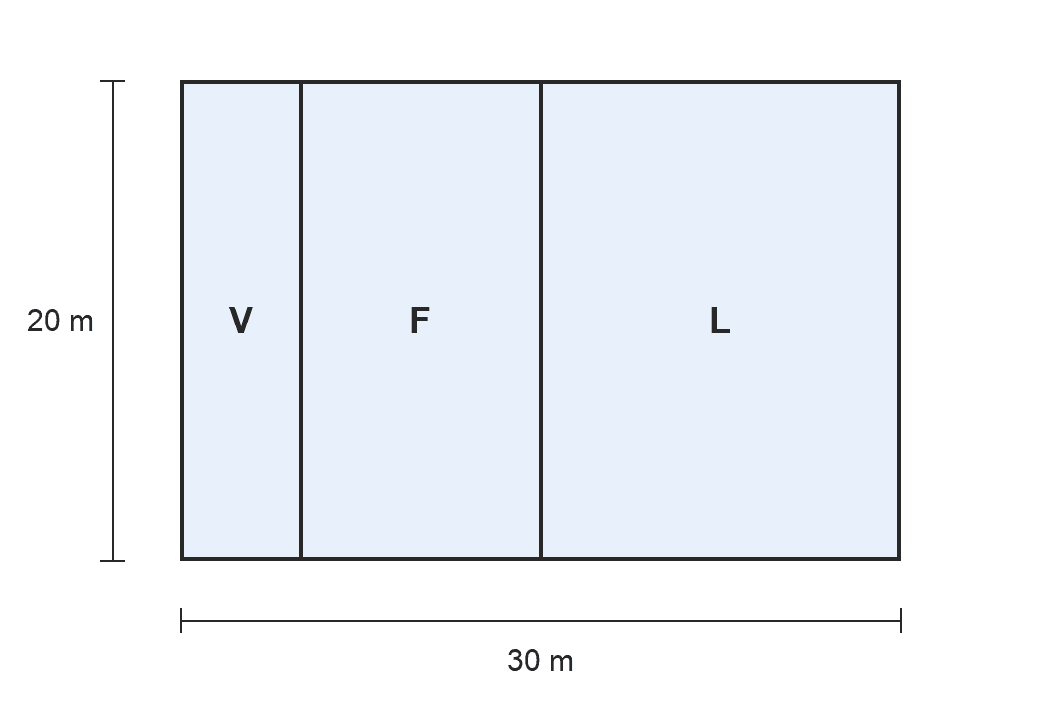
(a) Find the width of each strip.
(b) Find the area of each strip. Write the ratio of the three areas and compare it with the ratio of the widths.
(c) A fence costing ₹ 60 per metre is put along each of the two dividing lines. Find the cost of the fence.
- 395 marks
Question 39
Competency: Analysis & Evaluation
Case study: (Hypothetical data.) A nursery sells two potting mixes. Each is made of soil, sand and compost. The table gives the ratio of soil : sand : compost and the weight of one bag.
Mix Soil : sand : compost Weight of one bag A 16 kg B 15 kg (a) Find the weight of compost in one bag of each mix.
(b) Which mix has the larger part of compost in it? Compare the parts as fractions.
(c) Meena empties one bag of mix A and one bag of mix B into a tub and mixes them. Find the ratio of soil : sand : compost in the tub, as whole numbers in simplest form.
- 404 marks
Question 40
Competency: Creativity
Case study: (Hypothetical data.) A school has ₹ 6,000 to give as prizes for the first three places in a quiz. The committee sets these rules.
- The three prizes are in a ratio of whole numbers in simplest form, with the first prize the largest and the third prize the smallest.
- Each prize is a whole number of hundreds of rupees.
- The third prize is at least ₹ 600.
(a) Choose a ratio that follows all the rules. Find the three prizes.
(b) Meena suggests the ratio . Show that it breaks one of the rules.
(c) Choose a different ratio, with a different sum of terms, that follows all the rules. Find the three prizes.