
Opening your dashboard
Class 7 Maths Chapter 25 Probability: Competency-Based Questions (CBQ)
40 questions on Chapter 25, each worked through on its own page with the AI tutor. Class 7 Maths, ICSE 2026-27.
40 questions
1–5 marks · Mixed difficulty
- 11 mark
Question 1
Competency: Understanding
A weather app shows: “Probability of rain tomorrow: 0.9”.
Which statement gives the correct meaning of this message?
- 21 mark
Question 2
Competency: Application
A school noted the blood groups of the 40 students of Class VII.
Blood group A B AB O Number of students 10 14 4 12 A student of the class is chosen at random. The probability that the student's blood group is neither A nor B is
- 31 mark
Question 3
Competency: Analysis
At a fair, a player picks one bag and draws a ball from it without looking. A red ball wins a prize. All the balls are of the same size.
Which bag gives the best chance of winning?
- 41 mark
Question 4
Competency: Analysis
A die is thrown once. Two events are complementary when exactly one of them must happen on every throw.
Which pair of events is complementary?
- 51 mark
Question 5
Competency: Evaluation
Assertion (A): A fair coin has shown a head in each of the last 5 tosses. So in the next toss, the probability of getting a tail is more than .
Reason (R): A fair coin has two equally likely outcomes, head and tail, in every toss.
- 61 mark
Question 6
Competency: Application
A farmer tested a packet of seeds. Out of 200 seeds sown, 180 germinated (began to grow).
He now sows 5000 seeds of the same kind. About how many of them can he expect to germinate?
- 72 marks
Question 7
Competency: Application
In a school, the probability that a student chosen at random comes by bicycle is 0.15. Exactly 90 students of the school come by bicycle.
How many students are there in the school?
- 82 marks
Question 8
Competency: Evaluation
Twenty cards are numbered 1 to 20, one number on each card. The cards are shuffled and one card is drawn.
Ravi says, “Getting a prime number and getting an even number are equally likely.”
Is Ravi right? Show your working.
- 92 marks
Question 9
Competency: Analysis & Evaluation
Kiran throws a die 120 times. The number 6 comes up 32 times. She says, “This die is not fair.”
(a) About how many sixes would a fair die give in 120 throws?
(b) Does her result support what she says? What should she do to be more sure?
- 102 marks
Question 10
Competency: Application
Each letter of the word KOLKATA is written on a separate card. The seven cards are shuffled and one card is drawn.
(a) Which letters are the most likely to be drawn? Give their probability.
(b) Find the probability of drawing a vowel. Use it to find the probability of not drawing a vowel.
- 113 marks
Question 11
Competency: Application & Analysis
At a school fete, a stall has a box of 50 tokens. Exactly 10 of them are marked WIN. A player pays ₹ 10, draws one token without looking, and puts it back. A WIN token gets a prize worth ₹ 30.
(a) Find the probability that a player wins, and the probability that a player does not win.
(b) If 200 games are played, about how many prizes will be given?
(c) Will the stall expect to gain or lose money in these 200 games? By about how much?
- 123 marks
Question 12
Competency: Creativity
Asha and Bala want to play a game with one die. The die is thrown once in each round. Every round must have exactly one winner.
(a) Make a rule for the game so that it is fair (both players are equally likely to win a round). Show that it is fair.
(b) Now change the rule so that Asha is twice as likely to win a round as Bala. Show the two probabilities.
(c) What do the two probabilities add up to in each game? Why?
- 133 marks
Question 13
Competency: Analysis
Four groups in a class tossed the same coin different numbers of times.
Group 1 2 3 4 Number of tosses 20 50 100 500 Number of heads 14 29 54 255 (a) For each group, find the experimental probability of getting a head, as a decimal.
(b) What happens to this probability as the number of tosses increases?
(c) Which group's result should be trusted the most? About how many heads would you expect in 2000 tosses of this coin?
- 144 marks
Question 14
Competency: Application & Analysis
Case study — Snacks for Sports Day
The canteen manager asked some students to name their favourite snack. Each student named one snack. The bar graph shows the result.

(a) Read the graph. How many students were asked? Find the probability that a student chosen at random from them likes samosa the most.
(b) Find the probability that a student likes neither samosa nor idli the most.
(c) On Sports Day, 400 students will each buy one snack. Using the survey, about how many samosas and how many plates of idli should the canteen prepare?
- 155 marks
Question 15
Competency: Application & Evaluation
Case study — Will it rain on picnic day?
A school looked at the weather record of its town for the month of June in the last five years (150 days in all).
Kind of day Rainy Cloudy, no rain Sunny Number of days 90 36 24 (a) Find the probability of each kind of day in June. Check that the three probabilities add up to 1.
(b) About how many rainy days can be expected next June (30 days)?
(c) The school plans a picnic on a day in June. The organiser says, “A June day is more likely to be dry than rainy.” Is the organiser right? Give the probability of a day without rain as a percentage.
- 161 mark
Question 16
Competency: Understanding & Application
The line below is a probability scale from 0 to 1. Four points P, Q, R and S are marked on it. One of these points shows the probability of getting a number greater than 2 in one throw of a fair die.
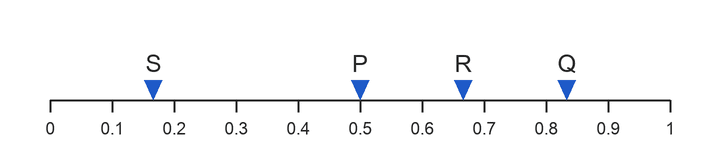
Which point is it?
- 171 mark
Question 17
Competency: Analysis
A card is drawn at random from ten cards numbered 1 to 10.
Which statement about this experiment is correct?
- 181 mark
Question 18
Competency: Application
The record of a school football team shows the number of goals it scored in each of its last 20 matches. (Hypothetical data.)
Goals scored in a match 0 1 2 3 4 Number of matches 4 7 5 3 1 Using this record, the probability that the team scores at least 2 goals in its next match is
- 191 mark
Question 19
Competency: Application
In a school raffle, 400 tickets are sold and one ticket is drawn at random for the first prize. Meena has 16 of the tickets.
The probability that Meena does not win the first prize is
- 201 mark
Question 20
Competency: Evaluation
Assertion (A): A bag has 3 red balls and 7 blue balls. If one ball is drawn at random, the probability of getting a red ball is .
Reason (R): The probability of an event is the number of favourable outcomes divided by the total number of possible outcomes, and every ball in the bag is a possible outcome.
- 211 mark
Question 21
Competency: Evaluation
Assertion (A): If the probability of an event E is 0.7, then the probability of “not E” is 0.3.
Reason (R): For any event E, the probability of E and the probability of “not E” are each less than .
- 221 mark
Question 22
Competency: Application & Analysis
The roll numbers of the 45 students of Class VII run from 1 to 45. The teacher picks one roll number at random to read out a notice.
The probability that the roll number picked is a multiple of 6 is
- 231 mark
Question 23
Competency: Analysis
A die was thrown 90 times and the number on top was noted each time. (Hypothetical data.)
Number 1 2 3 4 5 6 Number of times 12 17 15 18 14 14 Which statement about the experimental probabilities is true?
- 241 mark
Question 24
Competency: Application
Ravi makes a six-faced die. Its faces are marked 1, 2, 2, 2, 3 and 3. Each face is equally likely to land on top. He throws the die once.
The probability of getting an odd number is
- 251 mark
Question 25
Competency: Analysis
The table shows how the 60 students of a Class VII section come to school. (Hypothetical data.)
Bus Cycle Walk Boys 18 6 12 Girls 14 4 6 One student is chosen at random. The probability that the student is a boy who does not come by bus is
- 262 marks
Question 26
Competency: Creativity & Understanding
A bag has 12 cards numbered 1 to 12. One card is drawn at random.
(a) Write an event whose probability is . Show that its probability is .
(b) Write one event whose probability is 0 and one event whose probability is 1.
- 272 marks
Question 27
Competency: Evaluation
Before the kabaddi final, Rohan says, “Our team will either win or lose, so the probability that we win is .” The school team has won 21 of its last 28 matches. (Hypothetical data.)
(a) Why is Rohan's reasoning not correct?
(b) Use the record to estimate the probability that the team wins the final.
- 282 marks
Question 28
Competency: Application
A survey of 100 families in a colony recorded the number of children in each family. (Hypothetical data.)
Number of children 0 1 2 3 or more Number of families 12 30 8 (a) Find the value of .
(b) A family of the colony is chosen at random. Find the probability that it has at least 2 children.
- 292 marks
Question 29
Competency: Analysis
Three students write the probabilities of the four results of the school's next hockey match (win, draw, loss, match abandoned because of rain). Their answers are called set X, set Y and set Z.
Set Win Draw Loss Abandoned Set X 0.45 0.20 0.30 0.05 Set Y 0.50 0.30 0.30 −0.10 Set Z 0.40 0.30 0.20 0.20 Which set can be correct? Give a reason for each set.
- 302 marks
Question 30
Competency: Analysis & Application
A craft box holds 36 buttons. Six of them are red and the rest are of other colours. Ruchi wants the probability of drawing a red button at random to become by adding only red buttons to the box.
(a) Find the probability of drawing a red button now.
(b) How many red buttons must she add?
- 312 marks
Question 31
Competency: Understanding
A day of the week is chosen at random.
(a) Find the probability that the name of the day begins with the letter S.
(b) Find the probability that the name of the day ends with the letters “day”.
(c) Find the probability that the name of the day has the letter Z in it.
- 323 marks
Question 32
Competency: Application & Analysis
During one hour on the day before Makar Sankranti, a shop sold 40 kites, each of red, blue, green or yellow colour. The probability that a kite sold is red is , and the probability that it is blue is . The shop sold twice as many green kites as yellow kites. (Hypothetical data.)
(a) How many red kites and how many blue kites were sold?
(b) How many green kites and how many yellow kites were sold?
(c) Find the probability that a kite sold is neither red nor blue.
- 333 marks
Question 33
Competency: Evaluation & Analysis
To plan the sports day, 60 students of School A and 80 students of School B were asked whether cricket is their favourite game. In School A, 30 students said yes. In School B, 36 students said yes. (Hypothetical data.)
(a) Find the experimental probability that a student of School A likes cricket best, and the same for School B.
(b) More students said yes in School B than in School A. Does this mean that a student of School B is more likely to like cricket best? Give a reason.
(c) Find the experimental probability that a student picked from all 140 students likes cricket best.
- 343 marks
Question 34
Competency: Understanding & Analysis
A letter is chosen at random from the 26 letters of the English alphabet.
(a) Find the probability that the letter comes before the letter F in the alphabet.
(b) Find the probability that the letter is one of the letters used in the word PROBABILITY.
(c) Find the probability that the letter is not used in the word PROBABILITY.
- 353 marks
Question 35
Competency: Evaluation
To choose the day of the school picnic, the principal asked the 25 students of one section, Class VII-A. Twenty of them said they prefer Saturday. The principal says, “The probability that a student of our school prefers Saturday is , so about 960 of our 1200 students prefer Saturday.” (Hypothetical data.)
(a) Find in its simplest form and check the principal's number 960.
(b) Give one reason why the principal's conclusion may not be reliable.
(c) What should the principal do to get a more reliable estimate?
- 363 marks
Question 36
Competency: Application & Evaluation
A caterer noted that at six earlier functions, 450 of the 720 guests chose the vegetarian meal and the rest chose the non-vegetarian meal. A new function has 480 guests. (Hypothetical data.)
(a) Find the probability that a guest chooses the vegetarian meal, and the probability that a guest chooses the non-vegetarian meal. Give each as a fraction and as a percentage.
(b) About how many plates of each meal should the caterer expect to serve at the new function?
(c) Should the caterer prepare exactly this many plates of each meal? Explain.
- 374 marks
Question 37
Competency: Application & Analysis
Case study — Seats for the annual day
The front four rows of the school hall have 10 seats each. The plan shows which seats are booked (dark) and which are vacant (white). A volunteer picks one of these 40 seats at random for a surprise gift.

(a) Count the booked seats and the vacant seats. Find the probability that the seat picked is booked, and the probability that it is vacant.
(b) The volunteer now picks a seat from Row D only. Find the probability that it is vacant.
(c) Later, 5 more seats in Row D and 2 more seats in Row C get booked. A seat is picked at random from all 40 seats again. Find the probability that it is vacant now.
- 385 marks
Question 38
Competency: Analysis & Evaluation
Case study — Saplings on the school campus
Last monsoon the Eco Club planted saplings of five kinds. The table shows how many of each kind were planted and how many were still alive after one year. (Hypothetical data.)
Kind of sapling Neem Mango Gulmohar Tulsi Banyan Number planted 40 30 50 60 20 Number alive after one year 32 21 35 54 8 (a) Find the experimental probability that a sapling of each kind is alive after one year. Give each as a decimal.
(b) Find the probability that a sapling chosen at random from all those planted is alive after one year. Which kind has the greatest chance of staying alive?
(c) Rina says, “Gulmohar did better than Mango because 35 Gulmohar saplings are alive but only 21 Mango saplings.” Is she right? Explain.
- 394 marks
Question 39
Competency: Analysis & Evaluation
Case study — Choosing a helper by lots
The 40 students of Class VII belong to four houses. The class teacher writes the name of each student on a slip, puts all the slips in a box and draws one slip to choose a helper for the science fair. The table shows the number of students in each house.
House Ashoka Tagore Raman Kalam Number of students 14 10 8 8 (a) Find the probability that the helper belongs to each house. Check that the four probabilities add up to 1.
(b) Find the probability that the helper does not belong to Ashoka house.
(c) The teacher wants every house to have the same chance of providing the helper. Is this so for the method above? Suggest a method that gives every house the same chance, and state that chance.
- 405 marks
Question 40
Competency: Application & Evaluation
Case study — Archery practice
Nisha practised archery on the target shown. An arrow that lands in the inner circle scores 10 points, in the middle ring 5 points and in the outer ring 2 points. An arrow that misses the board scores 0 points.
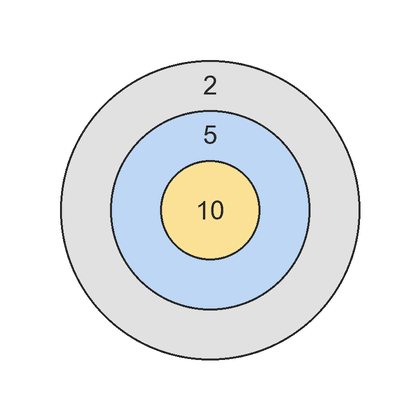
She shot 80 arrows. The table shows the results. (Hypothetical data.)
Result Inner circle Middle ring Outer ring Missed the board Number of arrows 12 36 24 8 (a) Find the experimental probability of each result. Check that the four probabilities add up to 1.
(b) A shot is a “good shot” if it scores 5 or more points. Find the probability of a good shot, and of a shot that is not a good shot.
(c) Her coach wants the probability of a good shot to be at least after 100 arrows in all, that is, after 20 more arrows. Is this possible? Show your reasoning.