
Opening your dashboard
Class 7 Maths Chapter 16 Lines and Angles: Competency-Based Questions (CBQ)
40 questions on Chapter 16, each worked through on its own page with the AI tutor. Class 7 Maths, ICSE 2026-27.
40 questions
1–5 marks · Mixed difficulty
- 11 mark
Question 1
Competency: Understanding
In a skating show, Zoya spins through three-quarters of one complete turn without stopping.
The angle she turns through, and its type, is
- 21 mark
Question 2
Competency: Application
The barrier at a railway crossing lies horizontal when it is closed and stands vertical when it is fully open.
The barrier has already been raised through . Through what more angle must it turn to stand vertical?
- 31 mark
Question 3
Competency: Analysis
A carpenter wants to check whether the edges of two shelves are parallel. He lays a straight wooden strip across both edges and measures a pair of angles.
Which pair of readings proves that the two edges are parallel?
- 41 mark
Question 4
Competency: Application
Two straight roads cross each other. At the crossing, the angle at one corner is 4 times the angle at the next corner.
The larger of these two angles is
- 51 mark
Question 5
Competency: Understanding
Think of capital letters made with straight strokes. Where two strokes are parallel, the stroke joining them acts as a transversal.
In which letter do the parallel strokes and the transversal form a pair of corresponding angles?
- 61 mark
Question 6
Competency: Understanding
Assertion (A): The complement of an angle of is an angle of .
Reason (R): One degree is divided into 60 equal parts and each part is called a minute, so .
- 72 marks
Question 7
Competency: Evaluation
Asha says, "For any acute angle, its supplement is exactly more than its complement."
Test her statement with the angle . Then decide whether it is true for every acute angle, and give a reason.
- 82 marks
Question 8
Competency: Application
A paper hand fan opens out to an angle of . Its folds divide this angle into 8 equal angles.
Find the measure of each small angle in degrees and minutes. Check your answer.
- 92 marks
Question 9
Competency: Analysis & Evaluation
Two straight sticks cross each other at a point. Ravi measures the four angles at the point, going round in order, and writes:
He says, "The four angles add up to , so all my readings are correct."
Is Ravi right? If the first two readings are correct, what should the other two readings be?
- 102 marks
Question 10
Competency: Application
Two parallel roads AB and CD are crossed by a straight water pipeline PQ. The pipeline meets the roads at M and N, as shown. .
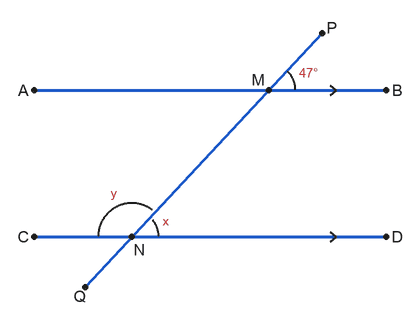
Find the angles marked and . Give a reason for each.
- 113 marks
Question 11
Competency: Analysis
A park has two parallel walls AB and CD. A footpath runs straight from gate A to a lamp post O, and then straight from O to gate C, as shown. and .

(a) Find , the angle between the two parts of the footpath at the lamp post.
(b) Find the reflex angle .
- 123 marks
Question 12
Competency: Creativity & Analysis
You are making a "lucky spinner" for the school fair. The round board is divided into 5 sectors by straight lines drawn from the centre. Design your own spinner that follows all these rules:
- One sector has a right angle at the centre.
- One sector has an obtuse angle, and another sector has an acute angle that is the supplement of this obtuse angle.
- The two remaining sectors are equal to each other.
(a) Write the five angles of your spinner and show that they follow the rules.
(b) Your friend chooses a different obtuse angle for her spinner. Explain why her two equal sectors must be the same size as yours.
- 133 marks
Question 13
Competency: Analysis & Evaluation
A painter draws three straight lines , and on a wall. To test them, he stretches a straight string across all three and measures the angle above each line, on the right of the string. His readings are shown.
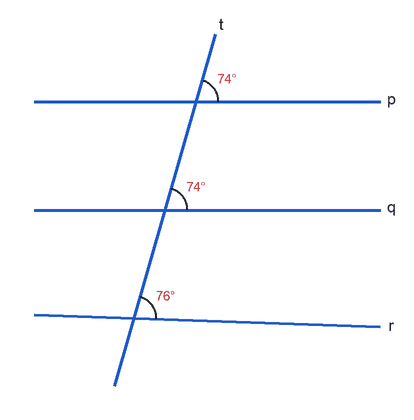
He says, "The readings are almost the same, so all three lines are parallel."
(a) Which two lines are certainly parallel? Name the condition you use.
(b) Use co-interior angles to test whether is parallel to .
(c) What should the reading at be if is to be parallel to the other two lines? Is the painter's statement correct?
- 144 marks
Question 14
Competency: Application & Analysis
Case study — A street map
The map shows a part of a town. Main Road AB and Station Road CD are parallel. Lane PQ meets the two roads at M and N. Lane RS meets them at X and Y. A surveyor has marked and .
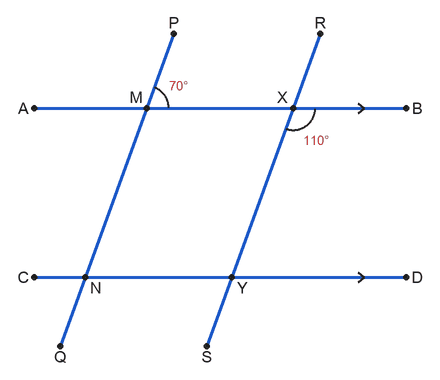
(a) Find . Name the pair of angles you use.
(b) Find . Name the pair of angles you use.
(c) A shopkeeper says that the two lanes PQ and RS will never meet, however far they are extended. Is he right? Justify your answer by taking Main Road AB as the transversal of the two lanes.
- 155 marks
Question 15
Competency: Application & Analysis
Case study — The reclining chair
The back-rest of a reclining chair can be locked in four positions. The table shows the angle between the seat and the back-rest in each position.
Position 1 2 3 4 Angle between seat and back-rest (a) Name the type of angle in each of the four positions.
(b) The chair is in position 2. Through what angle must the back-rest turn to lie flat as in position 4? Also show that in position 3 the angle is exactly three times its supplement.
(c) The maker wants to add a new position in which the angle is four times its supplement. Find this angle. Between which two positions in the table does it lie?
- 161 mark
Question 16
Competency: Analysis
Three street lamps A, B and C stand along a village road. A surveyor measures m, m and m. (Hypothetical data.)
Which statement must be true?
- 171 mark
Question 17
Competency: Understanding
The Sun looks about wide when seen from the Earth.
Written in seconds, this angle is
- 181 mark
Question 18
Competency: Application
A round pizza is cut by straight cuts from the centre into equal slices. Neha picks some slices that lie side by side.
For which number of slices is the angle at the centre an obtuse angle?
- 191 mark
Question 19
Competency: Analysis
A ceiling fan has identical blades. Each blade makes a right angle with the next blade at the centre. One blade breaks off.
What is the angle at the centre between the two blades that were on the two sides of the broken blade, measured across the gap?
- 201 mark
Question 20
Competency: Analysis
Tara thinks of an angle. She adds the complement and the supplement of her angle and gets .
What is Tara's angle?
- 211 mark
Question 21
Competency: Application
Two horizontal bars AB and CD of a gate are parallel. A slanting pole EF crosses AB at K and CD at N, as shown. The angle marked is above AB and to the left of the pole.
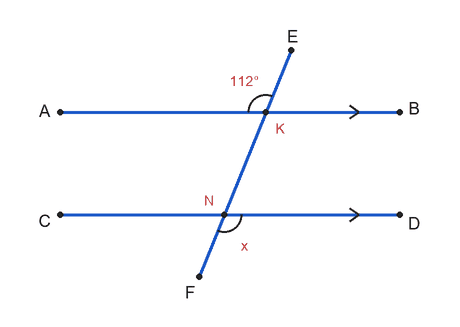
What is the measure of the angle marked ?
- 221 mark
Question 22
Competency: Application
Two rails PQ and RS are cut by a straight strip TU at K and N, as shown. The angle is .
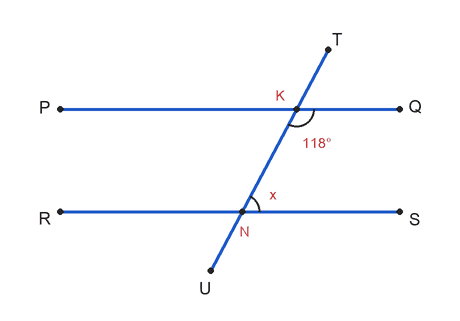
For the rails to be parallel, the angle marked must be
- 231 mark
Question 23
Competency: Analysis & Evaluation
Assertion (A): If a transversal makes equal interior alternate angles with two lines, the two lines are parallel.
Reason (R): This is true only when the transversal is perpendicular to both lines.
- 241 mark
Question 24
Competency: Analysis
Four straight lanes run through a colony. No two lanes are parallel, and no three lanes pass through the same point.
How many points are there where two lanes cross?
- 251 mark
Question 25
Competency: Evaluation
Assertion (A): The ray AB and the ray BA are the same ray.
Reason (R): A ray has one end point and goes on endlessly in one direction only.
- 262 marks
Question 26
Competency: Application
(Hypothetical data.) The arm of a toy robot is turned by a small motor. In every step the motor turns the arm through .
(a) How many steps make one complete turn?
(b) How many steps make a right angle?
- 272 marks
Question 27
Competency: Analysis
The drawing of a metal bracket lists four of its angles as
, , ,
Name the type of each angle. How many of the four angles are obtuse?
- 282 marks
Question 28
Competency: Analysis & Evaluation
Kabir draws and , so that the two angles have the arm OB in common. He says, " must be ."
(a) Show a way of drawing the angles so that .
(b) Is Kabir always right? Find the other value that can have.
- 292 marks
Question 29
Competency: Evaluation
Rita says, "An angle can never be equal to its own supplement."
(a) Let the angle be . Use an equation to decide whether Rita is right.
(b) Find the angle that is equal to its own complement.
- 302 marks
Question 30
Competency: Analysis
Three parallel horizontal rails of a fence are crossed by one straight post. The post is a transversal of every pair of rails.
(a) How many pairs of corresponding angles are formed in all?
(b) How many pairs of interior alternate angles are formed in all?
- 312 marks
Question 31
Competency: Application
(Hypothetical data.) The two side rails of a bridge are parallel. A straight cross-brace cuts them. Two interior angles on the same side of the brace are in the ratio .
(a) Find the two angles.
(b) Name the type of each angle.
- 323 marks
Question 32
Competency: Application
(Hypothetical data.) A security camera at a school gate sweeps from one extreme position to the other. On its scale, the left extreme is at and the right extreme is at .
(a) Find the angle through which the camera sweeps.
(b) Name the type of this angle.
(c) The company widens the sweep by . Find the new angle and name its type.
- 333 marks
Question 33
Competency: Evaluation & Analysis
Ravi draws a straight line AC and marks a point O on it. He draws the rays OB and OD on the same side of AC, so that , as shown.
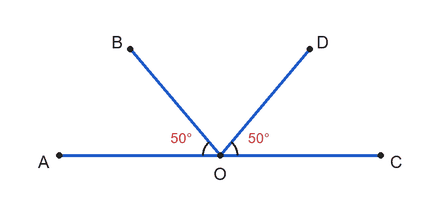
Ravi says, "B, O and D lie on one straight line, because and are vertically opposite angles."
(a) Find .
(b) Is Ravi right? What is wrong with his reason?
(c) On which sides of AC must B and D lie for equal angles and to show that B, O and D are in a straight line?
- 343 marks
Question 34
Competency: Creativity
You are designing a treasure hunt for your class. The hunter stands at a flag and turns four times, one after the other, always clockwise. After the four turns she faces the direction she started with, having turned through exactly one complete turn, that is , in all.
(a) Write four turn angles in degrees and minutes. Every angle must include minutes, and at least one angle must be a reflex angle.
(b) Show that your four angles add up to .
(c) Name the type of each of your four angles.
- 353 marks
Question 35
Competency: Evaluation
Ria measures an angle ABC with a protractor. The angle clearly looks wider than a right angle. But she reads from the scale that starts at on the other arm of the angle, and writes "".
(a) Why must Ria's reading be wrong?
(b) Which reading should she have taken? Find the correct measure of .
(c) Check your answer by finding the supplement of and comparing it with your answer.
- 363 marks
Question 36
Competency: Analysis
Five points A, B, C, D and E are marked on a map. The points A, B and C lie on one straight road. D and E are not on that road. No other three of the five points lie on one straight line.
(a) How many different straight lines can be drawn so that each passes through at least two of the five points?
(b) How many such lines would there be if no three of the five points were on one straight line?
(c) Why is the answer to (a) smaller than the answer to (b)?
- 374 marks
Question 37
Competency: Application & Analysis
Case study — A garden sprinkler
(Hypothetical data.) A garden sprinkler can be set to water an arc of a circle. The table shows the angle swept in each of its five settings.
Setting 1 2 3 4 5 Angle swept (a) Name the type of the angle swept in each of the five settings.
(b) Which setting should be used (i) at a corner of a rectangular lawn, (ii) at the middle of a straight edge of the lawn, and (iii) at the inner corner of an L-shaped lawn, where the lawn surrounds the sprinkler on three-quarters of a full circle?
(c) The owner wants a new setting that sweeps of a complete turn. Find this angle and name its type. How many degrees of the full circle does the sprinkler not water with this setting?
- 384 marks
Question 38
Competency: Analysis
Case study — A cycle wheel
(Hypothetical data.) A cycle wheel has spokes. They are fixed at equal gaps round the hub O, the centre of the wheel. The table shows five pairs of spokes. The number tells how many gaps lie between the two spokes of the pair, counted clockwise from the first spoke of the pair to the second.
Pair P Q R S T Gaps between the spokes (a) Find the angle between two neighbouring spokes.
(b) Find the angle at O for each pair in the table, measured clockwise through the gaps counted, and name its type.
(c) For a pair of spokes, the angle at O is the supplement of the angle for spokes that are gaps apart. How many gaps lie between these two spokes?
- 395 marks
Question 39
Competency: Analysis & Application
Case study — A delivery rider
(Hypothetical data.) A delivery rider starts facing North. Directions are measured clockwise from North: North is , East , South and West . North-East is , South-East , South-West and North-West . At each stop she makes the turn given in the table, and then rides on.
Stop S1 S2 S3 S4 S5 Turn clockwise anticlockwise clockwise clockwise (a) In which direction does she face after S1, after S2 and after S3?
(b) After which stop does she first face South? In which direction does she face after S5?
(c) Name the type of the turn at S5. Find the smaller turn, in the other sense, that would have given the same direction.
- 405 marks
Question 40
Competency: Evaluation & Application
Case study — A staircase rail
The figure shows the side view of a staircase. The handrail EH and the line AS through the edges of the steps are parallel. Both rise from the horizontal floor, and the handrail makes with the floor at E. A vertical post stands at B on the floor. It meets the line of the step edges at D and the handrail at C.
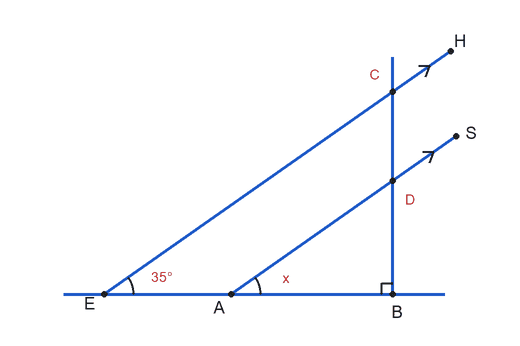
(a) Name the pair of angles formed by the floor and the two parallel lines at E and A. Find the angle .
(b) Find , the angle between the post and the line of the step edges. Give the reasons.
(c) (Hypothetical rule.) A designer says that a handrail is comfortable if the angle between the handrail and the post, below the handrail, is between and . Find and decide whether this staircase follows the rule. Between which two values must the slope of the rail with the floor lie for the rule to hold?