
Opening your dashboard
Class 7 Maths Chapter 11 Simple Interest: Competency-Based Questions (CBQ)
40 questions on Chapter 11, each worked through on its own page with the AI tutor. Class 7 Maths, ICSE 2026-27.
40 questions
1–5 marks · Mixed difficulty
- 11 mark
Question 1
Competency: Analysis
Asha lends ₹ 6,000 to a friend for 2 years. Bina lends ₹ 4,000 to another friend for 3 years. Both charge simple interest at the same rate per annum.
Who earns more interest?
- 21 mark
Question 2
Competency: Application
A gold-loan receipt has these details.
Loan Date of loan Date of repayment Rate ₹ 5,000 5 March 29 July (same year) per annum, simple interest The interest to be paid is
- 31 mark
Question 3
Competency: Application
Bank P pays simple interest at per annum. Bank Q pays simple interest at per annum.
Nisha wants to deposit ₹ 16,000 for 2 years. How much more interest will she get from Bank Q than from Bank P?
- 41 mark
Question 4
Competency: Application
An advertisement of a finance company says:
"Borrow ₹ 10,000 today. Pay back just ₹ 13,000 after years."
What rate of simple interest per annum is the company charging?
- 51 mark
Question 5
Competency: Understanding
Farhan has to find the simple interest on ₹ 4,950 for 2 years at per annum. Before working it out, he makes a quick estimate to guard against a silly mistake.
Which is the best estimate?
- 61 mark
Question 6
Competency: Evaluation
Assertion (A): If the rate of interest and the time are both doubled, the simple interest on a sum also becomes double.
Reason (R): For a fixed principal, the simple interest depends on the product Rate Time.
- 72 marks
Question 7
Competency: Application
Arif borrowed ₹ 6,000 from a co-operative society to repair his scooter. The society charges simple interest at per annum.
When Arif cleared the loan, he paid ₹ 6,360 in all.
For how many months did he keep the money?
- 82 marks
Question 8
Competency: Analysis
A shop sells a bicycle in two ways.
- Cash price: ₹ 4,500, paid now.
- Pay-later plan: ₹ 1,500 now and ₹ 3,240 after 1 year.
On how much money is the shop really charging interest in the pay-later plan? Find the rate of simple interest per annum that the shop charges.
- 92 marks
Question 9
Competency: Evaluation
Ritu says, "On ₹ 5,000, the simple interest for 9 months at per annum is the same as the simple interest for 1 year at per annum."
Is Ritu right? Justify by working out both interests, and say why this happens.
- 102 marks
Question 10
Competency: Application
Grandfather has put some money in a senior citizens' scheme that pays simple interest at per annum. The scheme sends him the interest every 6 months, and each time he gets ₹ 1,350.
How much money has he put in the scheme?
- 113 marks
Question 11
Competency: Analysis
A post office clerk tells three customers that all of them were paid simple interest at the same rate. Their receipts show:
Customer Sum deposited Time Interest paid Anu ₹ 2,000 3 years ₹ 420 Binod ₹ 5,000 2 years ₹ 700 Chitra ₹ 3,000 4 years ₹ 900 Find the rate each customer actually got. Which customer was paid at a different rate, and how much more or less did that customer get than at the common rate?
- 123 marks
Question 12
Competency: Creativity
Tara wants to earn exactly ₹ 1,800 as simple interest. She may choose:
- the principal: ₹ 5,000, ₹ 6,000, ₹ 7,500 or ₹ 10,000;
- the rate: , , or per annum;
- the time: a whole number of years, not more than 5.
(a) Design two different plans (principal, rate, time) that each give exactly ₹ 1,800. Show that they work.
(b) Which of your two plans gives Tara her money back sooner?
- 133 marks
Question 13
Competency: Analysis & Evaluation
Kabir has to find the amount to be paid back on a loan of ₹ 8,000 taken for 2 years 6 months at per annum simple interest. His working is shown below.
years
₹ 1,560
Amount ₹ 9,560
Find Kabir's mistake. Work out the correct amount. By how much is Kabir's answer wrong?
- 144 marks
Question 14
Competency: Application & Analysis
Case study — Paying back a part of a loan early
Farida borrows ₹ 30,000 from a bank to buy a cow for her dairy. The bank charges simple interest at per annum. At the end of each year it works out the interest for that year on the part of the loan that is still not paid back. Interest is never charged on interest.
At the end of the first year, Farida pays the bank ₹ 12,400. This pays the whole interest for the first year, and the rest of it reduces her loan.
(a) Find the interest for the first year.
(b) How much of the ₹ 12,400 reduces the loan? How much does Farida still owe?
(c) Farida clears the loan at the end of the second year. How much does she pay then? How much interest did she save by making the payment at the end of the first year, compared with paying nothing until the end of the second year (when she would pay simple interest on the whole ₹ 30,000 for 2 years)?
- 155 marks
Question 15
Competency: Analysis & Evaluation
Case study — Reading a deposit statement
Leela put a sum of money in a bank at simple interest. She did not note the sum or the rate. Her statement shows the amount at the end of each year.
End of year 1 2 3 Amount ₹ 16,200 ₹ 17,400 ₹ 18,600 (a) How much interest is added each year? How does the table show that the interest is simple interest?
(b) Find the sum Leela deposited and the rate of interest per annum.
(c) Leela's uncle says, "At this rate your money will be double in 10 years." Is he right? Find the amount at the end of 10 years, and the time in which the sum really doubles.
- 161 mark
Question 16
Competency: Analysis
Kavya borrowed some money at 8% per annum simple interest for 2 years 6 months. The interest she paid at the end was ₹ 1,200 less than the money she had borrowed.
The money she borrowed was
- 171 mark
Question 17
Competency: Analysis
A lender decides to increase the sum lent to a customer by 20% and to reduce the time of the loan by 20%. The rate of simple interest stays the same.
The interest he earns will then
- 181 mark
Question 18
Competency: Evaluation
Mr Gupta gets two loan offers. Both charge simple interest.
- Loan A: ₹ 20,000 at 9% per annum for 18 months.
- Loan B: ₹ 15,000 at 12% per annum for 2 years.
Which loan carries less interest, and by how much?
- 191 mark
Question 19
Competency: Evaluation
Assertion (A): A sum lent at 12% per annum simple interest for 6 months earns interest equal to 6% of the sum.
Reason (R): Six months is half a year, so the interest is half of the interest for a full year.
- 201 mark
Question 20
Competency: Analysis & Evaluation
Assertion (A): A sum of money doubles itself in 8 years at simple interest, so at the same rate it becomes four times itself in 16 years.
Reason (R): At simple interest, the interest earned in every year is the same.
- 211 mark
Question 21
Competency: Analysis
Dhruv deposited a sum of money in a bank at simple interest. The graph shows the amount (sum + interest) in his account at the end of each of the first 5 years.
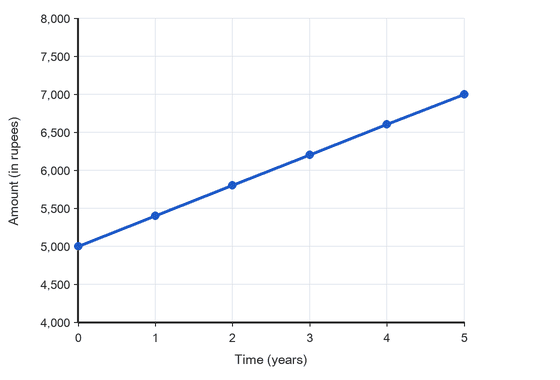
Another bank pays simple interest at 9% per annum. If Dhruv had put the same sum in that bank for the same 5 years, how much more money would he have at the end?
- 221 mark
Question 22
Competency: Analysis
Two friends compare their savings. Both deposits earn simple interest.
- Deposit 1: ₹ 2,500 earned ₹ 150 in 9 months.
- Deposit 2: ₹ 4,000 earned ₹ 240 in 10 months.
Which deposit earned the higher rate of interest per annum?
- 231 mark
Question 23
Competency: Understanding
Mr Joseph, who runs a bakery, borrowed ₹ 12,000 from a co-operative bank at simple interest. At the end of every month he pays the bank only that month's interest, which is ₹ 90.
The rate of interest per annum is
- 241 mark
Question 24
Competency: Evaluation
Ananya deposits ₹ 2,000 in a bank at 5% per annum simple interest.
Which of the following statements about her deposit is true?
- 251 mark
Question 25
Competency: Understanding
Mala invests ₹ 4,000 and Nikhil invests ₹ 9,000 in a scheme that pays 6% per annum simple interest for 5 years. When the scheme ends, each gets back a certain percent of the money he or she invested.
That percent is
- 262 marks
Question 26
Competency: Application
₹ 3,650 was lent on 10th January at 10% per annum simple interest. When the money was returned, the interest was ₹ 60. On what date was it returned? (The year is not a leap year.)
- 272 marks
Question 27
Competency: Analysis
Two friends, Amar and Bina, put equal amounts of money in different schemes for 3 years. Amar's scheme pays 6% per annum and Bina's pays 9% per annum, both at simple interest. At the end, Bina has ₹ 270 more interest than Amar. How much did each of them put in?
- 282 marks
Question 28
Competency: Evaluation
Pooja needs ₹ 10,000 for 1 year. Bank X charges simple interest at 9% per annum and a processing fee of ₹ 300. Bank Y charges simple interest at 10% per annum and no fee. Which loan costs her less in all, and by how much?
- 292 marks
Question 29
Competency: Application
A bank passbook shows that ₹ 24,000 was deposited on 1st April and that interest of ₹ 1,350 was credited for the next 9 months. Find the rate of simple interest per annum.
- 302 marks
Question 30
Competency: Analysis
A sum of money earned ₹ 180 as simple interest in the first 6 months. At the same rate, how much interest will the same sum earn in 2 years 3 months? Answer without finding the sum or the rate.
- 312 marks
Question 31
Competency: Analysis
(Hypothetical data.) The table shows the simple interest earned by one sum at one rate for different times. One entry has been written wrongly.
Time (years) 1 2 3 4 Interest (₹) 450 900 1,300 1,800 Find the wrong entry and write its correct value. Hence find the interest for 7 years.
- 323 marks
Question 32
Competency: Application
Ritesh wants to buy a scooter priced at ₹ 48,000. He pays 25% of the price in cash. He borrows the rest from a finance company at 10% per annum simple interest for 2 years and repays everything after 2 years.
Find (a) the sum he borrows, (b) the amount he repays after 2 years, (c) the total money he pays for the scooter and how much more it is than the price.
- 333 marks
Question 33
Competency: Analysis
Seema deposits ₹ 10,000 in a bank for 5 years. The bank pays simple interest at 6% per annum for the first 2 years and at 8% per annum for the next 3 years, each time on the same ₹ 10,000.
(a) Find the total interest she gets in the 5 years.
(b) Find the single rate per annum that would give the same interest in 5 years. Is it the middle of 6% and 8%?
- 343 marks
Question 34
Competency: Application
Mohit deposits ₹ 6,000 at 7% per annum simple interest. He wants his amount to become more than ₹ 7,500.
Make a table of his amount at the end of each of the first 4 years. After how many complete years is his amount first more than ₹ 7,500?
- 353 marks
Question 35
Competency: Analysis
Dev and Esha lend money at simple interest. The sums they lend are in the ratio 3 : 5, the rates of interest in the ratio 4 : 3 and the times in the ratio 5 : 2.
Find the ratio of the interest earned by Dev to that earned by Esha. If Esha earns ₹ 1,500, how much does Dev earn?
- 363 marks
Question 36
Competency: Creativity & Application
A post office clerk wants a ready reckoner so that customers can read off the interest quickly. All deposits get 6% per annum simple interest.
(a) Make a table of the interest on ₹ 1,000 for 1, 2, 3, 4 and 5 years.
(b) Use your table, without the formula, to find the interest on ₹ 7,000 for 4 years and on ₹ 2,500 for 3 years.
- 375 marks
Question 37
Competency: Analysis & Evaluation
Case study: (Hypothetical data.) A bank pays simple interest on fixed deposits as shown in the rate chart.
Time of deposit Rate for general customers Rate for senior citizens 1 year 6.0% per annum 6.5% per annum 2 years 6.5% per annum 7.0% per annum 3 years 7.0% per annum 7.5% per annum Mr Sharma, a senior citizen, has ₹ 40,000 to deposit for 3 years.
(a) He makes one 3-year deposit. Find his interest and his amount at the end.
(b) How much less interest would a general customer get from the same deposit?
(c) Mr Sharma's son says, "Take 1-year deposits instead and renew each year, so that you can change the bank if rates rise." If Mr Sharma takes three 1-year deposits one after another, each of ₹ 40,000 (the interest is taken out each time), how much interest does he get in 3 years? Compare this with a 2-year deposit followed by a 1-year deposit, and say which of the three plans gives the most interest.
- 384 marks
Question 38
Competency: Application & Analysis
Case study: Mr Kapoor, a retired teacher, lends ₹ 5,000 at 6% per annum simple interest for 2 years. When the money comes back, he lends the whole amount he receives (the sum and its interest) to another person at 5% per annum simple interest for 3 years.
(a) Find the amount he receives at the end of the first loan.
(b) Find the interest on the second loan and the total amount he has at the end of the 5 years.
(c) If he had lent the ₹ 5,000 at 6% per annum for the whole 5 years, would he have more money or less money, and by how much? Why does this happen?
- 395 marks
Question 39
Competency: Analysis & Evaluation
Case study: (Hypothetical data.) Two cousins, Gita and Hari, each put money in a bank at simple interest. Gita's money is in Deposit X and Hari's is in Deposit Y. The graph shows the amount in each deposit at the end of each year.

(a) Read from the graph the sum put in each deposit. Hence find the rate of interest per annum of each deposit.
(b) At the end of which year are the two amounts equal? What is that amount?
(c) Hari says, "My deposit earns interest at a higher rate, so it is always the better deposit." Is he right? Compare the two amounts at the end of 3 years and at the end of 7 years.
- 404 marks
Question 40
Competency: Application & Evaluation
Case study: (Hypothetical data.) Mohan, a farmer, has two loans, both at simple interest for 2 years.
- A bank loan of ₹ 30,000 at 8% per annum.
- A loan of ₹ 10,000 from a moneylender at 18% per annum.
(a) Find the interest on each loan for 2 years and the total interest.
(b) Find the single rate per annum on his total borrowing of ₹ 40,000 that would give the same total interest in 2 years.
(c) Mohan has ₹ 10,000 of savings at the start. He can use it either to clear the moneylender's whole loan, or to reduce the bank loan to ₹ 20,000. Find how much interest he saves in each case. Which is better, and by how much?