
Opening your dashboard
Class 7 Chemistry Chapter 5 Language of Chemistry: Competency-Based Questions (CBQ)
40 questions on Chapter 5, each worked through on its own page with the AI tutor. Class 7 Chemistry, ICSE 2026-27.
40 questions
1–5 marks · Mixed difficulty
- 11 mark
Question 1
Cognitive domain: Application
In the school laboratory, Anu drops three clean iron nails into a beaker of blue copper sulphate solution. After half an hour she sees two things. The solution has become light green. The nails have a reddish-brown coating.
Which conclusion is correct?
- 21 mark
Question 2
Cognitive domain: Analysis
A teacher heats potassium chlorate to prepare oxygen. She does it twice, with the same amount of potassium chlorate and the same flame. The second time she mixes in 1 g of black manganese dioxide. Her results are shown in the table.
Trial In the test tube Time taken to fill one jar with oxygen Manganese dioxide left at the end 1 Potassium chlorate only 12 minutes – 2 Potassium chlorate + 1 g manganese dioxide 3 minutes 1 g Which conclusion do the results support?
- 31 mark
Question 3
Cognitive domain: Understanding
Riya makes a model of a chemical reaction with beads. She joins 4 white beads in pairs to show two molecules of hydrogen. She joins 2 red beads to show one molecule of oxygen. Then she pulls all the beads apart and joins them again to make models of water molecules. Each water molecule has 2 hydrogen atoms and 1 oxygen atom.
What will Riya find?
- 41 mark
Question 4
Cognitive domain: Application
Sunita's family cooks on a biogas stove. Biogas is mainly methane. The formula of methane is . Her elder brother writes the balanced equation for the burning of methane:
What does this equation tell Sunita?
- 51 mark
Question 5
Cognitive domain: Understanding
Assertion (A): When an electric current is passed through water that has a little acid in it, the water breaks up into hydrogen and oxygen.
Reason (R): Some chemical reactions take place only in the presence of light.
- 61 mark
Question 6
Cognitive domain: Evaluation
Assertion (A): The equation follows the law of conservation of matter.
Reason (R): In a chemical reaction, atoms are neither created nor destroyed.
- 71 mark
Question 7
Cognitive domain: Understanding
On Science Day, a teacher holds a strip of magnesium ribbon with tongs and brings it into a flame. The ribbon burns with a dazzling white light. A white powder is left on the tongs.
Complete the sentences about this reaction.
The magnesium has combined with the ________ of the air. The white powder is a new compound called ________. Energy is given out as heat and light, so the reaction is ________ (exothermic / endothermic).
- 81 mark
Question 8
Cognitive domain: Understanding
Sameer's teacher heats a red powder, mercuric oxide, in a hard glass test tube. Shiny silvery drops of mercury collect on the cooler part of the test tube. A colourless gas, oxygen, comes out of the test tube.
Name the reactant in this reaction. How many products are formed from it?
- 91 mark
Question 9
Cognitive domain: Application
A laboratory helper is carrying a bottle of dilute hydrochloric acid. A little acid spills on a small heap of washing soda (sodium carbonate) lying on the table.
Predict two things that can be observed where the acid falls on the washing soda.
- 102 marks
Question 10
Cognitive domain: Application
A bottle of green copper carbonate powder has been lying in the school store room for five years. The powder is still green. Today the teacher puts a little of this powder in a dry test tube and holds it over a burner. In two minutes the powder turns black.
Explain why the powder changed in the test tube but not in the bottle. Write the word equation for the change in the test tube.
- 112 marks
Question 11
Cognitive domain: Analysis
The teacher says, "Zinc reacts with dilute hydrochloric acid to form zinc chloride and hydrogen." She asks the class to write the skeletal equation. Kabir writes:
Find the two mistakes in Kabir's equation. Then write the correct skeletal equation.
- 122 marks
Question 12
Cognitive domain: Evaluation
On a cold evening Chotu's family burns 2 kg of coal in an angeethi. In the morning only a small heap of grey ash is left. Chotu weighs the ash. It is much lighter than 2 kg.
Chotu says, "This proves that matter is destroyed when coal burns."
Is Chotu right? Give reasons for your answer.
- 134 marks
Question 13
Cognitive domain: Application
Jaya puts up a "magic show" at her school science fair. She wears safety goggles and her teacher stands beside her. She tells the visitors, "I use no magic words. I only mix or heat things." She shows three tricks, one after the other, and the visitors clap after each one. At the end she says, "Every trick was a chemical reaction. In each one, something new was made." Her three tricks are given in the table.
Trick What Jaya does What the visitors see 1. "Water into milk" Pours colourless barium chloride solution into colourless sodium sulphate solution The liquid turns milky white at once 2. "Smoke without fire" Holds a glass rod dipped in ammonia solution near the mouth of a test tube of concentrated hydrochloric acid Dense white fumes 3. "Sweet coal" Heats white sugar in a dish The sugar melts and then turns into a black solid (a) Each trick shows one sign (characteristic) of a chemical reaction. Name the sign shown by each trick.
(b) Write the word equation for Trick 1. Name the substance that makes the liquid look milky.
(c) A visitor says, "In Trick 3 the sugar has only melted. Nothing new is made." Use what is seen in Trick 3 to show that he is wrong. Then explain why Trick 1 would not work if Jaya mixed dry barium chloride powder with dry sodium sulphate powder.
- 145 marks
Question 14
Cognitive domain: Analysis
Near Meera's village there is a lime kiln. Workers fill the kiln with pieces of limestone, which is calcium carbonate. A coal fire heats the limestone strongly for many hours. The limestone breaks up into white lumps of quicklime (calcium oxide) and a gas, carbon dioxide, which goes out of the chimney. Builders buy the quicklime. Before whitewashing a house they add water to it. The mixture hisses and becomes very hot, and slaked lime (calcium hydroxide) is formed. The kiln owner notes that 100 kg of pure limestone gives him only 56 kg of quicklime.
(a) Write the word equation for the reaction in the kiln and for the reaction with water. Which of the two reactions is endothermic and which is exothermic?
(b) The formulae are: calcium carbonate , calcium oxide , carbon dioxide , water and calcium hydroxide . Write the equation for each reaction using these formulae. Count the atoms on both sides and say whether each equation is balanced.
(c) The owner asks, "Where did the rest of my limestone go?" Answer him, and calculate the mass of carbon dioxide formed from 100 kg of limestone. A builder then adds 18 kg of water to the 56 kg of quicklime, and all of it reacts. What mass of slaked lime does he get?
- 155 marks
Question 15
Cognitive domain: Creativity
Leela's mother keeps a tin of baking powder in the kitchen. The label says that baking powder is a dry mixture of baking soda (sodium bicarbonate) and a solid acid. The powder lies quietly in the tin for months. But when Leela's mother mixes it into wet cake batter, the batter fills with bubbles of gas and rises.
Leela thinks: "The two substances in baking powder react with each other only when water is present."
(a) Which condition necessary for a chemical reaction is Leela thinking of?
(b) Design a simple experiment that Leela can do at home to test her idea. Say what she should take, what she should do, and what she should keep the same to make the test fair.
(c) What result will show that Leela's idea is correct? Which sign of a chemical reaction will she see?
(d) Use your result to tell Leela's mother how to store the tin during the monsoon, and why.
- 161 mark
Question 16
Cognitive domain: Analysis
Two students are watching bubbles. Aman opens a sealed bottle of a fizzy drink, and bubbles rise through the liquid and escape. Bela drops a few granules of zinc into dilute hydrochloric acid in a test tube, and bubbles of a colourless gas rise from the zinc.
Which statement is correct?
- 171 mark
Question 17
Cognitive domain: Application
The label on a bottle of hydrogen peroxide solution in a school laboratory says: "Keep in a dark brown bottle in a cool place." Hydrogen peroxide slowly breaks down into water and oxygen.
Which statement gives the correct reason for the label?
- 181 mark
Question 18
Cognitive domain: Analysis
Ishaan builds a ball model of the reaction between nitrogen and hydrogen to form ammonia. A blue ball stands for an atom of nitrogen (N) and a white ball stands for an atom of hydrogen (H). Balls that touch are joined together in one molecule. His model is shown in the figure.

Which statement about the model is correct?
- 191 mark
Question 19
Cognitive domain: Evaluation
Assertion (A): Heat has to be supplied to start every exothermic reaction.
Reason (R): In an exothermic reaction, energy is released.
- 201 mark
Question 20
Cognitive domain: Evaluation
Assertion (A): The equation , for the breaking up of calcium carbonate on strong heating, is a balanced equation.
Reason (R): A chemical equation is balanced only when the number of molecules on the left side is equal to the number of molecules on the right side.
- 211 mark
Question 21
Cognitive domain: Understanding
Ananya writes the condition for the reaction above the arrow in four word equations in her copy.
Which word equation has the correct condition?
- 221 mark
Question 22
Cognitive domain: Analysis
Sonal studies how fast hydrogen peroxide solution gives oxygen. In each trial she uses 20 mL of the solution and measures the time taken to collect 50 mL of oxygen. (Hypothetical data.)
Trial Manganese dioxide Temperature Time to collect 50 mL of oxygen 1 none 25 °C 10 minutes 2 1 g 25 °C 1 minute 3 none 50 °C 4 minutes 4 1 g 50 °C 30 seconds Which pair of trials should she compare to find the effect of manganese dioxide alone?
- 231 mark
Question 23
Cognitive domain: Application
Reena mixes 14.0 g of iron powder with 10.0 g of sulphur powder in a hard glass test tube and heats it strongly. The two react to form 22.0 g of a black solid, iron sulphide. The rest of the mixture does not react. When she brings a magnet near the cooled solid, nothing is pulled out of it. (Hypothetical data.)
What mass of which powder is left unused in the test tube?
- 241 mark
Question 24
Cognitive domain: Analysis
Iqbal counts the atoms of each element on the two sides of a balanced equation and records them in a table.
Element Left side Right side Iron 1 1 Hydrogen 2 2 Chlorine 2 2 Which equation did he count? The formula of iron chloride is .
- 251 mark
Question 25
Cognitive domain: Application
In a word equation, an upward arrow () written after a substance shows that it is formed as a gas, and a downward arrow () shows that it is formed as an insoluble solid (a precipitate).
Which word equation uses these arrows correctly?
- 262 marks
Question 26
Cognitive domain: Application
In a fume cupboard, a teacher lowers a small piece of burning sulphur into a gas jar of oxygen. The sulphur burns with a bright blue flame, and a colourless gas with a sharp, choking smell is formed. The gas is sulphur dioxide, and its formula is .
(a) Write the word equation for this reaction.
(b) Write the equation using symbols and formulae. Count the atoms on both sides and say whether the equation is balanced.
- 272 marks
Question 27
Cognitive domain: Application
In Rina's kitchen the air is full of oxygen, and the pipe to the stove holds cooking gas. The gas does not catch fire by itself. It burns only after Rina clicks the lighter at the burner.
(a) Name the condition that Rina's lighter provides to start the burning.
(b) Name one other reaction from this chapter that also needs this condition, and write its word equation.
- 282 marks
Question 28
Cognitive domain: Evaluation
A teacher writes the skeletal equation for the breaking up of ammonia:
Tarun counts all the atoms. He gets 4 atoms on the left side (1 nitrogen and 3 hydrogen) and 4 atoms on the right side (2 nitrogen and 2 hydrogen). He says, "Both sides have 4 atoms, so the equation is balanced."
Is Tarun right? Explain, and write the balanced equation.
- 292 marks
Question 29
Cognitive domain: Analysis
Under her teacher's supervision, Kiran mixes silver nitrate solution with sodium chloride solution and filters off the white precipitate of silver chloride. She spreads a little of the wet solid on each of two watch glasses, A and B, and puts both side by side on a sunny window sill. She covers B with an upturned black box. After one hour the solid on A has turned grey-violet on top, while the solid under the box is still white. (Silver chloride slowly breaks up into silver and chlorine when light falls on it.)
(a) Name the condition needed for the change on watch glass A, and give the sign which shows that a chemical reaction has taken place.
(b) Why did Kiran cover B with a box on the same window sill, instead of keeping it in a cupboard in another room?
- 302 marks
Question 30
Cognitive domain: Application
In a demonstration, a teacher heats iron filings and sulphur powder together in a hard glass test tube until a black solid is formed. When it has cooled, she puts a little of the black solid into another test tube in the fume cupboard and adds dilute hydrochloric acid. Bubbles form at once, and a smell like that of rotten eggs reaches the nearest students.
(a) Name the black solid and the gas that smells of rotten eggs. Write the word equation for the reaction with the acid.
(b) Name two characteristics of a chemical reaction shown by the reaction with the acid, and say why the teacher uses a fume cupboard.
- 312 marks
Question 31
Cognitive domain: Understanding
A chemical reaction can happen in different ways: (i) two substances combine to form one new substance, (ii) one compound splits into two or more substances, or (iii) an element reacts with a compound to give more than one product.
State which way is shown by each word equation.
(a) Iron + Sulphur Iron sulphide
(b) Calcium carbonate Calcium oxide + Carbon dioxide
(c) Magnesium + Hydrochloric acid Magnesium chloride + Hydrogen
- 323 marks
Question 32
Cognitive domain: Application
Rohan heats 2.45 g of potassium chlorate in a test tube with a little manganese dioxide, which is not used up and is left out of the masses. Potassium chloride, a white solid, is left in the test tube. It weighs 1.49 g. Oxygen gas escapes. (Hypothetical data.)
(a) Use the law of conservation of matter to find the mass of oxygen formed.
(b) What masses of potassium chloride and of oxygen are expected from 4.90 g of potassium chlorate?
(c) Rohan weighs the open test tube before and after heating. He finds that the mass is less after heating. Explain why.
- 333 marks
Question 33
Cognitive domain: Analysis
Carbon monoxide burns in oxygen to form carbon dioxide. The balanced equation is:
(a) How many molecules of carbon monoxide and of oxygen are needed to make 10 molecules of carbon dioxide?
(b) A gas jar holds 8 molecules of carbon monoxide and 3 molecules of oxygen. How many molecules of carbon dioxide can be formed? Which gas is left over, and how many of its molecules?
- 343 marks
Question 34
Cognitive domain: Evaluation
Rahul puts a piece of magnesium ribbon in dilute hydrochloric acid, and another student puts a spoonful of sugar in water. Both solids slowly disappear. Rahul says, "In both beakers the solid has just dissolved, so both changes are the same."
(a) Is Rahul right?
(b) Give two observations in the magnesium beaker that show a chemical reaction.
(c) How can the student show that the sugar has not changed into a new substance?
- 353 marks
Question 35
Cognitive domain: Analysis
In each balanced equation below, one formula has been covered and replaced by X.
(a)
(b)
(c)
Find the formula of X in each equation by counting the atoms on both sides, and name the substance.
- 363 marks
Question 36
Cognitive domain: Analysis
Two students each take 6.4 g of red-brown copper powder in an open dish and heat it in air. (Hypothetical data.)
Student How the copper was heated Mass after heating What the solid looks like Dev Strongly for 20 minutes, with stirring 8.0 g Black all through Esha Gently for 3 minutes, without stirring 7.2 g Black on top, red-brown underneath (a) Explain why Dev's solid became heavier, using the equation for the reaction, and find the mass of oxygen that combined.
(b) Dev's copper has all changed into copper oxide. Use his result to find how much of Esha's copper has changed and how much is still copper.
- 374 marks
Question 37
Cognitive domain: Analysis
Neha's science club is given four white powders, labelled P, Q, R and S, by the teacher. The labels are in code, so the club does not know what the powders are. Wearing safety goggles and working under the teacher's supervision, the members do three tests on a very small amount of each powder, and they write down exactly what they see. Their notes are in the table, and they want to find out which tests show a chemical reaction. (Hypothetical data.)
Test P Q R S Add to water and stir Dissolves Dissolves Does not dissolve Dissolves Add dilute hydrochloric acid Brisk effervescence No change Brisk effervescence No change Heat strongly in a dry test tube No change Turns black, and drops of liquid collect on the cooler part No change No change (a) Which powders show a chemical reaction with dilute hydrochloric acid? Name the sign that shows it.
(b) Which powder shows a chemical reaction on heating? Give two observations that support your answer.
(c) A student says, "P and R must be the same substance, because both fizz with the acid." Use the table to show that the student is wrong.
- 384 marks
Question 38
Cognitive domain: Application
A science museum has a model car that runs on hydrogen. The hydrogen burns with the oxygen of the air to form water, and the energy released makes the car move. The museum makes the hydrogen from water. It passes an electric current through water that has a little acid in it, and the water breaks up into hydrogen and oxygen. A guide tells the visitors, "The car uses up water only to make it again."
(a) Write the word equation for the burning of hydrogen and for the breaking up of water, showing the condition over the arrow where there is one.
(b) Write the skeletal equation for the breaking up of water, and then balance it by counting the atoms.
(c) When 36 g of water is completely broken up, 4 g of hydrogen is formed. Find the mass of oxygen formed, and state the law that you used.
- 395 marks
Question 39
Cognitive domain: Evaluation
Aisha has read that builders add water to quicklime (calcium oxide) before whitewashing. In the school laboratory, under her teacher's supervision, she drops a lump of quicklime into 50 mL of water in a beaker at room temperature. The water hisses as the lump crumbles into a white powder. She stirs the mixture, measures its temperature every minute for 12 minutes and plots the graph. (Hypothetical data.)
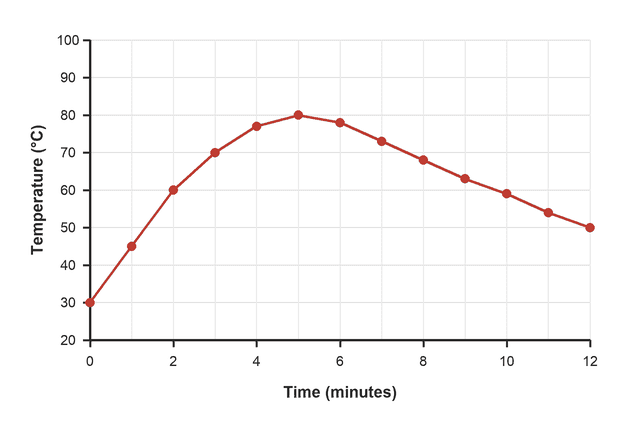
(a) Read from the graph the starting temperature, the highest temperature and the time at which it was reached. Find the rise in temperature.
(b) Which characteristic of a chemical reaction does the graph show? Name this kind of reaction, and give the evidence for it from the graph.
(c) After 5 minutes the temperature falls. Aisha says, "The reaction has stopped giving out energy, so no more heat is being made." Evaluate her statement.
- 404 marks
Question 40
Cognitive domain: Creativity
Meera is the new laboratory assistant. In the store room she finds a jar of iron filings standing next to a jar of sulphur powder, a tin of quicklime (calcium oxide) with a loose lid, and a bottle of concentrated hydrochloric acid beside a bottle of ammonia solution. Both of these bottles give off strong-smelling gases. The principal wants a short label for each set, so that any student can see at once what must not happen. Each label must give one rule in one short line, and the reason for the rule.
(a) Write the label for the jars of iron filings and sulphur powder, and the reason. Must the two jars be kept apart? Explain.
(b) Write the label for quicklime, and the reason. Include the word equation for the reaction that the label is meant to prevent.
(c) Write the label for the bottles of concentrated hydrochloric acid and ammonia solution, and the reason. Say what would be seen if their gases met.