
Opening your dashboard
Class 7 Chemistry Chapter 4 Atomic Structure: Competency-Based Questions (CBQ)
40 questions on Chapter 4, each worked through on its own page with the AI tutor. Class 7 Chemistry, ICSE 2026-27.
40 questions
1–5 marks · Mixed difficulty
- 11 mark
Question 1
Cognitive domain: Application
In a science quiz, two cards describe two particles, X and Y. (The atomic number of sodium is 11.)
Card Protons Neutrons Electrons X 11 12 11 Y 11 12 10 Which statement about X and Y is correct?
- 21 mark
Question 2
Cognitive domain: Analysis
A teacher draws three jars of gas on the board. She draws a different number of molecules in each jar.
Jar Gas Formula of one molecule Molecules drawn 1 Helium He 60 2 Oxygen 30 3 Ozone 20 Which conclusion is correct?
- 31 mark
Question 3
Cognitive domain: Analysis
The table shows a part of the Periodic Table. The letters W, X, Y and Z stand for four elements. They are not the real symbols of the elements.
Period IA IIA IIIA IVA VA VIA VIIA Zero 2 Z 3 W X Y Which statement is correct?
- 41 mark
Question 4
Cognitive domain: Application
The label on a tin of anti-rust paint says that it contains zinc phosphate. Sameer wants to write its formula. He knows that the zinc ion is and the phosphate ion is .
Which formula is correct?
- 51 mark
Question 5
Cognitive domain: Understanding
Assertion (A): Iron forms two different chlorides, and .
Reason (R): Iron shows variable valency. Its valency can be 2 or 3.
- 61 mark
Question 6
Cognitive domain: Understanding
Assertion (A): Almost all the mass of an atom is in its nucleus.
Reason (R): The nucleus of an atom has a positive charge.
- 71 mark
Question 7
Cognitive domain: Application
Farmers add urea to the soil to help their crops grow. The bag gives the formula of urea as . Fill in the blanks.
One molecule of urea contains ________ atoms of nitrogen and ________ atoms of hydrogen. The total number of atoms in one molecule of urea is ________.
- 81 mark
Question 8
Cognitive domain: Understanding
When Anu has loose motions, the doctor gives her a packet of ORS. The packet lists two salts: sodium chloride and potassium chloride.
Name the radical that is present in both salts. Is it a basic radical or an acid radical?
- 91 mark
Question 9
Cognitive domain: Application
Carbon and silicon are both in group IVA of the Periodic Table. Carbon forms the gas methane, , with hydrogen. Silicon is used to make computer chips.
Predict the formula of the compound that silicon forms with hydrogen. Give a reason for your answer.
- 102 marks
Question 10
Cognitive domain: Evaluation
Sagar reads that every atom has protons with a positive charge and electrons with a negative charge. He says, "Then my steel spoon is full of electric charge. It should give me a shock every time I touch it."
Judge Sagar's statement. Give reasons for your answer.
- 112 marks
Question 11
Cognitive domain: Understanding
The air we breathe contains oxygen gas, . High above the Earth there is a layer of another gas, ozone, .
(a) Give one similarity and one difference between a molecule of oxygen and a molecule of ozone.
(b) What do and represent? How many atoms of oxygen are there in each?
- 122 marks
Question 12
Cognitive domain: Evaluation
Neha learns that the gas hydrogen sulphide has the formula . She says, "One atom of sulphur joins with two atoms of hydrogen. So the valency of sulphur is always 2." Her teacher writes the formulae of two more compounds of sulphur on the board: and . (The valency of oxygen is 2.)
Judge Neha's statement. Work out the valency of sulphur in and in to support your answer.
- 134 marks
Question 13
Cognitive domain: Application
Rohan reads the label on a bottle of packaged drinking water. It lists the minerals dissolved in one litre of the water. His teacher explains that these minerals are present in the water as radicals (ions).
Radical Symbol Amount in 1 litre Calcium 20 mg Magnesium 6 mg Sodium 10 mg Bicarbonate 70 mg Chloride 15 mg Sulphate 12 mg At home, Rohan's mother shows him a hard white layer inside their old kettle. It has formed slowly over many months, because water is boiled in the kettle every day. This layer is mostly calcium carbonate.
(a) Sort the six radicals in the table into basic radicals and acid radicals. Which of them are made of atoms of more than one element?
(b) Write the formulae of magnesium bicarbonate and sodium sulphate. Show the valencies you use.
(c) The carbonate radical is . Write the formula of calcium carbonate. Explain why this formula needs no brackets and no small numbers after Ca or after .
- 144 marks
Question 14
Cognitive domain: Analysis
Kulfi sellers often pack their boxes with "dry ice". Dry ice is solid carbon dioxide, . It is much colder than ordinary ice. As it warms up, it changes straight into carbon dioxide gas, so it leaves no water behind. Carbon dioxide gas does not let things burn, so it is also filled in some fire extinguishers. Yet the two elements in it behave very differently. Carbon, in the form of charcoal, is a black solid that burns well. Oxygen is a gas that is needed for burning.
(a) Name the elements in carbon dioxide and give the number of atoms of each in one molecule. How many atoms are there altogether in ?
(b) The valency of oxygen is 2. Work out the valency of carbon in . Is it the same as the valency of carbon in methane, ?
(c) Use the passage to give two facts which show that a molecule of a compound has properties different from those of its elements. Are the molecules in a lump of dry ice different from the molecules in carbon dioxide gas? Explain.
- 155 marks
Question 15
Cognitive domain: Creativity
For a class exhibition, Ishita wants to make a "valency card" model. Each element or radical is a card. Each card has paper arms, and the number of arms is equal to the valency. Cards can be joined arm to arm. A formula is complete only when no arm of any card is left free.
(a) Describe the cards she should make for magnesium, aluminium, chlorine and oxygen.
(b) Use the model to find the formulae of magnesium chloride and aluminium oxide. Say how many cards of each kind are needed.
(c) How should she make the card for the nitrate radical, , so that the model gives the formula of aluminium nitrate? Write this formula. Why must the nitrate card never be cut into smaller pieces?
(d) State one thing about a real atom that this model does not show.
- 161 mark
Question 16
Cognitive domain: Analysis
The figure shows an atom of an element X. The nucleus has 13 protons (p) and 14 neutrons (n). The dots are electrons.
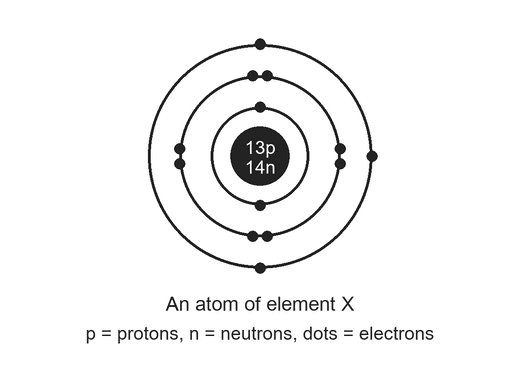
Which one change would turn this atom into an atom of a different element?
- 171 mark
Question 17
Cognitive domain: Application
A chemist studies four elements P, Q, R and S. The table shows how many atoms of hydrogen (valency 1) combine with one atom of each element.
Element P Q R S Atoms of hydrogen combined with one atom 3 1 4 2 Which option lists the elements in decreasing order of their valency?
- 181 mark
Question 18
Cognitive domain: Understanding
A baker adds baking soda to a cake mix. Baking soda is sodium bicarbonate. In water it gives two radicals, and .
Which statement about these two radicals is correct?
- 191 mark
Question 19
Cognitive domain: Analysis
The figure shows ball-and-stick models of three molecules W, X and Y. Each ball is one atom with its symbol inside it, and a line joins two atoms.

Which statement is correct?
- 201 mark
Question 20
Cognitive domain: Analysis
Carbon monoxide, , is a poisonous gas that can collect in a closed room where a charcoal stove is burning. Carbon dioxide, , is the gas that makes soda fizzy. Both gases are made of only carbon and oxygen.
What is the best explanation for why they behave so differently?
- 211 mark
Question 21
Cognitive domain: Application
Ravi writes the elements of period 3 with their group numbers. He knows that the valencies of the elements in groups IA to zero are 1, 2, 3, 4, 3, 2, 1, 0 in that order.
Element Na Mg Al Si P S Cl Ar Group IA IIA IIIA IVA VA VIA VIIA Zero Which pair of elements has the same valency?
- 221 mark
Question 22
Cognitive domain: Understanding
Sand is mainly silicon dioxide. The valency of silicon is 4 and the valency of oxygen is 2.
Assertion (A): The formula of silicon dioxide is and not .
Reason (R): When the valency numbers interchanged at the base have a common factor, they are divided by it to give the lowest ratio.
- 231 mark
Question 23
Cognitive domain: Understanding
Assertion (A): The mass number of an atom is always less than its atomic number.
Reason (R): The nucleus of every atom contains protons, and the nucleus of most atoms also contains neutrons.
- 241 mark
Question 24
Cognitive domain: Application
A sports drink contains glucose, . A student looks at two molecules of glucose.
How many atoms are there in all in the two molecules, and how many of them are hydrogen atoms?
- 251 mark
Question 25
Cognitive domain: Application
Anil writes the formulae of four compounds from a list of ions. He remembers that brackets are used only when a radical (a group of atoms) is needed more than once.
(The radicals are , , , and .)
For which compound must he put a radical in brackets in its formula?
- 261 mark
Question 26
Cognitive domain: Application
When a piece of zinc is dropped into dilute hydrochloric acid, bubbles of hydrogen gas come off. In this change, one atom of zinc takes the place of the hydrogen in two molecules of hydrogen chloride, , and zinc chloride is formed.
Fill in the blanks: one atom of zinc displaces ________ atoms of hydrogen, so the valency of zinc is ________.
- 271 mark
Question 27
Cognitive domain: Application
Doctors often give iron tablets containing ferrous sulphate to people who have too little iron in their blood. Iron shows the valencies 2 and 3. What is the valency of iron in ferrous sulphate? Give a reason.
- 282 marks
Question 28
Cognitive domain: Evaluation
Tarun writes on the board. His friend says, "That is the same as writing , because both show 6 hydrogen atoms and 3 oxygen atoms." Judge the friend's statement. Explain what each way of writing stands for.
- 292 marks
Question 29
Cognitive domain: Analysis
Meena stirs a spoonful of sugar into a glass of water. The sugar can no longer be seen, but every sip of the water tastes sweet. Her friend says, "The sugar has broken up into separate atoms of carbon, hydrogen and oxygen."
(a) What is the smallest particle of sugar that spreads all through the water?
(b) Use the sweet taste to show that her friend is wrong.
- 302 marks
Question 30
Cognitive domain: Application
A laboratory uses potassium dichromate, an orange solid, for a colour test. It is made of potassium ions, , and dichromate ions, . How many ions of each kind are needed so that no charge is left over? Write the formula, and say whether it needs brackets.
- 312 marks
Question 31
Cognitive domain: Understanding
When charcoal (carbon) burns in a stove, it seems to disappear and leaves only a little ash. The carbon atoms join with oxygen from the air and form carbon dioxide gas.
Use Dalton's ideas about atoms to answer:
(a) Are the carbon atoms destroyed when the charcoal burns? Give a reason.
(b) Where do the carbon atoms go?
- 323 marks
Question 32
Cognitive domain: Analysis
The table gives the particles in three atoms P, Q and R. (Hypothetical data.)
Atom Protons Neutrons Electrons P 12 12 12 Q 12 14 12 R 13 13 13 (a) Which two atoms are of the same element? Give a reason.
(b) Find the mass number of each atom.
(c) Q and R have the same mass number. Are they atoms of the same element? Explain.
- 333 marks
Question 33
Cognitive domain: Application
A chemist's notebook describes three substances by the atoms in one molecule.
Substance Atoms in one molecule A 1 sodium, 1 hydrogen, 1 carbon, 3 oxygen B 1 magnesium, 2 nitrogen, 6 oxygen C 1 calcium, 1 carbon, 3 oxygen (a) Write the formula of each substance. Radicals present are bicarbonate, nitrate and carbonate; use brackets only where a radical is repeated.
(b) Find the total number of atoms in one molecule of each.
(c) Which substance needs brackets in its formula? Explain.
- 343 marks
Question 34
Cognitive domain: Application
Calcium is in group IIA, phosphorus is in group VA and chlorine is in group VIIA of the Periodic Table.
(a) Write the valency of each of the three elements.
(b) Write the formula of the compound of calcium and phosphorus.
(c) Using the valency of phosphorus from (a), write the formula of the compound of phosphorus and chlorine.
- 353 marks
Question 35
Cognitive domain: Evaluation
Three students make statements about radicals. Judge each statement as true or false and give a reason.
(i) Ela: "The nitrate radical has valency 3, because it has three oxygen atoms."
(ii) Kabir: "The hydroxide radical is made of two elements, so it cannot be an acid radical."
(iii) Tanvi: "The chloride is a radical although it is made of only one element."
- 363 marks
Question 36
Cognitive domain: Analysis
The phosphate radical is and the sulphate radical is . A metal X forms the compound and a metal Y forms the compound . Both metals are among the first 20 elements of the Periodic Table.
(a) Find the valency of X and the valency of Y.
(b) In which group of the Periodic Table should each metal be placed?
(c) Write the formula of the chloride of each metal.
- 374 marks
Question 37
Cognitive domain: Analysis
In a science club, students study the models of two atoms, M and X, shown below. A fellow student says that the two atoms can join to form a neutral compound, but only after each atom first changes into an ion. The teacher adds that an atom becomes stable when its outermost occupied shell is full, that is, with 2 electrons in the first shell or 8 electrons in the second shell. The letters M and X are not the real symbols of the elements.
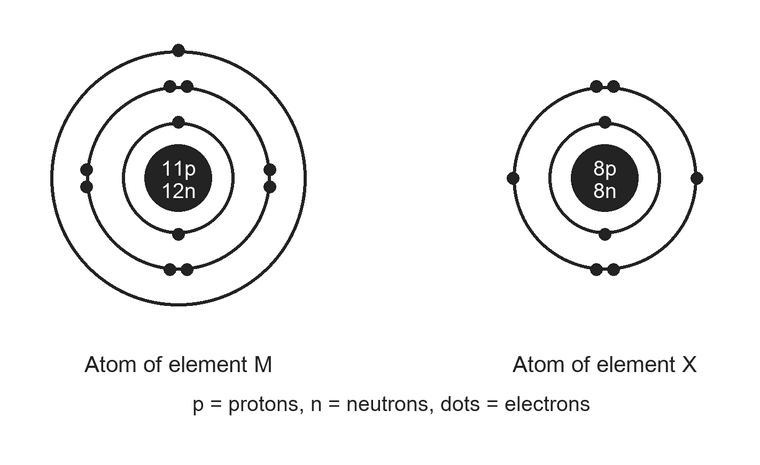
(a) Write the number of protons and the number of electrons in each atom, and the atomic number of each.
(b) Which atom loses electrons and which gains electrons so that each has 2 + 8 = 10 electrons? Write the symbol of each ion, with its charge.
(c) Write the formula of the compound formed by M and X. Show that it is neutral.
- 384 marks
Question 38
Cognitive domain: Analysis
A school laboratory has a cylinder of a gas mixture that is used to test gas sensors. It contains nitrogen, oxygen, carbon dioxide and argon. To help the class picture the particles, the teacher says: "Imagine that we could pick out just 100 particles of this mixture and sort them." The table shows what we would find. (Hypothetical data.)
Gas Formula of one particle Particles in the sample Nitrogen 70 Oxygen 18 Carbon dioxide 10 Argon Ar 2 The teacher adds that this mixture has far more carbon dioxide than ordinary air, so it must never be breathed.
(a) Say whether each gas is made of atoms or molecules, and whether it is an element or a compound.
(b) Find the total number of atoms, and the number of oxygen atoms, in the sample of 100 particles.
(c) A second sample has 1,000 particles in the same ratio. Find the number of carbon atoms and oxygen atoms in it.
- 394 marks
Question 39
Cognitive domain: Creativity
Zoya makes a "valency-balance check" for her class chart. For a correct formula, the total positive valency of the basic radicals must be equal to the total negative valency of the acid radicals. For , the positive total is and the negative total is , so the formula passes. The radicals on her chart are: , , , , and .
(a) Use the check to test and . Correct the formula that fails.
(b) A classmate writes the formula of iron(III) bromide as and the formula of iron(III) phosphate as . Test both with the check. Which wrong formula does the check fail to catch, and why is that formula still wrong?
(c) Add one rule to Zoya's check so that it would also catch the mistake in (b). Then choose one basic radical and one acid radical from the chart that have not been joined above, write their formula and show that it passes your improved check.
- 405 marks
Question 40
Cognitive domain: Evaluation
Plants need nitrogen to grow, and farmers add nitrogen fertilisers to the soil to supply it. At a village meeting, a farmers' group reads about three nitrogen fertilisers: ammonium chloride, , ammonium sulphate, , and ammonium nitrate, . Kabir says: "Ammonium sulphate is the richest in nitrogen, because one molecule of it has 2 nitrogen atoms, twice as many as ammonium chloride."
(a) For each fertiliser, write the number of nitrogen atoms and the total number of atoms in one molecule.
(b) Find the fraction of the atoms in each molecule that are nitrogen atoms, and arrange the three fertilisers from the highest fraction to the lowest.
(c) Evaluate Kabir's claim, using your answers.