
Opening your dashboard
Class 7 Biology Chapter 7 Allergy: Competency-Based Questions (CBQ)
40 questions on Chapter 7, each worked through on its own page with the AI tutor. Class 7 Biology, ICSE 2026-27.
40 questions
1–5 marks · Mixed difficulty
- 11 mark
Question 1
Cognitive domain: Application
Aman's new school shirt is made of a synthetic fabric. Whenever he wears it, an itchy red rash appears on his neck and arms, exactly where the cloth touches his skin. When he wears his old cotton shirt, there is no rash. His classmates wear the same synthetic shirt without any trouble. By which route is the allergen entering Aman's body ?
- 21 mark
Question 2
Cognitive domain: Analysis
Farida has asthma. The figure shows one of her bronchioles in cross-section at two different times, X and Y.
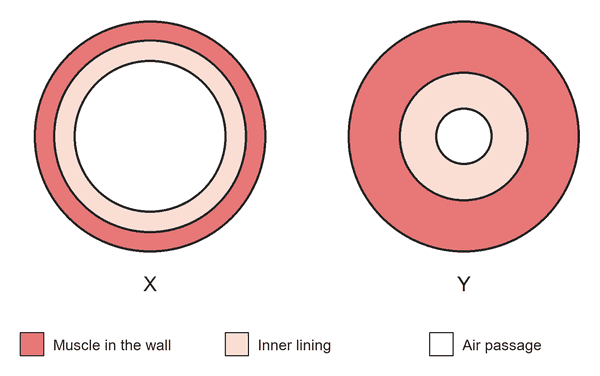
Which picture shows the bronchiole during an attack of asthma, and why ?
- 31 mark
Question 3
Cognitive domain: Analysis
A clinic in a large city of northern India counted the patients who came with sneezing, a running nose and itchy, watery eyes during one year.
Months Number of such patients February to April (spring) 180 May and June (summer) 120 July to October 30 November to January (winter, smoggy days) 160 Which explanation fits the two high periods in the table best ?
- 41 mark
Question 4
Cognitive domain: Application
Raghav has a bad throat infection. Before giving him an injection of penicillin, the nurse asks, "Are you allergic to any medicine ?" What is the most important reason for her question ?
- 51 mark
Question 5
Cognitive domain: Understanding
Assertion (A): A child who is allergic to cow's milk may also get an allergic reaction after eating cheese.
Reason (R): Cheese is a dairy product, and many people who cannot tolerate milk are also unable to tolerate dairy products.
- 61 mark
Question 6
Cognitive domain: Analysis
Assertion (A): To find out what a patient is allergic to, a doctor may use either a skin prick test or an allergy blood test.
Reason (R): An allergy blood test can check for several allergens with a single sample of blood.
- 71 mark
Question 7
Cognitive domain: Application
A food allergy that affects less than 1 person per 10,000 of the population may be considered "rare". A city has a population of 50,000. A health survey finds that 3 people in the city are allergic to a certain fruit.
Complete the sentence :
For this city, a food allergy counts as rare if fewer than ______ people have it, so the allergy to this fruit is ______.
- 81 mark
Question 8
Cognitive domain: Understanding
Riya gets hay fever every spring, when the flowers open. Last spring she took the medication given by her doctor and felt better. This spring, as soon as pollen was in the air again, her running nose and sneezing came back.
Complete the sentence :
The trouble came back because Riya's ______ system is still hypersensitive to pollen, so the inflammatory chemical ______ was released in her body once again.
- 91 mark
Question 9
Cognitive domain: Application
Whenever little Kavya had a stomach ache, her parents noticed that she had eaten eggs that day. They were sure she was allergic to eggs. The doctor asked for an allergy test, and it showed no reaction to egg.
Complete the sentence :
The test has helped to ______ an egg allergy, which shows that a belief based only on the parents' own ______ can be wrong.
- 102 marks
Question 10
Cognitive domain: Evaluation
Rohit is strongly allergic to peanuts. His friend says, "Eat one or two peanuts every day. Slowly your body will get used to them and the allergy will go away for ever."
Should Rohit follow his friend's advice ? Justify your answer using what the chapter says about precautions.
- 112 marks
Question 11
Cognitive domain: Evaluation
On the same evening, Anil and Bina were both bitten by mosquitoes in the park. Anil had only a small bump that went away soon. Around Bina's bite, the skin became red, swollen and covered with a rash. Bina's aunt said, "A mosquito bite is the same for everybody. Bina is just making a fuss."
Is the aunt's remark fair ? Justify your answer using the idea of allergy.
- 122 marks
Question 12
Cognitive domain: Understanding
Dr Mehta tells a patient, "I can find your allergen by a skin prick test or by an allergy blood test. Both are equally valid." The patient asks how the two tests differ.
Explain the difference between the two tests on two points : (a) what is done to the patient, and (b) how the result is obtained.
- 134 marks
Question 13
Cognitive domain: Application
Case: Class 7 is going on a day trip. The class teacher has collected an allergy form from every student. Three forms read :
- Zoya : dust allergy
- Kiran : allergy to sea-food
- Dev : allergy to aspirin
The plan is to visit an old, dusty fort in the morning, eat lunch at a seaside restaurant, and carry a first-aid box with common medicines.
(a) Which student is most likely to have trouble inside the fort ? Through which route will the allergen enter, and what may happen ?
(b) What precaution must be taken for Kiran at lunch ? Give a reason.
(c) Dev gets a headache on the trip. Why must the teacher check his form before giving him any tablet from the first-aid box ?
(d) Why is it better to collect these forms before the trip than to wait and see who falls ill ?
- 145 marks
Question 14
Cognitive domain: Analysis
Case: Irfan, aged 8, fell ill several times after lunch. His mother kept a diary for six days.
Day Lunch What happened within an hour Monday Roti, dal, curd Nothing Tuesday Poha with roasted peanuts Vomiting, itching Wednesday Rice, fish curry Nothing Thursday Paneer paratha, a piece of peanut chikki Vomiting, red rashes on the skin, itching Friday Egg curry, rice Nothing Saturday Idli with groundnut (peanut) chutney Vomiting, red rashes on the skin, itching (a) Which food item is most likely to be Irfan's allergen ? Give the evidence from the diary.
(b) Wheat, milk products, fish and eggs are among the foods that cause most food allergies. How does the diary show that these are probably not the cause in Irfan's case ?
(c) By which route does this allergen enter his body ? Describe how it ends up causing the red rashes on his skin.
(d) Irfan's mother feels sure about the cause from her diary. What should the family still do, and what precaution must Irfan take from now on ?
- 155 marks
Question 15
Cognitive domain: Creativity
Case: The student council wants the school canteen to become "allergy-aware". The canteen sells about twenty items, such as sandwiches, milkshakes, boiled eggs, peanut laddoos and fish cutlets. The council has asked you to design a simple system so that a student with a food allergy can choose safely.
(a) Which foods should the canteen flag on its menu board ? Design a labelling system for them and show it as a table for any four canteen items.
(b) Write two rules for the canteen staff and one rule for students who are prone to food allergies. Give a reason for each.
(c) Design a small "My Allergy Card" that such a student can carry. List the things that should be written on it.
- 161 mark
Question 16
Cognitive domain: Analysis
Anu was found to be allergic to cow's milk when she was years old. Her doctor repeated an allergy blood test once a year and recorded the concentration of antibodies specific to milk protein in her blood. (Hypothetical data.)
Age of Anu (years) Milk-specific antibodies (units per mL) Which statement is best supported by these results ?
- 171 mark
Question 17
Cognitive domain: Understanding
Four people felt unwell, and each of them wondered whether it was an allergy. Which case is most likely to be an allergy ?
- 181 mark
Question 18
Cognitive domain: Application
A doctor has to test a patient for different allergens by a skin prick test. She uses the patient's back, because it has a large area. With a pen she marks small sites on the skin and writes a number beside each. She then places a drop of one allergen extract at each site and pricks the skin through it. Why does she mark and number the sites ?
- 191 mark
Question 19
Cognitive domain: Understanding
Assertion (A): A doctor may order a quantitative allergy blood test for a child whose allergy to peanuts is already known.
Reason (R): The quantitative result of an allergy blood test can help the doctor to estimate the risk of a severe reaction.
- 201 mark
Question 20
Cognitive domain: Application
Four students were stung by wasps at a picnic. A first-aider must find out which student is having anaphylaxis and not an ordinary local allergic reaction. Which sign should make her suspect anaphylaxis ?
- 211 mark
Question 21
Cognitive domain: Evaluation
Neel is allergic to peanuts and to penicillin, and he also has hay fever every spring. His doctor discusses four plans with his parents. Which plan agrees with the chapter ?
- 221 mark
Question 22
Cognitive domain: Analysis
One sample of blood was taken from a patient and sent to a laboratory. The laboratory measured the concentration of antibodies specific to five allergens. The results are shown below. The doctor treats a reading below units per mL as negligible. (Hypothetical data.)
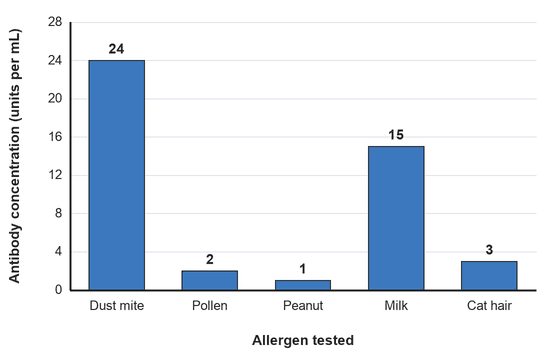
Which statement is supported by the results ?
- 231 mark
Question 23
Cognitive domain: Understanding
Assertion (A): Anaphylaxis is a local allergic reaction that stays in the small area of skin that touched the allergen.
Reason (R): During anaphylaxis, several organ systems, such as the digestive, respiratory and circulatory systems, can be affected.
- 241 mark
Question 24
Cognitive domain: Analysis
A health worker counted the children with allergic rhinitis (a running nose caused by allergy) in three towns. All the children were of the same age. (Hypothetical data.)
Town Air pollution Children with allergic rhinitis, per children P High R Medium Q Low Which statement best fits these data and the chapter ?
- 251 mark
Question 25
Cognitive domain: Application
Kabir wheezes every time he sweeps the dusty store room, and his attacks get worse when he becomes nervous or worried. His doctor has told him that he has asthma. Which advice agrees with the chapter ?
- 262 marks
Question 26
Cognitive domain: Understanding
Ishaan is allergic to wheat.
(a) Name two symptoms that he is likely to show after eating a wheat chapati.
(b) Food allergies rarely cause breathing trouble, yet his doctor warns that wheat may also make him wheeze. Explain how this can happen.
- 272 marks
Question 27
Cognitive domain: Evaluation
Seema is allergic to cow's milk. Her uncle says, "Give her goat's milk instead. It comes from a different animal, so it must be safe."
Is the uncle right ? Give two reasons from the chapter.
- 282 marks
Question 28
Cognitive domain: Application
Tanya's hay fever starts every March, when the flowers begin to blossom. This year it did not stop in April but went on through May and June.
(a) Use the chapter to explain why her trouble went on into the summer.
(b) Her doctor suggests anti-allergy shots. Why are they a suitable choice for her ?
- 292 marks
Question 29
Cognitive domain: Application
Farhan is allergic to latex. Latex is used in some disposable gloves and in most party balloons.
(a) He has a dental appointment next week. What should he do before the treatment begins, and why ?
(b) His cousin's birthday room will be decorated with balloons. Suggest one precaution for him.
- 302 marks
Question 30
Cognitive domain: Evaluation
Pooja says, "Only cow's milk, soya, eggs, wheat, peanuts, fish and shellfish can cause food allergy. A mango can never cause one."
Is Pooja's statement correct ? Explain.
- 312 marks
Question 31
Cognitive domain: Analysis
A doctor examined all the people of a housing colony on one day. She found that of them had an itchy allergic skin rash (allergic dermatitis) on that day. (Hypothetical data.)
A resident said, "The chapter says that above of people have allergic dermatitis. Our colony proves the chapter wrong."
(a) Find the percentage of the colony's people who had allergic dermatitis on that day.
(b) Does this survey prove the chapter wrong ? Explain.
- 323 marks
Question 32
Cognitive domain: Application
Black mould has grown on a damp wall of Nikhil's bathroom. Mould releases tiny spores into the air. Each time Nikhil has a bath there, he starts sneezing and coughing, and his eyes become red and watery.
(a) Name the likely allergen and its route of entry into his body.
(b) Name one more symptom he may get if the spores reach his lungs.
(c) Suggest one precaution for his family.
- 333 marks
Question 33
Cognitive domain: Analysis
Ravi had both tests for allergy on the same day. His skin prick test showed a big swelling at the house dust spot and none at the other spots. His blood test showed a high concentration of antibodies specific to house dust and low concentrations for the other allergens tested.
(a) What do the two results show together ?
(b) Why can the doctor trust the result even though the tests are so different ?
(c) Name one advantage of the blood test over the skin prick test.
- 343 marks
Question 34
Cognitive domain: Evaluation
Arnav has asthma. Tests show that he is allergic to dust mites, tiny animals that live in house dust and bedding. His attacks are worst at night. His parents list four ideas:
P : Wash his bed sheets and pillow covers every week in hot water, and dust his room with a damp cloth.
Q : Keep a thick carpet and many soft toys in his bedroom to make it cosy.
R : Sweep his room with a dry broom every night while he is lying in bed.
S : Give him the medicine only, and change nothing else in the house.
Which one idea is helpful ? Give a reason why each of the other three is not.
- 353 marks
Question 35
Cognitive domain: Application
At a family dinner, three guests had allergic reactions soon after eating:
- Guest 1 ate kheer made with milk, and had vomiting and hives.
- Guest 2 ate a cashew-nut sweet, and had vomiting, red rashes on the skin and itching.
- Guest 3 ate prawn curry, and had vomiting and abdominal pain.
(a) By which route did the allergens enter all three guests, and what type of allergy is this ?
(b) Which symptom do all three guests share ? Explain why it appears in that part of the body.
(c) Suggest one precaution that each guest should take at future dinners.
- 363 marks
Question 36
Cognitive domain: Application
A clinic has children who are allergic to milk. Roughly of children with milk allergy also react to beef. (Hypothetical data for the clinic.)
(a) How many of the children are expected to react to beef ?
(b) Why can beef cause a reaction in a child who is allergic to milk ?
(c) What should the parents of such a child do about beef ?
- 375 marks
Question 37
Cognitive domain: Analysis
Case: In a school health camp, students were examined and were found to have an allergy. The table shows the type of allergy of each of these students. (Hypothetical data.)
Type of allergy Number of students Food Dust Pollen (seasonal) Medicines Insect bites (a) What percentage of the students have an allergy ?
(b) Which type is the most common, and what percentage of the allergic students have it ?
(c) Dust and pollen are airborne allergens. What percentage of the allergic students have one of these two types, and by which route do these allergens enter the body ?
- 385 marks
Question 38
Cognitive domain: Creativity
Case: The school nurse wants a simple flow chart that a student helper can follow, to decide which allergic condition a student may have. The four conditions are hay fever, asthma, hives and anaphylaxis. The helper can see only the symptoms.
(a) Design a flow chart of three yes/no questions that leads to the four conditions. Write it as a numbered list.
(b) Test your chart on this student: in spring, a boy has a running nose, sneezing and watery eyes. He does not feel faint, he has no wheezing or breathing trouble, and there are no bumps or patches on his skin. State the condition your chart gives.
(c) Add one safety rule that must be at the bottom of the chart, and give a reason.
- 394 marks
Question 39
Cognitive domain: Analysis
Case: Two allergy clinics in a city recorded the food that caused the food allergy of each new patient in one year. Clinic X treats only children, and Clinic Y treats only adults. (Hypothetical data.)
Food Clinic X (children) Clinic Y (adults) Cow's milk Soya Eggs Wheat Peanuts Fish Shellfish Other foods Total (a) Which food caused the most allergies in the children's clinic ? Does this agree with the chapter ?
(b) Which food caused the most allergies in the adults' clinic ? Use the milk row to show that allergies occur at different rates in adults and children.
(c) Find the percentage of all patients whose allergy was caused by the seven foods named in the chapter, and compare it with the chapter's figure.
- 404 marks
Question 40
Cognitive domain: Evaluation
Case: A forwarded message in a class group says:
- "An allergy is an infection and spreads from one student to another."
- "The allergy blood test is useless, because nothing is put on the skin, so no reaction can be seen."
- "Only foods can cause allergic reactions."
(a) Correct statement 1. What is an allergen, and why do some students react to it while others do not ?
(b) Correct statement 2. What does the blood test measure, and why is it said to be very safe ?
(c) Correct statement 3. Give two other things that can cause allergic reactions.