
Opening your dashboard
Class 7 Biology Chapter 1 Plant and Animal Tissues: Competency-Based Questions (CBQ)
40 questions on Chapter 1, each worked through on its own page with the AI tutor. Class 7 Biology, ICSE 2026-27.
40 questions
1–5 marks · Mixed difficulty
- 11 mark
Question 1
Cognitive domain: Application
When a young ashoka tree in a school garden was 3 m tall, the gardener painted a white band round its trunk, 1 m above the ground. Five years later the tree is 6 m tall. How high above the ground is the white band now, and why ?
- 21 mark
Question 2
Cognitive domain: Analysis
A branch of an old tree fell in a storm. The figure shows the cut surface of the branch. The rings of xylem lie between the pith and the bark.
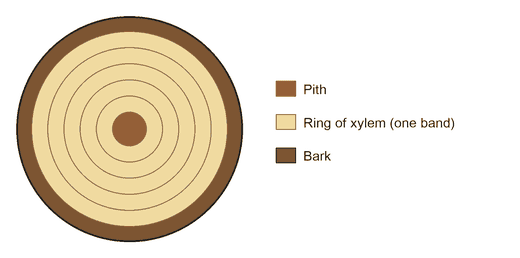
How old was the branch, and which tissue formed these rings of xylem ?
- 31 mark
Question 3
Cognitive domain: Application
A museum scientist looks at a thin slice of tissue taken from the leg of an animal. She notes : "The cells lie in small spaces. They are embedded in a hard matrix. The matrix is laid down in concentric layers around a central canal." Which tissue is she looking at, and what makes its matrix hard ?
- 41 mark
Question 4
Cognitive domain: Analysis
A student looked at three slides of epithelial tissue and noted the shape of the cells.
Slide Shape of the cells P Thin, flattened and polygonal Q Cube-like R Tall, column-like, arranged vertically; no cilia One of these slides was made from the inner lining of the stomach, where the cells mainly give out (secrete) juices. Which slide is it, and what is this tissue called ?
- 51 mark
Question 5
Cognitive domain: Understanding
Assertion (A): In a strong wind, the leaf stalk of a papaya leaf bends but does not snap.
Reason (R): Leaf stalks contain collenchyma, which gives flexible support to the plant parts.
- 61 mark
Question 6
Cognitive domain: Analysis
Assertion (A): The muscles of the heart get tired after working for some hours and must rest, just like the muscles of the arms.
Reason (R): Cardiac muscles are found only in the walls of the heart.
- 71 mark
Question 7
Cognitive domain: Application
A nerve cell that carries messages to a muscle of the foot has its cell body near the backbone. One fibre of this cell runs all the way down the leg and is nearly one metre long.
This very long fibre is the ______ of the nerve cell, and many such fibres bundled together form a ______.
- 81 mark
Question 8
Cognitive domain: Understanding
Rehana's mother is cooking aloo palak. Rehana knows that the soft parts of both the potato and the spinach leaf are made of thin-walled parenchyma cells, but the two do different jobs.
The parenchyma cells of the green spinach leaf contain ______ and manufacture food, while the parenchyma cells of the potato mainly store ______.
- 91 mark
Question 9
Cognitive domain: Application
At a blood donation camp, a sample of blood was left standing in a test tube with a chemical that stops it from clotting. After some time it settled into two parts : a clear, pale liquid on top and a deep red layer of cells below.
The liquid part on top is the ______, and the deep red colour of the lower layer is due to the ______.
- 102 marks
Question 10
Cognitive domain: Understanding
A potato plant makes its food in the green leaves above the ground, but the food is stored in the potatoes under the soil. When an old potato is planted, the food stored in it moves up into the new shoots. Name the tissue that carries the food in both cases, and explain how the same tissue can do both jobs.
- 112 marks
Question 11
Cognitive domain: Evaluation
A sports coach tells his students, "With enough practice you can train every muscle of your body to move exactly when you want it to — the muscles of your legs, and even the muscles in the wall of your intestine." Is the coach right ? Justify your answer.
- 122 marks
Question 12
Cognitive domain: Application
The inner lining of the wind pipe has cells that bear tiny hair-like cilia. Tiny dust particles that enter with the air settle on this lining. Suppose the cilia of a person's wind pipe stop lashing for some time. Predict what will happen to the dust particles on the lining, and give a reason.
- 135 marks
Question 13
Cognitive domain: Analysis
Case: Kavya soaked moong seeds overnight and kept them on wet cotton. When the roots were 14 mm long, she chose one seedling and made six fine ink marks on its root with a soft pen. Mark 1 was at the tip and the marks were 2 mm apart. The parts of the root between the marks are zones A to E. She put the seedling back on the wet cotton and measured each zone again after two days.
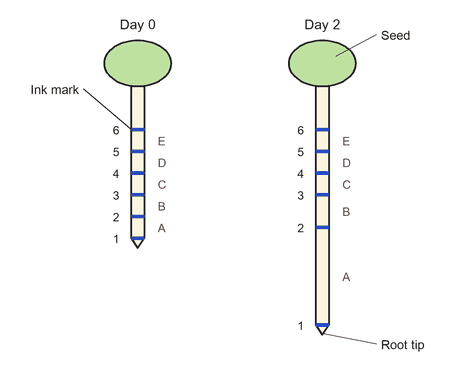
Zone (between marks) A (1 and 2) B (2 and 3) C (3 and 4) D (4 and 5) E (5 and 6) Length on Day 0 2 mm 2 mm 2 mm 2 mm 2 mm Length on Day 2 9 mm 3 mm 2 mm 2 mm 2 mm (a) Find the total length of the marked part of the root on Day 0 and on Day 2. By how much did it grow ?
(b) Which zone grew the most ? Which zones did not grow at all ?
(c) Name the tissue present at the root tip that explains this result. State two features by which its cells can be recognised under a microscope.
(d) Kavya's friend says, "A root grows like a rubber band being pulled — every part of it stretches equally." Use the table to show that this is not correct.
- 145 marks
Question 14
Cognitive domain: Evaluation
Case: The biology laboratory of a school has a plastic model of the human knee and lower leg. Five parts of the model carry numbers. A card kept with the model describes each part. Kabir was asked to name the tissue of each part, and he wrote the names shown in the last column.
Part What the card says Kabir's label 1 Smooth cap covering the end of the thigh bone Bone 2 Band joining the thigh bone to the shin bone; has more yellow (elastic) fibres than a tendon, so it can stretch a little Tendon 3 Cord joining the calf muscle to the heel bone; made mainly of white fibres, so it hardly stretches Ligament 4 Thin layer binding the skin to the tissue below it Areolar tissue 5 Layer under the skin; its cells are filled with fat globules Adipose tissue (a) Which of Kabir's labels are correct ?
(b) Correct each wrong label. Give the clue from the card that helped you each time.
(c) All five parts belong to one major group of animal tissues. Name the group and say why this name suits it.
(d) Kabir says, "Blood cannot belong to this group, because it is a liquid." Is he right ? Justify.
- 155 marks
Question 15
Cognitive domain: Creativity
Case: For the science exhibition, Class 7 wants to build a large model called "A Stem is like a Building". The model must show how three supporting tissues — parenchyma, collenchyma and sclerenchyma — and the conducting tissue xylem do their work in a plant. The class can use everyday things such as sponge pieces, small balloons, rubber tubing, drinking straws, wooden sticks, wire and clay.
(a) Choose a material for each of the four tissues. For each one, say which feature of the tissue the material shows.
(b) Compare each tissue with a part of a building, to match the title of the model.
(c) Write a caption of two or three sentences to be displayed with the model.
- 161 mark
Question 16
Cognitive domain: Analysis
A student studied two specimens, P and Q, under a microscope and noted down what she saw. (Hypothetical data.)
Specimen What the student saw P A slice of a potato tuber: thousands of cells, all alike in shape and size, all packed with starch grains and all doing the same work Q Slices cut from a whole frog's heart: cardiac muscle, nerve fibres, connective tissue and blood vessels, which together make the heart pump blood Which statement about P and Q is correct ?
- 171 mark
Question 17
Cognitive domain: Analysis
In a school laboratory, a student stained four thin slides from one young plant and counted the cells that were dividing in each slide, out of cells viewed. (Hypothetical data.)
Slide Taken from Dividing cells out of 1 Tip of a growing root 2 Tip of a young shoot 3 A fully grown green leaf 4 The soft white inside of a mature potato tuber Which conclusion do these counts support best ?
- 181 mark
Question 18
Cognitive domain: Analysis
Assertion (A): Fibres taken from the stems of some plants can be twisted into strong ropes.
Reason (R): Sclerenchyma, which occurs in stems as fibres, is made of dead cells.
- 191 mark
Question 19
Cognitive domain: Analysis
A student cut a thin slice of a young stem and described four kinds of cells, W, X, Y and Z, that she saw. (Hypothetical data.)
Cell Description W Large, thin-walled, living cells with spaces between them X Thick-walled tubes, dead, placed end to end; the partitions between them have dissolved Y Living tubes with companion cells beside them; they carry food made in the leaves Z Long, narrow, dead cells with thick walls and no spaces between them Which cells form the conducting (vascular) tissue, and in which direction can the food-carrying cells conduct ?
- 201 mark
Question 20
Cognitive domain: Evaluation
Assertion (A): The columnar epithelium that lines the inner wall of the stomach has cilia, which push the food forward.
Reason (R): Ciliated epithelium has cilia that keep lashing and move the substances in contact with it.
- 211 mark
Question 21
Cognitive domain: Analysis
A laboratory record shows what was found in two fluid samples, F and G, taken from the human body. (Hypothetical data.)
Sample Plasma Red blood corpuscles White blood corpuscles Platelets F Present Present Present Present G Present Absent Present Absent Which conclusion is correct ?
- 221 mark
Question 22
Cognitive domain: Application
Aman's father is a healthy adult whose body weight is kg. In an adult, about of the body weight is made up of the muscles that are attached to the bones. About how many kilograms of his weight is this, and does he control these muscles by his will ?
- 231 mark
Question 23
Cognitive domain: Understanding
The figure shows a neuron. A message reaches this neuron and is passed on to a muscle fibre.

In what order does the message pass through the parts marked P, Q and R, and what are these parts called ?
- 241 mark
Question 24
Cognitive domain: Application
The leaves of a water lily float on the surface of a pond. A thin section of the leaf stalk, seen under a microscope, is made mostly of large, thin-walled cells with big air-filled spaces between them. Which tissue is this, and how does it help the plant ?
- 251 mark
Question 25
Cognitive domain: Application
Riya walks out of a dark room into bright sunlight. Without any effort on her part, the pupils of her eyes become smaller. The muscles of the iris of her eye bring this about. Which kind of muscles are these ?
- 262 marks
Question 26
Cognitive domain: Understanding
An Amoeba is a single cell. It moves, takes in food and gets rid of waste all by itself. A goat's body, on the other hand, is made of billions of cells that do different jobs. Why does the body of a goat need tissues, while an Amoeba does not ?
- 272 marks
Question 27
Cognitive domain: Application
A farmer picked off every leaf of a young papaya plant, but kept the plant well watered. After a few weeks the roots of the plant had grown very little. Name the tissue that carries the food in a plant and use it to explain why the roots grew so little.
- 282 marks
Question 28
Cognitive domain: Application
In autumn a bear eats a great deal of food and becomes fat. The extra food is stored below the skin as fat. Name the tissue that holds this fat, say to which kind of connective tissue it belongs, and state what its cells are filled with.
- 292 marks
Question 29
Cognitive domain: Application
A boy spilt hot water on his hand. His mother at once held the hand under cool running tap water for about twenty minutes. The outer layer of the skin on a small patch of the hand later peeled off, and the doctor covered the patch with a clean, non-fluffy dressing. Name the tissue that formed the peeled layer and explain why the patch has to be covered.
- 302 marks
Question 30
Cognitive domain: Creativity
Write a riddle of three or four lines for your classmates whose answer is cardiac muscle. Use at least two true facts about cardiac muscle as clues, and then write the answer with the two clues you used.
- 312 marks
Question 31
Cognitive domain: Analysis
A gardener cuts off the top cm of the main stem of a young hibiscus plant. In the following months the main stem does not grow any taller at the cut end, but the side branches keep growing longer. Use your knowledge of plant tissues to explain both observations.
- 323 marks
Question 32
Cognitive domain: Application
A hospital chart lists three problems found in three patients.
Patient Problem 1 The lining of the oviduct has lost its cilia 2 The cube-like cells forming the wall of a kidney tubule are damaged 3 The flat, polygonal cells forming the outer layer of the skin are scraped off For each patient, name the kind of epithelium that is affected and state what job it does.
- 333 marks
Question 33
Cognitive domain: Evaluation
Ravi compares a neuron with a telephone network and makes three statements.
(i) "The cell body (cyton) is like the telephone exchange, because the message passes through it."
(ii) "The dendrites are like the wires that carry the message away from the exchange to the next house."
(iii) "A nerve is like a single long wire, because it is one very long neuron."
Judge each statement. Say whether it is correct, and correct the ones that are wrong.
- 343 marks
Question 34
Cognitive domain: Application
Maya kept a clean chicken leg bone in a jar of vinegar (a weak acid) for a week. When she took it out and rinsed it, she found that it was soft and rubbery and could be bent easily. (a) What does a normal bone feel like, and what makes it so? (b) Use this to explain why the bone became soft in vinegar. (c) The end of the same bone carried a smooth, whitish cap of cartilage, which was already bendable before the bone went into the vinegar. Why did the vinegar make a big change in the bone but not in how bendable the cartilage was?
- 353 marks
Question 35
Cognitive domain: Application
While eating a pear, Isha felt tiny, hard, gritty particles in the soft pulp. Her teacher told her that the grit is made of groups of cells with very thick walls and no living contents. (a) Name the tissue to which these cells belong. (b) In stems, this tissue occurs as fibres whose cells are long and narrow, but the grit cells are short and rounded. Which features of the grit cells still place them in this tissue, and which feature makes them hard? (c) Name two places in the plant body where this tissue is normally found.
- 363 marks
Question 36
Cognitive domain: Understanding
A tomato is cut across. The thin outer skin, most of the soft juicy pulp and a few thin stringy veins can be seen. (a) Name the kind of tissue that makes up the pulp and the kind that forms the veins. (b) Say which of these two is a simple permanent tissue and which is a complex permanent tissue. (c) Is the whole tomato a tissue or an organ? Give a reason.
- 375 marks
Question 37
Cognitive domain: Analysis
Case: Sana kept a log of four things that happened to her one Sunday. (Hypothetical data.)
Time What happened Muscle that did the work 8 a.m. She chewed her breakfast Muscles of her jaw 9 a.m. Her stomach churned the breakfast and mixed it with juices Muscles in the wall of the stomach 11 a.m. Her heart beat faster during a skipping race Muscles in the wall of the heart 1 p.m. She smiled for a family photograph Muscles of her face (a) Name the kind of muscle in each of the four rows.
(b) Sana says, "I can stop any of these four actions whenever I want." Which rows prove her wrong? Give the reason.
(c) Which of the four rows have striations? Describe one difference in the shape of the cells of those muscles.
- 385 marks
Question 38
Cognitive domain: Analysis
Case: Prakash put a leafy twig of a balsam plant, with its cut end dipped in red ink, in a bright sunny place. The balsam stem is thin and partly transparent, so every minutes he could measure, with a ruler, the height to which the red colour had risen inside the stem. (Hypothetical data.)
Time after dipping min min min min Height of the red colour cm cm cm cm (a) By how much did the red colour rise in every minutes ?
(b) The twig is cm long. If the colour keeps rising at this rate, after how many minutes will it reach the top ?
(c) Prakash saw red lines appear first in the veins of the lowest leaves and only later in the veins of the top leaves. Explain why, using your answer to (a). Name the tissue through which the colour travelled, and state two features of its cells that let it carry water up the stem.
- 394 marks
Question 39
Cognitive domain: Evaluation
Case: Kavya measured a neem sapling in her school garden every year. She measured its height and also the girth of its stem cm above the ground. (Hypothetical data.)
Year 0 1 2 3 Height (cm) Girth of the stem (cm) (a) Find the increase in height in each of the three years.
(b) Over the three years, how many times its starting value did the height become, and how many times did the girth become? Which kind of growth was faster in proportion?
(c) Kavya says, "As the sapling gets older, its growth is slowing down." Use the table to decide whether she is right.
- 405 marks
Question 40
Cognitive domain: Creativity
Case: Class 7 is planning a game called "Tissue Trail" for the science exhibition. Each player picks a clue card that gives a place and a job in the body of a plant or an animal. The player must name the tissue.
(a) Write two clue cards for plant tissues. Give the clue and the answer on each card.
(b) Write two clue cards for animal tissues. Give the clue and the answer on each card.
(c) Write one "trap card" that carries a common mistake made by students, and then correct the mistake.