
Opening your dashboard
Class 6 Physics Chapter 3 Force: Competency-Based Questions (CBQ)
40 questions on Chapter 3, each worked through on its own page with the AI tutor. Class 6 Physics, ICSE 2026-27.
40 questions
1–4 marks · Mixed difficulty
- 11 mark
Question 1
Competency: Application
A trolley full of library books stands in a school corridor. Anu and Bala pull it forward with forces of 35 N and 25 N. Chetan, who wants to take it the other way, pulls it backward with a force of 45 N. Take these as the only forces acting along the corridor.
What is the resultant force on the trolley?
- 21 mark
Question 2
Competency: Understanding & Application
A batter hits a cricket ball high into the air. Think about the ball after it has left the bat and before it touches the ground.
Which forces act on the ball during this time?
- 31 mark
Question 3
Competency: Application & Analysis
Ravi tries to slide a steel cupboard across a floor by pushing it horizontally. His observations are given below.
Push applied What happens 20 N cupboard does not move 35 N cupboard does not move just above 50 N cupboard begins to slide How large is the force of friction on the cupboard while Ravi pushes it with 35 N?
- 41 mark
Question 4
Competency: Understanding & Evaluation
Mitali's toy car rolls a short distance on the tiled floor and stops. She finds that its wheels turn stiffly on their axles. Her friends make four suggestions to make the car roll farther on the same floor after the same push.
Which suggestion is the best?
- 51 mark
Question 5
Competency: Understanding & Analysis
Assertion (A): No force acts on a school bag that is lying at rest on a table.
Reason (R): When two equal forces act on a body in opposite directions, their resultant is zero.
- 61 mark
Question 6
Competency: Understanding
Assertion (A): A kabaddi player rubs dry soil on her sweaty palms before she tries to hold an opponent.
Reason (R): Dry and rough surfaces have more friction between them than wet and smooth surfaces.
- 72 marks
Question 7
Competency: Understanding & Application
The figure shows a box being dragged along a floor by a rope. Three other arrows, P, Q and R, are drawn on the box.

(a) Which arrow shows the force of friction that the floor exerts on the box? Give a reason for your choice.
(b) The rope is now tied to the other side and the box is dragged back towards the right. What happens to the direction of friction on the box? State the rule you used.
- 82 marks
Question 8
Competency: Application & Analysis
Farah hangs a spring from a hook and hangs different weights from its lower end. Each time she measures the length of the spring.
Weight hung (gf) 0 100 200 300 Length of the spring (cm) 12 14 16 18 (a) Which effect of a force do these readings show? By how much does the length increase for every 100 gf?
(b) When Farah hangs a guava from the same spring, its length becomes 17 cm. Find the weight of the guava.
- 92 marks
Question 9
Competency: Analysis
Kavya gives the same gentle push to the same plastic disc in two situations and measures how far it goes before stopping.
Situation Distance moved before stopping Disc sliding on a wooden table 30 cm Disc floating on still water in a long trough 120 cm (a) Which exerts less friction on the disc, the wooden table or the water? How do the readings show this?
(b) The blades of a ceiling fan move through air. Yet the fan slows down and stops after it is switched off. Name two places where friction acts on the turning fan.
- 102 marks
Question 10
Competency: Application
A vegetable seller finds that he has to pull his loaded handcart with a force of 50 N to keep it moving on a level road. The axles of the cart are dry. After he greases the axles, a pull of 35 N keeps the same loaded cart moving on the same road.
(a) How much extra force was he applying because of the dry axles? Which disadvantage of friction does this show?
(b) State two other harmful effects that friction will have on the axles if he keeps using the cart without greasing them.
- 114 marks
Question 11
Competency: Analysis
Case study: A group of students pulls a wooden block along a wooden table with a spring balance and notes the force needed to keep the block sliding steadily. This force is equal to the friction on the block. They put loads on the block to change its weight, and then repeat everything with a glass sheet laid on the table. Their results are shown in the graph.
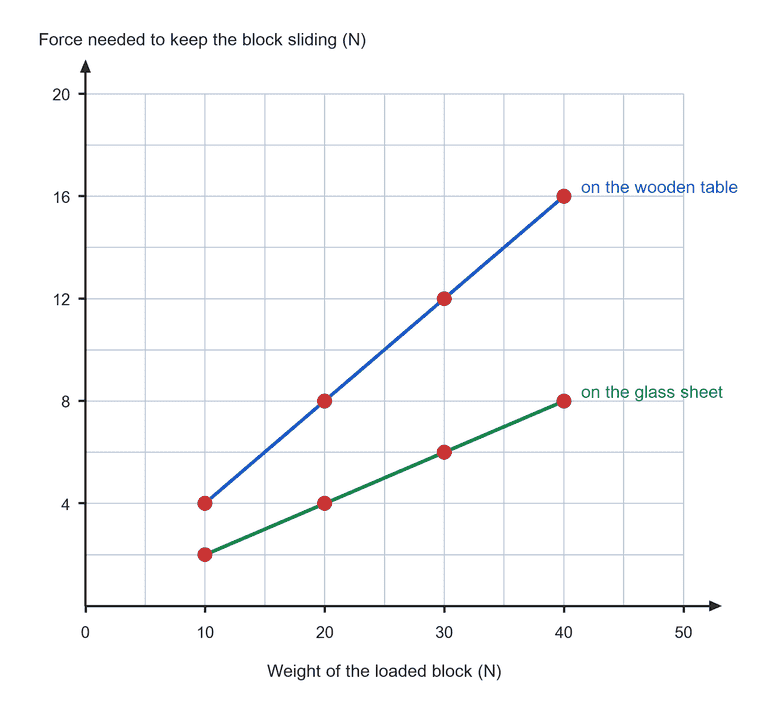
(a) From the graph, read the force needed to keep the block sliding when the weight of the loaded block is 30 N (i) on the wooden table, (ii) on the glass sheet.
(b) Write two conclusions about the force of friction that the graph supports.
(c) Use the pattern in the graph to predict the force needed on the wooden table when the weight of the loaded block is 50 N. What weight of the loaded block on the glass sheet needs the same force as a weight of 30 N does on the wooden table?
- 124 marks
Question 12
Competency: Analysis & Evaluation
Case study: In a science club, two long bar magnets are placed in a line with the north pole of one facing the south pole of the other. The members measure the force with which the two poles pull each other for different gaps between them.
Gap between the poles (cm) 2 4 8 Force between the poles (gf) 32 8 2 (a) Is this force a contact force or a non-contact force? Give a reason. Why do the magnets pull, and not push, each other here?
(b) Describe what happens to the force each time the gap is doubled. Support your answer with the readings.
(c) Rohan says, "The force halves each time, so at a gap of 16 cm it will be 1 gf." Is he right? Check his rule against the table and give your own prediction for 16 cm.
- 134 marks
Question 13
Competency: Analysis & Evaluation
Case study: For a science fair, three students make toy boats from the same plastic sheet. The boats differ in the shape of the front. Each boat is loaded to the same mass of 200 g and is pulled across a 2 m long water tank by the same small falling weight. The time each boat takes is noted.
Boat Shape of the front Time to cross the tank X flat 10 s Y rounded 7 s Z pointed 5 s (a) Which boat experiences the least friction from the water? How does the table show this?
(b) Name the way of reducing friction used in boat Z and explain how it works. Give one example of it from nature.
(c) A visitor says, "Boat Z was the fastest because it must have been the lightest." Judge this statement using the details of the test. Suggest one step that would make the students' conclusion more reliable.
- 144 marks
Question 14
Competency: Creation
Your teacher says that it is easier to roll a heavy body than to slide it. She asks your group to design a fair test to check this in the classroom.
You are given: a thick dictionary, a piece of string, a long rubber band, five round pencils and a ruler. (A rubber band stretches more when it is pulled with a bigger force.)
(a) Write the steps of your test.
(b) State two things you will keep the same so that the test is fair, and draw the table in which you will record your readings.
(c) What result do you expect, and what will it tell you about sliding friction and rolling friction? Name one device in daily life that uses this idea.
- 153 marks
Question 15
Competency: Application & Evaluation
Case study: On a rainy day, three students slip in the polished corridor of a school, where water has collected. The staff suggest these measures.
Measure Suggestion 1 Polish the floor again so that it shines. 2 Lay rough rubber mats along the corridor. 3 Mop the floor dry after every break. (a) Why is the wet, polished floor slippery?
(b) Which of the three measures will help to prevent slipping, and which will not? Give a reason for each.
(c) The caretaker pushes a heavy trolley along the same corridor. Its wheels have become stiff. He wants less friction at the axles of the wheels, while the students need more friction under their shoes. Is there any contradiction? Explain, and suggest how he can reduce the friction at the axles.
- 161 mark
Question 16
Competency: Application
A rubber ball is thrown hard against a wall. For a moment the ball is seen to get squashed, and then it bounces back along a different path.
Which of the following correctly describes the effects of the force of the wall on the ball?
- 171 mark
Question 17
Competency: Application
Arun, a Class 6 student, is helping his family shift boxes into a new house. He can exert a muscular force of at most 90 N when he lifts a box straight up from the ground. A pile has four boxes of mass 2 kg, 5 kg, 8 kg and 12 kg. Take the weight of a 1 kg mass as 1 kgf, and take 1 kgf = 10 N. (Hypothetical data.)
Which is the heaviest box that Arun can lift?
- 181 mark
Question 18
Competency: Analysis
In a school science club, two pairs of identical steel pieces are rubbed against each other 100 times with the same force. A drop of oil is put between the pieces of pair P. Pair Q is rubbed dry. A thermometer is then used to read the rise in temperature of one piece from each pair. (Hypothetical data.)
Pair Oil between the pieces? Rise in temperature P Yes 2 °C Q No 9 °C Which conclusion is best supported by the table?
- 191 mark
Question 19
Competency: Understanding
Radha draws a bucket of water up from a well with a rope. Three forces are named below.
P: the force of Radha's hands on the rope
Q: the force of the rope on the bucket
R: the force of the earth on the bucket
Which option describes each force correctly as a push or a pull?
- 201 mark
Question 20
Competency: Analysis
Assertion (A): The force with which the earth attracts a mango falling from a tree is a non-contact force.
Reason (R): A mango that is hanging on the tree also has weight.
- 211 mark
Question 21
Competency: Understanding
Assertion (A): An aeroplane flying high in the sky experiences no force of friction, because it does not touch any solid surface.
Reason (R): Air also opposes the motion of a body that moves through it.
- 221 mark
Question 22
Competency: Analysis
A painter wants to stop the rubber foot of his ladder from slipping on a smooth tiled floor. With a spring balance, he measures the force needed to start sliding the foot, with the ladder's load on it, along the floor under four different conditions. The bar chart shows his readings. (Hypothetical data.)
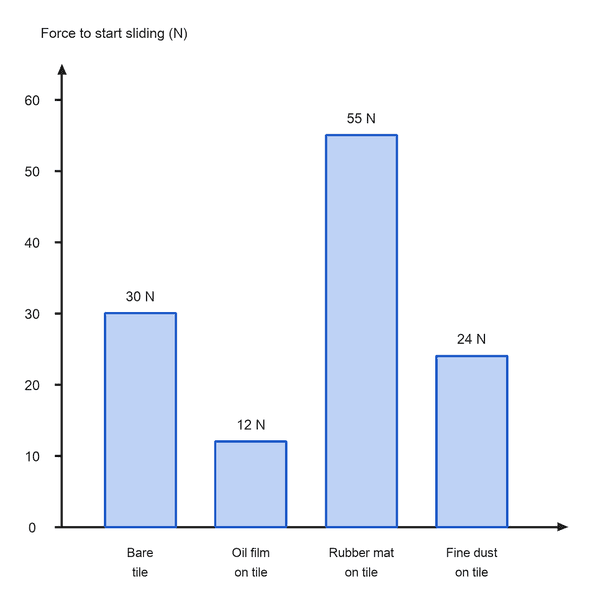
Which condition should he choose to keep the foot from slipping?
- 231 mark
Question 23
Competency: Evaluation
Before a long cycle ride, Meena put a few drops of oil on four parts of her bicycle: the chain, the axles of the pedals, the rubber brake blocks that press on the rim, and the hub of the front wheel. Her elder brother says that one of these is a mistake.
Which one is the mistake?
- 241 mark
Question 24
Competency: Application
The rubber tyre of a scooter has grooves 8 mm deep when it is new. Friction with the road wears the rubber away, and the depth of the grooves decreases by 0.5 mm for every 2000 km the scooter travels. The tyre must be replaced when the grooves are only 2 mm deep. (Hypothetical data.)
How far can the scooter travel on a new tyre before the tyre must be replaced?
- 251 mark
Question 25
Competency: Analysis
Four trials are done with a wooden block that is pulled with a spring balance. The surface and the weight of the block are changed. The force needed to keep the block sliding steadily is noted each time. (Hypothetical data.)
Trial Surface Weight of the block (N) Force to keep it sliding (N) 1 Wooden table 10 5 2 Wooden table 20 10 3 Glass sheet 20 4 4 Glass sheet 30 6 Which two trials should be compared to find the effect of the weight of the block alone on friction?
- 262 marks
Question 26
Competency: Understanding
A farmer ploughs his field with a pair of bullocks. His neighbour ploughs a field of the same size with a tractor.
(a) Name the kind of force with which the bullocks pull the plough, and the kind of force with which the tractor pulls it.
(b) Both of these forces are contact forces. Explain what a contact force is, and say through what the bullocks and the tractor are in contact with the plough.
- 272 marks
Question 27
Competency: Application
The figure shows a ball bearing, seen from the end of the axle, that is fitted between the axle and the hub of a ceiling fan.
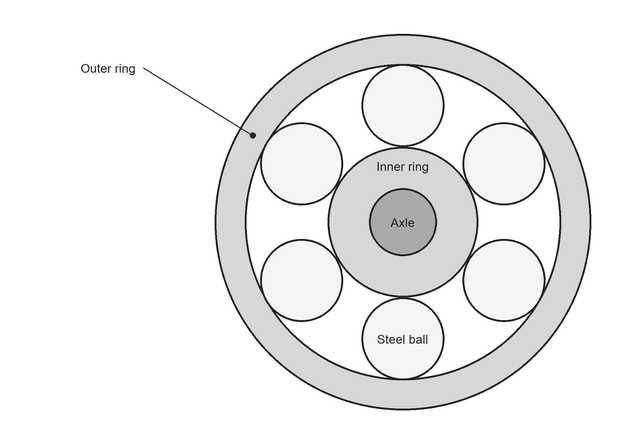
(a) Which kind of friction would act if the axle turned directly inside the hub, and which kind of friction acts when the steel balls roll between the two rings?
(b) After the switch is turned off, a fan with ball bearings keeps turning for a longer time than a fan without them. Explain why.
- 282 marks
Question 28
Competency: Creativity
You are given a lump of clay, a thick sponge and a steel spring taken from an old ball pen.
(a) Write how you will use these three things to show that a force can change the shape of a body, and that the change may last or may disappear when the force is removed.
(b) Draw the table in which you will write your observations, and fill it with what you expect to see.
- 292 marks
Question 29
Competency: Analysis
In a small flour mill, an electric motor turns a rubber belt that runs round two pulleys. The belt turns the second pulley only because of the friction between the belt and the pulley. One day, oil from the machine drips on the belt, and the belt starts slipping on the pulley.
(a) Is friction helpful or harmful in this part of the machine? Give a reason.
(b) Why does the belt slip when it has oil on it? State one way of stopping the slipping.
- 302 marks
Question 30
Competency: Application
In a game parlour, a plastic puck slides on a smooth table. On one table, tiny holes in the surface blow out air, so the puck floats on a thin layer of air. A second table has no holes. The same push is given to the puck on both tables.
(a) On which table will the puck slide farther? Give a reason.
(b) The layer of air works like one of the ways of reducing friction that you have studied. Name that way and explain how the air layer reduces friction.
- 312 marks
Question 31
Competency: Evaluation
Sanju says, "A heavier body always has more friction than a lighter body." To test his claim, his teacher pulls two blocks along two different floors and notes the force needed to keep each block sliding steadily. (Hypothetical data.)
Body Weight Floor Force to keep it sliding X 40 N Rough cement floor 24 N Y 60 N Polished marble floor 15 N (a) Do the readings support Sanju's claim? Give a reason.
(b) Correct his claim by naming the two factors that decide the friction.
- 323 marks
Question 32
Competency: Analysis
A fisherman and his sons drag a small wooden fishing boat on a sandy beach with a rope. A spring balance in the rope gives these readings. (Hypothetical data.)
Situation Reading on the spring balance Just before the boat begins to move 600 N Boat sliding steadily on the sand 450 N Boat rolling steadily on round wooden logs placed under it 150 N (a) Name the kind of friction acting in each of the three situations.
(b) By how many newtons does the pull needed to keep the boat moving become less when the logs are used? What fraction of the sliding friction is the rolling friction?
(c) How much more force is needed to start the boat than to keep it sliding? Why is the force needed to start it larger?
- 333 marks
Question 33
Competency: Application
A school wants to stop three problems of slipping. For each case, name one way of increasing friction that can be used and explain how it works.
(a) The smooth marble steps of the school building become slippery in the rain.
(b) The wet floor of the toilet block makes students slip.
(c) A light handcart that carries water cans skids sideways when it is pulled up a wet slope.
- 343 marks
Question 34
Competency: Analysis
A magnetic cleaner for an aquarium has two parts. One magnet floats inside the tank, and the other is held on the outer side of the glass. When the outside magnet is moved along the glass, the inside magnet moves with it and cleans the glass in between.
(a) Name the kind of force between the two magnets. Is it a contact force or a non-contact force? Give a reason.
(b) The owner buys a tank with thicker glass. What will happen to the force between the two magnets, and why?
(c) Name the force that opposes the sliding of the inside magnet over the glass.
- 353 marks
Question 35
Competency: Application
Imran pumps air into a flat bicycle tyre with a hand pump. He pushes the handle down and pulls it up again, many times.
(a) Is the force that he applies on the handle a push or a pull while the handle goes down? What is it while the handle comes up?
(b) While the handle goes down, the air inside the pump is pressed into a smaller space. Name the kind of force (push, pull, stretch or squeeze) that acts on the air, and state the effect that it shows.
(c) As more and more air goes in, the flat tyre becomes round and hard. Which effect of a force on the tyre does this show?
- 363 marks
Question 36
Competency: Evaluation
A small factory runs two identical machines for a month. Machine P is oiled regularly. Machine Q is never oiled. (Hypothetical data.)
Monthly cost (in ₹) Machine P Machine Q Oil 200 0 Replacing worn parts 300 1400 Electricity 2000 2300 (a) Which machine suffers more wear and tear? Give a reason.
(b) Find the total monthly cost of each machine and the difference between the two totals.
(c) Which way of running the machine should the manager choose? Give two reasons based on friction.
- 374 marks
Question 37
Competency: Analysis
Case study: Ananya is flying from Kolkata to Bengaluru. The airline allows each passenger checked baggage of weight at most 15 kgf. She weighs her four items on a luggage scale at home. The scale has a spring that gets longer when the baggage is hung from it, and it shows the weight in kgf. Take the weight of a 1 kg mass as 1 kgf, and take 1 kgf = 10 N. (Hypothetical data.)
Item Mass (kg) Bag of clothes 7.5 Books 4.0 Shoes 1.5 Packets of sweets 3.0 (a) Find the total weight of the baggage in kgf and in newton.
(b) By how many kgf is the total weight above the limit? Which one item can she take out so that the baggage is within the limit and as close to the limit as possible?
(c) Which effect of a force does the spring of the luggage scale show? Name the force with which the earth pulls the baggage down.
- 384 marks
Question 38
Competency: Application
Case study: A carpenter fixes a wooden shelf to a wooden wall panel by driving iron nails into it. One nail is hard to drive into the hard wood, so he dips it in oil and then drives it in. It goes in easily, but after a few days the shelf sags, and the oiled nail has become loose. The other nails, which were not oiled, still hold the shelf firmly. For the next shelf, he uses nails that have many tiny ridges along their length. These ridged nails hold the shelf even more firmly than smooth nails.
(a) Name the force that keeps a nail fixed in the wood. Is it useful or harmful here?
(b) Explain why the oiled nail became loose.
(c) The carpenter says, "The ridges make the surface of the nail rough, so it grips the wood better than a smooth nail." Is he right? Name the way of increasing friction that this uses.
- 394 marks
Question 39
Competency: Evaluation
Case study: In the long jump event on Sports Day, Ritu runs along a hard track, jumps, and lands in a pit filled with soft sand. Her feet press into the sand and leave deep marks, and she stops within a short distance. Her friends crowd round to see how far she has jumped, and the marks of her heels show clearly in the sand. The sports teacher says that the sand must be dug up and loosened before every event.
(a) Which effect of a force on the sand do the marks of her feet show? Which effect of a force on Ritu's motion does her landing show?
(b) Name the force of the sand that brings Ritu to rest. Does it act along or against her motion?
(c) A student suggests replacing the sand with a smooth polished cement floor "to keep the pit clean". Evaluate this suggestion, giving two points based on force and friction.
- 404 marks
Question 40
Competency: Creativity
Case study: Rekha's grandmother, aged 78, uses a wooden walking stick whose lower end is smooth wood. After a shower, the stick slipped on the wet bathroom floor and she nearly fell. Rekha decides to design a better tip that can be fitted on the lower end of the stick. The tip must grip dry and wet floors, and it should last at least a year of daily use.
(a) Suggest a material for the tip and one feature of its bottom surface. Say how each of them increases friction.
(b) Explain why this feature of the bottom surface helps on a wet floor.
(c) After a year, the bottom of the tip has become smooth and flat. Name the disadvantage of friction that has done this, and say what Rekha should do.