
Opening your dashboard
Class 6 Maths Chapter 9 Ratio and Proportion: Competency-Based Questions (CBQ)
40 questions on Chapter 9, each worked through on its own page with the AI tutor. Class 6 Maths, ICSE 2026-27.
40 questions
1–5 marks · Mixed difficulty
- 11 mark
Question 1
Competency: Understanding
A painter makes the shade "sea green" by mixing blue paint and yellow paint in the ratio .
Which of these mixtures gives exactly the same shade?
- 21 mark
Question 2
Competency: Application
The label on a bottle of squash says: "Mix 250 mL of squash with 1.5 litres of water."
The ratio of squash to water, in its simplest form, is
- 31 mark
Question 3
Competency: Analysis
Two saplings were measured in June and again in December.
Sapling Height in June Height in December Neem 20 cm 40 cm Mango 60 cm 80 cm Riya says, "Both saplings grew equally well." Which statement compares the two saplings correctly by the division method?
- 41 mark
Question 4
Competency: Application
Anu and Bala share their pocket money in the ratio . Bala gets ₹ 80 more than Anu.
How much money do they share in all?
- 51 mark
Question 5
Competency: Application
On a tourist map, a length of 2 cm stands for an actual distance of 5 km.
On this map, the fort and the lake are 7 cm apart. The actual distance between them is
- 61 mark
Question 6
Competency: Evaluation
Assertion (A): A batter scores 30 runs in the first 5 overs of a match. So he will surely score 120 runs in 20 overs.
Reason (R): Finding the value for one unit and then multiplying gives a correct answer only when the two quantities are in direct variation.
- 72 marks
Question 7
Competency: Evaluation
Sonu makes lemonade with 2 cups of lemon juice and 3 cups of water. For a party he adds 4 more cups of each.
He says, "I added the same amount to both, so the lemonade will taste exactly the same."
Is Sonu right? Check with ratios. If he is wrong, how much water should go with 6 cups of juice?
- 82 marks
Question 8
Competency: Application
The rule for the Indian National Flag says that its length and its width must be in the ratio .
A tailor has three pieces of cloth:
Piece Length Width P 90 cm 60 cm Q 120 cm 90 cm R 1.5 m 100 cm Which pieces have the correct shape for the flag? Show your working.
- 92 marks
Question 9
Competency: Application
A board outside a photocopy shop says: "20 pages for ₹ 30".
Ria gets some pages copied at this rate. She gives the shopkeeper a ₹ 100 note and gets ₹ 46 back.
How many pages did Ria get copied?
- 102 marks
Question 10
Competency: Analysis
Meera has a photo that is 4 cm wide and 6 cm high. She wants a bigger print that is not stretched, so the ratio of width to height must stay the same.
The shop offers two sizes: 10 cm by 15 cm, and 12 cm by 16 cm (width by height).
Use the rule "product of extremes = product of means" to find which size she should choose.
- 113 marks
Question 11
Competency: Analysis & Evaluation
Grandmother wants to give ₹ 2,400 to Kiran (9 years old) and Leela (15 years old). She thinks of two plans.
Plan 1: Divide the whole amount in the ratio of their ages.
Plan 2: Give ₹ 600 to each child first. Then divide the rest in the ratio of their ages.
Find what each child gets under each plan. Which plan is better for Kiran, and by how much?
- 123 marks
Question 12
Competency: Creativity
You are making a fruit punch for the class party. Design your own recipe that follows all these rules:
- It uses three juices: mango, orange and pineapple.
- It makes exactly 2 litres of punch.
- The amount of mango juice is double the amount of orange juice.
- Each amount is a whole number of hundreds of millilitres (100 mL, 200 mL, ...).
(a) Write the amount of each juice in your recipe and show that it follows the rules.
(b) Write the ratio mango : orange : pineapple in its lowest terms.
(c) Use your ratio to find how much of each juice is needed for 5 litres of the same punch.
- 133 marks
Question 13
Competency: Analysis & Evaluation
An auto-rickshaw charges a fixed ₹ 30 for every trip, and then ₹ 12 for every kilometre travelled.
(a) Find the fare for a 4 km trip and for an 8 km trip.
(b) Dev says, "8 km is double of 4 km, so the fare for 8 km is double the fare for 4 km." Is Dev right?
(c) Does the fare vary directly with the distance? Explain using ratios.
- 144 marks
Question 14
Competency: Analysis & Evaluation
Case study — Coming to school
All 300 students of a school were asked how they come to school. The bar graph shows the result.
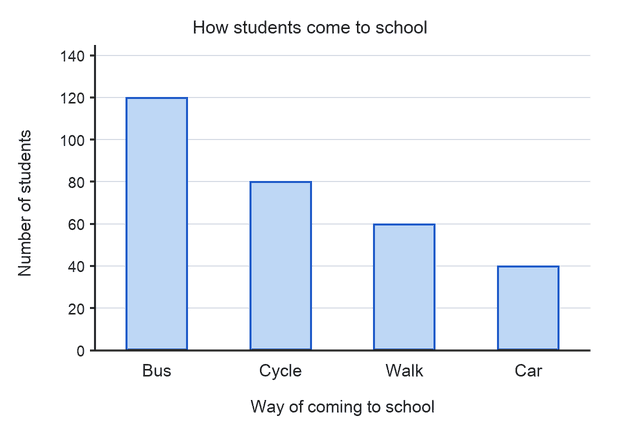
(a) Read the graph. Find the ratio of the number of students who come by cycle to the number who come by bus, in its lowest terms.
(b) Find the ratio of the number of students who walk to the total number of students.
(c) Next year the school will have 400 students. Suppose they come to school in the same ratio as now. The school has 3 buses, and each bus carries 40 students. Will 3 buses be enough next year? Justify your answer.
- 155 marks
Question 15
Competency: Application & Analysis
Case study — Khichdi for the class picnic
The cook's recipe card shows what is needed to make khichdi for 8 children.
Item Rice Dal Vegetables Quantity for 8 children 600 g 200 g 400 g Each child gets the same helping.
(a) Find the ratio rice : dal : vegetables in its lowest terms.
(b) 28 children are going for the picnic. How much rice and how much dal are needed? Give the rice in kilograms.
(c) On the picnic day the cook finds only 1.5 kg of rice and 450 g of dal in the store. There are plenty of vegetables. For how many children can she make khichdi by the same recipe? Which item runs short first?
- 161 mark
Question 16
Competency: Application
A toy company makes a model of a car. The model is 15 cm long and the real car is 4.5 m long.
What is the ratio of the length of the model to the length of the real car, in its simplest form?
- 171 mark
Question 17
Competency: Application
A rope 2.4 m long is cut into two pieces. One piece is 90 cm long.
What is the ratio of the length of the longer piece to the length of the shorter piece, in its simplest form?
- 181 mark
Question 18
Competency: Analysis
The ratios and are equal, so is a proportion.
Which of the following is also a proportion?
- 191 mark
Question 19
Competency: Understanding & Analysis
Assertion (A): The ratio is equal to the ratio .
Reason (R): The terms of the ratio have no common factor other than 1.
- 201 mark
Question 20
Competency: Understanding & Application
A box of 120 laddus is shared among Isha, Jay and Kavya. The strip shows how the laddus are shared. All the small boxes are of the same size, and each small box stands for the same number of laddus.

How many laddus does Jay get?
- 211 mark
Question 21
Competency: Application
Ishita reads 18 pages of a story book in 24 minutes. She reads at the same speed all the time.
How many pages will she read in 1 hour 20 minutes?
- 221 mark
Question 22
Competency: Analysis
The table shows the ratio of boys to girls in four sections of Class 6. (Hypothetical data.)
Section 6A 6B 6C 6D Boys : Girls In which section is the number of boys the greatest compared with the number of girls?
- 231 mark
Question 23
Competency: Evaluation
Assertion (A): If 6 identical erasers cost ₹ 48, then 9 of these erasers cost ₹ 72.
Reason (R): The cost of 9 erasers is ₹ 3 more than the cost of 6 erasers, because 9 is 3 more than 6.
- 241 mark
Question 24
Competency: Application
A gardener makes a potting mix for one pot from garden soil and compost in the ratio . The mix for one pot has a mass of 3.6 kg.
How many kilograms more soil than compost does the mix contain?
- 251 mark
Question 25
Competency: Analysis & Evaluation
A shop sells identical notebooks at the same price for each notebook. A student writes the cost of some numbers of notebooks in a table, but one entry is wrong. (Hypothetical data.)
Number of notebooks 3 5 8 10 Cost (₹) 45 75 125 150 Which entry is wrong?
- 262 marks
Question 26
Competency: Evaluation
A Class 6 section has 16 boys and 24 girls. Veena writes, "The ratio of boys to girls is ."
Is Veena right? If not, write the correct ratio of boys to girls in its simplest form, and name its antecedent and its consequent.
- 272 marks
Question 27
Competency: Application
In a day of 24 hours, Rhea sleeps for 8 hours and spends 6 hours at school. (Hypothetical data.)
Find, in simplest form, (i) the ratio of the time she sleeps to the time she is awake, (ii) the ratio of her time at school to the time she is awake.
- 282 marks
Question 28
Competency: Understanding & Application
Arun and Bina get pocket money every month from their uncle in a fixed ratio. (Hypothetical data.)
Month Arun's money (₹) Bina's money (₹) January 150 200 February 180 240 (a) Show that the ratio of Arun's money to Bina's money in January and in February form a proportion.
(b) In March, Arun gets ₹ 210. If the same ratio is kept, how much does Bina get?
- 292 marks
Question 29
Competency: Application
A leaking tap drips 45 mL of water in 9 minutes at a steady rate. (Hypothetical data.)
How much water does the tap waste in one whole day of 24 hours? Give your answer in litres.
- 302 marks
Question 30
Competency: Application & Analysis
A cart can carry a load of at most 100 kg. Five identical bricks weigh 12 kg together. (Hypothetical data.)
What is the greatest number of such bricks that can be loaded on the cart?
- 312 marks
Question 31
Competency: Application
A coach plans a practice session of 45 minutes for batting, bowling and fielding, in the ratio .
(a) Find the time for each part of the session.
(b) How many more minutes are given to batting than to fielding?
- 323 marks
Question 32
Competency: Creativity
You want to draw a plan of your classroom on a sheet of paper. The classroom is 8 m long and 6 m wide. The drawing on the paper can be at most 20 cm long and 15 cm wide.
A scale of the form means that 1 cm on the paper stands for cm in the classroom. For example, the scale means 1 cm on the paper stands for 50 cm in the classroom.
Choose your own scale , where is a whole number.
(a) Write the length and width of the classroom in centimetres.
(b) Using your scale, find the length and width of the drawing.
(c) Show that your drawing fits on the sheet.
- 333 marks
Question 33
Competency: Analysis & Evaluation
A scholarship of ₹ 4,500 is shared by Asha, Bina and Chitra. The ratio of Asha's share to Bina's share is , and the ratio of Bina's share to Chitra's share is . (Hypothetical data.)
(a) Write the ratio of the three shares, Asha : Bina : Chitra.
(b) Find the share of each girl.
(c) Chitra says, "I get more money than the other two girls together." Is she right?
- 343 marks
Question 34
Competency: Analysis & Evaluation
Aman types 540 words in 15 minutes and Bela types 700 words in 20 minutes. Each types at a steady speed. (Hypothetical data.)
(a) Find the number of words each of them types in one minute.
(b) Who types faster?
(c) How many words will the faster typist type in 1 hour 5 minutes?
- 353 marks
Question 35
Competency: Analysis
A charity box in a school has only ₹ 1, ₹ 2 and ₹ 5 coins. The numbers of coins of these three kinds are in the ratio . The total money in the box is ₹ 840. (Hypothetical data.)
How many coins of each kind are in the box?
- 363 marks
Question 36
Competency: Application & Evaluation
A milk booth sells 500 mL of milk for ₹ 30. The Bose family wants 1 litre 250 mL of milk every day for the 30 days of a month. They have a budget of ₹ 1,800 for milk for the month. (Hypothetical data.)
(a) Find the cost of 1 litre of milk.
(b) Find the cost of the milk the family wants for the month.
(c) Is the cost within the budget? If not, by how many rupees does it go over the budget?
- 374 marks
Question 37
Competency: Application & Analysis
Case study — The school garden
The gardener of a school has a rectangular plot of land that is 36 m long. He divides the length of the plot into three beds with fences, for vegetables, flowers and herbs. The plan below shows the plot. Each column of small squares is 2 m wide.
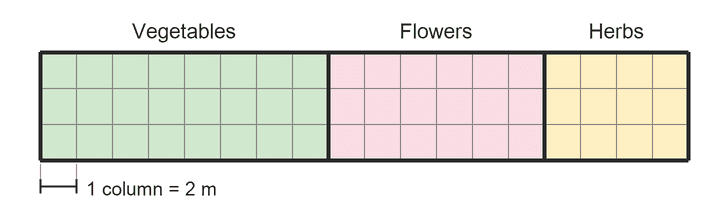
(a) Count the columns in each bed and write the ratio of the lengths of the three beds, vegetables : flowers : herbs, in its lowest terms.
(b) Find the length of each bed in metres.
(c) To grow more herbs, the gardener moves the fence between the flowers and the herbs 2 m towards the flowers. Find the new ratio of the length of the flower bed to the length of the herb bed, in its lowest terms.
- 385 marks
Question 38
Competency: Analysis & Evaluation
Case study — Filling the water tank
A pump fills the overhead tank of a school. The caretaker notes the water pumped by the pump after some minutes. The pump is meant to work at a steady rate. (Hypothetical data.)
Time (minutes) 5 8 12 15 Water pumped (litres) 60 96 144 190 (a) Find the litres of water pumped in one minute from each of the first three readings. What do you notice?
(b) If the pump keeps the same rate, how many litres should it pump in 15 minutes? Does the caretaker's fourth reading agree?
(c) The empty tank holds 1,500 litres. At the rate found in (a), how long does the pump take to fill it? Give the answer in hours and minutes.
- 394 marks
Question 39
Competency: Analysis & Application
Case study — Naina's report card
Naina's marks in three subjects are shown in the table. The maximum marks are not the same for all the subjects. (Hypothetical data.)
Subject Marks obtained Maximum marks Maths 36 40 Science 27 30 English 42 50 (a) Write the ratio of marks obtained to maximum marks for each subject, in its lowest terms.
(b) For which two subjects are these ratios equal? Verify that they form a proportion using the product of the extremes and the product of the means.
(c) Naina wants the same ratio in English as in Maths. How many marks out of 50 does she need in English, and how many more marks than her present marks is that?
- 405 marks
Question 40
Competency: Application & Evaluation
Case study — Prize money on Sports Day
A school keeps ₹ 12,000 as prize money for three events of its Sports Day. The money is shared among the events in the ratio of the number of students who take part in each event. (Hypothetical data.)
Event Race Long jump Relay Number of students 24 16 20 In the Race, the first, second and third prizes are in the ratio .
(a) Write the ratio of the numbers of students in the three events in its lowest terms, and find the prize money kept for each event.
(b) Find the amount of the first, second and third prizes in the Race.
(c) Find the money kept for each student in each event. What do you notice?