
Opening your dashboard
Class 6 Maths Chapter 7 Decimal Fractions: Competency-Based Questions (CBQ)
40 questions on Chapter 7, each worked through on its own page with the AI tutor. Class 6 Maths, ICSE 2026-27.
40 questions
1–5 marks · Mixed difficulty
- 11 mark
Question 1
Competency: Understanding
The school nurse measures Tanu's height as 1 metre 6 centimetres. She has to enter the height in metres in the health card.
What should she write?
- 21 mark
Question 2
Competency: Analysis
A jeweller weighs four gold rings on a digital scale.
Ring P Q R S Mass 4.5 g 4.05 g 4.505 g 4.055 g A customer asks for the lightest ring. Which ring should the jeweller show?
- 31 mark
Question 3
Competency: Application
Petrol costs ₹ 102.50 per litre. Imran fills 3.2 litres of petrol in his scooter.
How much does he pay?
- 41 mark
Question 4
Competency: Application
A ribbon 2.4 m long is cut into pieces for badges. Each badge needs a piece 0.15 m long.
How many badges can be made?
- 51 mark
Question 5
Competency: Understanding
Grandmother's recipe book gives all quantities as fractions of a kilogram. Riya weighs some butter on a digital scale, and the scale shows 0.125 kg.
Which fraction of a kilogram is this?
- 61 mark
Question 6
Competency: Evaluation
Assertion (A): A 0.5 kg packet of dal for ₹ 40 is a better buy than a 0.25 kg packet of the same dal for ₹ 22.
Reason (R): The price of 1 kg is found by dividing the price of a packet by its mass in kilograms.
- 72 marks
Question 7
Competency: Application & Evaluation
Leela has to travel 6 km to the railway station.
Auto-rickshaw: ₹ 25 fixed charge, and then ₹ 14.50 for every kilometre.
E-rickshaw: no fixed charge, ₹ 18.75 for every kilometre.
Which one is cheaper for her trip, and by how much?
- 82 marks
Question 8
Competency: Analysis
Part of a stationery bill got wet, and one price cannot be read.
Item Price Notebook ₹ 42.50 Pen ₹ 18.75 Colour box (cannot be read) Total ₹ 150.00 Find the price of the colour box. Check your answer.
- 92 marks
Question 9
Competency: Evaluation
Sana buys 4.5 m of cloth at ₹ 42.50 per metre. The shop's bill shows ₹ 1,912.50.
(a) Without multiplying exactly, show that this bill cannot be right.
(b) Find the correct amount. What mistake was made in the bill?
- 102 marks
Question 10
Competency: Application
A courier company takes parcels of up to 2 kg at its lowest rate.
Arif wants to send a book of 850 g, a toy of 0.675 kg and a box of sweets of 320 g in one parcel.
Can he send them at the lowest rate? How far below or above 2 kg is the parcel?
- 113 marks
Question 11
Competency: Analysis & Evaluation
Two families compare their cars after a holiday trip.
Car Distance travelled Petrol used Car A 201.6 km 12 litres Car B 148.5 km 9 litres (a) How far does each car go on 1 litre of petrol?
(b) Car A travelled farther. Does that alone show that car A uses petrol better? Which car really goes farther on each litre?
(c) On 20 litres of petrol, how many kilometres farther will the better car go than the other car?
- 123 marks
Question 12
Competency: Creativity
You have ₹ 100 to spend at the school stationery shop.
Item Pencil Eraser Sharpener Pen Notebook Price of one ₹ 6.50 ₹ 4.25 ₹ 5.75 ₹ 12.50 ₹ 28.75 Make your own shopping list that follows these rules:
- You buy at least three different items. You may buy more than one of any item.
- Your bill is more than ₹ 90 but not more than ₹ 100.
Write your list as a bill, find the total, and find the change you get from ₹ 100.
- 133 marks
Question 13
Competency: Analysis
A set of measuring cups has four sizes: litre, litre, litre and litre.
A soup recipe on a website says: "Add 0.45 litre of water."
(a) Write the size of each cup as a decimal.
(b) Asif wants to measure the water in one go, in the smallest cup that can hold it. Which cup should he pick? How much of that cup stays empty?
(c) Write 0.45 as a fraction in its lowest terms.
- 144 marks
Question 14
Competency: Application & Analysis
Case study — The school rain gauge
The science club measured the rainfall at school on five days of one week.
Day Mon Tue Wed Thu Fri Rainfall (mm) 12.5 0.8 23.75 4.2 18.25 (a) Find the total rainfall on the five days.
(b) On which day was the rainfall the greatest, and on which day the least? Find the difference between these two readings.
(c) The school's rainwater tank collects 2.4 litres of water for every millimetre of rain. The tank was empty on Monday morning, and it can hold 150 litres. Was the tank full by Friday evening? If not, how many more litres could it hold?
- 155 marks
Question 15
Competency: Analysis & Evaluation
Case study — Cloth for the school band
The school band needs 24 new shirts. The tailor says each shirt needs 1.35 m of cloth. The cloth shop gives two choices:
- By the metre: ₹ 86 per metre, for any length.
- Full roll: a roll of 35 m for ₹ 2,850.
(a) How much cloth is needed for the 24 shirts?
(b) Find the cost of exactly this much cloth by the metre. Is it cheaper than the full roll? By how much?
(c) The tailor now asks for extra cloth for one more shirt, in case of a cutting mistake. Which choice is cheaper now, and by how much?
- 161 mark
Question 16
Competency: Understanding
A science teacher writes the volume of a liquid in the lab record as 5 tenths + 3 thousandths of a litre.
Which decimal number shows this volume?
- 171 mark
Question 17
Competency: Application
A science teacher wants to write the readings 2.5 g, 0.375 g and 4.08 g in one table so that all three have the same number of decimal places. She does not want to change the value of any reading.
What is the smallest number of decimal places she can use?
- 181 mark
Question 18
Competency: Analysis
Four friends poured juice into identical jugs and noted the amounts in different ways.
Friend Asha Bela Chitra Deepa Amount of juice (litres) 0.55 0.65 Which two friends poured the same amount of juice?
- 191 mark
Question 19
Competency: Analysis
Three pieces of wire of lengths 1.25 m, 0.8 m and 2.35 m are joined end to end to make one long wire. At each joint, 5 cm (0.05 m) of the two pieces overlap and are twisted together.
How long is the joined wire?
- 201 mark
Question 20
Competency: Application
A 1.8 litre bottle is full of water. Seema pours 0.35 litre into a glass and 0.6 litre into a jug. While pouring, 0.15 litre spills on the table.
How much water is left in the bottle?
- 211 mark
Question 21
Competency: Application
A stack of 500 sheets of paper is kept in the school office. Each sheet is 0.012 cm thick.
How high is the stack?
- 221 mark
Question 22
Competency: Analysis
The decimal-point key of Rohan's calculator is broken, so it can divide only whole numbers. To find , he rewrites it as a division of two whole numbers that gives the same answer.
Which division should he use?
- 231 mark
Question 23
Competency: Evaluation
Assertion (A):
Reason (R): The product of two decimal numbers that are each less than 1 is always greater than either of them.
- 241 mark
Question 24
Competency: Analysis
Assertion (A): ₹ 2.50 + 75 paise = ₹ 77.50
Reason (R): Amounts in rupees and paise can be added only after both are written in the same unit.
- 251 mark
Question 25
Competency: Application
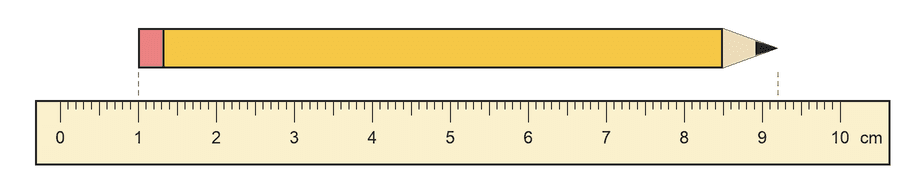
A pencil is placed along a ruler as shown. The ruler is marked in centimetres, and each centimetre is divided into 10 equal parts (millimetres).
What is the length of the pencil in metres?
- 262 marks
Question 26
Competency: Analysis
Radhika writes: and .
(a) Check her answers by counting the zeros in each denominator. Which answers are wrong?
(b) Write the correct decimal numbers.
- 272 marks
Question 27
Competency: Understanding & Analysis
Each large square below is divided into 100 equal small squares. The shaded part of each large square is shown.

(a) Write the decimal number for the shaded part of Grid A and of Grid B.
(b) Which grid has the greater part shaded? By how many hundredths?
- 282 marks
Question 28
Competency: Application & Evaluation
(Hypothetical data.) In a school relay race, four runners of a team ran 100 m each. Their times were 11.8 s, 12.35 s, 12.05 s and 11.9 s. The school record for the 4 × 100 m relay is 48 s.
Did the team break the record? By how many seconds did they beat it or miss it?
- 292 marks
Question 29
Competency: Application & Evaluation
Mr Das's bank passbook shows a balance of ₹ 4,520.75. He withdraws ₹ 1,250.50 and then ₹ 899.95. The bank does not allow the balance to go below zero.
(a) Find his balance now.
(b) Can he withdraw ₹ 2,500 more? What is the most he can withdraw?
- 302 marks
Question 30
Competency: Analysis
A new pencil is 0.175 m long.
(a) A shop lays 1000 such pencils end to end in a line. Find the length of the line in metres.
(b) Write this length in kilometres. What do you notice about the digits in your two answers? Explain why.
- 312 marks
Question 31
Competency: Application
(Hypothetical data.) 100 identical coins have a total mass of 0.75 kg.
(a) Find the mass of one coin in kilograms.
(b) Write the mass of one coin in grams.
- 323 marks
Question 32
Competency: Application & Analysis
An airline allows each passenger 15 kg of luggage without any charge. For extra luggage it charges ₹ 450 for every kilogram, and it charges in proportion for a part of a kilogram.
Meena has a suitcase of 9.35 kg, a bag of 4.8 kg and a gift box of 1250 g.
(a) Find the total mass of her luggage in kilograms.
(b) How many kilograms is her luggage over the free limit?
(c) How much must she pay for the extra luggage?
- 333 marks
Question 33
Competency: Analysis
There are 40 students in Class 6B. The sports teacher noted the part of the class that chose each sport.
Sport Cricket Football Hockey Athletics Part of the class 0.35 0.25 0.15 the rest (a) Write 0.35, 0.25 and 0.15 as fractions in their lowest terms.
(b) What fraction of the class chose athletics?
(c) How many students chose each sport? Which two sports are equally popular?
- 343 marks
Question 34
Competency: Analysis & Evaluation
A packing unit puts 24 packets of rice in each crate. Every packet has a mass of 0.45 kg. A small truck can carry crates of rice with a total mass of 540 kg. Ignore the mass of the crates.
(a) Find the mass of the rice in one crate.
(b) How many crates can the truck carry?
(c) Now find the number of packets by dividing 540 kg by the mass of one packet. Does this agree with your answers to (a) and (b)?
- 353 marks
Question 35
Competency: Creativity & Understanding
The teacher marks 3.4 and 3.5 on the number line on the board.
(a) Write five different decimal numbers that lie between 3.4 and 3.5. At least two of them must have 3 decimal places.
(b) Write your five numbers as like decimals and arrange them in ascending order.
(c) Find how far your smallest number is above 3.4, and how far your greatest number is below 3.5.
- 363 marks
Question 36
Competency: Analysis & Evaluation
(Hypothetical data.) The track in a school ground is 0.4 km long. Divya ran 6.4 km round the track in 48 minutes, at a steady pace.
(a) How many laps did she run?
(b) How many minutes did she take for one lap?
(c) To earn a finisher's badge in the school's 10 km fun run, a runner must finish within 70 minutes. If she keeps the same pace, will she earn the badge? Give a reason.
- 375 marks
Question 37
Competency: Analysis & Evaluation
Case study — Milk in the school canteen
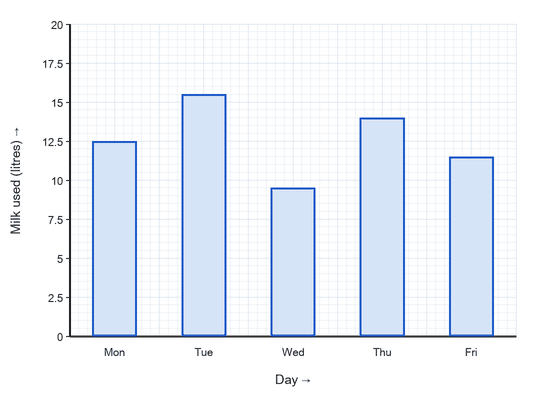
(Hypothetical data.) The bar graph shows the milk used in a school canteen on five days of a week. One small division of the vertical scale is 0.5 litre.
The canteen had ordered 70 litres of milk for these five days.
(a) Read the milk used on each day from the graph. Which day used the most and which day the least? How many litres more were used on the busiest day than on the quietest day?
(b) Find the total milk used in the five days. How much of the 70 litres was left?
(c) Each glass holds 0.25 litre. How many glasses of milk were served in the five days? How many full bottles of 0.35 litre can be filled from the milk that was left?
- 384 marks
Question 38
Competency: Analysis & Evaluation
Case study — Jyoti's bean plant
(Hypothetical data.) Jyoti measured the height of her bean plant at the end of each week.
Week 0 (start) 1 2 3 4 Height (cm) 2.5 4.35 7.1 10.85 14.8 (a) Find how much the plant grew in each of the four weeks.
(b) In which week did it grow the most? How much more than in week 1 was that?
(c) Ritu says, "The plant grew 3.95 cm in week 4, so it will be 25 cm tall at the end of week 6." Using Ritu's idea, find the height at the end of week 6. Is she right?
- 395 marks
Question 39
Competency: Application & Analysis
Case study — Juice for Sports Day
(Hypothetical data.) The school buys juice for Sports Day. The juice comes in cartons. Each carton holds 1.25 litres and costs ₹ 42.50. There are 240 students, and each student gets one glass of 0.25 litre.
(a) How many glasses can be filled from one carton?
(b) How many cartons are needed for 240 students? Find their cost.
(c) The sports teacher has ₹ 2,100. How much money is left after buying the cartons in (b)? With this money, how many more cartons can she buy, and how much money is then left?
- 404 marks
Question 40
Competency: Creativity & Analysis
Case study — The decimal riddle
The Maths Club plays a game. One member writes clues for a secret decimal number, and the others find it. Aman wrote these clues.
Clue 1: The number is greater than 3.6 and less than 3.7.
Clue 2: It has exactly 3 decimal places.
Clue 3: Its hundredths digit is 4.
Clue 4: When it is multiplied by 1000, the answer ends in the digit 5.
(a) Using Clues 1 and 2 only, write the smallest and the greatest possible numbers.
(b) Using all four clues, find the secret number.
(c) Make your own riddle for the number 0.275, with at least three clues.