
Opening your dashboard
Class 6 Maths Chapter 3 Natural Numbers and Whole Numbers: Competency-Based Questions (CBQ)
40 questions on Chapter 3, each worked through on its own page with the AI tutor. Class 6 Maths, ICSE 2026-27.
40 questions
1–5 marks · Mixed difficulty
- 11 mark
Question 1
Competency: Understanding
In which of these situations can the answer be a whole number that is not a natural number?
- 21 mark
Question 2
Competency: Application
Tickets for a school play are numbered in order. Raju's ticket number is the predecessor of 50,000. Simi's ticket number is the successor of 49,989.
How many tickets have numbers between Simi's number and Raju's number?
- 31 mark
Question 3
Competency: Analysis
Four toy machines take two whole numbers and show one result.
- Machine P adds the two numbers.
- Machine Q subtracts the second number from the first.
- Machine R multiplies the two numbers.
- Machine S divides the first number by the second. (The second number is never 0.)
Which machines will always show a whole number, whatever whole numbers are put in?
- 41 mark
Question 4
Competency: Application
A grocer stacks tins in rows. The top row has 1 tin, the next row has 2 tins, the next has 3 tins, and so on.
He has 60 tins. What is the greatest number of complete rows he can make?
- 51 mark
Question 5
Competency: Evaluation
Meena and Tarun are talking about the number line for whole numbers.
Meena: "From any whole number, I can always move one step to the left and reach a whole number."
Tarun: "From any whole number, I can always move one step to the right and reach a whole number."
Who is correct?
- 61 mark
Question 6
Competency: Understanding
Assertion (A): When 15 sweets are shared equally among 0 children, each child gets 0 sweets, because .
Reason (R): When 0 is divided by any non-zero whole number, the quotient is 0.
- 72 marks
Question 7
Competency: Evaluation
Vivek had ₹ 500. He spent ₹ 180 on a book and then ₹ 70 on pens.
To find the money left, he wrote .
Is Vivek's working correct? Find the money left. Which property of subtraction does this show?
- 82 marks
Question 8
Competency: Analysis
A toy robot moves on a number line. It starts at the point marked with a dot. The figure shows its first jump and its second jump.
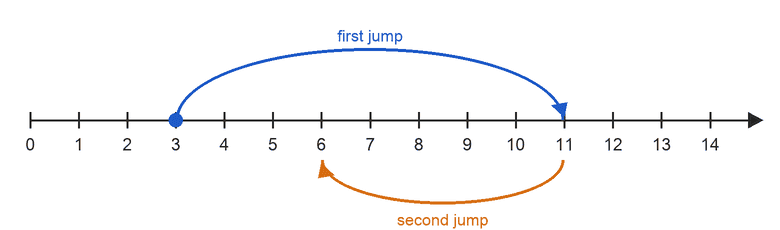
(a) Write one number statement for the two jumps. Where is the robot now?
(b) From there, the robot goes to 14 in equal jumps of 2 units. How many jumps does it need?
- 92 marks
Question 9
Competency: Analysis
For Diwali, Reema arranges diyas in rows. The table shows her designs.
Design Diyas in the rows Total diyas Design 2 1, 2, 1 4 Design 3 1, 2, 3, 2, 1 9 Design 4 1, 2, 3, 4, 3, 2, 1 16 (a) How many diyas does Design 5 need? Write the rule for the total number of diyas in Design .
(b) Reema has 150 diyas. Which is the biggest design she can make, and how many diyas will be left over?
- 102 marks
Question 10
Competency: Analysis
This is a magic square. Its magic sum is 15.
2 9 4 7 5 3 6 1 8 (a) Anil adds 5 to every number of this square. Write his new square. Is it a magic square? What is its magic sum?
(b) Without writing the square, find the magic sum if every number of the first square is doubled instead. Give a reason.
- 113 marks
Question 11
Competency: Analysis & Evaluation
Three quiz cards carry these statements. For each card, decide whether the statement is always true, sometimes true or never true. Give a reason or an example each time.
Card 1: The sum of a whole number and its successor is an odd number.
Card 2: The predecessor of a natural number is a natural number.
Card 3: When a natural number is divided by 0, the answer is a whole number.
- 123 marks
Question 12
Competency: Creativity
Make up a word problem about shopping that can be solved by the expression
Then solve your problem by using the distributive property, and check the answer by direct multiplication.
- 133 marks
Question 13
Competency: Application & Analysis
Nisha makes models of a shoe rack with matchsticks. Every rack is two squares high. Fig. 1 has 1 column of squares, Fig. 2 has 2 columns and Fig. 3 has 3 columns, as shown.
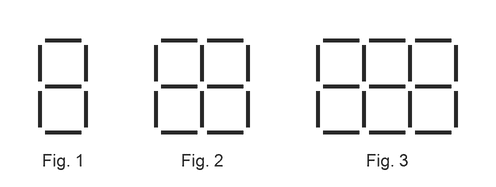
(a) Copy and complete the table, where is the number of columns and M is the number of matchsticks. Write the rule that gives M in terms of .
Number of columns () 1 2 3 4 Number of matchsticks (M) 7 ..... ..... ..... (b) How many matchsticks are needed for a rack of 25 columns?
(c) Nisha has a box of 80 matchsticks. What is the greatest number of columns she can make in one rack? How many matchsticks will be left?
- 145 marks
Question 14
Competency: Application & Analysis
Case study — Seats in the open-air theatre
A school builds an open-air theatre with 15 rows of seats. The table shows the number of seats in the first four rows. The same pattern continues up to the last row.
Row number 1 2 3 4 Number of seats 2 4 6 8 (a) Write the rule for the number of seats in row . How many seats are there in row 15?
(b) Find the total number of seats in the theatre, using a rule from this chapter.
(c) For the annual day, a ticket for rows 1 to 10 costs ₹ 50 and a ticket for rows 11 to 15 costs ₹ 30. How much money is collected if every seat is sold?
- 154 marks
Question 15
Competency: Analysis & Evaluation
Case study — The picnic bill
A class of 42 students is going on a picnic. Each student pays ₹ 135 for the bus and ₹ 65 for food. Three students work out the total amount to be collected.
Student Working Asha Bala Charu (a) Work out Asha's and Bala's answers. Which property of whole numbers says that they must be equal? Whose way is easier?
(b) Work out Charu's answer. What mistake has she made, and by how much is her answer short?
(c) Later, 3 students drop out. The teacher says, "The new total is ." Check this by finding . Which property is the teacher using?
- 161 mark
Question 16
Competency: Analysis
Rita picks a whole number and writes two results.
Result 1: the predecessor of the successor of .
Result 2: the successor of the predecessor of .
Which statement is correct?
- 171 mark
Question 17
Competency: Application
A cashier adds the prices of three items: ₹ 38, ₹ 47 and ₹ 62. To add quickly, she writes instead of .
Which two properties of addition of whole numbers does she use to change into ?
- 181 mark
Question 18
Competency: Analysis
Four students draw a number line for the whole numbers, as shown in the figure.

Which line is a correct number line for the whole numbers?
- 191 mark
Question 19
Competency: Application
Meera notices that the sum of five consecutive natural numbers follows a pattern:
Five houses in a lane have consecutive house numbers. The sum of the five house numbers is 105. What is the smallest of the five house numbers?
- 201 mark
Question 20
Competency: Analysis
A restaurant joins square tables end to end in one long row. One person sits on each free side of a table. The table shows how many people can be seated.
Number of tables in the row 1 2 3 Number of people seated 4 6 8 How many tables are needed to seat exactly 34 people?
- 211 mark
Question 21
Competency: Analysis
Meena fills a magic square with different whole numbers. The numbers in its top row add up to 30.
What is the sum of all nine numbers in the square?
- 221 mark
Question 22
Competency: Understanding
Assertion (A): The number line for the whole numbers can never be drawn completely on paper.
Reason (R): Every whole number has a successor, so the whole numbers never end.
- 231 mark
Question 23
Competency: Application
A padlock has a code which is a 4-digit natural number. Sanjay forms the code by using each of the digits 6, 0, 2 and 9 exactly once, and he makes the smallest such code. His sister sets the lock to the successor of his code.
What code does the lock show?
- 241 mark
Question 24
Competency: Analysis
A floor is covered with square tiles, as shown. The white tiles and the grey tiles are counted row by row to find the total number of tiles.

Which equation does the figure show?
- 251 mark
Question 25
Competency: Evaluation
Assertion (A): A magic square can be made by using the nine numbers 1, 1, 2, 3, 4, 5, 6, 7 and 8, one in each cell.
Reason (R): The numbers in a magic square must all be different.
- 262 marks
Question 26
Competency: Analysis
Two grasshoppers, Tip and Tap, start at 0 on a number line for the whole numbers. Tip jumps 6 units to the right each time and Tap jumps 9 units to the right each time. Both stop before 40.
(a) Write the numbers where Tip lands and the numbers where Tap lands.
(b) At which numbers do both grasshoppers land? Which of these is reached first?
- 272 marks
Question 27
Competency: Evaluation
Ria notices this pattern:
(a) Use the pattern to write the answer to , where each number has seven 1s.
(b) Ria says, "By the same pattern, ten 1s times ten 1s gives 12345678910987654321." Is her answer reasonable? Give a reason.
- 282 marks
Question 28
Competency: Application
In a video game, a player's score is a whole number. At the end of a level, the player picks one of four cards, and the card changes the score:
Card P: add 0.
Card Q: multiply by 1.
Card R: multiply by 0.
Card S: divide by 1.
(a) Which cards leave every score unchanged? Which card makes every score 0?
(b) The designer wants to add Card T: divide by 0. Explain why the game cannot have this card.
- 292 marks
Question 29
Competency: Application
A machine prints a token for each whole number from 0 to 99, one token for each number.
(a) How many tokens does the machine print in all?
(b) The school needs tokens that carry only natural numbers. How many printed tokens are not needed? Which token is it?
- 302 marks
Question 30
Competency: Understanding & Application
A necklace has beads in this pattern, which repeats again and again:
red, blue, blue, green, red, blue, blue, green, red, blue, blue, green, ...
(a) What is the colour of the 50th bead?
(b) How many red beads are there among the first 50 beads?
- 312 marks
Question 31
Competency: Analysis & Evaluation
Anil makes a chain of hexagons with matchsticks. Each hexagon after the first shares one side with the hexagon before it. A chain of 1 hexagon needs 6 matchsticks, a chain of 2 hexagons needs 11 and a chain of 3 hexagons needs 16.
Anil says, "I have exactly 100 matchsticks, so I can make a chain that uses all of them."
(a) Write the rule for the number M of matchsticks needed for a chain of hexagons.
(b) Is Anil right? Give a reason. How many hexagons can he make with 100 matchsticks, and how many matchsticks are left?
- 323 marks
Question 32
Competency: Creativity
Design a number-line game. A counter starts at 5 on the number line for the whole numbers. You write three move cards. Each card says "move right units" or "move left units", where is a natural number.
Your three cards must follow these rules:
- at least one card moves the counter to the left;
- the counter never goes to the left of 0;
- after the third card the counter is back at 5;
- the three cards are different.
Write your three cards, show where the counter is after each card, and check the rules.
- 333 marks
Question 33
Competency: Understanding & Application
Anu has ₹ 45 in her piggy bank. She wants to buy a toy which costs ₹ 60. Her brother says, "Work out to see how much money you will have left."
(a) Is a whole number? What does this show about the subtraction of whole numbers?
(b) Find and say what it means in this story.
(c) Is equal to ? Which property of subtraction does your answer show?
- 343 marks
Question 34
Competency: Application & Analysis
A tailor has a roll of cloth which is 30 m long. She cuts pieces of 4 m each, one after another.
(a) Start at 30 on a number line and jump 4 units to the left again and again, for as long as you can. Write the numbers where you land. How many pieces does she cut, and how much cloth is left?
(b) Is a whole number? What does this show about the division of whole numbers?
(c) How many more metres of cloth does she need to cut exactly 8 pieces of 4 m each?
- 353 marks
Question 35
Competency: Analysis
Fig. A, Fig. B and Fig. C show square arrays of dots. In each figure the hollow dots are the dots that were added to the previous square array to make the new one.

(a) How many hollow dots are there in Fig. A, Fig. B and Fig. C?
(b) Fig. A is a array, Fig. B is a array and Fig. C is a array. Write the rule for the number of hollow dots added to make an array.
(c) An array is made by adding 41 hollow dots to the previous array. Find and the total number of dots in this array.
- 363 marks
Question 36
Competency: Analysis & Evaluation
A school records the rainfall in millimetres on each day of a week. (Hypothetical data.)
Day Mon Tue Wed Thu Fri Sat Sun Rainfall (mm) 0 12 0 5 30 0 8 (a) On how many days is the reading a natural number? What is the reading on the other days, and is it a whole number?
(b) Find the total rainfall for the week. If the rainfall next week is the successor of this week's total, what is it?
(c) A student says, "A reading of 0 means that the rain gauge was broken." Is the student right? Give a reason.
- 375 marks
Question 37
Competency: Application & Analysis
Case study — A metro line
A metro line runs along a straight road. The figure shows the stations A, B, C, D, E and F on a number line, where each number is the distance in km from station A.

(a) Read the distance of station C from station A. Find the distance between station B and station E.
(b) A train starts at station A, runs to station F and then comes back to station C. How far does it travel in all? How far is it from station A when it stops?
(c) A ticket costs ₹ 4 for every km travelled. Mira travels from station E to station B, and Dev travels from station A to station C. Who pays more, and how much more?
- 384 marks
Question 38
Competency: Analysis & Evaluation
Case study — Marathon bib numbers
A city marathon gives every runner a bib number. The bib numbers are natural numbers starting from 1, given in order with no number missed. The last bib number is 12,000.
(a) How many runners are there? How many bibs have fewer than 4 digits?
(b) How many bibs have exactly 4 digits? How many bibs have 5 digits?
(c) A helper suggests starting the bib numbers from 0 instead of 1, and still finishing at 12,000. How many bib numbers would there be then? Is the helper's plan a good one? Give a reason.
- 395 marks
Question 39
Competency: Application & Analysis
Case study — Flower beds with a paved border
A park has square flower beds. Each bed is tiles long and tiles wide (grey). A border of one row of white paving tiles goes all round the bed, as shown.
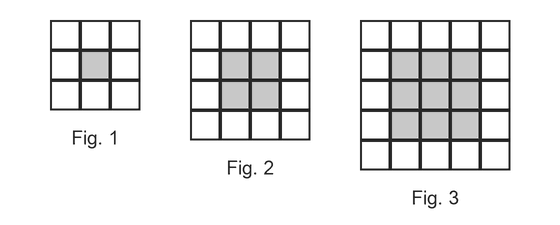
(a) Copy and complete the table, where is the number of tiles along a side of the bed and T is the number of paving tiles in the border. Write the rule that gives T in terms of .
Side of the bed () 1 2 3 4 Number of paving tiles (T) ..... ..... ..... ..... (b) How many paving tiles are needed for a bed with ?
(c) The gardener can make either one bed with or two separate beds with each, each bed with its own border. Which plan needs fewer paving tiles, and by how many? Which plan has more grey tiles for flowers?
- 404 marks
Question 40
Competency: Analysis & Evaluation
Case study — The tile boards
A craft club makes tile boards. Every tile carries a whole number. A board is called a magic square if its numbers are all different and every row, every column and both diagonals add up to the same sum.
Board X:
8 1 6 3 5 7 4 9 2 Board Y is made by turning Board X a quarter turn clockwise:
4 3 8 9 5 1 2 7 6 Board Z is made from Board X by swapping two tiles of the bottom row:
8 1 6 3 5 7 9 4 2 (a) Board X is a magic square. Find its magic sum from the top row, and check that both diagonals of Board X give the same sum.
(b) Is Board Y a magic square? Give a reason by comparing its lines with the lines of Board X.
(c) Find the lines of Board Z whose sum is not 15. Which two tiles must be swapped to get Board X back?