
Opening your dashboard
Class 6 Maths Chapter 18 Symmetry: Competency-Based Questions (CBQ)
40 questions on Chapter 18, each worked through on its own page with the AI tutor. Class 6 Maths, ICSE 2026-27.
40 questions
1–5 marks · Mixed difficulty
- 11 mark
Question 1
Competency: Application
A sign painter has a stencil for only the left half of each capital letter. He paints the left half, then flips the stencil over about a vertical line and paints the right half.
Which word can he paint completely in this way?
- 21 mark
Question 2
Competency: Application
Riya stands 1.5 m in front of a plane wall mirror. She then takes a step of 0.5 m towards the mirror.
How far is Riya from her image now?
- 31 mark
Question 3
Competency: Analysis
A square floor tile has a circle at its centre and two equal dots near two opposite corners, as shown.
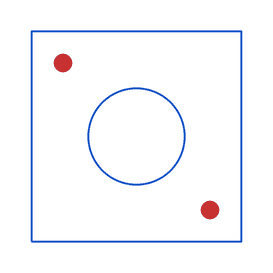
A mason wants to cut the tile with one straight cut into two halves that are mirror images of each other, design included. Along which lines can he cut?
- 41 mark
Question 4
Competency: Understanding
On squared paper, a dotted vertical line is taken as the line of symmetry. A point P is marked 3 squares to the left of the line and 2 squares above the bottom edge of the paper.

The point symmetric to P with respect to the dotted line is
- 51 mark
Question 5
Competency: Analysis
A triangular pennant has exactly one line of symmetry. Two of its sides are 5 cm and 9 cm long.
The third side of the pennant
- 61 mark
Question 6
Competency: Evaluation
Assertion (A): The point symmetric to a point P with respect to a line AB lies on the same side of AB as P.
Reason (R): The line AB is the perpendicular bisector of the line segment joining P to its symmetric point.
- 72 marks
Question 7
Competency: Application
On a town map, a straight canal is shown by a line AB. A temple P is marked 2.4 cm from the line AB. A rest house is to be built at the point Q that is symmetric to P with respect to AB.
The scale of the map is 1 cm 50 m. Find the actual distance between the temple and the rest house.
- 82 marks
Question 8
Competency: Understanding
Four road signs have these shapes:
Sign P Q R S Shape Equilateral triangle Circle Rectangle (not a square) Square Write the number of lines of symmetry of each shape. Then arrange the signs in order, from the fewest lines of symmetry to the most.
- 92 marks
Question 9
Competency: Evaluation
Neha says, "A shape with more sides always has more lines of symmetry."
Test Neha's rule with an equilateral triangle and a rectangle that is not a square. Is her rule correct?
- 102 marks
Question 10
Competency: Analysis
A dot rangoli is symmetrical about a vertical line. There are 3 dots on the line itself and 4 dots to the right of the line.
How many dots are there in the whole rangoli? Explain why the answer is not .
- 113 marks
Question 11
Competency: Analysis
The grid shows a dotted vertical line and some points. Each small square has side 1 unit.
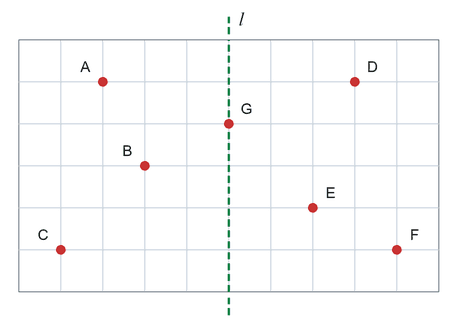
(a) Which marked points are symmetric to A and to C with respect to the line ?
(b) Is E symmetric to B with respect to ? If not, say exactly where the point symmetric to B lies.
(c) G lies on the line . Where is the point symmetric to G?
- 123 marks
Question 12
Competency: Creativity
Design a tile pattern on a square grid of 4 rows and 4 columns by shading small squares. Your pattern must follow these rules:
- Exactly 6 small squares are shaded.
- The pattern is symmetrical about the vertical middle line of the grid.
- The pattern is not symmetrical about the horizontal middle line.
(a) Draw your pattern, or list the shaded squares row by row.
(b) Show that your pattern follows the second and third rules.
(c) Can a pattern with exactly 6 shaded squares on this grid be symmetrical about both middle lines? Explain.
- 133 marks
Question 13
Competency: Analysis & Evaluation
In a drawing, three pairs of points are joined across a line AB. Each joining segment meets AB at a point O. Asha measures them and makes this table.
Pair of points Angle between the segment and AB Distance of first point from O Distance of second point from O P and Q 2.5 cm 2.5 cm R and S 3 cm 3.4 cm T and U 2 cm 2 cm (a) Which pair is symmetric with respect to AB? Give the reason.
(b) For each of the other two pairs, say which condition fails.
(c) S is to be shifted along the line RS so that R and S become symmetric. How far, and in which direction, must S move?
- 144 marks
Question 14
Competency: Analysis & Evaluation
Case study — The paper kite
Arjun makes a paper kite ABCD on two thin sticks AC and BD, which cross at O. The kite is symmetrical about the stick AC. He measures cm, cm, cm and .
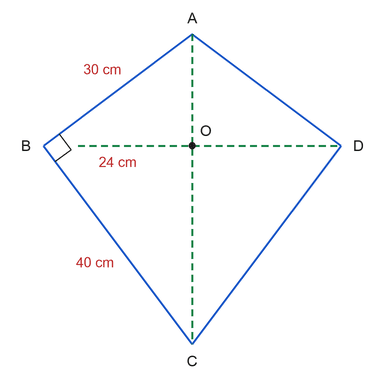
(a) Which point of the kite is symmetric to B with respect to AC? Use symmetry to write the lengths of AD and CD and the size of .
(b) A coloured tape is pasted all along the boundary of the kite. Find the length of tape needed.
(c) Find the length of the stick BD and the angle at which the two sticks cross. Arjun's sister says, "BD is also a line of symmetry of the kite." Is she right? Give a reason.
- 155 marks
Question 15
Competency: Application & Analysis
Case study — A symmetrical garden
A garden is planned so that its straight central path AB is the line of symmetry of the whole garden. Each item on the west side of the path has a matching item on the east side.
Item on the west side Lamp post Bench Mango tree Distance from the path 3 m 4.5 m 7 m (a) Where must the matching lamp post be placed on the east side? How far apart are the two lamp posts?
(b) How far apart are the two mango trees? A fountain stands on the path itself. Where is its matching point?
(c) The east bench is fixed 4.5 m from the path, but the line joining the two benches is not at right angles to the path. Are the two benches symmetric with respect to the path? Two gates P and Q are 10 m apart on the front wall, one on each side of the path. What must be true of the path so that it is the line of symmetry for P and Q?
- 161 mark
Question 16
Competency: Application
Meera folds a rectangular sheet of paper in half. She cuts out a semicircle so that its straight edge lies along the fold. Then she opens the sheet.
The hole in the opened sheet is
- 171 mark
Question 17
Competency: Analysis
A dot P lies 3 cm away from a straight mirror line AB, and its mirror image (its symmetric point) is the dot Q. Then the mirror image of Q in the same line AB is marked as the dot R.
Where does R lie?
- 181 mark
Question 18
Competency: Analysis
On squared paper, two points P and Q are marked, and so are four more points K, L, M and N.
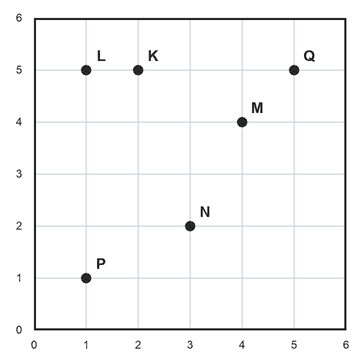
Which of the four points lies on the line of symmetry for the points P and Q?
- 191 mark
Question 19
Competency: Evaluation
Assertion (A): A point on the mirror line AB is its own mirror image.
Reason (R): The symmetric point of a point is at the same distance from AB as the point itself, and a point on AB is at distance 0 cm from AB.
- 201 mark
Question 20
Competency: Analysis
Dev is making a pattern on a grid of 4 rows and 6 columns. The dotted line is the vertical middle line. He wants the whole pattern to be symmetrical about this line. He has shaded the left half, and he has already shaded some squares in the right half.
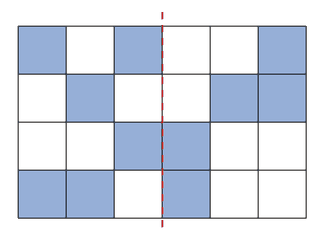
He will not change the left half. To make the pattern symmetrical, he must change the right half by
- 211 mark
Question 21
Competency: Understanding & Application
A triangular signboard has three lines of symmetry. The perimeter of the signboard is 27 m.
The length of one side of the signboard is
- 221 mark
Question 22
Competency: Analysis
A dot P is marked 5 cm away from a straight line AB. The line is then slid 2 cm towards P, staying parallel to its first position, and the new line is called CD. The mirror image of P in CD (its symmetric point) is the dot Q.
The distance between P and Q is
- 231 mark
Question 23
Competency: Application
On squared paper, the dotted line runs from the bottom-left corner O of the grid to the top-right corner. The point P is 1 square from the left edge and 4 squares above the bottom edge.
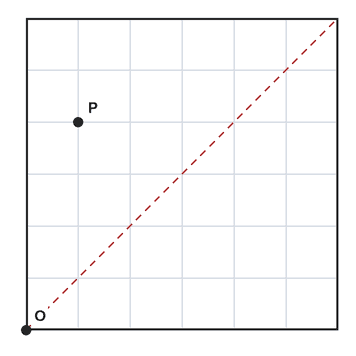
The point symmetric to P with respect to the dotted line is
- 241 mark
Question 24
Competency: Understanding
A rectangular flag, which is not a square, has a circular disc on it. The centre of the disc lies on the horizontal line through the middle of the flag, but it is nearer to the left edge.
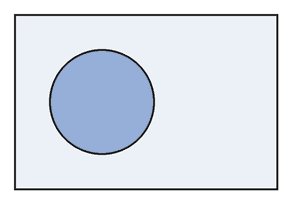
How many lines of symmetry does the flag (with its disc) have?
- 251 mark
Question 25
Competency: Evaluation
Assertion (A): For two given dots X and Y, there can be more than one line with respect to which Y is the symmetric point of X.
Reason (R): Y is the symmetric point of X with respect to a line only when that line cuts the segment XY in half at right angles.
- 262 marks
Question 26
Competency: Application
Sheela has a rectangular card 12 cm long and 8 cm wide. She cuts the card along a line of symmetry into two pieces.
(a) Along which lines can she cut?
(b) Write the length and the breadth of each piece in each case.
- 272 marks
Question 27
Competency: Evaluation
Tanu wants to find the point symmetric to a point P with respect to a line AB. She draws a slanting line from P that meets AB at O and makes an angle of with AB. She extends it beyond AB and marks Q so that . She says, "Q is the symmetric point of P."
Is Tanu right? Give a reason, and say how she should correct her construction.
- 282 marks
Question 28
Competency: Understanding & Analysis
The word AMBULANCE is painted in mirror writing on the front of an ambulance, so that a driver ahead can read it correctly in the rear-view mirror. In a mirror image, a letter that has a vertical line of symmetry looks unchanged.
(a) Which letters of the word AMBULANCE look unchanged in the mirror?
(b) Using lines of symmetry, explain why the letter B does not look unchanged.
- 292 marks
Question 29
Competency: Application
A square sheet of paper ABCD is folded so that the corner A falls exactly on the opposite corner C.
(a) Which line of the sheet is the crease?
(b) At what angle does the crease cut AC? Give a reason using symmetry.
- 302 marks
Question 30
Competency: Evaluation
Two points P and Q are 10 cm apart. Rahul says, "The line of symmetry for P and Q can pass through the point P."
Is Rahul right? Give a reason, and find the distance of P from the line of symmetry, measured along PQ.
- 312 marks
Question 31
Competency: Application
ABCD is a square tile of side 8 cm, with A at the bottom left, B at the bottom right and D at the top left. A dot P on the tile is 2 cm from the side AD and 3 cm from the side AB. Q is the dot that is symmetric to P about the vertical line through the middle of the tile.
Find the distance of Q from the side AD and from the side AB.
- 323 marks
Question 32
Competency: Analysis
On squared paper, Dev draws a triangle PQR. He then draws its mirror image PQR in a straight mirror line, and later he rubs the mirror line out. He writes the position of each corner as the number of squares from the left edge and the number of squares above the bottom edge.
Corner P Q R P Q R Squares from the left edge 2 4 2 10 8 10 Squares above the bottom edge 1 1 4 1 1 4 (a) P and P are symmetric points with respect to the mirror line. Find where the mirror line was, and say whether it was vertical or horizontal.
(b) Check your mirror line with the pairs Q, Q and R, R.
(c) Dev's friend says the mirror line was 7 squares from the left edge, because 7 is halfway between Q (4 squares) and P (10 squares). Is he right? Give a reason.
- 333 marks
Question 33
Competency: Analysis
A line is the line of symmetry of a figure. A straight line is perpendicular to and cuts at O. Two points A and B are marked on , on the same side of , with cm and cm. The points A and B are symmetric to A and B with respect to .
(a) Where do A and B lie?
(b) Find the lengths AA, BB, AB and BA.
(c) Which points have O as their mid-point? What is the line for the line segments AA and BB?
- 343 marks
Question 34
Competency: Analysis
A rectangular tile is 12 cm long and 6 cm wide. It is cut along a dotted line into two squares of side 6 cm.
(a) Is the line along which the tile is cut a line of symmetry of the rectangle? Give a reason.
(b) How many lines of symmetry does each square piece have?
(c) Is the number of lines of symmetry of the rectangle equal to the total number for the two squares? Find both numbers and give the reason for your answer.
- 353 marks
Question 35
Competency: Creativity
Use the capital letters of the English alphabet and what you know about their lines of symmetry.
(a) Write a word of at least three letters in which every letter has a vertical line of symmetry.
(b) Write a word of at least three letters in which every letter has a horizontal line of symmetry.
(c) Write a word of at least two letters in which every letter has both a vertical and a horizontal line of symmetry.
- 363 marks
Question 36
Competency: Application
In a triangle ABC, and . The line of symmetry of the triangle meets BC at M. (The three angles of a triangle add up to .)
(a) Find .
(b) Find .
(c) A point D is marked on the line AM. Compare the lengths DB and DC. Give a reason.
- 374 marks
Question 37
Competency: Analysis & Application
Case study — The paper plate
Anil has a circular paper plate of radius 10 cm. First, he folds the plate so that its two halves fit exactly on each other, and he makes a crease. The folded plate is a semicircle. Next, he folds the semicircle once more along its own line of symmetry. Then he opens the plate completely. Later, he takes a second plate and folds it along a line that is 4 cm from the centre of the plate, not passing through the centre.
(a) What is the first crease? How long is it?
(b) How many creases are there on the opened plate, and at what angle do they cross?
(c) For the second plate, will the two parts of the plate fit exactly on each other? Give a reason.
- 385 marks
Question 38
Competency: Analysis & Evaluation
Case study — Lines of symmetry of six shapes
Asha made paper cut-outs of six shapes and counted the lines of symmetry of each. She drew the bar graph below. The triangle is an equilateral triangle, and the pentagon and the hexagon are regular. The kite and the rectangle each have 4 sides. The rectangle is not a square.

(a) Read the number of lines of symmetry of each shape from the graph. Which shapes have fewer lines of symmetry than sides?
(b) What pattern do you see for the triangle, the square, the pentagon and the hexagon? Asha now wants to add a bar for a circular cut-out. Can she draw this bar on her graph? Give a reason.
(c) The kite, the rectangle and the square all have 4 sides, and each of them has at least one line of symmetry on the graph. Asha says, "So every 4-sided shape has at least one line of symmetry." Is she right? Give a reason, and name a 4-sided shape that supports your answer.
- 394 marks
Question 39
Competency: Analysis & Application
Case study — Testing by folding
Chitra cut out some shapes from card. She marked a dotted line on each shape, folded the shape along that line, and noted whether the two parts fitted exactly on each other. Her results are in the table. In the triangle, cm and cm. (Hypothetical data.)
Shape Dotted line Parts coincide? Rectangle, 8 cm by 5 cm Joins the mid-points of the two longer sides Yes Rectangle, 8 cm by 5 cm One diagonal No Triangle ABC Bisector of angle A Yes Triangle ABC From B to the mid-point of AC No Square Joins the mid-points of two opposite sides Yes Square One diagonal Yes (a) Which of the dotted lines in the table are lines of symmetry?
(b) The table shows two lines of symmetry of the square. How many lines of symmetry does the square have in all? Name them.
(c) Chitra now folds the rectangle along the line joining the mid-points of the two shorter sides. What will she find? How many lines of symmetry does the rectangle have?
- 405 marks
Question 40
Competency: Application & Analysis
Case study — Checking a construction
Kavya marks two points P and Q, 7 cm apart, and wants to construct the line of symmetry for P and Q. She puts the needle of her compass at P and draws a circle. Then, with the same compass opening, she puts the needle at Q and draws a second circle. She tries this with four different compass openings. (Hypothetical data.)
Try 1 2 3 4 Compass opening (cm) 3.0 3.5 4.5 6.0 Every point that is at the same distance from P and from Q lies on the line of symmetry for P and Q.
(a) A point where the two circles meet is at the same distance, the compass opening, from P and from Q. Going from P to such a point and then on to Q can never be shorter than the straight path PQ of 7 cm. For each try, say whether the two circles meet at two points, touch at one point, or do not meet at all.
(b) In try 4 the circles meet at X, above PQ, and at Y, below PQ. Write the lengths PX, QX, PY and QY. Kavya joins XY. Explain why XY is the line of symmetry for P and Q.
(c) In try 3 the circles meet above PQ at a point Z. Is Z the same point as X? Does Z lie on the line XY? Give reasons.