
Opening your dashboard
Class 6 Maths Chapter 12 Fundamental Concepts (Algebra): Competency-Based Questions (CBQ)
40 questions on Chapter 12, each worked through on its own page with the AI tutor. Class 6 Maths, ICSE 2026-27.
40 questions
1–5 marks · Mixed difficulty
- 11 mark
Question 1
Competency: Understanding
A ticket for the town bus costs ₹ 15, whatever the day. On a certain day, passengers travel by the bus, so the money collected is ₹ .
Which statement is correct?
- 21 mark
Question 2
Competency: Application
A stationery shop sells notebooks in packs. Each notebook has 80 pages, each pack has notebooks, and Ravi buys packs.
The total number of pages he buys is . In the term , the coefficient of is
- 31 mark
Question 3
Competency: Analysis
In a quiz, the clue card reads:
"I am a polynomial in . I have exactly three terms. My degree is 4. My constant term is 7."
Which polynomial fits all the clues?
- 41 mark
Question 4
Competency: Application
A mason fixes tiles on a wall. There are rows of tiles and each row has tiles.
The total number of tiles on the wall is
- 51 mark
Question 5
Competency: Evaluation
Assertion (A): Rice costs ₹ per kg and dal costs ₹ per kg. So the total cost of 3 kg of rice and 2 kg of dal is ₹ .
Reason (R): Unlike terms cannot be added together to give a single term.
- 61 mark
Question 6
Competency: Application
The rule for the sum of the first even natural numbers is .
In a school hall, the first row has 2 chairs, the second row has 4 chairs, the third row has 6 chairs, and so on. There are 12 rows.
How many chairs are there in the hall?
- 72 marks
Question 7
Competency: Application
Anu had ₹ in her piggy bank. She bought a story book for ₹ . Then her grandmother gave her ₹ .
Find, in terms of , the money Anu has now.
- 82 marks
Question 8
Competency: Evaluation
A water tank holds litres of water. In the morning, litres are used. Kabir finds the water left in the tank like this:
Find Kabir's mistake and write the correct answer.
- 92 marks
Question 9
Competency: Application & Analysis
A fruit seller notes down the crates he receives in a day. Each crate of mangoes holds mangoes and each crate of apples holds apples.
Lot Fruit Number of crates Morning Mango 5 Noon Apple 3 Evening Mango 2 (a) Write the total number of fruits received as an algebraic expression in its simplest form.
(b) Is your expression a monomial, a binomial or a trinomial? What is the coefficient of in it?
- 102 marks
Question 10
Competency: Application
The floor of a rectangular hall has an area of square metres. The breadth of the hall is metres.
Find the length of the hall. Check your answer by multiplication.
- 113 marks
Question 11
Competency: Analysis & Evaluation
A farmer can buy one of two plots. Both plots need the same length of fencing.
Plot P: a square with each side metres.
Plot Q: a rectangle metres long and metres wide.
He wants the plot with the larger area. Find the area of each plot. Which plot should he choose, and by how much is it larger? Does the answer depend on the value of ?
- 123 marks
Question 12
Competency: Understanding & Creativity
Riddhi has seven cards. Each card has one term on it.
(a) Choose two cards that together form a binomial of degree 2.
(b) Choose two cards whose sum is a monomial. Write the sum.
(c) Make one new card of your own. Your card, together with the cards and , must form a trinomial in of degree 3. Write the trinomial in descending powers of .
- 133 marks
Question 13
Competency: Analysis
On a calendar page, Sara draws a box around four dates, two in one week and the two just below them. One such box is shown.
9 10 16 17 She wants a rule that works for every such box. Let the date at the top left of a box be .
(a) Write the other three dates in terms of . Find the sum of all four dates in its simplest form.
(b) Show that the two dates on one diagonal and the two dates on the other diagonal always have the same sum.
(c) Is the sum of the four dates always a multiple of 4? Give a reason.
- 144 marks
Question 14
Competency: Application & Analysis
Case study — Waste-paper drive
Three school houses collect waste paper for recycling. Old newspapers are tied in bundles of kg each. Old notebooks are packed in cartons of kg each. The table shows the mass of paper each house collected.
House Week 1 (kg) Week 2 (kg) Red Blue Green (a) Find the total mass collected by Red House in the two weeks.
(b) Find the total mass collected by all three houses in Week 1, and the total in Week 2.
(c) Subtract the Week 2 total from the Week 1 total. One bundle has the same mass as two cartons, that is, and are equal. What does your answer tell about the two weeks?
- 155 marks
Question 15
Competency: Analysis & Evaluation
Case study — Painting a classroom wall
The figure shows a classroom wall. The wall is metres long and metres high. It has a square window of side metres, and a door that is metres wide and metres high. The window and the door are not to be painted.
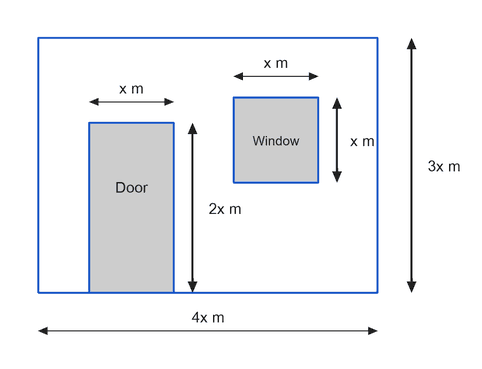
(a) Find the area of the whole wall.
(b) Find the total area of the window and the door. Hence find the area to be painted.
(c) One tin of paint covers square metres. How many tins are needed? Dev says, "Exactly three-fourths of the wall gets painted, whatever the value of ." Is Dev right? Justify.
- 161 mark
Question 16
Competency: Analysis
The maths club makes square paper frames. The perimeter (in cm) of a frame depends on the length (in cm) of its side. The club records three frames.
Side (cm) 2 5 7 Perimeter (cm) 8 20 28 Which rule for in terms of fits all three readings?
- 171 mark
Question 17
Competency: Understanding
In algebra, a quantity whose value is the same in every situation is called a constant, and a quantity whose value can change from one situation to another is called a variable.
Which of the following quantities is a constant?
- 181 mark
Question 18
Competency: Analysis
Mr Das writes four expressions on the board and asks, "Which of these becomes a monomial when it is simplified?"
Which expression should the students choose?
- 191 mark
Question 19
Competency: Evaluation
Meena makes a table to practise coefficients. Her teacher says that exactly one of her answers is wrong.
Row Term Coefficient of Meena's answer 1 2 3 4 In which row is Meena's answer wrong?
- 201 mark
Question 20
Competency: Analysis
Assertion (A): The degree of the polynomial is 4.
Reason (R): The degree of a polynomial in more than one literal is the greatest sum of the powers of the literals in any one term.
- 211 mark
Question 21
Competency: Understanding
Assertion (A): .
Reason (R): To divide a monomial by a monomial, we divide the numeral coefficients, cancel the literals common to both, and give the quotient a minus sign if exactly one of the two monomials is negative.
- 221 mark
Question 22
Competency: Application
A school has two rectangular play areas. The junior play area is square metres and the senior play area is square metres.
How many square metres more is the junior play area than the senior play area?
- 231 mark
Question 23
Competency: Application
A school buys boxes of chalk. Each box holds sticks of chalk.
How many sticks of chalk does the school buy in all?
- 241 mark
Question 24
Competency: Analysis
Meena writes four expressions on cards. Here stands for any natural number
She wants the card that gives an odd number for every natural number .
Which card should she choose?
- 251 mark
Question 25
Competency: Application
A rectangular lawn is divided into a square flower bed and a rectangular vegetable plot, as shown in the figure. The flower bed has side metres. The vegetable plot is 4 metres wide and metres high.
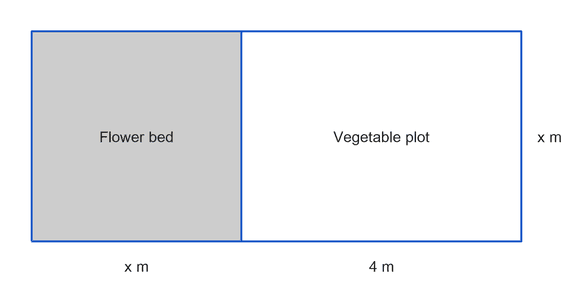
Which expression gives the area of the whole lawn, in square metres?
- 262 marks
Question 26
Competency: Application
Ila is years old. Her brother is 3 years older than Ila. Her father is 4 times as old as her brother.
(a) Write the brother's age and the father's age in terms of .
(b) Write the sum of the ages of all three in its simplest form.
- 272 marks
Question 27
Competency: Understanding
A student writes a line in her notebook:
(a) Write this line in words, using the meaning of each symbol.
(b) Using symbols, write: "Because is greater than , is not equal to ."
- 282 marks
Question 28
Competency: Analysis
Sonal and Tara each think of a number .
Sonal says: "Add 4 to , then multiply the result by 3."
Tara says: "Multiply by 3, then add 4."
(a) Write each girl's result as an algebraic expression in its simplest form.
(b) Find both results for . Are the two expressions the same?
- 292 marks
Question 29
Competency: Evaluation
Meera adds the polynomials and . She says, "Each polynomial has degree 3, so their sum also has degree 3."
Is Meera right? Find the sum and write its degree.
- 302 marks
Question 30
Competency: Application
A decorator has a ribbon cm long. He cuts it into equal pieces, each cm long.
(a) Find the number of pieces, in terms of .
(b) For , find the length of the ribbon and the length of one piece in cm, and use them to check your answer to (a).
- 312 marks
Question 31
Competency: Analysis
A packing carton is cm long, cm wide and cm high. (Volume of a carton = length breadth height.)
(a) Find the volume of the carton.
(b) A bigger carton has each of the three measurements doubled. Find its volume, and say how many times the volume of the first carton it is.
- 323 marks
Question 32
Competency: Analysis
Every even number is 2 multiplied by a natural number. Take three consecutive even numbers whose smallest is , where is a natural number.
(a) Write the other two even numbers in terms of .
(b) Find the sum of the three numbers in its simplest form.
(c) Show that this sum is always a multiple of 6. Use your result to find without adding the numbers one by one.
- 333 marks
Question 33
Competency: Evaluation
Two shops sell the same kind of pen. (Hypothetical data.)
Shop A: ₹ 5 for each pen, plus ₹ 10 for packing the whole order.
Shop B: ₹ 6 for each pen, with no packing charge.
Aman wants to buy pens.
(a) Write an expression for the amount he pays in each shop.
(b) Find the amount in each shop for , and .
(c) Which shop should Aman choose to buy 5 pens, and which to buy 15 pens? What do you notice for 10 pens?
- 343 marks
Question 34
Competency: Creativity
The expression is a binomial.
(a) Make up a short real-life situation (shopping, travel, school or sport) in which is the total amount of something. Say clearly what stands for.
(b) In your situation, what do and 20 stand for? Which of the two terms is the constant term?
(c) Find the value of the expression in your situation when .
- 353 marks
Question 35
Competency: Analysis
Ravi plays a number trick. He says, "Think of any number . Add 5. Multiply the result by 3. Subtract 9. Divide the result by 3. Now subtract the number you first thought of. I can tell you your answer."
(a) Write the result after each of the first four steps as an expression in .
(b) Find the final answer.
(c) Does the final answer depend on the number thought of? Try .
- 363 marks
Question 36
Competency: Application & Analysis
Neel finds in his head. He writes and .
(a) Multiply by and simplify.
(b) Use your answer with and to find .
(c) Use the same method to find .
- 375 marks
Question 37
Competency: Application & Analysis
Case study — Tiling a school terrace
The figure shows the floor plan of an L-shaped terrace of a school. All corners are right angles, and the lengths marked are in metres.

(a) Find the lengths of the two sides that are not marked.
(b) Find the perimeter of the terrace.
(c) Find the area of the terrace in two ways: by splitting it into two rectangles, and by taking the notch away from a big rectangle. Square tiles of side metres are laid on the terrace. How many tiles are needed?
- 384 marks
Question 38
Competency: Analysis
Case study — Lockers in the school corridor
The lockers in a corridor are numbered in pairs. In each pair, the left locker has an odd number and the right locker has the next even number. The table shows the first four pairs.
Pair number 1 2 3 4 Left locker 1 3 5 7 Right locker 2 4 6 8 (a) For the th pair, write the number of the left locker and the number of the right locker in terms of .
(b) Show that the sum of the two locker numbers in a pair is , and find this sum for the 12th pair.
(c) There are 10 pairs of lockers. Using the rules for the sum of the first odd numbers and the first even numbers, find the sum of all 20 locker numbers.
- 394 marks
Question 39
Competency: Analysis
Case study — A magic square puzzle
In a magic square, every row, every column and both diagonals have the same sum. The maths club has filled most of a magic square, where stands for any natural number greater than 4. Two cells, marked A and B, are still empty.
A B (a) Find the sum of the middle row. This is the sum of every row, column and diagonal.
(b) Find the expression that goes in cell A.
(c) Find the expression that goes in cell B. Check your answer by finding the sum of the bottom row.
- 405 marks
Question 40
Competency: Application & Evaluation
Case study — Sharing the prize money
Two schools win prize money in a quiz. Each school shares its prize money equally among its winning students. (Hypothetical data.)
School Prize money (₹) Number of winners Rose Valley Green Hill (a) Find the amount each winner of Rose Valley gets, in terms of .
(b) Check your answer to (a) by multiplication. Then find the amount each Rose Valley winner gets when .
(c) Find the amount each winner of Green Hill gets. Which school gives more money to each winner? Give a reason.