
Opening your dashboard
Class 6 Chemistry Chapter 6 Air and Atmosphere: Competency-Based Questions (CBQ)
40 questions on Chapter 6, each worked through on its own page with the AI tutor. Class 6 Chemistry, ICSE 2026-27.
40 questions
1–5 marks · Mixed difficulty
- 11 mark
Question 1
Cognitive domain: Application
Anu takes a plastic syringe that has no needle. She pulls the plunger back. Then she presses her thumb tightly over the nozzle and pushes the plunger in. The plunger moves in a little way and then will not go any further. When she lets go, the plunger springs back.
Which statement explains what Anu sees?
- 21 mark
Question 2
Cognitive domain: Analysis
A teacher lights three candles of the same kind. At the same moment she covers each candle with an upturned glass jar. The jars are of different sizes. The class notes how long each candle burns before it goes out.
Jar Size of the jar Time for which the candle burned P 250 mL 6 seconds Q 500 mL 12 seconds R 1000 mL 24 seconds Which conclusion fits these results best?
- 31 mark
Question 3
Cognitive domain: Understanding
After a night of very heavy rain, Devika sees many earthworms lying on the garden path. On dry days the earthworms stay inside the soil.
Why do the earthworms come out of the soil after heavy rain?
- 41 mark
Question 4
Cognitive domain: Application
A news report from a far-away country says: "More ultraviolet rays of the sun are now reaching the ground here. Doctors are seeing more cases of skin disease."
Which change in the atmosphere explains this report best?
- 51 mark
Question 5
Cognitive domain: Understanding
Assertion (A): The amount of oxygen in the air stays almost the same, although living beings and fires use up oxygen all the time.
Reason (R): Green plants give out oxygen during photosynthesis.
- 61 mark
Question 6
Cognitive domain: Analysis
Assertion (A): In the same town, the air on a rainy day in July and the air on a dry day in December have exactly the same composition.
Reason (R): The amount of water vapour in the air changes from place to place and from time to time.
- 71 mark
Question 7
Cognitive domain: Understanding
An ice-cream seller keeps his ice-cream frozen with blocks of a very cold white solid called dry ice.
Complete the sentences about dry ice.
Dry ice is solid ________. The same gas is used in fire ________, because it does not support burning. Green plants use this gas to prepare their food in a process called ________.
- 81 mark
Question 8
Cognitive domain: Application
Before the Dussehra holidays, Sara leaves a beaker of clear, freshly made lime water uncovered on the laboratory table. When she comes back, she finds a thin white crust floating on top of the lime water.
Name the gas in the air that reacted with the lime water to form this white solid.
- 91 mark
Question 9
Cognitive domain: Understanding
Ritu drops a dry piece of brick into a glass of water and watches it closely.
Predict what she will see coming out of the brick in the first few seconds. What does this tell her about the dry brick?
- 102 marks
Question 10
Cognitive domain: Evaluation
Javed's cycle stood in the open all through the monsoon. Its iron chain is now covered with a reddish-brown powdery coating. Javed says, "Rain water alone did this. Air has nothing to do with it. From now on I will keep the cycle in the shed, so I will never need to oil the chain."
(a) Name the reddish-brown coating. Is Javed right that air has nothing to do with it? Explain.
(b) Will keeping the cycle in the shed be enough in the monsoon? What else should Javed do, and how will it help?
- 112 marks
Question 11
Cognitive domain: Analysis
Meenal's teacher sets up two jars in exactly the same way. Each jar has pond water and a few cuttings of a water plant, covered by an upturned funnel. A test tube full of water stands upside down over the stem of each funnel. Jar 1 is kept in sunlight. Jar 2 is kept in a dark cupboard. The table shows what the class sees after three hours.
Jar Kept in Bubbles rising from the plant Gas collected in the test tube 1 Sunlight Many About half a test tube 2 Dark cupboard None None (a) Name the gas collected in Jar 1 and the process that produced it. How can the teacher test this gas?
(b) The plant in Jar 2 is also alive. Explain why no gas is collected in Jar 2.
- 122 marks
Question 12
Cognitive domain: Evaluation
The council of a small town plans to cut down the 200 old trees along its main road. This will make the road wide enough for many more cars and trucks. A council member says, "A wider road will give our town cleaner air."
Do you agree with the council member? Give two reasons based on the causes of air pollution.
- 134 marks
Question 13
Cognitive domain: Application
Sunrise School stands next to a bus depot. The students often cough during the morning assembly. The Eco Club wanted to find out what is in the air they breathe. They hung clean white cloths at three places and left them there for one week. The table shows what they found.
Place What is nearby The cloth after one week Depot gate Diesel buses start their engines here Black and greasy with soot Road-repair site Digging and stone cutting Brown with dust School garden Trees and grass Almost white The next year the depot changed all its buses from diesel to CNG. The club did the test again. This time the cloth at the depot gate stayed almost white.
(a) Name the pollutant that the cloth caught at the depot gate, and the pollutant it caught at the road-repair site. Say where each pollutant came from.
(b) Why did the cloth at the depot gate stay almost white after the buses changed to CNG? Name one more modern fuel that burns in the same clean way.
(c) Rahul says, "The cloth at the gate is white now, so the air there is perfectly clean." Is he right? Explain, and name two harmful gases that a cloth cannot show.
- 144 marks
Question 14
Cognitive domain: Application
Nikhil keeps four goldfish in a glass bowl. In May the bowl stood near a sunny window, and the water in it became warm. Nikhil saw tiny bubbles sticking to the inside of the glass. By evening the fish were swimming at the top and gulping at the surface of the water. His grandfather moved the bowl to a cool, bright place away from the hot sun. He put in a few green water plants. He also fitted a small pump that sends a stream of air bubbles through the water. By the next day the fish were swimming normally again.
(a) What were the tiny bubbles on the inside of the glass? Where did they come from?
(b) Explain why the fish started gulping at the surface after the water became warm.
(c) Explain how the water plants and the pump each help the fish. Which of these two helps only during the day? Give a reason.
- 155 marks
Question 15
Cognitive domain: Creativity
Rice and dal are boiling on the stove in Isha's kitchen. Isha thinks that the air in the kitchen now has more water vapour than the air in her bedroom. She wants to check her idea with a simple test. She has two steel tumblers of the same size, ice cubes, water, a dry cloth and a watch.
(a) Design the test. Write the steps Isha should follow.
(b) State two things she must keep the same in both rooms so that the test is fair.
(c) What result will show that her idea is right? Explain where the water drops on the outside of a tumbler come from.
(d) Her brother says, "Those drops are just water leaking out through the tumbler." Suggest one way in which Isha can show him that he is wrong.
- 161 mark
Question 16
Cognitive domain: Analysis
The atmosphere is the layer of air around the earth. To find out what it does, a science club compares two places, P and Q. Both places are the same distance from the sun and get the same amount of sunlight. Place P has a layer of air around it, like the earth. Place Q has no air around it at all. The table shows the temperature of each place at noon and at midnight. (Hypothetical data.)
Place Temperature at noon Temperature at midnight P 34 °C 24 °C Q 120 °C −130 °C Which conclusion fits the table best?
- 171 mark
Question 17
Cognitive domain: Application
Rohan wants to find out whether air has mass. He weighs a football that is soft because it has only a little air in it. Then he fills the football with more air using a hand pump until it is hard, shuts the valve and weighs it again on the same balance. He adds nothing else to the ball. (Hypothetical data.)
Football Mass shown by the balance Soft, with little air 400 g Hard, filled with more air 406 g Which statement explains the result?
- 181 mark
Question 18
Cognitive domain: Understanding
Assertion (A): Burning dry leaves and rubbish in an open plot is a good way to keep the air of a colony clean.
Reason (R): Burning leaves and rubbish gives out smoke and carbon dioxide into the air.
- 191 mark
Question 19
Cognitive domain: Understanding
Assertion (A): Carbon dioxide is called a greenhouse gas.
Reason (R): Carbon dioxide does not support burning, so it is used in fire extinguishers.
- 201 mark
Question 20
Cognitive domain: Analysis
Four test tubes are set up with clean iron nails. The class looks at the nails after one week.
Tube What is in the test tube 1 A nail in dry air. A drying agent that soaks up moisture is kept in the tube, and the tube is tightly corked. 2 A nail in boiled and cooled water, with a layer of oil floating on top of the water. 3 A nail with its lower half in tap water, in a tube that is open to the air. 4 A nail coated all over with grease, kept in moist air. In which tube or tubes will the nail get covered with rust?
- 211 mark
Question 21
Cognitive domain: Understanding
The pie chart shows the three groups of gases in dry air near the ground, drawn to scale. The sectors are marked P, Q and R, but the amounts are not written on them.

Which statement is correct?
- 221 mark
Question 22
Cognitive domain: Application
Ria lights a candle on a plate. She holds a clean, dry glass tumbler upside down, about 5 cm above the flame, for a few seconds. Fine droplets of water appear on the inside of the tumbler. When she holds a second dry tumbler in the same way over an empty plate, with no candle, it stays clear.
Then she covers the burning candle with a jar and waits until the flame goes out. She takes out the candle, pours a little clear lime water into the jar and shakes it. The lime water turns milky.
Which statement about the burning of the candle is correct?
- 231 mark
Question 23
Cognitive domain: Analysis
Two neighbouring fields, A and B, have the same soil and get the same water and sunlight. Last year, field A was sown with gram (chana) and field B was sown with wheat. This year both fields are sown with wheat, and the farmers use no fertiliser in either field. (Hypothetical data.)
Field Crop grown last year Wheat harvested this year (quintal per hectare) A Gram 28 B Wheat 21 Which explanation fits the results best?
- 241 mark
Question 24
Cognitive domain: Evaluation
The bar chart shows where the air pollution of a big city comes from, as a share of all the pollution. (Hypothetical data.)
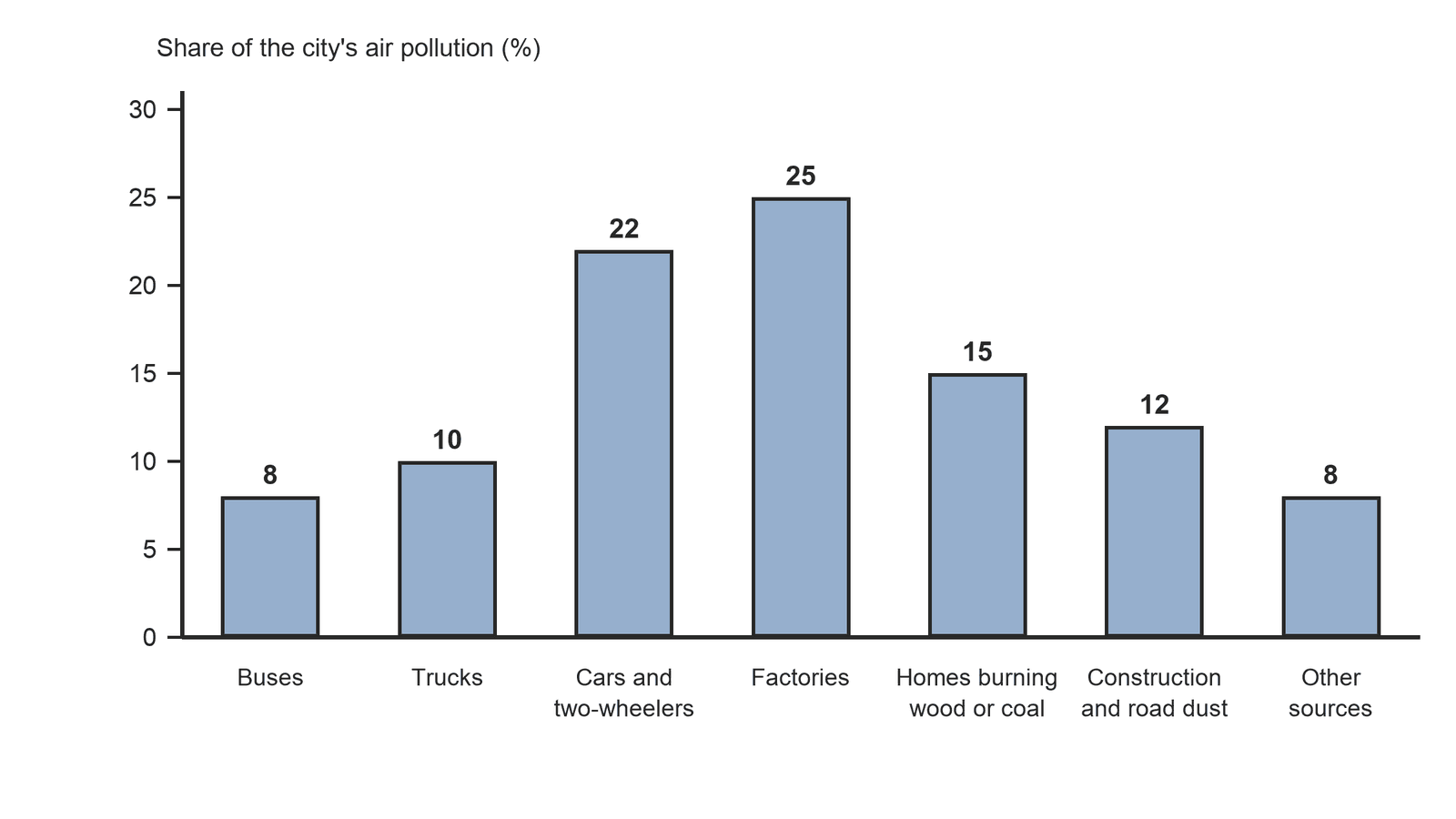
The city council can carry out only one of the four actions below. Each action would remove all the pollution that comes from the sources it covers. Which action will cut the pollution of the city's air the most?
- 251 mark
Question 25
Cognitive domain: Analysis
A teacher has three gas jars, P, Q and R. They hold oxygen, carbon dioxide and nitrogen, one gas in each jar, but the labels have fallen off. These three gases are all present in air, and each of them keeps its own properties even when it is mixed with the others in air. The class tests the jars and notes down what happens.
Jar What the class sees P A glowing splinter pushed into the jar bursts into flame. Q A burning splinter goes out. Clear lime water shaken with the gas turns milky. R A burning splinter goes out. Clear lime water shaken with the gas does not change. Which choice names the gases in the jars correctly?
- 262 marks
Question 26
Cognitive domain: Evaluation
In a class debate on global warming, Tanvi says, "Carbon dioxide is only a harmful gas. We should remove every bit of it from the air."
Do you agree with Tanvi? Give two reasons from what you have studied.
- 272 marks
Question 27
Cognitive domain: Application
Two astronauts are walking on the moon. The moon has no air around it. One astronaut shouts to the other, who is standing only 2 m away, but the second astronaut hears nothing. They can talk to each other only through radios fitted inside their helmets.
(a) Why does the shout not reach the second astronaut?
(b) Name one gas, which we get from the air on the earth, that the astronauts must carry in their suits. Give the reason.
- 282 marks
Question 28
Cognitive domain: Application
A school keeps two gas cylinders. A cylinder of oxygen stands beside the bed in the sick room. A cylinder of carbon dioxide is fixed in the science laboratory as a fire extinguisher. By mistake, the two cylinders are exchanged.
(a) A small fire starts in the laboratory, and gas from the cylinder that holds oxygen is sprayed on it. What will happen to the fire? Give the reason.
(b) A student who feels breathless is given gas from the cylinder that holds carbon dioxide. Will it help the student? Give the reason.
- 292 marks
Question 29
Cognitive domain: Application
Seema cuts two identical squares of cloth, each 30 cm × 30 cm. She ties four strings to the corners of the first square and fixes a small stone to the strings, so that it opens out like a parachute. She crumples the second square into a ball and ties it to an identical stone. She drops each one from a height of 2 m and notes the time to reach the ground. (Hypothetical data.)
Cloth Time to reach the ground Opened out, like a parachute 1.8 s Crumpled into a ball 0.7 s (a) Which cloth falls more slowly?
(b) Use the idea that air occupies space to explain why.
- 302 marks
Question 30
Cognitive domain: Application
Ravi is a traffic constable. He stands at a busy road junction for eight hours every day. For the last few weeks he has been coughing often and his eyes burn.
(a) Name two pollutants that the vehicles at the junction put into the air that Ravi breathes.
(b) Suggest one step the city can take so that the vehicles at the junction give out fewer pollutants.
- 312 marks
Question 31
Cognitive domain: Application
On a breezy afternoon, Mohan sprays an insecticide on his cotton crop with a hand sprayer. The spray drifts over to the next field, where the people working there cough and feel dizzy.
(a) Which cause of air pollution does this show?
(b) Suggest two things Mohan can do to protect other people when he sprays.
- 323 marks
Question 32
Cognitive domain: Analysis
Meena fills a glass right up to the brim with water and places a stiff card over its mouth. Holding the card with her palm, she turns the glass upside down and then takes her palm away. The card stays in place and the water does not fall out. She repeats the activity with a second glass that has a small hole in its base. She keeps a finger pressed on the hole while she fills the glass to the brim, turns it upside down and takes her palm away, and the card stays in place. The figure shows both glasses at this moment.
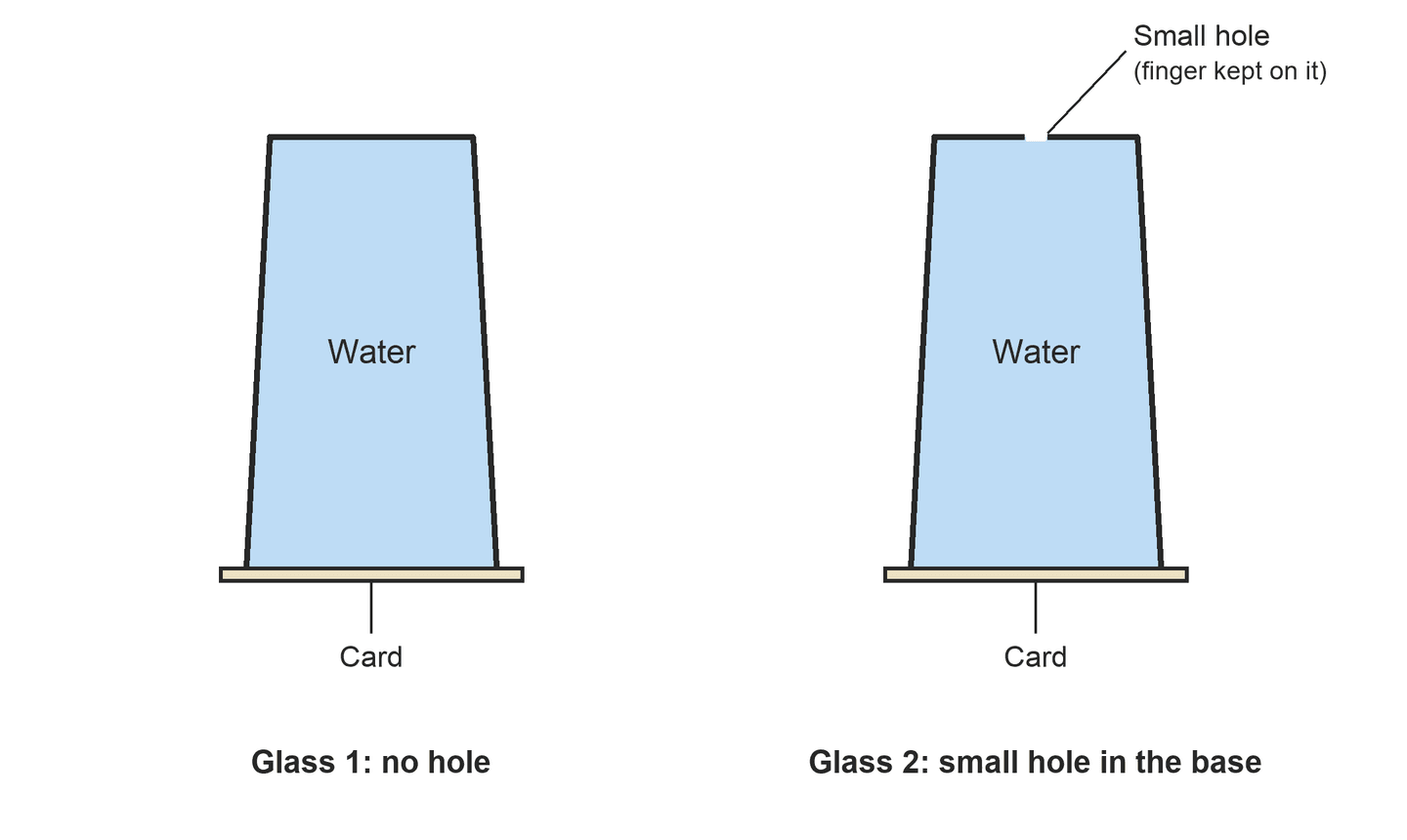
(a) Why does the card stay in place under the full glass?
(b) In which direction must the air push on the card to hold it up? What does this tell you about the pressure of air?
(c) Predict what happens to the card and the water of the second glass when Meena lifts her finger off the hole. Explain why.
- 333 marks
Question 33
Cognitive domain: Creativity
Aman sets up this experiment. A conical flask holds some water and a few germinating gram seeds. A bent tube from the cork of the flask dips into a test tube of clear lime water, and the flask is made airtight with vaseline. After a few hours the lime water turns milky. Meera says, "The lime water may have turned milky because of the water or the air in the flask. The seeds may have nothing to do with it."
(a) Design a second flask, called the control, so that Aman can test Meera's idea. Say what it must contain and what must be kept the same as in the first flask.
(b) What will you see in the lime water of the control flask?
(c) What do the results of the two flasks together show about germinating seeds?
- 343 marks
Question 34
Cognitive domain: Analysis
A market gardener has three tomato beds of the same size, with the same soil, water and care. The beds lie at different distances from a coal-burning power plant. At the end of the season he weighs the tomatoes from each bed. (Hypothetical data.)
Bed Distance from the power plant Tomatoes harvested P 0.2 km 11 kg Q 1 km 19 kg R 3 km 26 kg (a) What pattern do you see in the table?
(b) Name two pollutants that a coal-burning power plant puts into the air. Say how one of them can damage the plants.
(c) How many kilograms less does the gardener get from bed P than from bed R? What does this show about the effect of air pollution on farmers?
- 353 marks
Question 35
Cognitive domain: Evaluation
Two towns have the same number of people. Assume that the air of each town does not mix with the air of other places. The table shows how much carbon dioxide is added to the air of each town in a year by the burning of fuels and by respiration, and how much is taken out of the air by the green plants of the town in a year. (Hypothetical data.)
Town Carbon dioxide added in a year Carbon dioxide taken in by plants in a year Greenvale 80 thousand tonnes 85 thousand tonnes Steelpur 140 thousand tonnes 55 thousand tonnes (a) Find, for each town, whether the carbon dioxide in its air goes up or down in the year, and by how much.
(b) Which town's air is going out of balance? Name the process that restores the balance and explain why it cannot do so in that town.
(c) Suggest one step Steelpur can take.
- 363 marks
Question 36
Cognitive domain: Analysis
The table shows facts about a town, taken ten years apart. (Hypothetical data.)
Fact Ten years ago Now People living in the town 5.0 lakh 6.5 lakh Vehicles on the road 1.2 lakh 2.1 lakh Trees in the town 60,000 42,000 Factories next to homes 12 19 (a) By how many did the vehicles increase and by how many did the trees decrease?
(b) Match each of the four changes with a cause of air pollution.
(c) Show with numbers that the vehicles increased by a bigger fraction than the number of people.
- 374 marks
Question 37
Cognitive domain: Application
Savita notices that wet clothes dry quickly on a windy day. She tests three identical wet handkerchiefs, each holding the same amount of water, in the same room. Handkerchief 1 is folded into a thick pad and left on a table. Handkerchief 2 is opened out and hung on a line. Handkerchief 3 is also opened out and hung on a line, but a table fan blows air over it. She notes the time each one takes to dry. (Hypothetical data.)
Handkerchief How it is kept Time to dry 1 Folded, on a table, no fan 300 min 2 Opened out, on a line, no fan 150 min 3 Opened out, on a line, fan on 60 min (a) Which two handkerchiefs show the effect of moving air? What do they show?
(b) Compare handkerchiefs 1 and 2. Why does opening out a wet cloth help it to dry faster?
(c) A farmer spreads wet harvested grain in a thin layer on a sheet in the open on a breezy day. Use Savita's results to explain why this dries the grain quickly. Also find how many times faster handkerchief 3 dried than handkerchief 2.
- 384 marks
Question 38
Cognitive domain: Analysis
Dr Kavita runs a small clinic in a town that has many factories and a busy highway. Each month she counts the patients who come to her with cough, breathing trouble or burning eyes. The bar chart shows her counts for one year. In the winter months the air of the town is hazy, because smoke and dust hang low over the town. (Hypothetical data.)
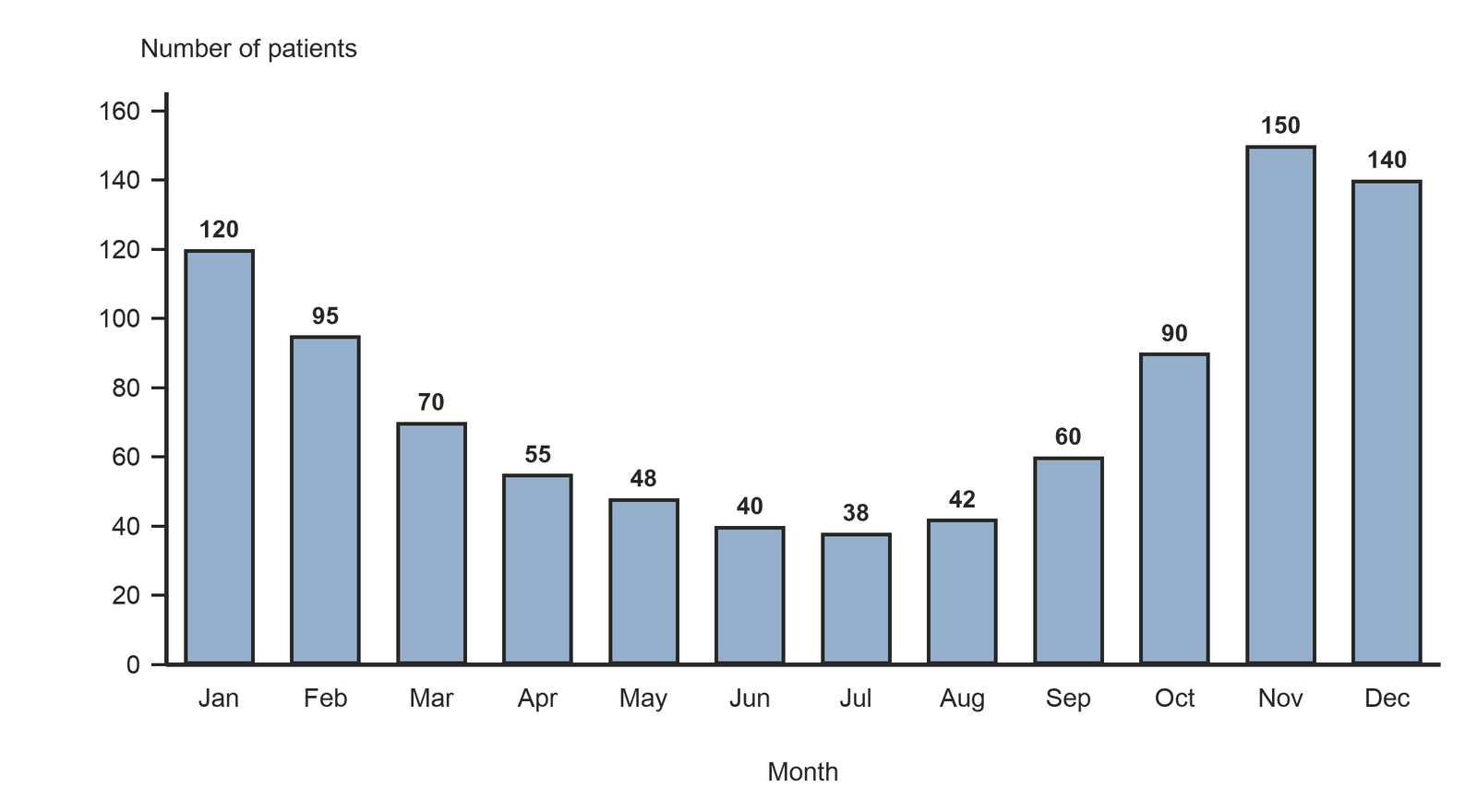
(a) In which month did the clinic see the most such patients? How many more patients came in that month than in July?
(b) Name two pollutants that can cause these illnesses and say where they come from in this town.
(c) Suggest two steps the town can take to reduce the number of such patients.
- 395 marks
Question 39
Cognitive domain: Creativity
The iron gate and the cycle stand of Anil's school stand in the open, and both have started to rust. Anil's teacher tells him that rusting can be prevented by painting, greasing or coating the iron with a non-corrosive metal. Anil wants to find out whether each of these three ways really works. He has some identical bright iron nails, a tin of paint, some grease, a few iron nails of the same size that already have a thin coating of zinc, four jars and some tap water.
(a) Plan the experiment. Say what goes into each of the four jars.
(b) State two things Anil must keep the same in all four jars.
(c) Predict what he will see in each jar after two weeks, and state the conclusion. Which of the three ways should the school use for its iron gate, and why is grease a poor choice for the gate?
- 404 marks
Question 40
Cognitive domain: Evaluation
A company puts up a board in a city. It says: "Our LPG autorickshaws are 100 % pollution-free! No smoke, no soot, no residue, and nothing at all goes into the air!" Nisha reads the board on her way to school. She knows that LPG is a modern-day fuel that does not leave any residue on burning. But she also remembers that a fuel burns by reacting with oxygen.
(a) Which parts of the claim on the board are correct and which part is not?
(b) Write the word equation for the burning of a fuel and use it to show what does go into the air.
(c) Name the gas from the equation that adds to global warming. Suggest one way in which the city can reduce the effect of this gas.