
Opening your dashboard
Class 6 Chemistry Chapter 4 Elements, Compounds, Symbols and Formulae: Competency-Based Questions (CBQ)
40 questions on Chapter 4, each worked through on its own page with the AI tutor. Class 6 Chemistry, ICSE 2026-27.
40 questions
1–5 marks · Mixed difficulty
- 11 mark
Question 1
Cognitive domain: Application
Asha's uncle is a goldsmith. First he hammers a small piece of gold into a very thin leaf. He uses the leaf to decorate a sweet box. Then he pulls another piece of gold through a tiny hole to get a long, fine wire for a chain. The gold does not break in either job.
Which properties of gold is he using?
- 21 mark
Question 2
Cognitive domain: Analysis
Riya's father works in a factory store. Three gas cylinders there have lost their names. Only this chart is left on the wall.
Cylinder Atoms in one molecule of the gas P 1 atom of nitrogen and 2 atoms of oxygen Q 2 atoms of nitrogen and 1 atom of oxygen R 2 atoms of nitrogen and nothing else Which conclusion is correct?
- 31 mark
Question 3
Cognitive domain: Understanding
Zoya reads the label on a bottle of mineral water. Under the heading "Minerals in this water" it lists four symbols: Ca, Mg, K and Na.
Which elements does the label show?
- 41 mark
Question 4
Cognitive domain: Application
Mr. Das fits glass in windows. He runs a small tool once across a sheet of glass. The tip of the tool scratches a clean line in the glass, and the sheet snaps neatly along that line. The tip is a tiny piece of a non-metal.
Which substance is the tip most likely to be, and why?
- 51 mark
Question 5
Cognitive domain: Understanding
Assertion (A): Water is used to put out a fire, although it is made of hydrogen, which burns, and oxygen, which helps things to burn.
Reason (R): The properties of a compound are different from the properties of the elements that make it.
- 61 mark
Question 6
Cognitive domain: Analysis
Assertion (A): A molecule of oxygen and a molecule of ozone are made of the same kind of atoms.
Reason (R): Oxygen and ozone have the same atomicity.
- 71 mark
Question 7
Cognitive domain: Understanding
Rekha's mother uses washing soda to clean very dirty clothes. The packet says: "Sodium carbonate, ".
Use the formula to complete the sentences.
Washing soda is made of ________ different elements. One molecule of it has ________ atoms of sodium. One molecule of it has ________ atoms in all.
- 81 mark
Question 8
Cognitive domain: Application
Two gas jars in a factory laboratory are labelled and . The gas in the jar marked is called sulphur dioxide.
Name the gas in the jar marked . How is one molecule of this gas different from one molecule of sulphur dioxide?
- 91 mark
Question 9
Cognitive domain: Understanding
Ravi puts an iron nail and a small piece of charcoal on a stone slab. Charcoal is a form of the element carbon. He hits each of them hard with a hammer.
Predict what will happen to the nail and to the charcoal. Give the reason.
- 102 marks
Question 10
Cognitive domain: Evaluation
A laboratory tested carbon dioxide gas from three different sources. Its report shows how much carbon and how much oxygen each sample contains.
Sample Where the carbon dioxide came from Mass of the sample Carbon in it Oxygen in it 1 Burning charcoal 11 g 3 g 8 g 2 A bottle of fizzy drink 22 g 6 g 16 g 3 Air that a person breathed out 44 g 12 g 32 g Aman says, "These samples come from three different places. So they must be three different compounds."
(a) Is Aman right? Use the numbers in the table to support your answer.
(b) How much carbon will there be in 33 g of carbon dioxide taken from any other source?
- 112 marks
Question 11
Cognitive domain: Application
Dev is writing formulae in his notebook. He uses these valencies (combining powers): sodium = 1, calcium = 2, oxygen = 2, sulphur = 2.
Compound Formula written by Dev Sodium oxide Calcium sulphide Both formulae are wrong.
(a) Write the correct formula of sodium oxide. Explain Dev's mistake.
(b) Write the correct formula of calcium sulphide. Explain Dev's mistake.
- 122 marks
Question 12
Cognitive domain: Evaluation
A shopkeeper sells two bottles of a clear, colourless liquid. He says, "Both bottles have pure water." Tanvi's elder sister tests them in her school laboratory. She heats a little liquid from each bottle and notes the temperature at which it boils.
Bottle Boiling point 1 100 °C 2 103 °C Is the shopkeeper right about both bottles? Give reasons for your answer.
- 134 marks
Question 13
Cognitive domain: Application
Kavita spends a Sunday in her uncle's metal workshop. In one corner he melts copper and tin together to make bronze for a statue. He tells her that he sometimes adds a little more tin to change how hard the bronze is. On a bench, a worker pulls copper into long, thin wires. Another worker beats aluminium into flat sheets to make kitchen vessels. In a locked glass case lie a few gold bangles. They were made ten years ago, yet they still shine like new.
(a) Is bronze an element, a compound or a mixture? Give one reason from the passage.
(b) Name the property of copper that lets it be pulled into wires. Name the property of aluminium that lets it be beaten into sheets. Which other property of aluminium makes it a good choice for cooking vessels?
(c) The statue will stand in an open park for many years. Why is bronze a better choice for it than copper alone? Explain also why the gold bangles still shine after ten years.
- 144 marks
Question 14
Cognitive domain: Analysis
Farah's mother is making caramel for a pudding. She heats white sugar in a steel pan. First the sugar melts. Then it turns brown. Farah forgets to switch off the stove. Steam rises from the pan, and at last only a black, bitter solid is left. Her teacher explains that the strong heat has broken the sugar down. The black solid is carbon, and the steam is water. Water itself is made of hydrogen and oxygen.
Substance What it is like Sugar White solid, sweet Carbon Black solid, not sweet Hydrogen Colourless gas that burns Oxygen Colourless gas that helps things to burn (a) Name the three elements present in sugar. Is sugar an element or a compound? Give a reason from the passage.
(b) Look at the table. Which characteristic of compounds does it show? Explain using sugar and carbon.
(c) Farah says, "I know an easier way to get the carbon out of sugar. I will dissolve the sugar in water and pour it through a filter paper." Will her method work? Explain. Why did strong heating work?
- 155 marks
Question 15
Cognitive domain: Creativity
Rohan wants to make models of molecules for the school science fair. He has clay balls of three colours: white for hydrogen atoms, red for oxygen atoms and black for carbon atoms. He also has a box of toothpicks to join the balls.
(a) Describe the model he should make for one molecule of water, , and for one molecule of carbon dioxide, . Say which balls he needs and how many.
(b) He wants three trays labelled , and . Describe what he should put on each tray, and say what each tray shows.
(c) After this, Rohan has only 6 white balls and 3 red balls left. What is the largest number of water molecules he can make with them? Write this number of water molecules using the formula.
(d) His friend Sameer joins 2 white balls and 2 red balls into one model. Sameer says, "This is also water, because it has hydrogen and oxygen." Is Sameer right? Explain.
- 161 mark
Question 16
Cognitive domain: Analysis
Aman is reading a chart in his geography book. It shows the five most abundant elements in the earth's crust, given as a percentage of the mass of the crust (rounded values).
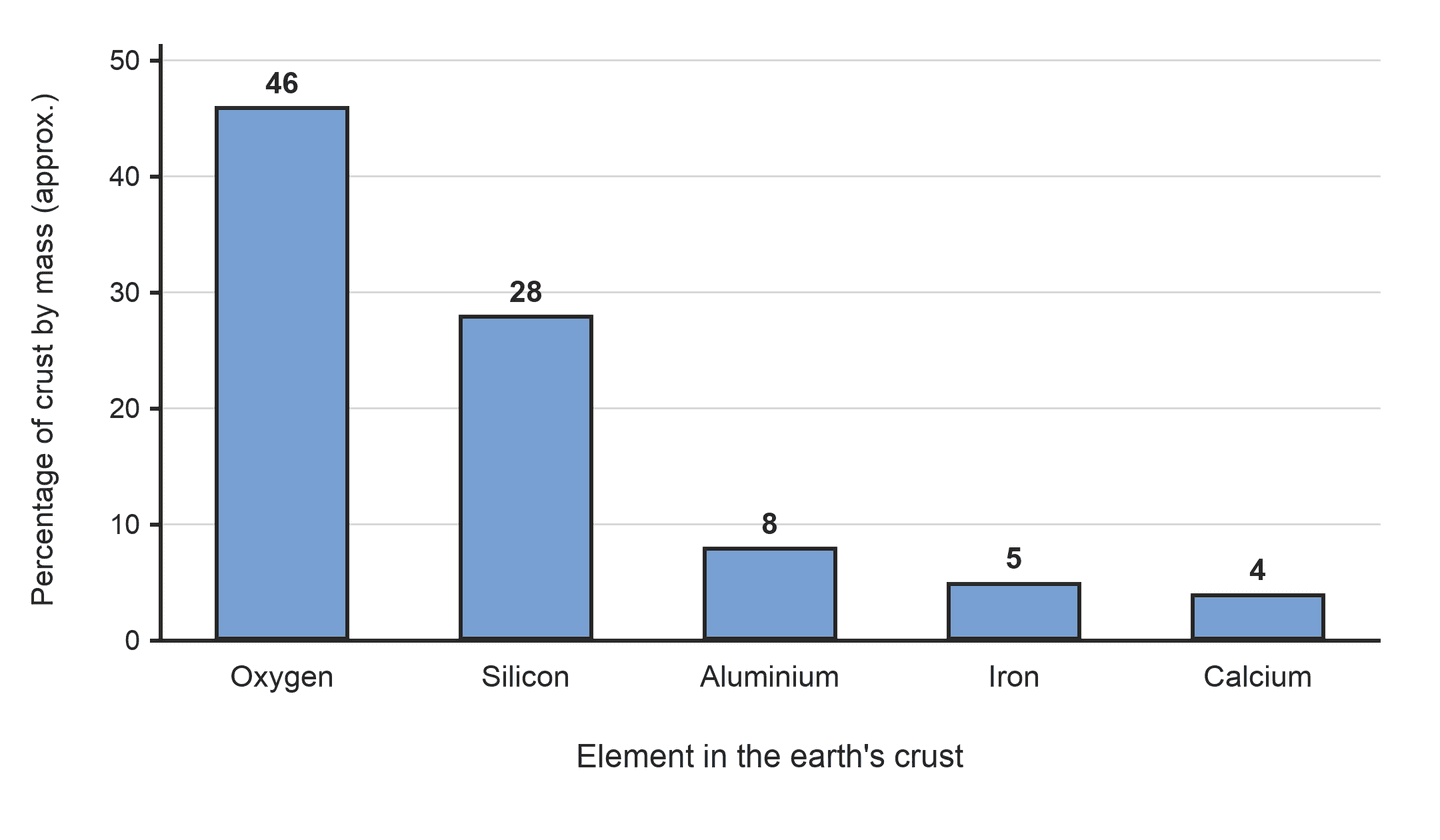
Which statement about the chart is correct?
- 171 mark
Question 17
Cognitive domain: Analysis
A pollution-control office has put up a poster about some gases that come out of vehicles and factories. It lists their formulae.
Gas Formula Sulphur dioxide Sulphur trioxide Nitrogen dioxide Nitric oxide Nitrous oxide Look at the number of atoms of the element named first and of the element named second in one molecule of each gas. Which pair of gases has the atoms of its two elements in the same ratio?
- 181 mark
Question 18
Cognitive domain: Application
Four trays in a school model kit hold loose molecules of some elements.
- Tray 1: 2 molecules of sulphur ()
- Tray 2: 5 molecules of ozone ()
- Tray 3: 7 molecules of hydrogen ()
- Tray 4: 12 molecules of helium ()
Which tray holds the largest number of atoms?
- 191 mark
Question 19
Cognitive domain: Analysis
Mr. Nair writes on the board: "Chalk and marble are made of the same compound, calcium carbonate. Its formula is ." He asks the class which of the following facts cannot be found out from the formula alone.
- 201 mark
Question 20
Cognitive domain: Understanding
Assertion (A): Water in the blood of animals carries dissolved food and other substances to all parts of the body.
Reason (R): Water is called a universal solvent.
- 211 mark
Question 21
Cognitive domain: Understanding
Assertion (A): Marble is a mixture of calcium, carbon and oxygen, because three elements are present in it.
Reason (R): In a compound the elements are joined in a fixed proportion by mass, but in a mixture they can be present in any proportion.
- 221 mark
Question 22
Cognitive domain: Application
In a quiz, Zoya is told about an element X that is not in her table. X combines with chlorine, which has valency 1, to form a compound with the formula . The valency of oxygen is 2. She has to write the formula of the compound formed by X and oxygen. (Hypothetical data.)
Which formula is correct?
- 231 mark
Question 23
Cognitive domain: Evaluation
In the school laboratory, Neel looks at a thermometer with a shiny silvery liquid inside it. He says, "A metal is always a hard solid, so this silvery liquid cannot be a metal."
Which reply to Neel is correct?
- 241 mark
Question 24
Cognitive domain: Application
Ramesh visits a small glass-bangle workshop. The owner shows him what he uses. Sand is melted to make the glass. A tool with a diamond tip cuts the glass. Copper wire carries current to the furnace, and iron tongs hold the hot glass.
Which of these materials is a compound?
- 251 mark
Question 25
Cognitive domain: Analysis
Meena is packing sweets for Diwali with her grandmother. She reads four labels on the kitchen shelf: "Iodised salt", "Pure cow ghee", "Silver varq (thin silver foil for sweets)" and "Rock sugar (misri)".
Which label names a substance that is an element?
- 262 marks
Question 26
Cognitive domain: Creativity
The science club plays a game called "Spell with symbols". A word is valid if all its letters can be split, in order, into the symbols of the first 20 elements: H, He, Li, Be, B, C, N, O, F, Ne, Na, Mg, Al, Si, P, S, Cl, Ar, K and Ca. For example, BONE is valid because it is B + O + Ne.
(a) Show that HOPS is valid and that HELP is not.
(b) Make a valid word of your own that uses at least three symbols. Write the name of each element you use.
- 272 marks
Question 27
Cognitive domain: Analysis
A mason's notebook lists three compounds that all contain calcium.
Compound Formula Calcium carbonate Calcium oxide Calcium hydroxide (a) Find the total number of atoms in one molecule of each compound.
(b) Two of them have the same total. Rakesh says that, for this reason, they must be the same compound. Is he right? Give a reason.
- 282 marks
Question 28
Cognitive domain: Evaluation
Ravi has learnt that the formula of magnesium oxide is and not , because subscripts that are the same are not written. He reads that a molecule of hydrogen peroxide has 2 atoms of hydrogen and 2 atoms of oxygen. He says, "Then its formula should be written as , in the same way."
(a) Is Ravi right? Give a reason.
(b) What does the formula show, which hydrogen peroxide is not like?
- 291 mark
Question 29
Cognitive domain: Recall
Sheela writes notes on the elements phosphorus and sulphur in her chemistry notebook.
A molecule of phosphorus has 4 atoms, so its atomicity is ________. Its formula is ________. A molecule of sulphur has 8 atoms, so its formula is ________.
- 302 marks
Question 30
Cognitive domain: Creativity
A teacher gives two unlabelled pieces to a group of students. One is a strip of copper and the other is a lump of sulphur. The students have a battery, a bulb, connecting wires, a hammer and a flat stone. They must find out which piece is the metal without being told.
Plan two simple tests. For each test, say what the students will see for the metal and for the non-metal.
- 312 marks
Question 31
Cognitive domain: Application
In the school laboratory, the teacher holds a shiny strip of magnesium with tongs in a flame, while the class wears safety glasses and looks away. The strip burns with a dazzling white light and a white powder is left. The powder does not burn when it is heated again. The teacher says the powder is a compound, magnesium oxide, , formed when magnesium combines with oxygen, a colourless gas of the air that helps things burn.
(a) Give two observations from the passage that show that magnesium oxide has properties different from those of magnesium and oxygen.
(b) What characteristic of the formation of compounds is shown by the bright light?
- 323 marks
Question 32
Cognitive domain: Application
Nina makes formula cards using this table of valencies: carbon 4, nitrogen 3, chlorine 1, aluminium 3, sulphur 2, sodium 1.
Write the formula of each compound by interchanging the valencies. Show the steps.
(a) The compound of carbon and chlorine (carbon tetrachloride)
(b) The compound of aluminium and sulphur (aluminium sulphide)
(c) The compound of sodium and nitrogen (sodium nitride)
- 333 marks
Question 33
Cognitive domain: Analysis
Rohit heats iron powder and sulphur powder in different amounts in a hard glass test tube. In each trial the black solid formed is iron sulphide, and the heating goes on until one of the two powders is used up. He weighs everything afterwards. (Hypothetical data.)
Trial Iron taken (g) Sulphur taken (g) Iron sulphide formed (g) Left over 1 7 4 11 Nothing 2 14 4 11 7 g iron 3 7 8 11 4 g sulphur 4 14 8 22 Nothing (a) In what ratio by mass do iron and sulphur combine in Trial 1?
(b) Use Trials 2 and 3 to explain why some iron or sulphur was left over.
(c) Rohit now heats 21 g of iron with 8 g of sulphur. How much iron sulphide will he get, and what will be left over?
- 343 marks
Question 34
Cognitive domain: Understanding
On a visit to a lighting shop, Rahul reads a hand-written poster: "ARGON (AR) is filled in electric bulbs. NEON (NE) glows red in advertisement signs." The shopkeeper adds that these gases belong to a family of six gases that are found in air only in traces and do not react with other elements.
(a) Name this family of gases, and name two other members of it.
(b) The poster writes the symbols as AR and NE. Write them correctly and state the rule the poster has broken.
(c) Rahul says, "Hydrogen is and oxygen is , so helium must be ." Is he right? Write the correct formula.
- 353 marks
Question 35
Cognitive domain: Evaluation
Three students make statements about atoms and molecules.
- Aman: "A molecule of hydrogen, , is the smallest unit of hydrogen that can exist on its own."
- Bela: "Every atom of every element can exist on its own, in the same way as an atom of helium."
- Chirag: "A molecule of a compound is made of atoms of one kind only."
Say whether each statement is true or false. Correct each false statement.
- 363 marks
Question 36
Cognitive domain: Analysis
Riya reads about an experiment that scientists did more than 200 years ago. A red powder R was heated strongly. A shiny, silvery liquid collected on the cooler part of the tube. A colourless gas also came off, and a glowing splinter held in it burst into flame. When the silvery liquid was heated further, it only boiled to a vapour, and no new substance formed. The gas also stayed the same when it was heated strongly. (The silvery liquid and its vapour are poisonous, so this experiment is not done in school laboratories.)
(a) Is R an element or a compound? Give a reason.
(b) Are the silvery liquid and the gas elements or compounds? Name them.
(c) Which characteristic of compounds does the change from the red powder to the liquid and the gas show?
- 374 marks
Question 37
Cognitive domain: Application
Sunita is helping her mother in the kitchen. A card on the shelf lists the formulae of four things the family uses for cooking, and tells whether each one is a solid or a liquid. Sunita wants to understand the card with what she has learnt in her chemistry class. She remembers that a formula tells us the elements present and the number of atoms of each element in one molecule.
Substance State Formula Common salt Solid Baking soda Solid Acetic acid (in vinegar) Liquid Cane sugar Solid (a) Which substance has the fewest atoms in one molecule? How many atoms are there?
(b) Which substance is made of four elements? Which two substances are made of exactly the same elements? Why are these two still different compounds?
(c) Sunita says, "One molecule of cane sugar has more atoms than 5 molecules of baking soda, , put together." Check her claim by calculation.
- 385 marks
Question 38
Cognitive domain: Analysis
At the school science fair, Kavya shows three boxes of model particles to explain different kinds of matter. In every box a red ball is an atom of one element and a blue ball is an atom of another element. Balls that touch are joined together and form one molecule. She asks the visitors to study the picture and answer her questions.

(a) Is the matter in Box A an element, a compound or a mixture? How many atoms are there in one of its molecules, and how many molecules are in the box?
(b) Is the matter in Box B an element, a compound or a mixture? Taking X for the red atom and Y for the blue atom, write its formula. How many red atoms and how many blue atoms are in the box?
(c) Kavya says, "Box C has both red and blue atoms, so it is a compound." Is she right? Count the molecules of each kind in Box C and the atoms of each colour in the box.
- 394 marks
Question 39
Cognitive domain: Evaluation
At a hobby fair, Mohan visits a stall with three samples. One is a clear stone that shines brilliantly. The second is a soft grey-black stick that leaves a black mark on paper. The third is a black lump that burns and gives heat. The stall owner says that all three are forms of the same element and gives a card with their details.
Sample What it is like Use Diamond Shines brilliantly; the hardest natural substance Pure diamond as a gem; impure diamond to cut glass Graphite Marks paper black Lead of pencils Coal Black solid that burns and gives heat Fuel (a) Name the element of which all three are forms, and write its symbol.
(b) Using the card, give one property in which diamond and graphite differ. Why do the three samples have different uses, even though they are forms of the same element?
(c) Mohan says, "Let us make pencil lead from diamond, because diamond is the hardest, so the pencil will last the longest." Do you agree? Give two reasons.
- 404 marks
Question 40
Cognitive domain: Analysis
At a school quiz, the quiz master uses clue cards about the first 20 elements. The names and the symbols are given below.
Element Symbol Element Symbol Element Symbol Element Symbol Hydrogen H Carbon C Magnesium Mg Argon Ar Helium He Nitrogen N Aluminium Al Potassium K Lithium Li Oxygen O Silicon Si Calcium Ca Beryllium Be Fluorine F Phosphorus P Boron B Neon Ne Sulphur S Sodium Na Chlorine Cl The cards say: Card 1: "My symbol comes from my Latin name, Natrium." Card 2: "I am a noble gas, and my symbol has two letters, the first of which is A." Card 3: "My symbol comes from my Latin name, Kalium." The quiz master then says, "Every element whose symbol is a single letter is a non-metal."
(a) Name the elements on Cards 1, 2 and 3.
(b) Check the quiz master's statement. List the elements in the table whose symbols have a single letter, and show with the help of two of them that the statement is wrong.
(c) How many elements in the table have two-letter symbols? Why do carbon, calcium and chlorine need different symbols?