
Opening your dashboard
Class 6 Chemistry Chapter 2 Common Laboratory Apparatus and Equipments: Competency-Based Questions (CBQ)
40 questions on Chapter 2, each worked through on its own page with the AI tutor. Class 6 Chemistry, ICSE 2026-27.
40 questions
1–5 marks · Mixed difficulty
- 11 mark
Question 1
Cognitive domain: Application
The gas pipe of a school laboratory in Nagpur is being repaired. So the Bunsen burners on the working tables cannot be lit today. The teacher still wants Class 6 to warm some water in a beaker.
Which apparatus should she take out, and why?
- 21 mark
Question 2
Cognitive domain: Analysis
Jaspreet wants to find out whether a bigger amount of water takes longer to boil. Her teacher tells her, "In a good experiment, change only one thing. Keep everything else the same."
Four set-ups are ready on the working table.
Set-up Water taken Vessel Burner P 100 mL Glass beaker Spirit lamp Q 200 mL Glass beaker Spirit lamp R 200 mL Glass beaker Bunsen burner S 100 mL Steel tumbler Bunsen burner Which two set-ups should Jaspreet compare?
- 31 mark
Question 3
Cognitive domain: Understanding
On a rainy July day, Anu writes four lines in her diary. Her science teacher says that only one of them is a scientific observation, because anyone can check it and use it to draw a conclusion.
Which line is it?
- 41 mark
Question 4
Cognitive domain: Application
Sam is helping to tidy the reagent shelf. He finds a bottle whose label has fallen off. The liquid inside has no colour and looks just like water.
What should Sam do?
- 51 mark
Question 5
Cognitive domain: Understanding
Assertion (A): The tap should be running when a waste liquid is thrown into the laboratory sink.
Reason (R): Running water dilutes a waste liquid and carries it down the drain, so it does not stay in the sink.
- 61 mark
Question 6
Cognitive domain: Analysis
Assertion (A): A crucible that has just been heated is lifted with a pair of tongs.
Reason (R): A crucible is made of porcelain.
- 71 mark
Question 7
Cognitive domain: Understanding
Mrs Rao's cough syrup comes with a small plastic cup. The cup has lines marked 5 mL and 10 mL, so she can pour out exactly the right amount of syrup.
Complete the sentences about the laboratory apparatus that does the same job.
In the laboratory, the same job is done by a measuring ________. It is made of ________ and has lines marked on it. It is used to measure the ________ of a liquid.
- 81 mark
Question 8
Cognitive domain: Understanding
Asif sees that the wet floor near a sunny window dries before the wet floor in a dark corner. To check this, he pours one cup of water on the sunny side of the floor and one cup on the shady side. He notes the time each patch takes to dry. Then he writes in his notebook:
"Water dries faster in a warmer place."
Which one of these words describes the sentence Asif wrote: observation, experiment or conclusion?
- 91 mark
Question 9
Cognitive domain: Application
Arjun holds an ice cube in his right hand for one minute. His left hand holds nothing. Then he drops the ice cube and dips both hands into the same bucket of tap water.
Predict how the water will feel to his right hand and to his left hand.
- 102 marks
Question 10
Cognitive domain: Application
Read what Farida did on two days.
- Monday: At lunch, Farida notices that the cut apple in her tiffin box has turned brown.
- Tuesday: At home, she cuts one apple into two halves. She rubs lemon juice on one half only. She keeps both halves on the same plate on the table and looks at them after one hour.
(a) On which day did Farida do an experiment? Give a reason.
(b) In her experiment, what is the one thing she changed? Name two things she kept the same.
- 112 marks
Question 11
Cognitive domain: Evaluation
The bell rings at the end of the chemistry period. Vikram leaves his used test tubes and beaker on the working table. He says, "The next class will wash them before they use them." He wipes his hands on his shirt and runs off to eat his lunch.
Is Vikram's way of ending the experiment acceptable? Support your answer with two laboratory rules that he has broken, and say why each rule matters.
- 122 marks
Question 12
Cognitive domain: Evaluation
Zoya and Kiran did the same experiment in the laboratory. This is what they wrote in their notebooks.
- Zoya: "Did the salt and water experiment today. It worked."
- Kiran: "Things used: beaker, glass rod, 100 mL water, 2 spatulas of salt. What I did: put the salt in the water and stirred for one minute. What I saw: the salt could not be seen any more and the water stayed clear."
The teacher says that Kiran has written like the scientist Robert Boyle.
(a) Whose record is better? Name the three things that a good record of an experiment has.
(b) Give one reason why such a record is more useful than Zoya's.
- 134 marks
Question 13
Cognitive domain: Application
Class 6 B is getting ready for the school science fair. Their team will show how to get clean salt from lumps of dirty rock salt. Their teacher, Mrs Thomas, gives them a working table in the chemistry laboratory and helps them to plan five steps. For every step the team must pick the right apparatus from the side shelf. Mrs Thomas will light the spirit lamp herself. She tells the team to use only a little rock salt and to handle every hot thing with care.
Step Work to be done 1 Crush the lumps of rock salt into a powder 2 Take exactly 50 mL of water 3 Put the powder into the water and stir till the salt dissolves 4 Filter the liquid to remove the dirt 5 Heat the clear liquid till all the water has gone and dry salt is left (a) Name the apparatus the team should pick for step 1 and for step 2. For step 3, name the vessel in which the solution is made and the apparatus used to stir it.
(b) Name the apparatus needed for step 4. In step 5, the clear liquid is taken in an evaporating dish. The dish is kept on a wire gauze, and the wire gauze rests on a tripod stand over the spirit lamp. What is the job of the tripod stand, and what is the job of the wire gauze?
(c) At the end of step 5 the dish is very hot. Which apparatus should be used to lift it? The team has a few drops of clear liquid left over for one more try. Which apparatus can they use in place of the evaporating dish, and why is it suitable?
- 144 marks
Question 14
Cognitive domain: Analysis
Sunrise School keeps an accident register in its chemistry laboratory. Every time a student gets hurt or something goes wrong, the laboratory helper writes it down. At the end of the year the science teacher counts the entries and puts up the table below on the notice board. He wants the students to study it and to find out which laboratory rules are being forgotten most often. He also wants to spend the school's money on the changes that will help the most.
What went wrong Number of times Burn from touching hot apparatus 10 Cut from broken glass lying in the sink 6 Chemical stain on the school uniform 5 Chemical falling on the skin 3 (a) Which accident happened most often? Which laboratory rule was forgotten in these cases?
(b) How many accidents are there in the register in all? What fraction of them were cuts from broken glass in the sink? Where should broken glass have been thrown?
(c) The school can make two changes: buy a lab coat for every student, and keep a dustbin next to every sink. Which rows of the table will each change help with? If these two kinds of accident stop completely, how many accidents will be left? What should a student do at once if a chemical falls on the skin?
- 155 marks
Question 15
Cognitive domain: Creativity
Meenu's uncle is a farmer. Before sowing, he puts his seeds into a bucket of water. He throws away the seeds that float and sows only the seeds that sink. He says, "Everybody believes that floating seeds are bad seeds."
Meenu wants to test this belief with an experiment. She has 100 moong seeds, a beaker of water, two plates of the same size, cotton wool and water.
(a) Design her experiment. Write the steps she should follow.
(b) Name three things she must keep the same for the two plates.
(c) What result would show that her uncle's belief is correct? What result would show that it is not correct?
(d) Meenu's brother says, "Just test one floating seed and one sinking seed. It is quicker." Why is this not a good idea?
- 161 mark
Question 16
Cognitive domain: Analysis
A student has two 100 mL measuring cylinders, P and Q, with some water in each of them, as shown in the figure.

She now pours all the water of P into Q. Water can stay in Q only up to its 100 mL mark; above that mark it would flow over the brim.
What happens?
- 171 mark
Question 17
Cognitive domain: Application
Class 6 A has this job in the chemistry laboratory: measure out 40 mL of water, and then heat the water in a glass beaker using a spirit lamp. The beaker is to be kept on a wire gauze.
A group collects its apparatus from the side shelf. Which list has everything the group needs for the job?
- 181 mark
Question 18
Cognitive domain: Analysis
Assertion (A): A test tube stand is made of wood or plastic.
Reason (R): A test tube stand is used to hold a test tube while it is being heated.
- 191 mark
Question 19
Cognitive domain: Analysis
Assertion (A): A wire gauze is placed on a tripod stand when a glass beaker is heated over a burner.
Reason (R): A tripod stand is an iron stand having three legs.
- 201 mark
Question 20
Cognitive domain: Analysis
A student makes a chart of four pieces of apparatus. Each row says what the apparatus is made of and what it is used for. Only one row is correct in both parts.
Which row is it?
- 211 mark
Question 21
Cognitive domain: Analysis
(Hypothetical data.) Reena puts one ice cube of the same size on each of three plates of the same size: a steel plate, a glass plate and a plastic plate. All three plates stand on the same table in the same room. She notes how long each ice cube takes to melt completely.
Plate Time for the ice cube to melt completely Steel 14 minutes Glass 23 minutes Plastic 31 minutes Which statement is supported by this experiment?
- 221 mark
Question 22
Cognitive domain: Application
At the end of a practical class a group has three things to dispose of: (1) a cracked test tube, (2) a used filter paper and (3) a little leftover salt solution.
Which row shows the correct way to dispose of all three?
- 231 mark
Question 23
Cognitive domain: Application
Nikhil has just finished warming a liquid in a test tube over a spirit lamp. The teacher asks him to end the experiment properly. He has four jobs left:
- P: Wash his hands with soap and dry them with a clean towel.
- Q: Put out the flame of the spirit lamp.
- R: Wash, clean and dry the test tube and put it back in its place.
- S: Hold the hot test tube in the test tube holder until it has cooled down.
In which order should he do the jobs?
- 241 mark
Question 24
Cognitive domain: Application
For an experiment, Tanvi must find how heavy a chemical is, as accurately as possible.
Where should she go, what should she use and why?
- 251 mark
Question 25
Cognitive domain: Evaluation
The teacher watches four students heating a little water in a test tube. She says, "Only one of you is following every rule I taught." This is what she sees:
- Tara wears a lab coat, takes a small quantity of the chemical, and holds the test tube with a test tube holder, with its mouth pointing away from everyone.
- Varun takes a small quantity and uses a test tube holder with the mouth turned away from others, but he has left his lab coat at home and works in his school shirt.
- Yash wears a lab coat and uses a test tube holder with the mouth turned away from others, but he takes a big heap of the chemical so that the result will look clearer.
- Zara wears a lab coat, takes a small quantity and heats the tube in a holder with its mouth turned away, but when she has finished she picks up the hot test tube with her bare fingers to put it in the stand.
Who is the student?
- 262 marks
Question 26
Cognitive domain: Understanding
Ishaan's group spreads all its apparatus in a heap on the working table. A test tube rolls off the crowded table and breaks. Then the group starts heating a liquid at once, without waiting to listen to the teacher's instructions.
(a) Why should the apparatus be arranged neatly before an experiment begins?
(b) Why should the teacher's instructions be followed carefully whenever an experiment is performed?
- 272 marks
Question 27
Cognitive domain: Evaluation
Rahul is slowly pouring a liquid out of a reagent bottle. Two classmates at the next table argue loudly about last night's cricket match. Rahul turns to look at them and spills some of the liquid on the table.
(a) Which rule of the laboratory have the two classmates broken?
(b) Give one reason why this rule keeps everyone in the laboratory safe, not only the two who broke it.
- 282 marks
Question 28
Cognitive domain: Application
A class of 36 students works in pairs. Each pair needs 3 test tubes. The laboratory has test tube stands, and each stand can hold 6 test tubes.
(a) How many test tubes does the class need in all, and how many test tube stands are needed to keep all of them in an organised manner?
(b) State one use of a test tube.
- 292 marks
Question 29
Cognitive domain: Application
A student pours some water into a 100 mL measuring cylinder. The figure shows the level of the water.
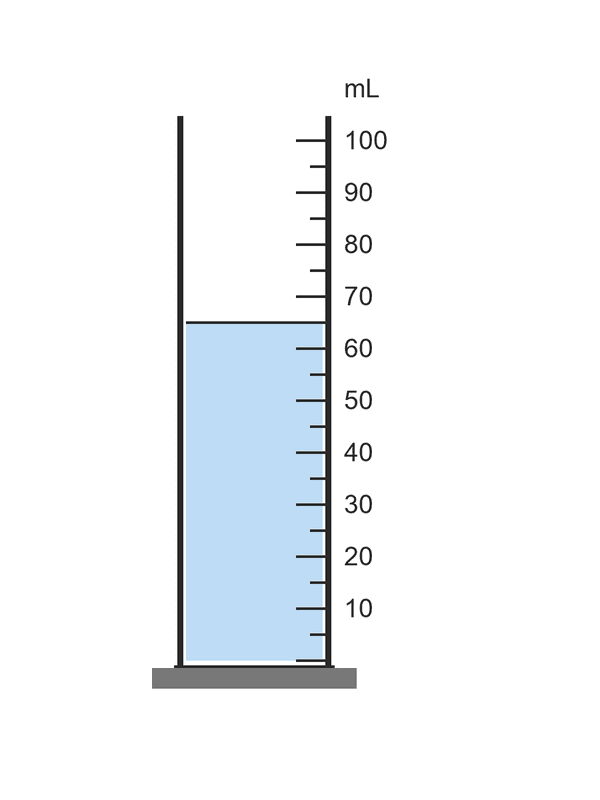
(a) What volume of water is in the cylinder?
(b) How much more water must she add to bring the level to the 90 mL mark?
- 302 marks
Question 30
Cognitive domain: Evaluation
Kabir visits the chemistry laboratories of two schools in his town. In both, he sees a gas burner on every working table. He writes in his notebook: "In both laboratories I visited, every working table had a gas burner. So all chemistry laboratories have a gas burner on every table, and a laboratory without gas burners is not a real laboratory."
(a) Which part of what he wrote is an observation and which part is a conclusion?
(b) Is his conclusion reliable? Give one reason.
- 312 marks
Question 31
Cognitive domain: Application
Sheela has two jobs in the laboratory. For job (i) she must test a few drops of a liquid with a small amount of a chemical and warm them gently. For job (ii) she must prepare 200 mL of sugar solution.
(a) Name the apparatus she should use as the container for job (i) and for job (ii).
(b) Why is the container for job (i) not suitable for job (ii)?
- 323 marks
Question 32
Cognitive domain: Analysis
A student copied this chart about five pieces of apparatus. Exactly three rows have a mistake.
Apparatus Description Use Funnel Cone-shaped with a stem at its narrow end; made of glass or plastic To filter and transfer liquids from one container to another Glass rod Hollow tube made of glass To stir chemical solutions Mortar and pestle A container and a hand-tool made of porcelain To measure the weight of substances Spirit lamp A burner containing a wick, in which spirit is used as fuel To heat up substances Tripod stand An iron stand having four legs Supports the apparatus during experiments (a) Name the three rows that have a mistake.
(b) Write the correct entry for each mistake.
- 333 marks
Question 33
Cognitive domain: Application
In a demonstration, the teacher prepares a gas in a glass vessel that holds the chemicals, and the gas has to be collected in a jar standing in water.
(a) Name the apparatus in which the chemicals are taken for preparing the gas.
(b) Name the apparatus that carries the gas from that vessel to the jar.
(c) Name the apparatus in which the gas is collected, and the big bowl-shaped vessel in which this apparatus stands.
- 343 marks
Question 34
Cognitive domain: Evaluation
Ritu reaches the chemistry laboratory ten minutes before the rest of the class. The teacher has not yet come. To "save time", she lights a spirit lamp and starts heating some liquid in a test tube.
(a) Name two rules she is breaking.
(b) What could go wrong because of this?
(c) What should she do while she waits?
- 353 marks
Question 35
Cognitive domain: Analysis
A gas jar and a measuring cylinder both look like glass cylinders. A student keeps them side by side on the table.
(a) State the use of each.
(b) Why can a gas jar not be used to measure the volume of a liquid accurately?
(c) Write one more difference between the two that you can see on the apparatus.
- 363 marks
Question 36
Cognitive domain: Understanding
During one practical class, three things happen at working table 4.
- (i) Clean beakers and flasks that are not needed yet lie on the working table, and one is nearly knocked over.
- (ii) A student needs dilute acid for the next step, and walks across the room to find it on another table.
- (iii) A student wants to rinse a used test tube at the end of the experiment.
Each working table is fitted with things that solve such problems. For each case, name the fitting of the working table that should be used, and say how it helps.
- 374 marks
Question 37
Cognitive domain: Analysis
(Hypothetical data.) At the end of the school year the laboratory assistant of Green Valley School checked every piece of apparatus on the side shelves and counted the pieces that had broken during the year. The chemistry teacher put the counts in a table, along with the material each apparatus is made of. She wants to find out which apparatus break most often, and why. She will use the table to plan what to buy for the next year, and to decide whether the school should change any apparatus to a different material.
Apparatus Made of Number at the start Number broken Test tube Glass 80 12 Beaker Glass 40 6 Evaporating dish Porcelain 20 2 Tripod stand Iron 15 0 Test tube stand Plastic 10 0 (a) What fraction of the test tubes broke? Give it in its lowest terms and as a percentage.
(b) How many pieces of apparatus broke in all, and what fraction of the broken pieces were made of glass? Give it in its lowest terms.
(c) Glass apparatus broke the most, and yet the laboratory still uses glass for most apparatus. Give two reasons from what you have learnt.
- 384 marks
Question 38
Cognitive domain: Application
Meena watches her grandmother make tea at home. Grandmother pours 200 mL of water into a steel pan with a steel jug, puts the pan on the gas stove, stirs in the tea leaves and sugar with a steel spoon and lifts the hot pan with a cloth. Meena says, "This is just like the chemistry laboratory, where heating, measuring and stirring are done with special apparatus."
(a) Name the laboratory apparatus that does the work of (i) the stove, (ii) the spoon, and (iii) the cloth used for lifting the hot pan.
(b) At the end, Grandmother pours the tea through a strainer into the cups, so that the tea leaves stay behind. Name the laboratory apparatus that does this job, and state its use as given in your book.
(c) Grandmother measures the water with a jug. Name the apparatus that the laboratory uses for measuring the volume of a liquid and say why it is better for an experiment.
- 395 marks
Question 39
Cognitive domain: Evaluation
A school wants to equip its chemistry laboratory for Class 6, where the students will work in 10 groups. Each group needs its own set of apparatus to heat a liquid safely and to measure liquids. The principal gives a budget of Rs 5,000 and says that any saving must not make the laboratory less safe. Before ordering, the laboratory assistant checks the prices of each item at a supplier in the town. The laboratory assistant has made this list. (Hypothetical data.)
Apparatus Cost of one (Rs) Number needed Spirit lamp 80 10 Tripod stand 150 10 Wire gauze 40 10 Beaker 60 20 Measuring cylinder 120 10 Test tube holder 25 10 (a) Find the total cost of the list. By how much does it cross the budget?
(b) Two cuts are suggested. Cut X: let two groups share each measuring cylinder, so only 5 are bought. Cut Y: buy only 5 spirit lamps, so that two groups would share one lamp and its flame. Find the saving from each cut.
(c) Which cut is the better choice? Give a reason from laboratory safety, and say how the groups can still work with the cut you choose.
- 404 marks
Question 40
Cognitive domain: Creativity
Class 5 will visit the chemistry laboratory next week. The Class 6 science club is asked to run a game called "Guess the apparatus" for them. Each clue card describes one apparatus by its description and use, without naming it, and the visitors must guess the name. The club also has to put up a board at the door of the laboratory with safety rules for the young visitors.
(a) Write three clue cards, each for a different apparatus from your book. Give the answer for each card.
(b) Write two rules for the board at the door and a reason for each.
(c) How can the club find out whether the visitors have understood the apparatus after the game? Suggest one simple activity.