
Opening your dashboard
Class 6 Biology Chapter 6 The Circulatory System: Competency-Based Questions (CBQ)
40 questions on Chapter 6, each worked through on its own page with the AI tutor. Class 6 Biology, ICSE 2026-27.
40 questions
1–5 marks · Mixed difficulty
- 11 mark
Question 1
Cognitive domain: Application
On a cold January morning in Delhi, Aman ran four rounds of the school field. The muscles of his legs did most of the work and produced a lot of heat. Soon his whole body felt warm — even his hands and ears, which had been cold before the run. Which function of the blood best explains this ?
- 21 mark
Question 2
Cognitive domain: Analysis
The figure shows three kinds of blood vessels, X, Y and Z, cut across. They are not drawn to the same scale.
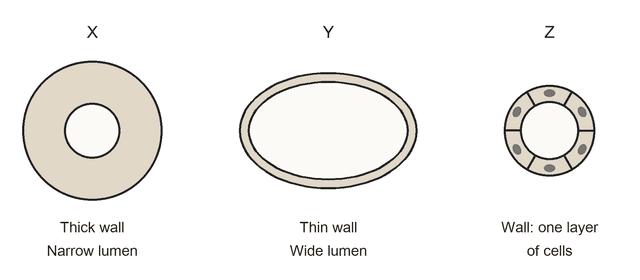
Glucose and oxygen have to pass out of the blood to reach the cells of a leg muscle. Through the wall of which vessel does this exchange take place, and why ?
- 31 mark
Question 3
Cognitive domain: Application
Mrs Das needs blood during an operation in a hospital in Kolkata. A test shows that her red blood cells carry only antigen B. The blood bank has no blood of her own group left. Going by what you have learnt about blood groups, which blood can the doctors choose for her ?
- 41 mark
Question 4
Cognitive domain: Application
For the science exhibition, Tanvi makes a clay model of the heart with its four chambers. Her teacher looks at it and says, "You have left a gap in the septum. A real heart could not work properly like this." If a real heart had such a gap in its septum, what would most likely happen ?
- 51 mark
Question 5
Cognitive domain: Understanding
Assertion (A): A person suffering from dengue fever may show bleeding symptoms.
Reason (R): In dengue fever the number of platelets gets greatly reduced, and platelets help in the clotting of blood.
- 61 mark
Question 6
Cognitive domain: Analysis
Assertion (A): The pulmonary artery carries deoxygenated blood.
Reason (R): Arteries have thick, elastic and muscular walls.
- 71 mark
Question 7
Cognitive domain: Understanding
At the school health check-up, Dr Iyer gently presses her fingers on Sana's wrist, along the side of the thumb. She feels a throb again and again, and counts 80 throbs in one minute. She does not use a stethoscope at all, yet she writes on Sana's card : "Heart beat – 80 per minute."
Complete the sentence :
The doctor can do this because each throb is felt when the left ______ of the heart contracts and forces blood into the aorta, so the number of throbs in a minute is the same as the number of ______ in a minute.
- 81 mark
Question 8
Cognitive domain: Application
For a class project, Jatin makes a board game called "Journey of a Red Blood Cell". A counter starts in the right ventricle. It moves to the lungs, where it picks up oxygen. Then it has to come back to the heart.
Complete the sentence :
On coming back from the lungs, the counter must enter the ______ (name the chamber of the heart), and the journey it has just finished is called the ______ circulation.
- 91 mark
Question 9
Cognitive domain: Understanding
In a hospital laboratory, a sample of blood is treated so that it does not clot. It is then left standing in a test tube. After some time, the red cellular part settles at the bottom, and a clear, pale yellowish liquid is seen above it.
Complete the sentence :
The yellowish liquid on top is the ______ of the blood, and most of it (about 90 per cent) is ______.
- 102 marks
Question 10
Cognitive domain: Evaluation
Eleven-year-old Kabir loves burgers, chips and sweets. He likes video games more than the playground. When his sister warns him, he says, "Heart diseases happen only to old people. I will start exercising and eating properly when I am forty."
Do you agree with Kabir ? Give two reasons from what you have learnt about keeping the heart healthy.
- 112 marks
Question 11
Cognitive domain: Application
A traffic policeman stands at a busy crossing in Mumbai for many hours. All this time, the blood in the veins of his legs has to travel upwards to reach his heart.
Which structures inside his veins keep this blood from slipping back down towards his feet ? Why do the arteries of his legs not need such structures ?
- 122 marks
Question 12
Cognitive domain: Analysis
Riya is making a chart called "What the blood does". She notes how the blood changes when it passes through two organs of the body, P and Q.
Organ Change in the blood as it passes through the organ P It gains oxygen and gives up carbon dioxide. Q It gives up waste products, which are then excreted from the body. Identify the organs P and Q. Give a reason for each answer.
- 135 marks
Question 13
Cognitive domain: Evaluation
Case: For the science exhibition, Ravi and Meenal draw a large chart of the circulation of blood. They draw the four chambers of the heart (RA, LA, RV and LV), the lungs and the rest of the body. They number the four main blood vessels 1 to 4, and the arrows show the direction in which the blood flows. Vessels 1 and 2 only cross each other on the chart — they do not join. The two students now have to colour the vessels : red for oxygenated blood and blue for deoxygenated blood.
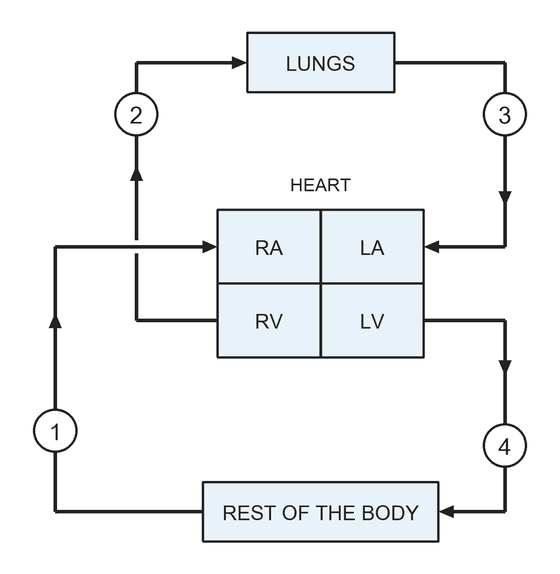
(a) Name the vessels numbered 1 and 4.
(b) Ravi says, "Vessel 2 is an artery, and arteries carry oxygenated blood. So vessel 2 must be red." Is Ravi right ? Justify your answer.
(c) Which two numbered vessels should be coloured red ? Give a reason for each.
(d) Meenal says, "The blood in vessel 4 goes to every part of the body except the lungs, because the lungs get their blood from vessel 2." Is Meenal right ? Justify your answer.
- 145 marks
Question 14
Cognitive domain: Analysis
Case: In the games period, Farhan studied his own pulse with the help of his teacher. First he sat quietly and counted his pulse. Then he skipped with a rope for three minutes. He sat down again and counted his pulse at regular gaps.
Time Pulse rate (beats per minute) Sitting at rest, before skipping 80 Just after skipping 128 3 minutes after skipping 108 6 minutes after skipping 96 9 minutes after skipping 88 12 minutes after skipping 82 15 minutes after skipping 80 (a) By how many beats per minute did Farhan's pulse rate rise because of the skipping ?
(b) Describe how his pulse rate changed while he rested after skipping. How long did it take to come back to the resting rate ?
(c) The muscles work much harder during skipping. Using the functions of the blood, explain why the heart beats faster at such a time.
(d) The next week Farhan has fever. If he counts his pulse while sitting at rest, is it likely to be equal to, less than or more than 80 beats per minute ? Give a reason.
- 155 marks
Question 15
Cognitive domain: Creativity
Case: A hospital is holding a voluntary blood donation camp in the hall of Lata's school in Pune. Many grown-ups in the colony are afraid to donate blood. The Health Club of the school asks Lata to design a poster, so that more healthy grown-ups come forward to donate.
(a) Write three correct facts about blood donation and blood banks that Lata should put on her poster.
(b) Lata wants one corner of the poster to explain blood groups. Draw the table she should make, showing the four blood groups and the antigens on the red blood cells in each. Mark the universal donor and the universal recipient on it.
(c) Suggest a slogan and one picture idea for the poster. Say how each will help to remove the fear of the people.
- 161 mark
Question 16
Cognitive domain: Understanding
In the school laboratory, Zoya looks at a prepared slide of human blood, first under low power and then under high power of the microscope. She sees many small, disc-shaped cells without a nucleus and a few larger cells, each with a distinct lobed nucleus. Her teacher says, "There is a third kind of blood cell on this slide, but you cannot see it at this magnification." Why can Zoya not see it ?
- 171 mark
Question 17
Cognitive domain: Analysis
Aarav traces the path of one drop of blood. The drop has just left the left ventricle and entered the aorta. It travels to the toe, comes back to the heart, goes to the lungs, comes back to the heart once more, and reaches the left ventricle again. During this one complete trip, how many times did the drop enter the heart from a blood vessel ?
- 181 mark
Question 18
Cognitive domain: Understanding
Dr Mehta writes four statements on the board and asks his class, "Which one is NOT done by the blood in our body ?"
- 191 mark
Question 19
Cognitive domain: Analysis
A student prepares a chart of four blood vessels, P, Q, R and S.
Vessel Direction of flow Wall Blood carried P Away from the heart Thick, elastic and muscular Oxygenated Q Towards the heart Thin and less muscular Deoxygenated R Towards the heart Thin and less muscular Oxygenated S Away from the heart Thick, elastic and muscular Deoxygenated Which row describes the pulmonary vein ?
- 201 mark
Question 20
Cognitive domain: Understanding
Assertion (A): The number of red blood cells in the blood of a healthy person stays almost the same.
Reason (R): In human blood, more than two million red blood cells are destroyed every second, but they are replaced immediately by new ones.
- 211 mark
Question 21
Cognitive domain: Analysis
Assertion (A): The human heart is located exactly in the middle of the chest cavity.
Reason (R): The heart lies in the chest cavity between the two lungs.
- 221 mark
Question 22
Cognitive domain: Analysis
At a health camp, a nurse records the resting pulse and the body temperature of four adults, K, L, M and N. None of them is an athlete. (Hypothetical data.) The usual resting pulse of a healthy adult is about 72 per minute and the usual body temperature is 37 °C.
Adult Resting pulse (per minute) Body temperature K 74 37.0 °C L 108 39.2 °C M 38 36.8 °C N 80 37.2 °C Whose readings suggest most clearly that the working of the heart should be checked ?
- 231 mark
Question 23
Cognitive domain: Application
For the science exhibition, Riya's group makes a working model in which the left ventricle contracts and pushes blood into the aorta. Their teacher asks, "In a real heart, what lets the blood go from the left ventricle into the aorta but regulates its flow so that it does not slip back when the ventricle relaxes ?"
- 241 mark
Question 24
Cognitive domain: Evaluation
Four students of Class 6, Dev, Esha, Farah and Gopal, keep a record of their weekly habits. (Hypothetical data.)
Student Exercise or outdoor play (minutes a day) Days a week with fried or oily food Servings of fruits and vegetables (a day) Days a week with many sweets Dev 90 6 1 5 Esha 5 0 5 0 Farah 60 1 4 1 Gopal 30 3 2 3 Taking all four columns together, whose habits are best for keeping the heart healthy ?
- 251 mark
Question 25
Cognitive domain: Evaluation
Four students describe how the blood moves in the body.
- Anil : "Blood goes from the right ventricle to the lungs through the pulmonary vein."
- Bela : "Oxygenated blood comes from the lungs to the left auricle through the pulmonary veins, passes into the left ventricle and is pumped into the aorta."
- Chirag : "The vena cavae pour the deoxygenated blood of the body into the left auricle."
- Divya : "The aorta carries deoxygenated blood from the left ventricle to all parts of the body."
Whose description is correct ?
- 262 marks
Question 26
Cognitive domain: Understanding
Mohan feels a throbbing at his wrist and says, "This is my heart beat. Pulse and heart beat are the same thing." His teacher says that they are related, but they are not the same.
Write one difference between the heart beat and the pulse, and say why counting the pulse still tells us the heart beat rate.
- 272 marks
Question 27
Cognitive domain: Analysis
Ananya says, "Arteries carry the blood to the organs and veins bring it back. So we do not need capillaries at all; the arteries can simply join the veins."
Using what you know about capillaries, explain why the body cells would suffer if this were true.
- 282 marks
Question 28
Cognitive domain: Application
After an accident, a patient's inferior vena cava is blocked. (Hypothetical case.)
(a) Blood from which parts of the body can no longer return to the heart through this vessel ?
(b) Which other vessel is still bringing blood into the heart from the rest of the body, and into which chamber do both these vessels open ?
- 292 marks
Question 29
Cognitive domain: Application
After a heavy lunch of rice, dal and vegetables, Sunil's food has been digested and absorbed in his small intestine.
Name the organ to which the blood carries this digested food from the small intestine, and state what may happen to the food there.
- 302 marks
Question 30
Cognitive domain: Evaluation
Rani says, "All the cells in the blood are red, and that is why blood looks red. The plasma is colourless like water."
Is her statement correct ? Correct every wrong part.
- 313 marks
Question 31
Cognitive domain: Application
Meera, a healthy adult, has about 5 litres of blood in her body. In her blood, the plasma makes up 55 per cent of the volume. Her textbook says that about 90 per cent of the plasma is water. (Hypothetical data.)
(a) Find the volume of plasma in Meera's blood.
(b) Find the volume of water in this plasma.
(c) Name two kinds of substances dissolved in the rest of the plasma, and one function of the blood that this water helps to carry out.
- 323 marks
Question 32
Cognitive domain: Analysis
Four events of the working of the left side of the heart are given in the wrong order.
- P : The blood passes from the left auricle through the valve into the left ventricle.
- Q : The pulmonary veins bring oxygenated blood into the left auricle.
- R : The valve at the opening of the aorta opens and the blood is pushed into the aorta.
- S : As the left ventricle starts to contract, the valve between the left auricle and the left ventricle closes.
(a) Write the events in the correct order.
(b) Name the valves that lie between an auricle and a ventricle, and state what they do.
- 333 marks
Question 33
Cognitive domain: Application
At a first-aid class, the teacher says, "If the heart stops beating, the person is in great danger within minutes, although the blood and the blood vessels are still present in the body."
Explain this with three points from what you have learnt about the circulatory system.
- 343 marks
Question 34
Cognitive domain: Analysis
Arjun has dengue fever. His doctor gets his platelet count tested every day. A healthy person has about 1,50,000 to 4,50,000 platelets per cubic mm of blood. (Hypothetical data.)
Day of fever Platelets per cubic mm of blood Day 1 2,10,000 Day 2 1,62,000 Day 3 96,000 Day 4 28,000 (a) On which day did Arjun's platelet count first fall below the healthy range ?
(b) What percentage of the Day 1 count is left on Day 4 ?
(c) His science book says that in dengue the count can fall to as low as 25 to 30 thousand per cubic mm. Is his Day 4 count in this range ? Why does the doctor now watch him closely for bleeding ?
- 353 marks
Question 35
Cognitive domain: Evaluation
Parth says, "Blood is only a liquid that flows. If we replaced all the blood in the body by clean water, the heart could still pump it round, so nothing would go wrong."
Evaluate his claim. Give three functions of the blood that plain water could not perform.
- 365 marks
Question 36
Cognitive domain: Analysis
Case: A blood bank in Nagpur shows the units of blood in its stock one morning in a bar chart. One unit is one bag of blood collected from one donor. (Hypothetical data.)
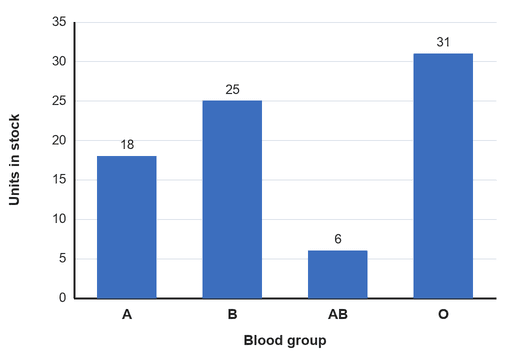
(a) How many units of blood of group O are in stock, and how many units are there altogether ?
(b) A patient of group AB needs blood. Which of the units in stock can the blood bank safely give, and why ?
(c) The officer says, "Only 6 units of group AB are in stock, so a patient of group AB cannot get enough blood from us." Evaluate his statement. Also find what percentage of the stock is group O blood, and say why group O units are specially useful in an emergency.
- 374 marks
Question 37
Cognitive domain: Creativity
Case: Sneha makes a model to show how a chamber of the heart pumps blood. She joins two water tanks with rubber tubes. In the line she fits a soft rubber bulb with a valve on each side of it. Each valve lets the water pass only from left to right, as shown by its arrow.

When she squeezes the bulb, water is pushed out of it towards Water tank 2. When she releases the bulb, it fills again with water from Water tank 1.
(a) Which chamber of the heart does the rubber bulb stand for ? What do the valves P and Q stand for ?
(b) Predict what happens to the water when she squeezes the bulb if valve P is taken out. Explain with the help of the heart.
(c) Suggest one change in the model so that it also shows that the right and left sides of the heart pump blood to two different places.
- 385 marks
Question 38
Cognitive domain: Analysis
Case: At a school health camp, a doctor tests the blood of four children, P, Q, R and S. Their blood counts are compared with the usual counts of a healthy child. The children's complaints are listed separately, in a different order. (Hypothetical data.)
Child Red blood cells White blood cells Platelets P Normal Low Normal Q Low Normal Normal R Normal Normal Low S Normal Normal Normal Complaints : 1. Gets tired quickly and becomes breathless on climbing stairs. 2. A small cut on the finger bleeds for a long time. 3. Falls ill again and again with cold and fever. 4. No complaint.
(a) Which child has complaint 1 ? Give a reason from the function of the blood cells.
(b) Which child has complaint 2 ? State what the missing blood cells normally do at a cut.
(c) Which child has complaint 3 ? Describe two ways in which the cells that are low in this child normally protect the body.
- 394 marks
Question 39
Cognitive domain: Application
Case: Ria goes to a laboratory for a blood test. The nurse ties a band above her elbow and a bluish vessel near the surface of the skin becomes clearly visible. She draws a sample of blood from this vessel with a syringe. When the needle is taken out, she presses a cotton swab on the spot for a minute, and the bleeding stops. The nurse explains that she did not use a vessel lying deep in the arm, because the blood there flows with jerks and under great force.
(a) Was the nurse's vessel an artery or a vein ? Give two reasons.
(b) Which blood cells helped to stop the bleeding ? What did they do ?
(c) Ria's friend asks, "Do all veins carry dark, deoxygenated blood ?" Answer with an example.
- 405 marks
Question 40
Cognitive domain: Evaluation
Case: A Class 6 teacher surveys the 40 students of her class about outdoor play and body weight. (Hypothetical data.)
Group Number of students Number who are overweight Play outdoors for at least 1 hour daily 25 3 Play outdoors for less than 1 hour daily 15 6 (a) Find the percentage of overweight students in each group.
(b) What does the survey suggest about outdoor play and body weight ? Why is this important for the heart ?
(c) Raju says, "Three of the students who play outdoors are overweight, so playing outdoors is of no use." Evaluate his statement. Suggest two other habits from the chapter that would help these students to keep a healthy weight and a healthy heart.