
Opening your dashboard
Class 5 Science Chapter 3 Food and Health: Competency-Based Questions (CBQ)
40 questions on Chapter 3, each worked through on its own page with the AI tutor. Class 5 Science, ICSE 2026-27.
40 questions
1–5 marks · Mixed difficulty
- 11 mark
Question 1
Cognitive domain: Application
On a school trip, four friends open their lunch boxes. Which lunch box comes closest to a balanced meal?
- 21 mark
Question 2
Cognitive domain: Application
A doctor sees a patient whose gums bleed when he brushes his teeth. A small cut on his hand has also taken a long time to heal. Which foods should the doctor advise him to eat more of?
- 31 mark
Question 3
Cognitive domain: Analysis
A health worker visits a village. She meets a young child who eats plenty of rice but almost no dal, milk or eggs.
Assertion (A): This child is at risk of getting kwashiorkor.
Reason (R): Kwashiorkor is caused by a lack of protein in the diet.
- 41 mark
Question 4
Cognitive domain: Analysis & Evaluation
Ria watches her uncle chop spinach into small pieces and then wash the pieces well under the tap.
Assertion (A): Washing vegetables after cutting them is a good habit that saves nutrients.
Reason (R): Some nutrients in cut vegetables can get washed away with the water.
- 51 mark
Question 5
Cognitive domain: Application
Iodine solution turns blue-black when it touches starch. Kavya boils a little milk, lets it cool and adds two drops of iodine solution. The milk turns blue-black. What does this tell Kavya about the milk?
- 61 mark
Question 6
Cognitive domain: Analysis
Neel's grandfather has been feeling very thirsty and very hungry all the time. He passes urine often, feels tired and is losing weight. Which check-up is the doctor most likely to ask for first?
- 71 mark
Question 7
Cognitive domain: Understanding
Neha's grandmother says, "Steamed idli is a better breakfast than fried puri." Give one reason why she is right.
- 82 marks
Question 8
Cognitive domain: Application
Many years ago, a lot of people living in some hilly areas far from the sea had a swelling in the front of the neck. Today, families there are asked to cook with iodised salt.
(a) Name the disease that caused the swelling. (1 mark)
(b) How does using iodised salt help to prevent it? (1 mark)
- 92 marks
Question 9
Cognitive domain: Application
Sara's mother kept some besan (gram flour) in an open paper bag in the kitchen. After a few weeks it started to smell bad and some of it looked spoilt.
(a) Why did the besan get spoilt? (1 mark)
(b) How should besan be stored so that it stays fresh? (1 mark)
- 102 marks
Question 10
Cognitive domain: Analysis
Tanya of Class 5 looks pale and gets tired quickly. She feels short of breath and dizzy when she climbs stairs. Her blood test shows that her haemoglobin is low.
(a) Lack of which mineral in her diet is the most likely cause? (1 mark)
(b) Why does low haemoglobin make her feel tired? (1 mark)
- 112 marks
Question 11
Cognitive domain: Analysis
Mr Rao bought loose red chilli powder from a roadside stall. At home, he stirred a spoonful of it into a glass of water. Some heavy red grains sank quickly to the bottom. When he rubbed them between his fingers, they felt gritty, like sand.
(a) Name the adulterant that is most likely in the chilli powder. (1 mark)
(b) Why do some sellers mix such things into food? (1 mark)
- 123 marks
Question 12
Cognitive domain: Analysis & Evaluation
The Class 5 students noted the snacks sold in their school canteen in one week. (Hypothetical data.)
Snack Number sold in the week Potato chips 180 Samosa 150 Fruit bowl 60 Sprouts chaat 40 Soft drink 170 (a) Which snack was sold the most? (1 mark)
(b) Name two snacks in the table that are junk food, and give the reason. (1 mark)
(c) Suggest one change the canteen could make to help the children eat better. (1 mark)
- 133 marks
Question 13
Cognitive domain: Application
Aman wants to make moong sprouts. He soaks the moong seeds in water for 6 to 8 hours. Then he drains the water and keeps the seeds wrapped in a wet cloth in a warm place for another 12 to 18 hours.
(a) What is this process of preparing seeds as food called? (1 mark)
(b) Why are sprouts healthier to eat than seeds that have only been soaked? (1 mark)
(c) Why does Aman keep the seeds in a wet cloth instead of a dry box? (1 mark)
- 144 marks
Question 14
Cognitive domain: Analysis & Evaluation
The label on a small packet of potato chips (30 g) says it has 10 g of fat and 16 g of carbohydrate. One gram of fat gives about 9 kilocalories (kcal) of energy, and one gram of carbohydrate gives about 4 kcal.
(a) How much energy does the fat in the packet give? (1 mark)
(b) How much energy does the carbohydrate in the packet give? (1 mark)
(c) What is the total energy from the fat and the carbohydrate? (1 mark)
(d) The packet gives a lot of energy but very little protein, vitamins or roughage. What do we call such food? (1 mark)
- 155 marks
Question 15
Cognitive domain: Evaluation & Creativity
Rahul wrote down everything he ate on one day.
Meal What Rahul ate Breakfast White bread with jam, and sweet tea Lunch Instant noodles and a cola Evening A packet of potato chips Dinner Rice with potato curry (a) Which nutrient did Rahul get the most of on this day? (1 mark)
(b) Name two nutrients, or parts of food, that Rahul got very little of. (2 marks)
(c) Suggest two changes to his meals that would make his diet more balanced. Give a reason for each. (2 marks)
- 161 mark
Question 16
Cognitive domain: Application
Dev's family eats white-bread sandwiches and rice most days, with very few vegetables or fruits. Dev often finds it hard to pass motion. His mother wants to change his meals. Which change will help him most?
- 171 mark
Question 17
Cognitive domain: Analysis
A school doctor talks to Class 5 about food and health.
Assertion (A): Eating milk, eggs and mango can help to prevent night blindness.
Reason (R): A person with night blindness cannot see well in dim light.
- 181 mark
Question 18
Cognitive domain: Analysis
At a health camp, a doctor writes down the signs seen in four children.
Child Signs Pooja Gums bleed and a small cut takes a long time to heal Qasim The front of the neck is swollen Ria Legs are bent outwards and the chest sticks out Sunil Cannot see well in dim light The doctor wants to advise one child to eat milk, fish and eggs, and also to spend some time in sunlight every day. For which child is this advice most suitable?
- 191 mark
Question 19
Cognitive domain: Evaluation
Neel's grandfather has diabetes. Neel reads about it in his science book.
Assertion (A): Doctors advise a person with diabetes to eat five small meals in a day instead of three big meals.
Reason (R): Diabetes spreads from one person to another when they share food.
- 201 mark
Question 20
Cognitive domain: Evaluation
Mr Joshi is 50 years old. He is overweight and his doctor says that his blood pressure is high. He asks which daily plan is best for him.
- 211 mark
Question 21
Cognitive domain: Application
Some families are going on a 5-day trek in the hills. They will have no refrigerator and no kitchen on the way. They want food that will stay good for the whole trip. Which set of foods should they carry?
- 221 mark
Question 22
Cognitive domain: Application
A food inspector catches four sellers who have mixed a cheap substance into the food they sell. Our lesson lists some common adulterants. Which seller mixed in a substance that the lesson lists for that food?
- 231 mark
Question 23
Cognitive domain: Analysis
At a school health camp, the doctor counted the children who had four deficiency diseases. The bar graph shows the numbers. (Hypothetical data.)
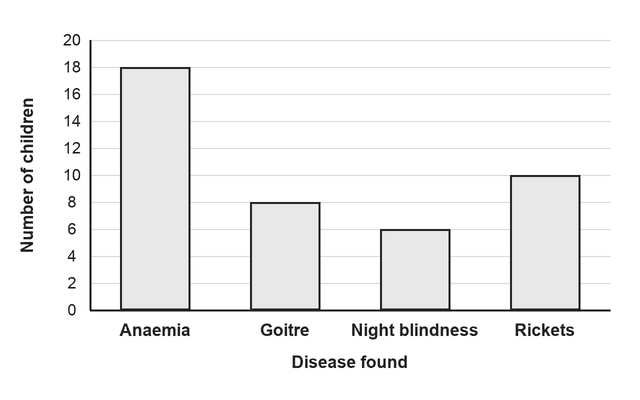
Two of these diseases are caused by the lack of a mineral. How many children in all had a disease caused by the lack of a mineral?
- 241 mark
Question 24
Cognitive domain: Evaluation
Ishaan wants a snack for the school break that gives energy and also some proteins and roughage, and that is not junk food. The table shows what 100 g of four snacks give. (Hypothetical data.)
Snack (100 g) Energy (kcal) Protein (g) Roughage (g) Potato chips 540 6 4 Cream biscuits 480 5 2 Roasted chana 370 19 12 Cake 400 4 1 Which snack should Ishaan choose?
- 251 mark
Question 25
Cognitive domain: Understanding
A student wrote four rows in her notebook about deficiency diseases. One row is not correct. Which row is not correct?
- 262 marks
Question 26
Cognitive domain: Understanding
On a hot afternoon, Sana played football for two hours and drank no water. By evening she felt very thirsty and tired.
(a) Name two ways in which her body lost water. (1 mark)
(b) Why must she drink more water on a hot day than on a cool day? (1 mark)
- 272 marks
Question 27
Cognitive domain: Application
Mr Naidu feels weak all the time. His muscles are weak and he has very little energy to do any work. The doctor says that his food lacks a vitamin. Mr Naidu does not eat meat or fish.
(a) Name the disease that Mr Naidu has and the vitamin that his food lacks, as given in the lesson. (1 mark)
(b) Name two foods from the lesson that he can eat to prevent it. (1 mark)
- 282 marks
Question 28
Cognitive domain: Analysis
Mr Das has high blood pressure. His doctor tells him to eat less than 5 g of salt in a day. The table shows the salt in the foods he ate in one day. (Hypothetical data.)
Food Salt (g) Instant noodles (1 bowl) 3.0 Pickle (2 spoons) 1.5 Namkeen (1 plate) 2.0 Boiled vegetables (1 bowl) 0.5 (a) Find the total salt that Mr Das ate in the day. (1 mark)
(b) By how much did he go above the doctor's limit, and which food in the table should he cut down first? (1 mark)
- 292 marks
Question 29
Cognitive domain: Evaluation
Ravi says, "I take a vitamin tablet every day, so I do not need to eat vegetables or fruits."
(a) Is Ravi right? Give a reason. (1 mark)
(b) Name two things, other than vitamins, that vegetables and fruits give us. (1 mark)
- 302 marks
Question 30
Cognitive domain: Analysis
Long ago, many sailors on long sea voyages fell ill with bleeding gums and wounds that did not heal. A ship's doctor tried an experiment. He gave three groups of 4 sick sailors a different extra food for a week. (Hypothetical data.)
Group Extra food given Sailors who got well X Oranges and lemons 4 Y Dry biscuits 0 Z Salted meat 0 (a) Which extra food cured the sailors? How can you tell from the table? (1 mark)
(b) Name the disease the sailors had and the vitamin that their food lacked. (1 mark)
- 312 marks
Question 31
Cognitive domain: Analysis
The table shows what 100 g of three foods contain. (Hypothetical data.) One gram of protein or of carbohydrate gives about 4 kcal of energy, and one gram of fat gives about 9 kcal.
Food (100 g) Protein (g) Carbohydrate (g) Fat (g) Boiled egg 13 1 10 Raw rice 7 78 1 Butter 1 0 81 (a) Which food is the best choice for a child who needs a body-building nutrient? Give a reason. (1 mark)
(b) Which food gives the most energy in 100 g? Show how you know. (1 mark)
- 323 marks
Question 32
Cognitive domain: Evaluation
Pure ghee costs a seller ₹600 for 1 kg, and vanaspati ghee costs him ₹200 for 1 kg. (Hypothetical data.) One day he mixes 3 kg of pure ghee with 1 kg of vanaspati ghee and sells all 4 kg as pure ghee at ₹600 for 1 kg.
(a) How much did the 4 kg of ghee cost the seller? (1 mark)
(b) How much more money does he earn than a seller who sells 4 kg of real pure ghee bought at ₹600 for 1 kg? (1 mark)
(c) Is the seller's act fair to the buyers? Give a reason. (1 mark)
- 333 marks
Question 33
Cognitive domain: Analysis
The food pyramid in our lesson says that we should eat 5 or more servings of the breads and cereals group, 5 or more servings of vegetables, 5 or more servings of fruits, 2–3 servings of the milk group and 2–3 servings of the meat or alternative group in a day. It says that fats, oils and sweets are to be used only occasionally.
Meera counted the servings she ate in one day. The bar graph compares them with the minimum in the pyramid. (Hypothetical data.)
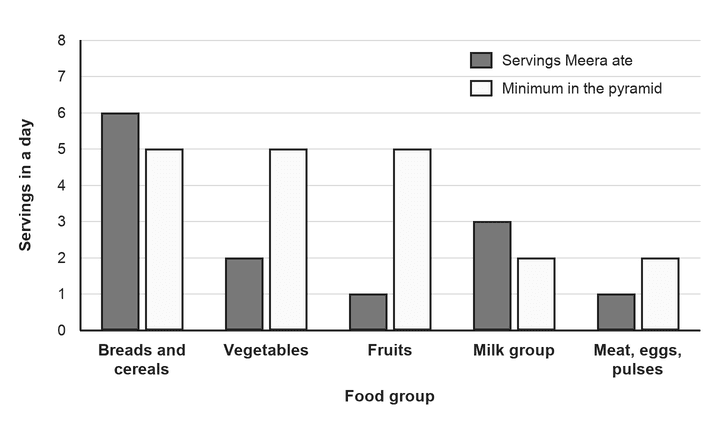
She also ate 4 servings of fats, oils and sweets.
(a) In which two groups did Meera eat at least the minimum number of servings? (1 mark)
(b) In which group was she furthest below the minimum, and by how many servings? (1 mark)
(c) Suggest one change to her day that would make her diet more balanced. Give a reason. (1 mark)
- 343 marks
Question 34
Cognitive domain: Application
A long power cut switched off the refrigerator at Kabir's home for a whole day. In it were milk, cooked dal and cut watermelon. Outside the refrigerator, his mother had rice and besan stored in closed airtight tins.
(a) Which of these foods are most likely to spoil first? (1 mark)
(b) Give a reason why they spoil sooner than the rice and the besan. (1 mark)
(c) Kabir finds that the dal smells sour and bad. Should the family eat it? Give a reason. (1 mark)
- 353 marks
Question 35
Cognitive domain: Application
A relief camp has three kinds of food parcels.
- Parcel X: rice, wheat flour and sugar
- Parcel Y: beans, eggs and milk powder
- Parcel Z: cooking oil, ghee and butter
Two children come to the camp. Tara has a swollen stomach, face and feet, thin limbs and reddish hair. Umar is very thin, his bones show clearly, and his skin is dry and loose. His doctor says that his food lacks proteins, carbohydrates and fats.
(a) Which parcel is best for Tara? Give a reason. (1 mark)
(b) Which two parcels should Umar get first, as the lesson advises for his disease? Give a reason. (1 mark)
(c) A helper says that parcel Z alone would cure both children. Is the helper right? Give a reason. (1 mark)
- 363 marks
Question 36
Cognitive domain: Analysis
A food inspector tested samples of four foods from shops in a town. (Hypothetical data.)
Food Samples tested Samples found adulterated Milk 20 6 Honey 10 5 Black pepper 8 2 Mustard oil 5 1 (a) Which food had the greatest number of adulterated samples? (1 mark)
(b) Find the percentage of adulterated samples for each food. Which food has the highest percentage? (1 mark)
(c) Why is the percentage a fairer way to compare the foods than the number of adulterated samples? (1 mark)
- 374 marks
Question 37
Cognitive domain: Analysis
Kabir, aged 10, eats well but spends most of his free time in front of the television. His doctor asks him to write down, for five days, the energy that he gets from food and the energy that his body uses. (Hypothetical data.)
Day Energy from food (kcal) Energy used by the body (kcal) Monday 2200 1900 Tuesday 2400 1900 Wednesday 2300 1900 Thursday 2500 1900 Friday 2100 1900 (a) Find the extra energy that Kabir got on Thursday. (1 mark)
(b) Find the total extra energy over the five days. (1 mark)
(c) What does the body do with the extra energy? Which lifestyle disease can Kabir get if this goes on? (1 mark)
(d) Give one change in food and one change in activity that will help Kabir. (1 mark)
- 384 marks
Question 38
Cognitive domain: Application
Aryan wants to stay "fit and fine". The lesson says that we must eat proper food, drink clean water, exercise regularly, rest properly and keep our surroundings clean. Aryan noted what he did in one day. (Hypothetical data.)
Habit What Aryan did Food Ate chapatis, dal, vegetables and a fruit Water Drank only one glass of water and a bottle of cola Exercise Played outdoors for 1 hour Rest Went to sleep at 1 a.m. and got up at 6 a.m. Surroundings Kept his room tidy and put the waste in a dustbin (a) In which three habits is Aryan already doing well? (1 mark)
(b) Which two habits need to change? Give one piece of advice for each. (2 marks)
(c) How does drinking enough water help our body? (1 mark)
- 394 marks
Question 39
Cognitive domain: Evaluation
Mrs Rao reads that too much salt can cause high blood pressure. She says, "From today I will not use any salt in our cooking at all." Her neighbour points to the salt packet in Mrs Rao's kitchen, which says "Iodised salt", and says that giving up salt completely is not a good idea.
(a) Why is eating too much salt bad for a person? (1 mark)
(b) Why is it not a good idea to stop using salt completely? Use the word on the packet in your answer. (2 marks)
(c) What advice would you give Mrs Rao? (1 mark)
- 405 marks
Question 40
Cognitive domain: Creativity
The Mehta family is planning a dinner for three people.
- Dadaji has high blood pressure and diabetes.
- Mummy looks pale, gets tired easily and has low haemoglobin.
- Rohan, aged 10, loves chips and soft drinks.
The family does not eat meat.
(a) Plan a dinner menu for the family that has foods from at least four food groups. Name the food groups. (2 marks)
(b) Name one food in your menu that is especially useful for Mummy and say why. (1 mark)
(c) Name two things that Dadaji should keep small or avoid in the dinner, with a reason for each. (2 marks)